


Cheap life insurance means getting the most coverage your family needs for the least you can pay, not the smallest policy you can find. For most people that’s a level term policy bought while they’re young and healthy: published 2026 sample rates put $250,000 of 20-year term at $11 to $13 a month for a healthy 25- to 35-year-old.
Quick answer: The cheapest life insurance for most buyers is a fully underwritten level term policy sized to your actual needs, bought as early as possible, from the carrier whose underwriting treats your health profile best. A healthy 35-year-old can get $500,000 of 20-year coverage for about $17 to $20 a month. Seniors and people with health conditions pay more, but comparing several insurers usually cuts the price meaningfully.
What Cheap Life Insurance Really Means
The cheapest policy on the market isn’t a bargain if it doesn’t cover what your family would need. A useful definition of cheap life insurance is the lowest premium for the right amount of coverage, for the right number of years, from an insurer that will approve you at a good rate class. Three decisions drive almost all of the savings: product type, term length, and which carrier you apply to.
Why term is the starting point
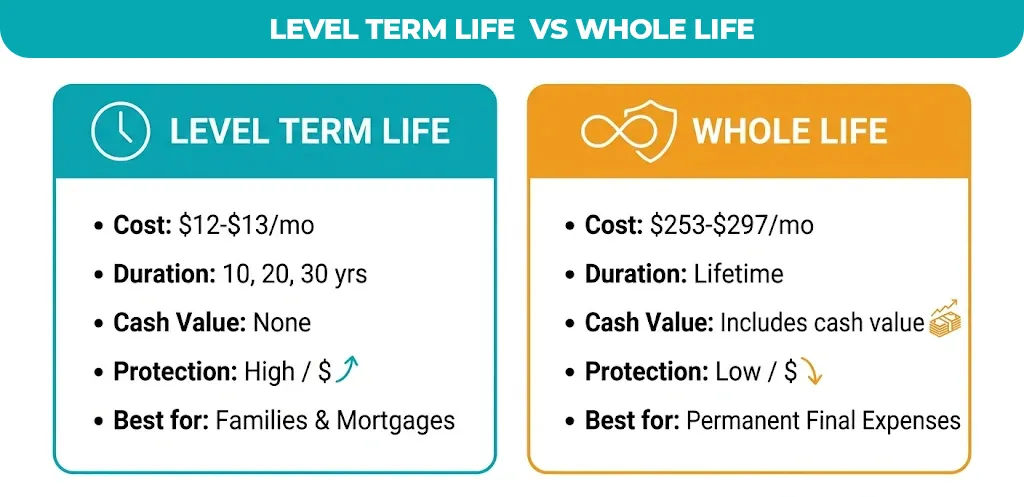
Level term life insurance pays a death benefit if you die during a set period, 10, 20, or 30 years, and costs a fraction of permanent coverage because it has no cash value and most policies expire before a claim. For a healthy 35-year-old, Choice Mutual’s 2026 sample rates show $250,000 of 20-year term at $12 a month for a woman and $13 for a man; $250,000 of whole life for the same buyer runs about $253 and $297. For the years when a mortgage and children depend on you, term buys roughly 20 times the protection per dollar.
Why comparing carriers matters
Every insurer prices health differently. One may offer its best class to someone with well-controlled blood pressure; another may rate the same person one class lower, which can add a noticeable amount to the premium. One treats a family history of heart disease as a minor factor; another doesn’t. A captive agent can show you one company’s prices. An independent agent can run your profile across several carriers and apply to the one whose rules fit you. For most people with any health history at all, that comparison is the single biggest discount available.
How much is a $100,000 life insurance policy per month?
For a healthy applicant, very little. Choice Mutual’s sample rates for $100,000 of 20-year term, preferred non-tobacco, valid as of March 9, 2026, are $8 a month for a 25-year-old of either sex, $8 to $9 at 35, $13 to $15 at 45, $17 to $21 at 50, $24 to $33 at 55, and $64 to $92 at 65. A 10-year term is cheaper still at every age. At $100,000, the policy fee makes up a larger share of the premium, so the cost per $1,000 of coverage is higher than on a $250,000 or $500,000 policy; many buyers find the larger policy costs only a few dollars more. See our guide to how much life insurance costs for the full picture.
What Determines the Cost of Life Insurance
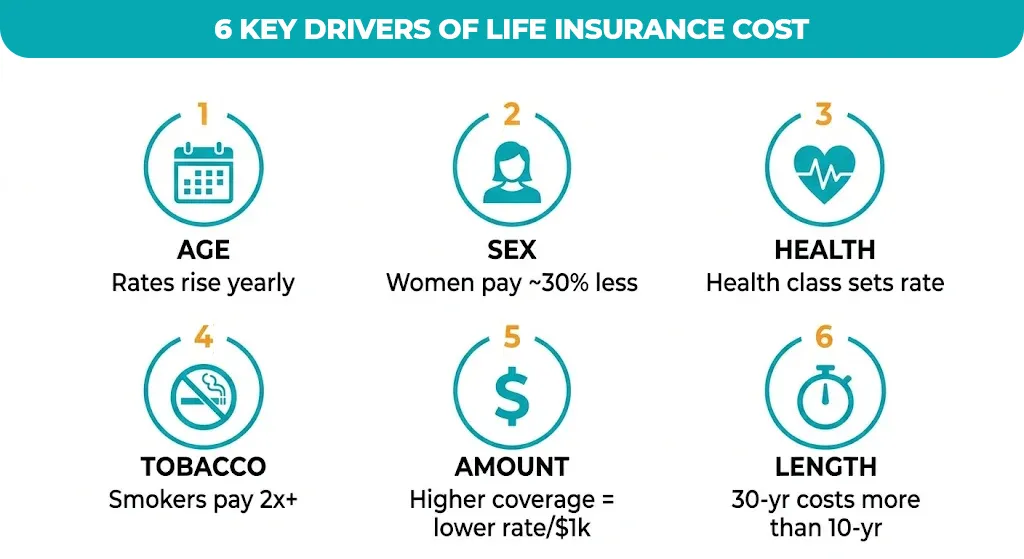
Life insurance is priced on the likelihood that the insurer pays a claim during the policy, so everything that predicts life expectancy affects the premium. Age and health matter most, followed by sex, tobacco use, coverage amount, term length, and the type of underwriting. Understanding the levers tells you which ones you can move.
The main rate drivers
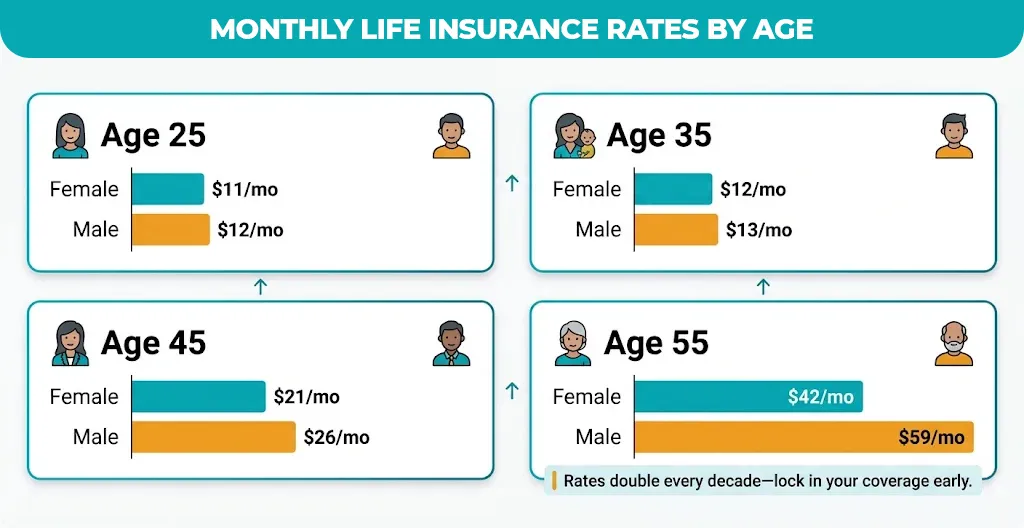
• Age: The biggest factor. In the tables below, a 20-year policy roughly doubles in price between 35 and 45 and doubles again by 55.
• Sex: Women live longer on average and pay less. Choice Mutual notes men generally pay about 30% more, except in Montana, where state law requires equal rates.
• Health class: Insurers sort applicants into classes such as Preferred Plus, Preferred, Standard Plus, and Standard based on blood pressure, cholesterol, weight, and medical history. Applicants with health conditions may receive a table rating, which adds a surcharge to standard rates, typically about 25% per table.
• Coverage amount: Larger policies cost more in total but less per $1,000, because fixed policy fees are spread over more coverage.
• Term length: A 30-year term costs more per month than a 20-year term because the insurer is locking in your price for longer.
• Payment method: Monthly billing often carries a small surcharge over annual payment, and automatic bank draft is usually cheapest.
Medical exam vs. no exam
Fully underwritten policies, which usually include a paramedical exam with blood and urine samples, are generally the cheapest, because the insurer has the most information and can offer its best classes. Many insurers now offer accelerated underwriting, which uses your application, prescription history, and database checks to approve healthy applicants without an exam at the same prices. Simplified issue policies skip the exam and ask health questions, and cost more. Guaranteed issue policies ask no health questions and cost the most per dollar of coverage. Insurers also check the Medical Information Bureau (MIB), a shared database of prior applications, so disclose everything accurately. Our guide to life insurance with no medical exam explains the trade-offs.
Cheap life insurance for smokers
Tobacco is the most expensive health factor most people can change. Choice Mutual says cigarette use can raise premiums sometimes 100% more, and Insurance.com’s smoker rate data shows a 30-year-old smoker may pay about twice what a nonsmoker pays, with the gap widening at older ages. Insurance.com’s 2023 Compulife figures for a $250,000 20-year term, regular health, put a 40-year-old smoker at about $100 a month for a woman and $125 for a man, against $21 and $26 for preferred nonsmokers in Choice Mutual’s 2026 samples.
Ways smokers can pay less:
• Quit, then wait. Most insurers offer nonsmoker rates after 12 months tobacco-free, though some require longer. Buy coverage now if you need it, then reapply for a better class after you qualify.
• Ask about non-cigarette rates. Some insurers give better rates to occasional cigar smokers or users of chewing tobacco than to cigarette smokers. Vaping and nicotine patches are usually treated as tobacco use.
• Compare carriers. Smoker pricing varies more between insurers than nonsmoker pricing does.
• Buy a shorter term or smaller amount to bridge the gap until you can requalify.
2026 sample rates by age and coverage amount
The table shows Choice Mutual’s published monthly sample rates for 20-year level term, preferred non-tobacco class, valid as of March 9, 2026. Figures are for women and men.
| Age | $100,000 | $250,000 | $500,000 |
| 25 | $8 / $8 | $11 / $12 | $15 / $18 |
| 35 | $8 / $9 | $12 / $13 | $17 / $20 |
| 45 | $13 / $15 | $21 / $26 | $35 / $45 |
| 50 | $17 / $21 | $31 / $38 | $54 / $69 |
| 55 | $24 / $33 | $42 / $59 | $82 / $112 |
| 65 | $64 / $92 | $137 / $192 | $257 / $378 |
For a 10-year term, the same buyers pay less: $250,000 runs $8 to $10 at 25, $15 to $17 at 45, and $67 to $99 at 65. For 30-year term, $250,000 runs $14 to $17 at 25 and $51 to $67 at 50; most insurers don’t offer 30-year terms past the mid-50s. Our term life insurance rates page has more detail by term length.
Note: These are preferred-class samples from one source. Standard-class applicants pay more, and your actual quote depends on the insurer’s underwriting. Use the tables for direction, not as a promise.
Term vs. Whole Life for Budget Buyers
For the lowest cost per dollar of coverage, level term wins by a wide margin. Whole life earns its place only when you need coverage that never expires, which for most budget buyers means a small policy to cover final expenses. Families usually do best with term on both parents, sized to income replacement and debts.
Cheap term life insurance
Level term is the product the rest of this guide’s rates describe. You choose the amount and the length, the premium stays fixed, and coverage ends when the term does. For a 35-year-old, Choice Mutual’s samples show $500,000 of 20-year term at $17 to $20 a month. The same death benefit in whole life would cost many hundreds a month. Term’s weakness is that it ends; its strength is that you can buy enough of it to actually protect your family. Our guides to level term life insurance and whether term life insurance is worth it go deeper.
Choosing the term length is where budget buyers often overspend or underinsure. Match it to your longest obligation: a 30-year mortgage or a newborn points to 30 years, teenagers and a mortgage with 15 years left point to 20, and a few years of remaining debt point to 10. A 10-year policy bought at 25 costs about $8 a month for $100,000, but it ends at 35, exactly when most people’s needs peak.
Cheap whole life insurance
Whole life is never cheap per dollar of death benefit, but it can be the right answer for a small amount of lifelong coverage. Final expense whole life, usually $5,000 to $50,000, is designed to pay funeral and burial costs, has simplified underwriting, and never expires or increases in price. Seniors who can’t get term, or who want coverage guaranteed to be there at 85 or 90, often choose it. Our guides to affordable whole life insurance and whole life insurance rates by age cover pricing.
To keep whole life affordable: buy only the amount you need for lifelong goals, consider a shorter payment period only if you can afford it, and compare final expense carriers, since underwriting leniency varies widely.
Cheap family life insurance
Covering a family cheaply usually means three things:
• Term on the primary earner, sized to replace income until the children are independent and to clear the mortgage.
• Term on the other parent, including a parent who stays home, since child care and household work would have to be paid for.
• A child rider on one parent’s policy, which adds a small benefit for each child for a few dollars a month, instead of separate policies for children.
Group life insurance through an employer is a useful supplement, but it’s usually one or two times salary and ends with the job. Our guide to group term life insurance explains how to use it alongside individual coverage.
| Feature | Level term | Whole life | Better value for budget buyers |
| Monthly cost, $250,000 at 35 (2026 sample) | $12 to $13 | $253 to $297 | Term |
| Coverage per dollar | Highest | Lowest | Term |
| Length | 10, 20, or 30 years | Lifetime | Whole life, if you need lifelong coverage |
| Cash value | None | Builds slowly | Whole life, but at a high price |
| Premium | Level for the term | Level for life | Tie |
| Underwriting | Full or accelerated | Full, or simplified for final expense | Depends on health |
| Best use | Income replacement, mortgage, child-raising years | Final expenses; lifelong dependents | Term for protection, small whole life for burial costs |
Cheap Life Insurance by Age
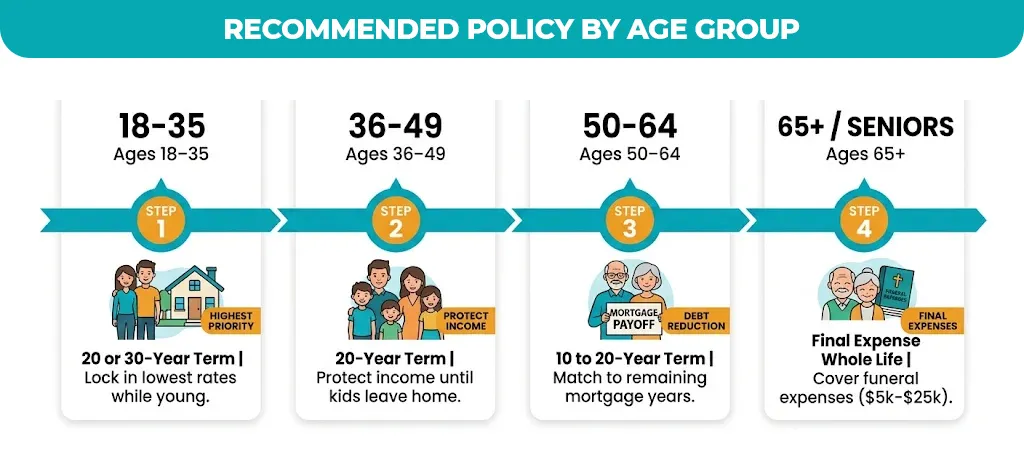
The cheapest policy at 25 is not the cheapest policy at 65, because the products that make sense change with age. Young adults should lock in long terms while rates are lowest. Buyers over 50 still have good term options and should act before prices climb. Seniors over 80 are mostly choosing among final expense and guaranteed issue policies.
Cheap life insurance for young adults
Ages 18 to 35 are when life insurance costs least, and the price barely moves across that range: Choice Mutual’s samples show $250,000 of 20-year term at $11 to $12 a month at 25 and $12 to $13 at 35. A 30-year term at 25 costs $14 to $17 for the same coverage and lasts until 55. The best move for a young adult with or expecting dependents is to buy the longest term you can see a need for, at the largest amount you can afford, while you qualify for the top health class. Policies under $15 a month are realistic for most healthy applicants in their 20s and early 30s.
Cheap life insurance for 50 and over
Is 52 too old to get life insurance? No. A healthy 52-year-old is squarely in the range insurers write every day. Choice Mutual’s samples for age 50 show $250,000 of 20-year term at $31 to $38 a month and 10-year term at $20 to $23; at 55, those become $42 to $59 and $28 to $37. Rates rise quickly through the 50s, so applying at 52 rather than 57 saves meaningfully over the life of the policy.
For buyers over 50, the cheapest approach is usually a term policy matched to the years until retirement or until the mortgage is paid, plus a small final expense policy if lifelong coverage matters. Our guides to term life insurance for seniors and best life insurance for seniors compare the options.
Cheap life insurance for seniors over 80
Past 80, term insurance is largely unavailable, and the realistic choices are final expense whole life and guaranteed issue policies. Both are priced per $1,000 of coverage at rates that reflect age, so “cheap” means a small face amount, typically $5,000 to $25,000, sized to funeral costs. Simplified issue final expense policies ask health questions and pay the full benefit from day one for those who qualify. Guaranteed issue policies ask no questions but usually have a two-year waiting period during which a natural-cause death returns premiums rather than the full benefit. Our guide to life insurance for seniors over 80 covers eligibility and typical prices.
A note on local shopping, including Sioux Falls
People search for cheap life insurance in their own city, such as Sioux Falls, SD, but life insurance isn’t priced by city. Insurers file rates by state, and Choice Mutual notes that while your state determines which products are available, insurers don’t set unique rates by state. A buyer in Sioux Falls pays the same as a buyer in Rapid City for the same policy. What local shopping can do is connect you with an agent licensed in South Dakota who represents several carriers; the comparison between carriers, not the zip code, is what lowers the price.
| Age group | Policy type to consider | Typical coverage target | How to keep the price low |
| 18 to 35 | 20- or 30-year level term | 10 to 12 times income, or mortgage plus income needs | Buy early; lock in the longest term you’ll need; qualify for the best health class |
| 36 to 49 | 20-year level term | Income replacement until children are independent | Apply before 45; compare carriers on any health conditions |
| 50 to 64 | 10- to 20-year term, plus small final expense if needed | Remaining mortgage and years to retirement | Apply early in the decade; shorter terms cost far less |
| 65 to 79 | 10-year term if healthy; final expense whole life | Final expenses and small debts | Simplified issue over guaranteed issue when health allows |
| 80 and over | Final expense or guaranteed issue whole life | $5,000 to $25,000 | Buy only what funeral costs require; compare carriers’ age limits |
How to Get the Best Cheap Coverage With Premier Services Agency
Most people overpay for life insurance in one of four ways: buying more than they need, waiting too long, applying to the wrong insurer for their health profile, or never going back to requalify after their health improves. Each has a fix.
Step 1: Calculate what you need, then stop
Over-insuring is the most common way to turn cheap coverage into expensive coverage. Add up the income your family would need to replace, your mortgage and other debts, future education costs, and final expenses; subtract savings and any group coverage. Buy that amount, not a round number a calculator suggested. For many families the result is $250,000 to $750,000, and the difference between $500,000 and $1,000,000 at 35 is about $12 a month in the sample rates. Only pay it if you need it.
Step 2: Buy before your next birthday
Life insurance rates are set by your age at issue, and some insurers use your nearest birthday rather than your last one. The sample rates show a 20-year, $250,000 policy rising from $21 to $26 at 45 to $31 to $38 at 50. Applying now rather than in a year is the cheapest discount available, and it compounds over the term.
Step 3: Use accelerated underwriting when you qualify
If you’re healthy, ask about accelerated underwriting. Many insurers will approve applicants without an exam at fully underwritten prices using application answers, prescription history, and database checks. Approval can take days instead of weeks, and there’s no cost penalty. If you’re asked to take an exam anyway, schedule it for a morning, fast as instructed, skip alcohol and heavy exercise the day before, and hydrate.
Step 4: Apply with the right carrier for your health
Each insurer has its own underwriting guide. One may give its best class to controlled high blood pressure or a BMI of 30; another may not. Smoker, diabetic, and family-history rules differ even more. An independent agent can describe your profile to several carriers informally before you apply and submit to the one most likely to offer the best class. This is where comparing cheap life insurance quotes saves the most for anyone who isn’t in perfect health.
Step 5: Requalify when your health changes
A rate class isn’t permanent. If you quit smoking, lose significant weight, or bring blood pressure or cholesterol under control, you can apply for a new policy or ask your insurer to reconsider after 12 to 24 months. Smokers who’ve been tobacco-free for a year often cut their premium roughly in half. Keep the old policy in force until the new one is approved.
Step 6: Compare quotes side by side
Run the same coverage amount, term, and health details across several carriers and compare total cost over the term, not just the monthly premium. Check the insurer’s financial strength and whether the policy is convertible. Premier Services Agency can pull term life insurance quotes and whole life insurance quotes from multiple carriers for the same profile.
Note: Avoid the two false economies. A 10-year term that ends while your kids are still at home will need replacing at a higher age and price, and a guaranteed issue policy bought by someone who could pass simplified underwriting costs far more per dollar than it needs to.
Conclusion
Cheap life insurance comes from four decisions made well: the right product, usually level term; the right amount, based on what your family would actually need; the right timing, which is as early as possible; and the right insurer for your health profile. A healthy 35-year-old can protect a family with $500,000 of coverage for less than $20 a month. Buyers over 50, smokers, and people with health conditions pay more, but comparing carriers almost always narrows the gap. Whole life has a place for small, lifelong needs; for everything else, term buys far more protection per dollar.
| Your situation | Cheapest sensible option |
| Under 35 with dependents or a mortgage | 20- or 30-year level term, bought now |
| 36 to 49 | 20-year level term; compare carriers on any health conditions |
| 50 to 64 | 10- to 20-year term, plus small final expense coverage if lifelong needs exist |
| Over 80 | Final expense whole life sized to funeral costs; guaranteed issue only if health requires |
| Smoker | Term now from a carrier lenient on tobacco; requalify after 12 months smoke-free |
| Health condition | Compare carriers before applying; one insurer’s rules may fit you far better |
| Need coverage fast with no exam | Accelerated underwriting, if healthy; simplified issue otherwise |
Compare Cheap Life Insurance Quotes at Premier Services Agency
The fastest way to find your lowest rate is to have one profile run across several insurers. Compare cheap life insurance quotes at Premier Services Agency: share your age, health, and the coverage you need, and a licensed agent will match you with the carriers most likely to approve you at the best class.
• Request a quote: Get a quote from Premier Services Agency
• Ask a question: Contact Premier Services Agency
• Call: (470) 650-0470