

What Is Affordable Whole Life Insurance and How Does It Work?
Whole life insurance is a type of permanent life insurance, meaning it does not expire after a set number of years the way term life insurance does. As long as premiums are paid, the policy stays in force for the insured person’s entire lifetime.
Permanent Coverage and Level Premiums
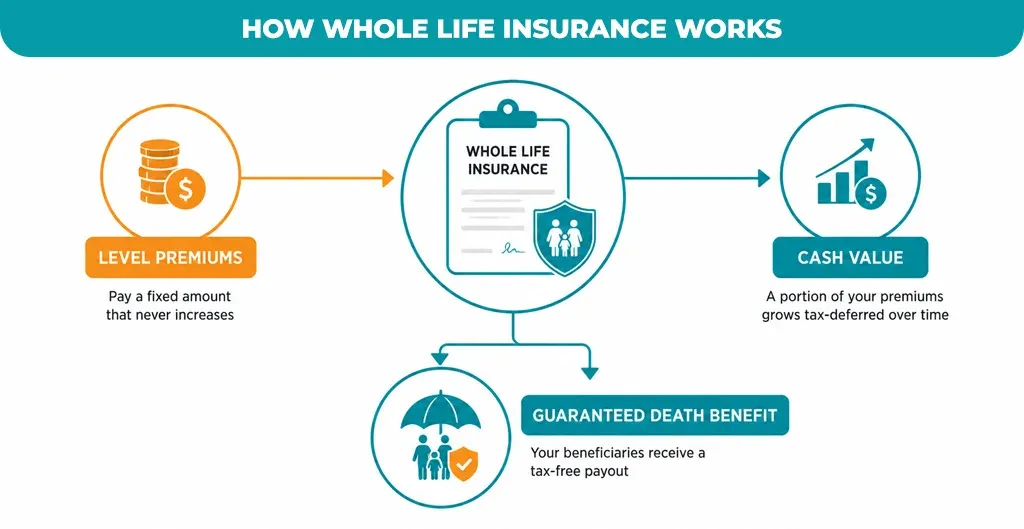
The defining feature of whole life insurance is that the premium is calculated once, at the time you apply, and it does not increase because of age or a change in health. A policy purchased at age 35 will cost the same in year one as it does in year thirty. This is different from term life insurance, which is priced for a fixed period and becomes significantly more expensive, or unavailable, if you try to buy new coverage later in life.
Because the insurer is guaranteeing a payout at an unknown future date rather than for a fixed term, whole life premiums start considerably higher than term premiums for the same amount of coverage. NerdWallet’s 2026 rate data shows the average cost of a 20-year, $500,000 term policy for a 40-year-old is about $53 a month, compared to hundreds of dollars a month for a comparable whole life policy.
The Cash Value Component
A portion of every whole life premium is allocated to a cash value account that grows on a tax-deferred basis, meaning you do not pay income tax on the growth each year the way you would with a standard savings or brokerage account. Over time, this cash value can be:
- Borrowed against through a policy loan, typically without the credit check required for a bank loan.
- Withdrawn, up to the amount you’ve paid in premiums, without triggering income tax in most cases.
- Used to help pay premiums later in life if the policy has accumulated enough value.
Cash value growth is generally slow in the early years of a policy, since a larger share of the premium in those years pays for the cost of insurance and administrative expenses. Some whole life policies, particularly those from mutual insurance companies, may also pay annual dividends, which are not guaranteed but can be used to increase the death benefit or cash value further.
The Guaranteed Death Benefit
The death benefit on a whole life policy is contractually guaranteed and is paid to your named beneficiaries income-tax-free, provided the policy remains active and premiums are current. This guarantee, combined with the fact that the policy cannot be canceled by the insurer for health reasons once it’s issued, is why whole life insurance is often used for estate planning, final expense coverage, and leaving a fixed legacy amount.
Key Takeaways
- Whole life insurance never expires as long as premiums are paid, unlike term life insurance.
- Premiums are locked in at the age you apply and do not increase later.
- A portion of each premium builds tax-deferred cash value you can access while alive.
- The death benefit is guaranteed and paid to beneficiaries tax-free.
What Factors Influence the Cost of Whole Life Insurance?
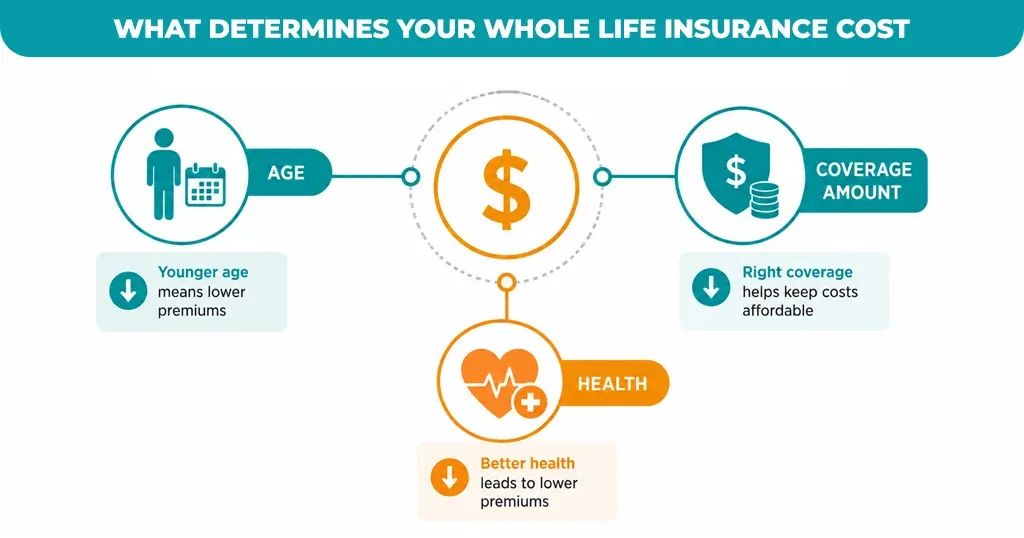
Whole life insurance premiums are calculated using actuarial data that estimates how long you’re expected to live and how much risk you represent to the insurer. Three factors have the largest impact on your rate.
Age and Health Status
Age is the single biggest driver of whole life insurance cost. The younger and healthier you are when you apply, the more years the insurer expects to collect premiums before paying a claim, which keeps your monthly cost down. Insurance and Estates’ 2026 pricing data illustrates how sharply this changes with age for a $100,000 whole life policy purchased by a male in excellent health:
Age at Purchase | Approximate Monthly Premium |
30 | $105 |
50 | $214 |
60 | $324 |
Source: Insurance and Estates, 2026 whole life cost analysis.
Coverage Amount (Face Value)
The death benefit, or face value, you choose has a direct and proportional effect on your premium. Buying $1 million of coverage costs roughly ten times more than buying $100,000 of coverage from the same insurer at the same age. This is why right-sizing coverage to an actual financial goal, rather than defaulting to a round number, is one of the most effective ways to keep a policy affordable.
Medical Underwriting
Most fully underwritten whole life policies require a health questionnaire, and some require a medical exam, which the insurer uses to assign a health classification such as Preferred Plus, Preferred, Standard, or a substandard “table” rating. Insurance and Estates reports that a Standard health rating can cost 20% to 30% more than a Preferred Plus rating for identical coverage, and each substandard table rating above Standard can add another 25% or more to the premium.
Key Takeaways
- Buying young is the single largest lever for keeping whole life insurance affordable.
- Premiums scale directly with the coverage amount you select.
- Your health classification, not just your age, can change your premium by 20% or more.
- Nonsmoker rates typically require documented tobacco-free time before they apply.
Pros and Cons of Purchasing Whole Life Insurance
Whole life insurance is not the right fit for every budget or every goal, so it helps to weigh the trade-offs directly against term life insurance before committing to a policy.
Pros
- Coverage cannot be canceled for health reasons. As long as premiums are paid on time, the insurer cannot drop the policy or reduce the death benefit because your health changes.
- Premiums are fixed for life. The rate you’re quoted at application is the rate you pay permanently.
- Cash value accumulates on a tax-deferred basis, giving you a source of funds you can access later in life for emergencies, supplemental retirement income, or opportunities.
Cons
- Upfront costs are significantly higher than term life insurance for the same death benefit, since the policy is designed to pay out eventually rather than only within a limited window.
- Early cash value growth is modest. In the first several years, a large share of the premium covers the cost of insurance and fees rather than building cash value, and returns are generally lower than what a diversified investment portfolio could produce over the same period.
- Surrendering the policy early can trigger costs. If you cancel a whole life policy in its early years, you may receive less than what you paid in, and any gain above your premium basis in the cash value can be subject to income tax.
Affordable Whole Life Insurance for Different Life Situations
Affordable Whole Life Insurance for Seniors and Adults Over 50
Fully underwritten whole life insurance becomes more expensive with age, but it is not the only option. Guaranteed-issue or “guaranteed acceptance” whole life policies, such as Colonial Penn’s well-known $9.95 plan, accept applicants in a set age range regardless of health, with no medical exam and no health questions. The tradeoff is a smaller death benefit per dollar of premium and a two-year graded benefit period, during which a death from natural causes typically results in a refund of premiums paid rather than the full death benefit. These policies work best as a fallback for seniors who cannot medically qualify for a standard policy, not as a first choice for anyone who can still qualify for traditional underwriting.
Affordable Whole Life Insurance for Smokers
Smokers pay meaningfully more for whole life insurance because tobacco use is one of the strongest mortality risk factors insurers track. MoneyGeek’s 2026 data puts average whole life premiums for a 40-year-old smoker at $735 a month for women and $784 a month for men, compared to $540 and $574 for nonsmokers at the same age and coverage amount. Smokers can lower future premiums by documenting a tobacco-free period, since most insurers will move an applicant to nonsmoker rates after 12 to 36 consecutive months without tobacco use.
Affordable Whole Life Insurance for Families and Military Households
Families evaluating whole life insurance often benefit from comparing a smaller permanent policy against a larger term policy, since term coverage is typically far less expensive during the years when income replacement matters most, such as while raising children or paying a mortgage. Military families have access to Servicemembers’ Group Life Insurance (SGLI) for term coverage while on active duty, and many private insurers, including USAA and other companies that specialize in serving military members, also offer whole life policies with underwriting that accounts for deployment and hazardous duty.
Choosing a Provider: Why Comparison Shopping Matters
Two insurers can quote very different premiums for the exact same applicant, coverage amount, and health profile, because each company weighs age, health class, and underwriting guidelines differently. That’s why comparing multiple whole life insurance quotes, rather than accepting the first quote you receive, is one of the most reliable ways to find the most affordable option available to you.
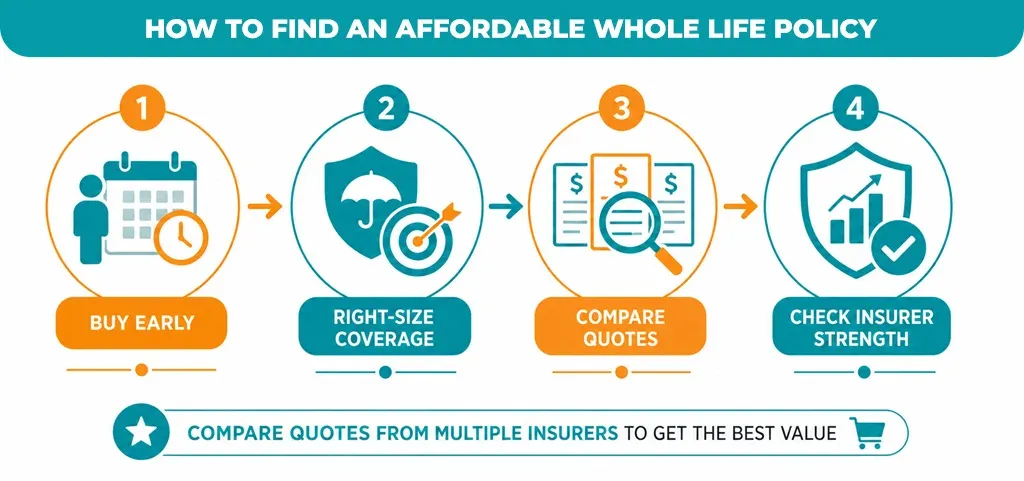
When comparing carriers, it is worth checking two independent sources of information:
- AM Best, a rating agency that specializes in the insurance industry, assigns financial strength ratings that indicate how well-positioned an insurer is to pay future claims.
- The National Association of Insurance Commissioners (NAIC), which supports state insurance regulators and publishes complaint index data that shows how a company’s consumer complaint volume compares to its size in the market.
An independent insurance agency works with multiple carriers rather than selling policies from a single company, which allows it to compare rates, underwriting classes, and rider options across insurers on your behalf.
Final Thoughts
Affordable whole life insurance is achievable when you understand what actually drives the price: your age at the time of purchase, the coverage amount you choose, and your health classification. Buying early, matching your face amount to a real financial goal, and being selective about riders are the three most effective ways to keep a permanent policy within your budget. Because premiums vary significantly between insurers for the exact same applicant, the most reliable path to an affordable policy is comparing quotes from multiple carriers rather than relying on a single company’s offer.
Are you prepared to locate an affordable policy? Connect with Premier Services Agency to compare affordable whole life insurance quotes from top-rated carriers and get guidance tailored to your age, health, and coverage goals.