


A healthy 40-year-old man can buy $500,000 of 20-year term life insurance for about $59 a month in 2026, while a comparable whole life policy costs roughly ten times as much. For most families with dependents or a mortgage, that price gap is the whole answer.
Quick answer: Term life insurance is worth it if someone depends on your income or would inherit your debts. It replaces that income for a fixed 10 to 30 years at the lowest cost of any life insurance. It’s usually not worth it once your savings can cover your family’s needs on their own.
Is Term Life Insurance Worth It?
Yes, for anyone whose death would leave a spouse, children, or co-borrower short of money. Term life buys the largest death benefit per dollar of any policy type, and it covers the years when the financial risk of dying is highest: while children are young and the mortgage is large.
The core mechanism: leverage now, self-insurance later
Term life is pure risk transfer. You pay a small, level premium, and the insurer promises a large tax-free payout if you die during the term. There’s no cash value, which is why it costs so little.
| Buyer (nonsmoker, average health) | $500,000, 20-year term | Total premiums over 20 years | Coverage per $1 of premium |
| Woman, 30 | $32/mo | $7,680 | about $65 |
| Man, 30 | $38/mo | $9,120 | about $55 |
| Woman, 40 | $47/mo | $11,280 | about $44 |
| Man, 40 | $59/mo | $14,160 | about $35 |
Monthly rates are MoneyGeek averages updated October 11, 2026; totals and ratios are our arithmetic.
The plan is to use those 20 or 30 years to build savings, pay down the mortgage, and raise children to independence. When your assets could replace your income on their own, you’ve reached the self-insurance threshold and no longer need the policy.
When term life is not worth it
• You’re single with no dependents and no co-signed debt.
• You already have enough savings and investments to cover your family’s needs.
• You need coverage for life, such as for a lifelong dependent or estate liquidity, in which case permanent insurance may fit better.
Premier Services Agency’s broader guide to whether life insurance is worth it covers who needs coverage at all.
20-Year vs. 30-Year Terms: Which Length Is Worth It?
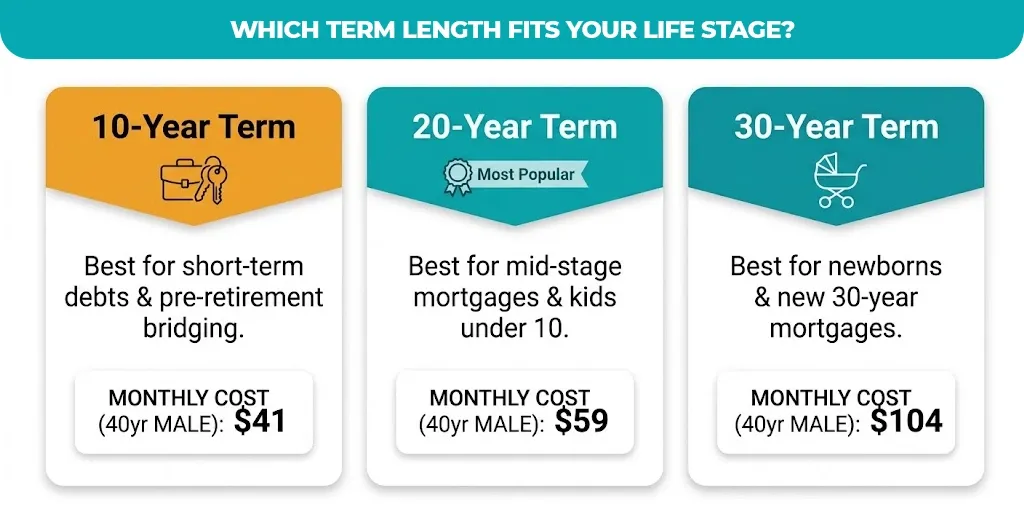
Pick the term that ends when your biggest obligation ends. A 20-year term fits most parents in their 30s and 40s; a 30-year term is worth the higher price for new parents or anyone with a fresh 30-year mortgage.
| Term length | Woman, 40 | Man, 40 | Best for |
| 10 years | $34/mo | $41/mo | Short debts, older buyers, bridging to retirement |
| 20 years | $47/mo | $59/mo | Children under 10, mid-way through a mortgage |
| 30 years | $82/mo | $104/mo | Newborns, a new 30-year mortgage |
Rates are MoneyGeek’s 2026 averages for $500,000 of coverage, nonsmokers in average health.
Is 20-year term life insurance worth it?
Yes, if your youngest child will be financially independent and your mortgage mostly paid within 20 years. It’s the most popular length and the one Dave Ramsey’s team recommends, at 15 to 20 years. The risk is outliving your need by a few years and having to buy new coverage at an older age, so lean longer if you’re unsure.
Is 30-year term life insurance worth it?
Yes, for parents of babies or toddlers and buyers in their 20s or early 30s with a new mortgage. It costs about 75% more per month than a 20-year term at 40, but it locks today’s health rating for three decades. MoneyGeek notes a single 30-year policy is often cheaper than buying a series of shorter terms, because renewal rates rise sharply with age.
Is the term life to age 80 worth it?
Some policies, sometimes marketed as “term to 80,” run until you turn 80 or renew annually until then, with premiums that climb as you age. They can make sense for a specific late-life debt, but costs rise steeply: in MoneyGeek’s data, a 10-year, $500,000 term costs a 70-year-old man about $600 a month and an 80-year-old man about $2,274. For final expenses only, a small whole life burial policy is usually cheaper to keep.
Compare lengths in Premier Services Agency’s guides to 10-year term and 30-year term life insurance.
Is Group, Voluntary, AAA, or Direct Term Life Insurance Worth It?
Free employer coverage is always worth taking, but it’s rarely enough on its own. Paid voluntary coverage is worth it mainly for people who can’t qualify for an individual policy at a good rate.
Is group term life insurance worth it?
Basic group term life that your employer pays for is worth accepting, since it costs you little or nothing. It’s usually a flat amount or one to two times salary, far below the 10 to 12 times income Ramsey’s team suggests. Two limits matter: coverage usually ends or must be converted when you leave the job, and employer-paid coverage above $50,000 creates small amounts of taxable income each year, per IRS Publication 525.
Is voluntary or supplemental term life insurance worth it?
Voluntary (also called supplemental) term life lets you buy extra coverage through payroll deduction. It’s worth it if you have health issues that would raise individual rates, because group plans often offer a guaranteed issue amount without medical questions. For healthy buyers, it’s often worse value than individual term because:
• Rates are usually age-banded and rise every five years, unlike a level individual term premium.
• Coverage may not be portable, or only at higher rates, when you change jobs.
• Coverage limits and spouse coverage are often capped.
Premier Services Agency explains these trade-offs in its guides to group term life insurance and supplemental life insurance.
Is AAA term life insurance worth it?
AAA’s life insurance is sold to members through an affiliated insurer and is convenient to buy, but convenience isn’t the same as the lowest price. Association and direct-to-consumer plans may price differently than the broader market, so treat an AAA quote as one data point and compare it against several independent quotes for the same coverage amount and term.
Is direct term life insurance worth it?
Buying online directly from one insurer is fast and works well for young, healthy applicants with simple histories. The trade-off is that you only see one company’s underwriting. In MoneyGeek’s 2026 data, a 40-year-old man’s 20-year, $500,000 rate ranged from $46 to $75 a month across 21 insurers, so comparing several carriers through an independent agent can save hundreds of dollars a year, especially if you have a health condition.
Convertible, Return of Premium, and Long-Term Care Options
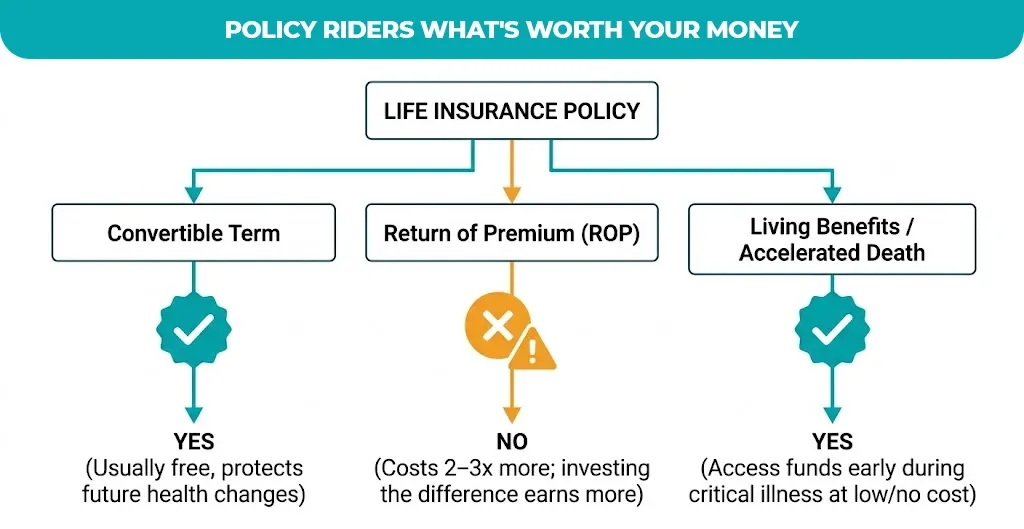
A conversion privilege is almost always worth having, a return-of-premium rider usually isn’t, and living-benefit riders are worth it when they cost little or nothing.
| Option | Extra cost | Worth it when… |
| Convertible term | Usually built in at no extra charge | You may want permanent coverage later but can’t predict your health |
| Return of premium (ROP) | Often 2–3x a standard term premium | You know you won’t invest the difference and value the refund |
| Accelerated or chronic illness rider | Often free or low cost | You want access to part of the benefit during a serious illness |
| Long-term care rider (on permanent policies) | Meaningful added premium | You want combined death and care benefits in one policy |
Is convertible term life insurance worth it?
Yes. Most quality term policies let you convert some or all of the coverage to permanent insurance without a new medical exam, before a deadline set in the contract, such as a certain age or policy year. That protects you if your health declines and you later need lifelong coverage. Before buying, check how long the conversion window lasts and which permanent products you can convert into.
Is the return of premium term life insurance worth it?
Usually not. ROP term refunds your premiums if you outlive the term, but it typically costs two to three times as much as standard term, according to Policygenius. The refund earns no interest, so inflation erodes it, and dropping the policy early often forfeits most of the refund. Investing the price difference usually comes out ahead. ROP can still fit someone who prizes the guaranteed refund and knows they wouldn’t invest the savings. See Premier Services Agency’s return of premium guide for a full breakdown.
Is long-term care life insurance worth it?
Pure term policies don’t include long-term care coverage, but many offer accelerated death benefit riders that pay part of the death benefit early for a terminal, chronic, or critical illness. These riders are worth having when they’re included at low or no cost. Benefits that meet IRS requirements can be received tax-free, as explained in IRS Publication 525. Full long-term care riders are mostly found on permanent policies; compare them against standalone coverage in Premier Services Agency’s long-term care insurance guide.
Note: A living-benefit payout reduces the death benefit left for your family. Read the rider’s triggers, maximum percentages, and any fees before you rely on it.
Is Term Life Insurance Worth It at Your Age?
Term life delivers the most value in your 20s through 40s, when rates are low and dependents and debts are high. After 60, it’s worth it only for a specific need, such as a mortgage, a dependent spouse, or a business obligation.
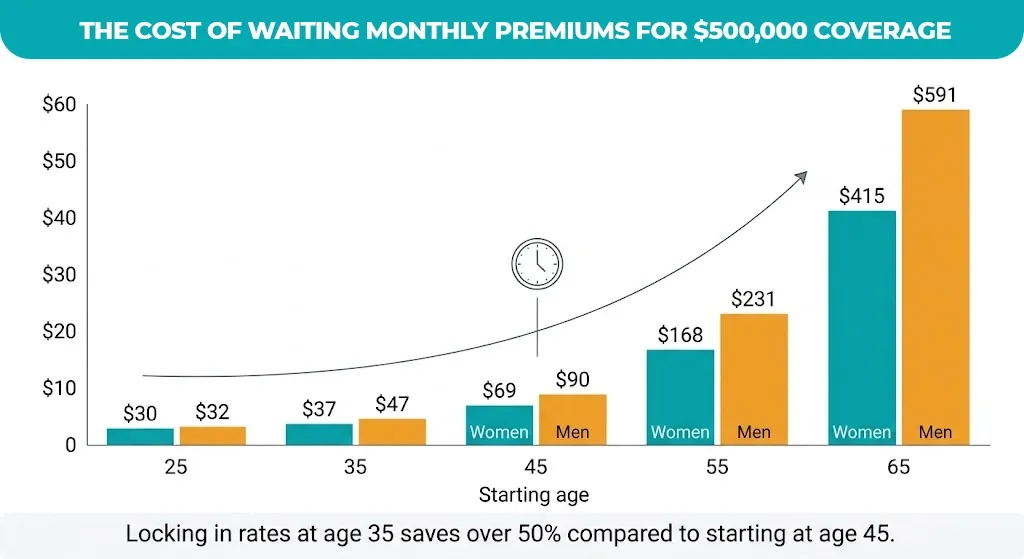
| Age | Woman, $500K 20-year | Man, $500K 20-year | Verdict |
| 25 | $30/mo | $32/mo | Worth it if you have a partner, child, or co-signed debt; cheapest time to lock in |
| 35 | $37/mo | $47/mo | Usually worth it: peak years for kids and mortgages |
| 45 | $69/mo | $90/mo | Worth it if dependents or debts remain; rates now climb faster each year |
| 55 | $168/mo | $231/mo | Case by case; consider a 10- or 15-year term sized to remaining debts |
| 65 | $415/mo | $591/mo | Only for a defined need; otherwise self-insure or use small final expense coverage |
Rates are MoneyGeek 2026 averages for nonsmokers in average health.
Is term life insurance worth it in your 40s if you’re healthy?
Yes, and the sooner the better. A healthy 40-year-old man pays about $59 a month for a 20-year, $500,000 policy; waiting until 45 raises the average to $90, and any new diagnosis in between could raise it further. Locking in a level premium now protects you from both age and health changes. Healthy applicants may also qualify for better classes: MoneyGeek shows a 40-year-old man at Preferred Plus paying about $35 a month for the same coverage.
Is term life insurance worth it at age 65?
Only if you still have a real financial gap: a mortgage, a spouse who would lose pension or Social Security income, or business debt. If your savings can cover your family’s needs, you’ve likely reached the self-insurance threshold. For funeral costs alone, a small whole life final expense policy is often a better fit than term; see Premier Services Agency’s guides to term life for seniors and final expense insurance.
Is selling a term life insurance policy worth it?
Sometimes. Standard term has no cash value, but a convertible term policy may be sold in a life settlement, typically by older owners or those in declining health. Once the conversion window closes, the policy is generally no longer a settlement candidate, according to ThinkAdvisor. In 2025, Life Insurance Settlement Association members paid an average of $212,066 per settlement, across all policy types. If you no longer need coverage and you’re 65 or older, ask for a settlement quote before letting a convertible policy lapse.
Buy Term and Invest the Difference: The 2026 Math
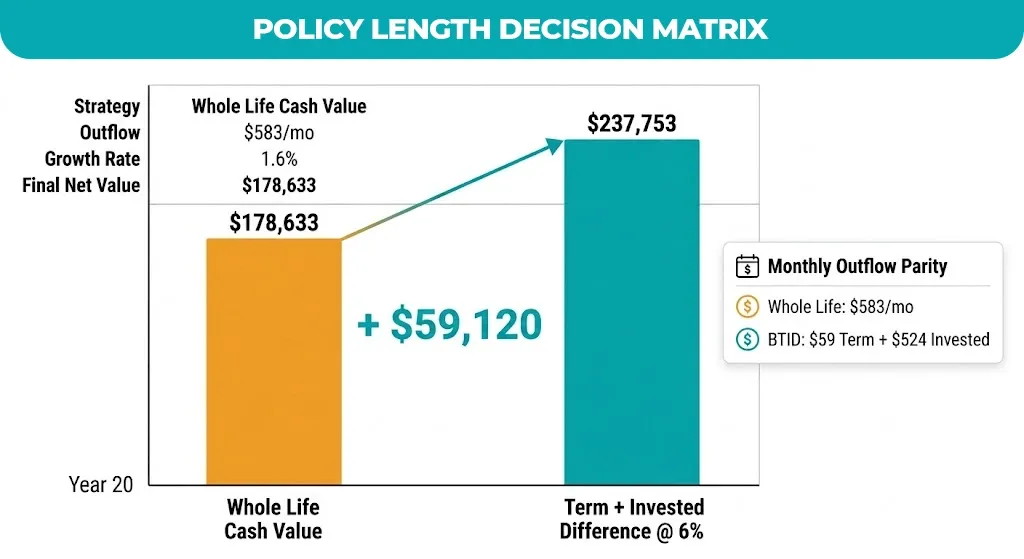
For a 40-year-old man, buying $500,000 of term and investing the $524 a month he would otherwise spend on whole life builds about $238,000 in 20 years at a 6% annual return, versus about $179,000 of illustrated whole life cash value. Even at 4%, investing comes out ahead, but only if you actually invest the difference every month.
The inputs
• Term: $59 a month for a 20-year, $500,000 policy (MoneyGeek 2026 average, man, 40).
• Whole life: $7,000 a year, about $583 a month, for a $500,000 dividend-paying policy issued at 40 (Choice Mutual illustration, March 2026).
• Difference invested: $524 a month, compounded monthly in a low-cost stock index fund at assumed 4% or 6% average annual returns.
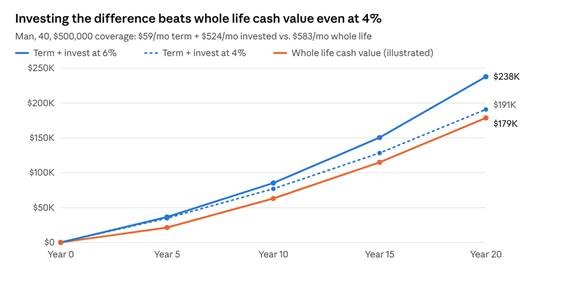
Buy term and invest the difference vs. whole life, 20 years
20-year wealth trajectory
| Year | Total invested | Invested at 4% | Invested at 6% | Whole life cash value |
| 5 | $31,460 | $34,700 | $36,434 | $21,305 |
| 10 | $62,920 | $76,918 | $85,190 | $63,015 |
| 15 | $94,380 | $128,282 | $150,437 | $114,884 |
| 20 | $125,840 | $190,774 | $237,753 | $178,633 |
Investment values are our calculations and are not guaranteed. Whole life values include non-guaranteed dividends.
What the math leaves out
• Taxes: money in a taxable brokerage account owes tax on dividends and gains; inside a 401(k) or IRA the comparison improves. Whole life cash value grows tax-deferred.
• Coverage after year 20: the term policy ends, while the whole life policy continues with an illustrated death benefit of about $612,000 at year 20.
• Behavior: BTID only works if the difference is invested consistently and not spent.
• Market risk: stock returns vary, and a bad decade near the end can cut the result sharply.
Note: For most families, the bigger win is simply affording enough coverage. The $583 whole life premium is nearly 10 times the $59 term premium for the same $500,000 death benefit, so families on a tight budget often end up underinsured with whole life.
Premier Services Agency compares both sides in term vs. whole life insurance and is whole life insurance worth it.
What Do Financial Experts Say?
Dave Ramsey’s team strongly favors term life. Warren Buffett hasn’t publicly prescribed a personal life insurance strategy, but his low-cost index fund advice is the investing half of the buy-term-and-invest-the-difference approach.
What does Dave Ramsey say about term life insurance?
Ramsey Solutions recommends level term life insurance worth 10 to 12 times your annual income, with a term of 15 to 20 years, per its coverage guide. The idea is that the term covers the years until your children are independent and you’ve built enough wealth to become self-insured, at which point you can drop the policy. His team recommends term over whole life, citing whole life’s higher cost and fees, and says stay-at-home parents need their own policies too.
| Ramsey guideline | Example: $70,000 income |
| Coverage: 10–12x income | $700,000 to $840,000 |
| Term length: 15–20 years | Until the youngest child is grown |
| Policy type | Level term, not whole life |
| Exit plan | Self-insured through savings and investments |
What does Warren Buffett say about life insurance?
Buffett has built Berkshire Hathaway around insurance companies, but he hasn’t publicly told individuals which type of life insurance to buy. What he has said publicly is how he’d invest for his family: in his 2013 shareholder letter, he described instructions for his wife’s trustee to put 90% of the cash in a very low-cost S&P 500 index fund and 10% in short-term government bonds, as summarized by The Motley Fool. Buy-term-and-invest-the-difference advocates borrow that logic: keep insurance for protection and put long-term savings in low-cost index funds.
Conclusion:
Term life insurance is worth it when it covers a real, time-limited financial risk at a price you can keep paying. Size the policy to 10 to 12 times income or your actual debts and expenses, end it when your youngest child is independent or your mortgage is paid, and buy it while you’re young and healthy.
| Your situation | Best choice |
| Young children and a new mortgage | 30-year level term |
| Children in school, mortgage half paid | 20-year level term |
| Employer offers free basic coverage | Take it, then add individual term to fill the gap |
| Health issues limit individual approval | Voluntary group term, up to the guaranteed issue amount |
| May need lifelong coverage later | Convertible term |
| Age 65+, savings cover your family | Self-insure, or small final expense coverage for funeral costs |
| Want money back no matter what | Compare ROP with term plus investing first |
Compare Term Life Quotes With Premier Services Agency
Premier Services Agency helps families compare life insurance options with no-pressure guidance, from level term to final expense coverage.
• Review how much coverage you need and for how long.
• Compare level term rates across multiple carriers.
• Explore final expense and senior options if the term no longer fits.
• Free quotes with no obligation.
Get a Free Quote · See term life insurance rates · Learn about level term