


Life insurance for seniors over 80 is still available, but the options narrow sharply compared to earlier ages. Most carriers stop issuing new term life insurance once an applicant turns 80 or 81, which shifts the market for seniors over 80 toward three main products: final expense (burial) insurance, guaranteed issue whole life, and guaranteed universal life.
These policies typically offer $5,000 to $25,000 in coverage, require no medical exam, and are priced to cover funeral costs, medical bills, or small debts rather than to replace income. Monthly premiums for a $10,000 final expense policy average $125 for women and $164 for men, according to MoneyGeek’s 2026 analysis of insurer rate data.
Premiums are higher at this age than at any earlier stage of life, and a two-year waiting period on the natural-death benefit applies to most policies that skip health questions entirely. This guide explains what coverage is actually available after 80, what it costs, how underwriting works, and how to compare carriers before buying a policy for yourself or an aging parent.
| Quick Answer Seniors over 80 can still buy life insurance, but almost always as a small, guaranteed-acceptance whole life or final expense policy rather than term insurance. Coverage is typically capped between $5,000 and $25,000, no medical exam is required, and monthly premiums for a $10,000 policy average $125 to $164 depending on gender, according to MoneyGeek’s 2026 rate analysis. Most guaranteed-acceptance policies include a two-year waiting period before the full death benefit is paid for deaths from natural causes. |
Key Takeaways
- Term life insurance is generally unavailable after age 80 or 81; permanent, no-exam policies fill the gap.
- Final expense insurance, also called burial insurance, is the most common and most affordable option at this age.
- Guaranteed issue policies never ask health questions but carry a standard two-year graded death benefit for natural death.
- Simplified issue and fully underwritten policies can offer full, first-day coverage, but require answering health questions or taking an exam.
- Premiums are fixed for life once approved, but coverage amounts are capped, usually at $25,000 to $30,000.
- Checking a carrier’s AM Best financial strength rating and state license through the NAIC helps confirm it can pay claims.
What Life Insurance for Seniors Over 80 Actually Covers
Life insurance for seniors over 80 is built around a narrower set of goals than the policies people buy in their 40s or 50s. According to Ethos’s guide to coverage after 80, insurance at this age is less about income replacement and more about giving families financial control and dignity after a loss.
Most seniors use the death benefit to cover funeral costs, outstanding medical bills, or small debts so a spouse or adult children are not left with sudden expenses. A modest policy can also pass a tax-efficient death benefit directly to children or grandchildren, without the complexity of a larger estate plan.
Types of Life Insurance Available After Age 80
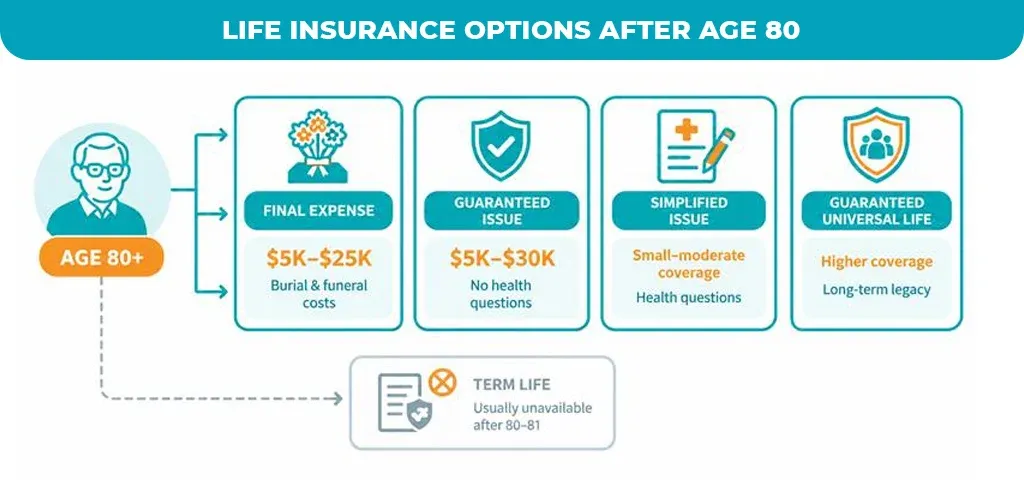
The main options for seniors over 80 are final expense burial insurance, guaranteed issue whole life, simplified issue whole life, and guaranteed universal life. Standard term life insurance is rarely available past this age, since most carriers cap new term applications at 80 or 81.
Final Expense (Burial) Insurance
Final expense insurance is a small whole life policy built specifically to cover end-of-life costs. It typically pays $5,000 to $25,000, usually skips the medical exam, and is priced against real funeral costs rather than income replacement.
The National Funeral Directors Association reports a national median cost of $8,300 for a funeral with viewing and burial, and $6,280 for a funeral with cremation, based on its most recent General Price List study. A $10,000 to $15,000 final expense policy comfortably covers either figure.
Guaranteed Issue Whole Life Insurance
Guaranteed issue policies approve every applicant within the eligible age range and ask no health questions at all. Because the insurer takes on unknown health risk, these policies always carry a two-year graded death benefit: if the insured dies of natural causes within the first two years, the beneficiary typically receives the premiums paid back plus interest rather than the full face amount.
Death from an accident is usually paid in full from day one, even during the waiting period. Coverage amounts are generally capped at $25,000 to $30,000, and premiums are fixed for life once the policy is issued.
Simplified Issue Whole Life Insurance
Simplified issue policies ask a short list of health questions instead of requiring a medical exam. Because the insurer uses those answers to assess risk before approval, many simplified issue and final expense policies can offer full, first-day coverage with no waiting period, rather than the two-year graded benefit attached to guaranteed issue plans.
Guaranteed Universal Life (GUL)
Guaranteed universal life suits seniors who need a death benefit above the typical $25,000 final expense ceiling, such as covering estate costs or leaving a larger legacy. Several carriers offer GUL to applicants up to age 85, but premiums run well above final expense rates because the payout is guaranteed regardless of health status.
Term Life Insurance After 80
A small number of carriers still write 10-year term policies up to age 80, but coverage stops entirely once an applicant’s nearest age is 81. Where it is still available, term coverage is expensive relative to the death benefit: sample quotes across more than 30 carriers show annual premiums of roughly $5,400 to $7,800 for $100,000 of 10-year term coverage at age 80.
For larger amounts, U.S. News reports that an 80-year-old in relatively good health could pay more than $20,000 a year for a 10-year, $500,000 term policy. Because term coverage expires at the end of its level period, a policyholder who buys it at 80 would be uninsured again at 90, which is why most seniors at this age choose permanent coverage instead.
How Much Does Life Insurance Cost for an 80-Year-Old?
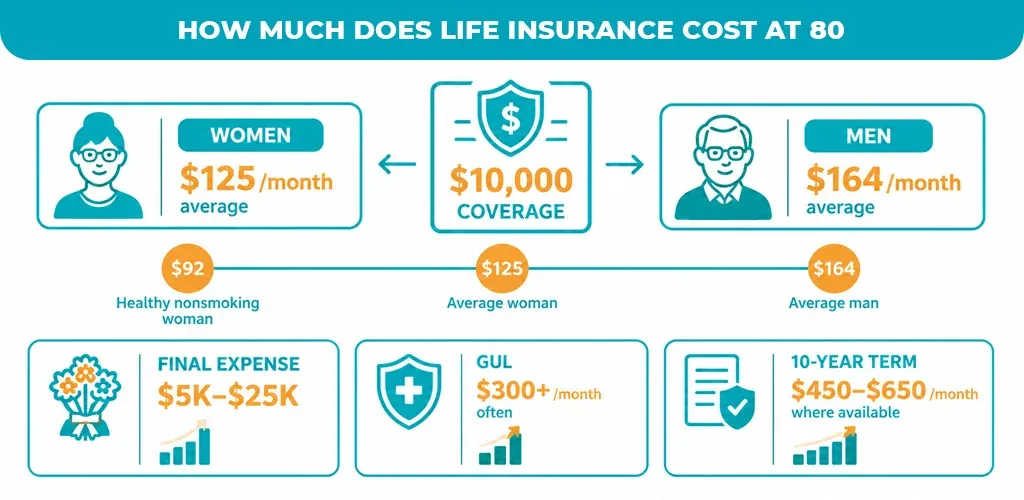
A $10,000 final expense policy for an 80-year-old averages $125 a month for women and $164 a month for men, based on MoneyGeek’s 2026 analysis of premiums by age, gender, and coverage amount. Rates for a healthy 80-year-old nonsmoking woman can start closer to $92 a month for the same $10,000 of coverage.
| Policy Type | Typical Coverage | Typical Monthly Premium (Age 80) |
| Final expense/burial insurance | $5,000 – $25,000 | $92 – $164 for $10,000 of coverage |
| Guaranteed issue whole life | $5,000 – $25,000 | Similar to or slightly above final expense rates |
| Guaranteed universal life (GUL) | Above $25,000, higher limits | Often $300+ for modest coverage amounts |
| 10-year term (where available) | $100,000 | Roughly $450 – $650 (about $5,400 – $7,800/year) |
Two factors drive the price at this age more than any other: gender, since women’s longer average life expectancy generally means lower premiums than men’s at the same age, and underwriting type, since guaranteed issue plans cost more than simplified issue plans with comparable coverage because the insurer is accepting unknown health risk.
Life Insurance for Seniors Over 80 With No Medical Exam
No-exam coverage for seniors over 80 comes in two forms: guaranteed issue, which asks no health questions at all, and simplified issue, which asks a short health questionnaire but still skips the physical exam and lab work.
- Guaranteed issue: Every applicant in the eligible age range is approved. No health questions. Always carries a two-year graded death benefit for natural death.
- Simplified issue: A handful of yes/no health questions determine approval and rate, class. No medical exam required, and many plans pay the full death benefit from day one.
Ethos, which underwrites both guaranteed acceptance and simplified issue whole life for applicants up to age 85, notes that eligibility and pricing at this age depend heavily on the applicant’s age and current health profile, since insurers use both to set the risk class.
The Two-Year Waiting Period (Graded Death Benefit), Explained
A waiting period only applies to policies that skip health questions entirely. Guaranteed issue policies never ask about health, so they always carry a two-year graded death benefit: if the insured dies of natural causes within two years of the policy’s start date, the beneficiary receives the premiums paid, plus interest, instead of the full payout.
Accidental death is typically paid in full starting on day one, even during the two-year window. Final expense and simplified issue policies that do ask a short set of health questions can offer full, first-day coverage instead, because the insurer uses those answers to price the risk before approving the application.
What Does Colonial Penn Give You for $9.95 a Month?
The $9.95 premium buys one “unit” of Colonial Penn’s guaranteed acceptance whole life insurance, not a fixed dollar amount of coverage. According to Colonial Penn’s own FAQ page, the benefit amount per unit depends on the applicant’s age, gender (except in Montana, where pricing is based on age only), and state of residence, and applicants can select up to 25 units to increase their coverage.
- Guaranteed acceptance for adults roughly ages 50 to 85 in most states, with no medical exam and no health questions.
- The premium is fixed for life once the policy is issued and does not increase with age.
- Like other guaranteed issue plans, it carries a standard two-year graded death benefit for death by natural causes; accidental death is generally covered in full sooner.
- A short free-look period allows a full refund if the buyer cancels shortly after the policy is delivered.
Because the exact benefit for $9.95 varies by applicant, the only way to know the actual coverage amount is to request a personalized quote directly from the carrier.
Is It Too Late to Get Life Insurance at 80 Years Old?
No. It is not too late to buy life insurance at 80, though the choice of products narrows and premiums rise. Guaranteed issue and simplified issue whole life policies remain available from multiple carriers well into a person’s mid-80s, and final expense insurance is specifically designed for this age group.
Insurers price these policies against real remaining life expectancy. According to the Social Security Administration’s most recent period life table, an 80-year-old man has an average remaining life expectancy of 8.11 years, and an 80-year-old woman has an average remaining life expectancy of 9.49 years.
That multi-year time horizon is exactly why guaranteed issue insurers build in a two-year waiting period rather than declining older applicants outright, and why small, capped-benefit policies remain financially workable for both the insurer and the buyer at this age.
Best Life Insurance Companies That Cover Seniors Over 80
There is no single “best” life insurance company for everyone over 80, since the right choice depends on whether the priority is guaranteed acceptance, a larger death benefit, or the lowest possible premium. The table below summarizes maximum issue ages reported by NerdWallet and Insurify for carriers that actively write policies for applicants in their 80s.
| Company | Max Issue Age (Whole/Guaranteed Life) | Known For |
| AARP / New York Life | Up to 85 (75 in New York) | Guaranteed acceptance, no medical exam |
| Mutual of Omaha | Up to 85 (75 in New York) | No-exam and final expense coverage |
| State Farm | Guaranteed issue final expense to 80 | Customer satisfaction, online quotes |
| Guardian Life | Up to 90 | Payment flexibility, mutual company |
| MassMutual | Up to 90 | Whole life with cash value/dividends |
| TruStage | Guaranteed issue to 80; whole life to 85 | No-exam guaranteed acceptance |
| Pacific Life | Up to 80 | No-exam coverage, flexible conversion |
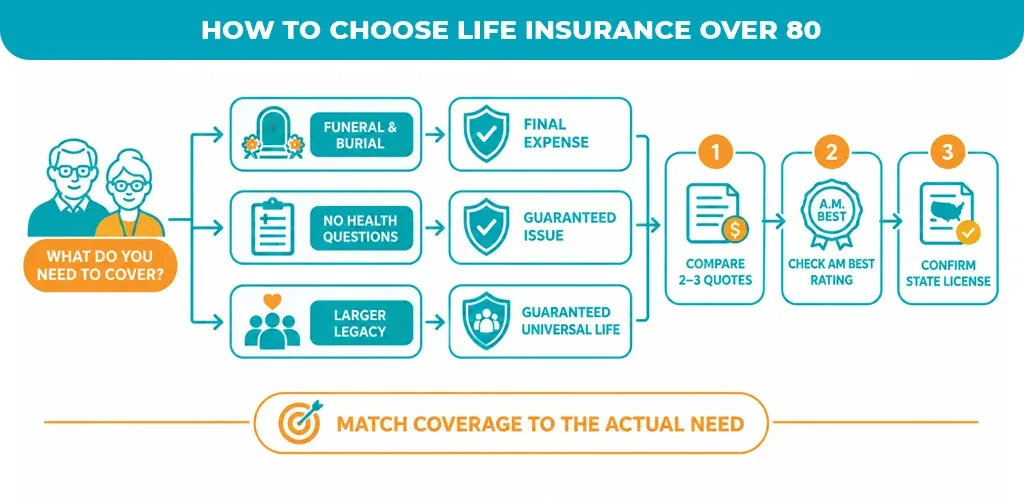
Whichever company you consider, two checks matter more than brand recognition: the carrier’s AM Best financial strength rating, which reflects its ability to pay future claims, and confirmation through your state insurance department or the NAIC that the company is licensed to sell in your state.
How to Choose the Right Policy for Yourself or a Parent Over 80
- Start with the actual need. Match the coverage amount to a real cost, such as the NFDA’s national median funeral cost of $8,300 for burial or $6,280 for cremation, rather than buying the maximum available.
- Decide between guaranteed issue and simplified issue. Guaranteed issue is the only option if health conditions would otherwise cause a decline, but it comes with a two-year waiting period. Simplified issue can pay in full from day one if the applicant can answer the health questions favorably.
- Compare quotes from at least two or three carriers. Premiums for the same coverage amount can differ meaningfully between insurers, as shown in the cost table above.
- Check the AM Best rating. This independent rating measures an insurer’s financial strength on a scale from A++ down to D-, and reflects its ability to pay claims over time.
- Confirm the free-look period. State law requires a minimum free-look window, typically 10 to 30 days after the policy is delivered, during which the buyer can cancel for a full refund of premiums paid.
Conclusion & Next Steps
Securing life insurance for seniors over 80 requires navigating a unique financial landscape focused heavily on final expenses rather than income replacement. By prioritizing top-rated carriers, evaluating simplified versus guaranteed acceptance plans, and carefully matching your policy type to actual personal needs, you can easily turn uncertainty into absolute peace of mind.
Ready to Secure Peace of Mind? Don’t leave your family’s future to chance. Connect with the experts at Premier Services Agency today to compare personalized life insurance quotes for seniors over 80, check your options with zero medical exams, and lock in the best rate available for your budget.