

Whole Life Insurance Rates by Age Chart: 2026 Guide

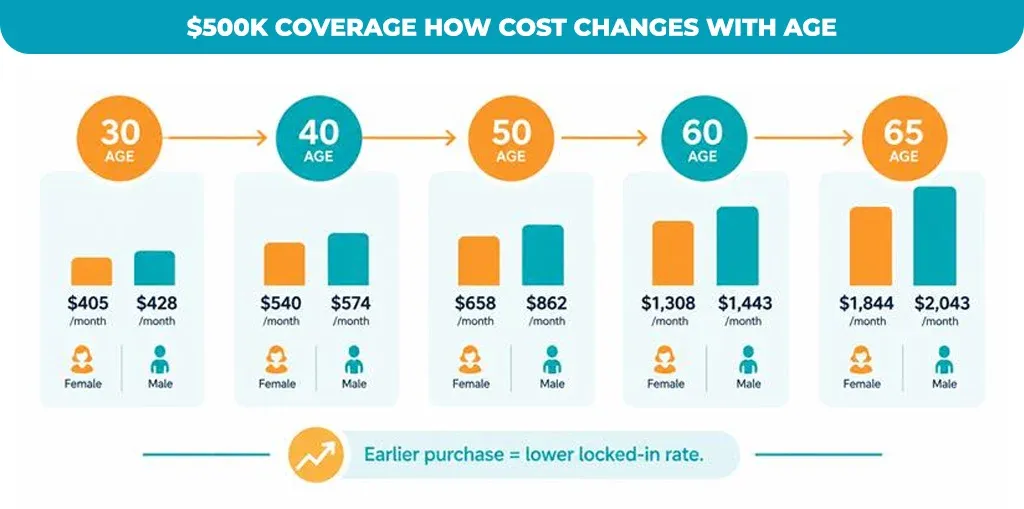
Whole life insurance premiums are priced mainly on your age, sex, health classification, tobacco use, and the coverage amount you select, and once you are approved, that premium is locked in for the rest of your life. A healthy 30-year-old woman pays about $405 a month for a $500,000 whole life policy, while a 60-year-old woman pays about $1,308 a month for the same coverage more than three times as much- based on MoneyGeek’s 2026 analysis of nonsmoker, average-health rates. Men pay somewhat more than women at every age in that same analysis.

This guide walks through a complete whole life insurance rates by age chart for $100,000, $250,000, and $500,000 in coverage, explains how insurers calculate your premium, compares whole life against term life insurance, and helps you decide whether permanent coverage fits your estate planning, final expense, or cash-value goals.

Quick Answer
A $500,000 whole life insurance policy for a healthy nonsmoker costs roughly $405 to $428 a month at age 30, $540 to $574 at age 40, $658 to $862 at age 50, and $1,308 to $1,443 at age 60 (women to men), based on MoneyGeek’s 2026 rate analysis, updated September 2026. Your premium is fixed for life at the age you apply, so buying earlier locks in a lower rate for decades. The full chart below covers $100,000, $250,000, and $500,000 in coverage from age 30 through 65.

Key Takeaways

  • Age is the single largest factor in a whole life insurance premium, and the rate you lock in at application never increases as you get older.
  • A $500,000 whole life policy costs about $405–$428 a month at age 30 and roughly triples by age 60, according to MoneyGeek’s 2026 data.
  • Smoking adds roughly 36% to a whole life premium, and poor health adds another 10%–18%, based on the same analysis.
  • Whole life costs several times more than term life for equivalent coverage because it never expires and part of the premium funds tax-deferred cash value.
  • The “right” coverage amount depends on your goal final expenses, estate planning, or a guaranteed legacy not a single fixed number.

$500K Coverage: How Cost Changes With Age

How Whole Life Insurance Works

Whole life insurance is a form of permanent life insurance: it pays a guaranteed death benefit whenever you die, as long as your premiums are current, and it builds cash value alongside that death benefit. It differs from term life insurance, which only provides coverage for a set number of years.

Level, guaranteed premiums: your rate is set at issue and does not rise with age or new health conditions that develop later in life. Lifetime coverage: as long as scheduled premiums are paid, the policy stays in force for your entire life rather than expiring after 10, 20, or 30 years.

Cash value growth: a portion of each premium funds a tax-deferred cash value account that grows at a guaranteed minimum rate. Participating (mutual) insurers, including Northwestern Mutual, MassMutual, and New York Life, may also pay annual dividends on top of the guaranteed rate, though dividends are not guaranteed and can vary year to year.

Policy loans and withdrawals: you can borrow against or withdraw from the cash value while you are alive. Outstanding loans accrue interest, and unpaid loans or withdrawals reduce the death benefit your beneficiaries receive.

What Does Whole Life Insurance Cover?

A whole life policy pays a tax-free death benefit to your named beneficiaries and, in many cases, gives you access to living benefits while you are still alive. Guaranteed death benefit: a lump sum, generally income-tax-free to beneficiaries, that can cover funeral costs, outstanding debt, estate taxes, or income replacement.

Cash value accumulation policy equity that builds over time and that you can borrow against or withdraw from. Accelerated (living) benefit riders allow you to access a portion of the death benefit early if you are diagnosed with a qualifying chronic or terminal illness.

Waiver-of-premium rider keeps the policy in force without further premium payments if you become totally disabled, subject to the insurer’s definition of disability. Guaranteed insurability rider: lets you purchase additional coverage at set future dates without new medical underwriting.

How Much Does Whole Life Insurance Cost?

Whole life insurance costs substantially more than term life insurance for the same death benefit because it combines permanent, lifelong protection with a cash-value savings component that term life does not offer. For a 40-year-old man, a 20-year, $500,000 term life policy averages about $59 a month, compared with about $574 a month for the same $500,000 of whole life coverage nearly ten times as much according to MoneyGeek’s 2026 rate analysis.

Monthly premiums scale with three main cost drivers that actuaries build into every policy: mortality risk (largely a function of age and health), the interest the insurer expects to earn on invested premiums, and the company’s operating expenses. Of the three, age-related mortality risk has the largest effect on what an individual applicant pays.

Whole Life Insurance Rates Chart by Age

Whole life premiums rise gradually through your 30s and 40s, then climb sharply after age 50. A policy bought at 30 locks in a fixed rate that can end up costing a fraction of what the same coverage would cost if purchased at 60, because the premium never increases once the policy is issued.
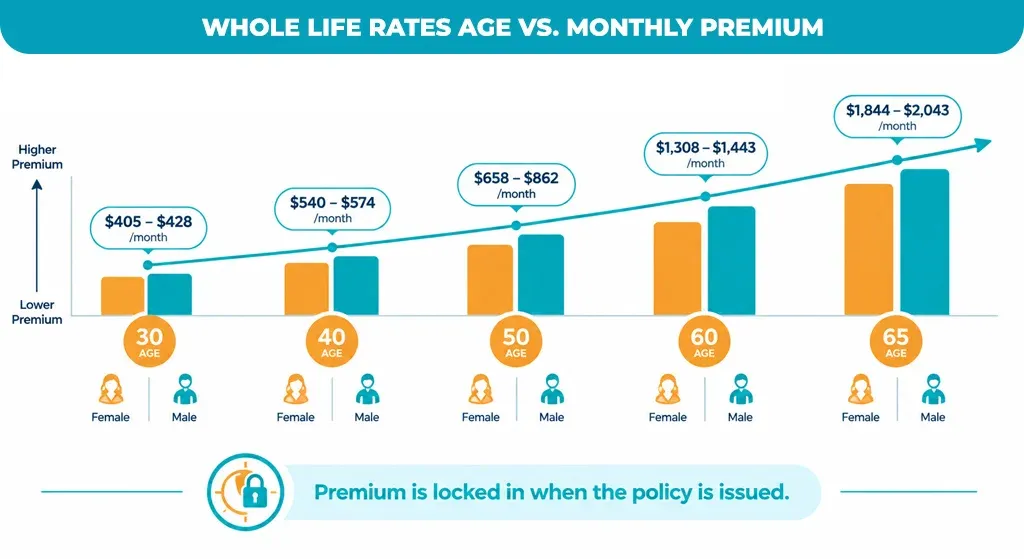
Whole Life Rates: Age vs. Monthly Premium 

Monthly Whole Life Insurance Rates by Age and Coverage Amount

The table below shows average monthly premiums for nonsmokers in average health, listed as Female / Male, based on MoneyGeek’s 2026 nationwide rate analysis.

Age$100,000 Coverage$250,000 Coverage$500,000 Coverage
30$98 / $103$208 / $222$405 / $428
35$111 / $116$239 / $256$467 / $495
40$127 / $130$274 / $294$540 / $574
45$135 / $155$315 / $361$629 / $703
50$146 / $186$336 / $443$658 / $862
55$204 / $239$468 / $569$918 / $1,115
60$288 / $308$665 / $732$1,308 / $1,443
65$399 / $434$936 / $1,034$1,844 / $2,043

In summary, the cost curve is not linear. Between age 30 and 50, a $500,000 policy’s monthly premium roughly doubles for women (from $405 to $658) and for men (from $428 to $862). Between age 50 and 65, it roughly triples again for both sexes. Waiting even five years past age 50 has a noticeably larger dollar impact than waiting five years in your 30s, which is why insurance professionals generally advise locking in a rate as early as it fits your budget and coverage needs.

Lock In Your Rate Before It Rises

Whole life insurance premiums increase every year you wait. Compare personalized quotes today to secure permanent coverage and protect your family’s future at today’s price.

How Smoking and Health Class Affect the Chart

Tobacco use and health rating shift every figure in the chart above, sometimes substantially.

  • Smokers pay roughly 36% more than nonsmokers at age 40 for equivalent coverage. At $500,000, that is about $735 a month for women who smoke versus $540 for nonsmokers, and about $784 for men who smoke versus $574 for nonsmokers.
  • Poor health adds roughly 10% to 18% over average-health rates, depending on age and coverage amount. At age 40, a $500,000 policy averages about $610 a month for a woman in poor health versus $540 in average health, and about $647 for a man in poor health versus $574 in average health.
  • Most insurers will consider you a nonsmoker again after 12 consecutive tobacco-free months, though the exact requirement varies by carrier.

What Other Factors Can Affect the Cost of Whole Life Insurance?

Age sets the baseline, but several other underwriting factors move your final premium up or down.

  • Health status and medical history: insurers evaluate height, weight, blood pressure, cholesterol, and medical history to assign a health class, and pre-existing conditions such as diabetes or heart disease can raise your rate or require specialized underwriting.
  • Tobacco and nicotine use: cigarette smokers pay meaningfully higher premiums, and some insurers also rate other nicotine products, such as vaping or chewing tobacco, differently from cigarettes.
  • Gender: women generally pay less than men at the same age and health class, reflecting differences in average life expectancy used in actuarial mortality tables.
  • Coverage amount: higher death benefits require the insurer to take on more risk, which increases the monthly premium, though the cost per $1,000 of coverage often decreases slightly at higher face amounts because fixed policy fees are spread across a larger benefit.
  • Underwriting type: fully underwritten policies require a medical exam and detailed health history and typically offer the lowest rates for healthy applicants. Simplified issue policies skip the exam but ask health questions. Guaranteed issue policies ask no health questions at all but cap coverage and cost more per dollar of benefit. AARP’s guaranteed acceptance whole life program, for example, is available to AARP members age 50 and older for up to $30,000 in coverage and is underwritten by New York Life Insurance Company, not AARP itself.

Is Whole Life Insurance More Expensive Than Term Life Insurance?

Yes. Whole life insurance is substantially more expensive than term life insurance for the same death benefit, and the gap widens with age because whole life guarantees a payout no matter when you die, while term life only pays out if you die within the policy term.
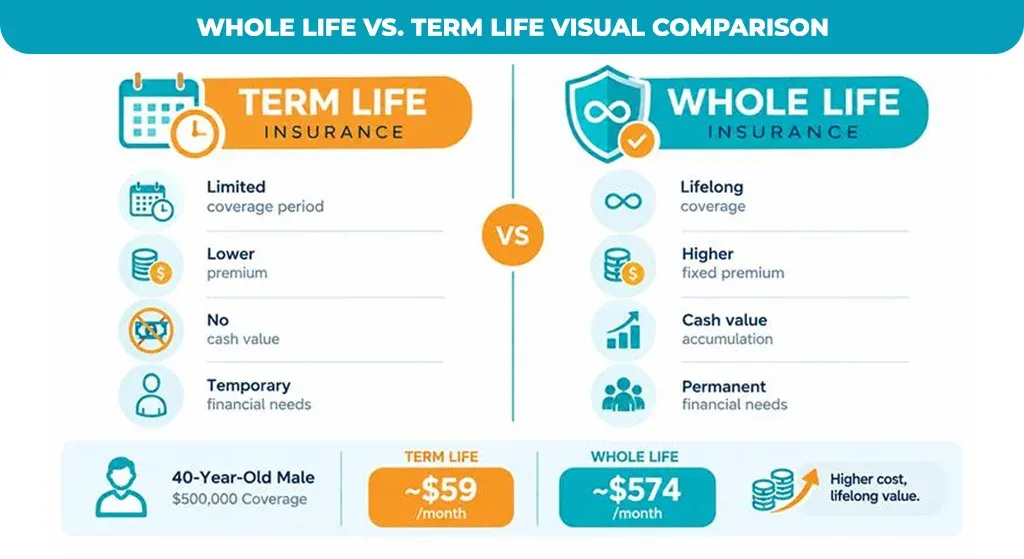

Whole Life vs. Term Life Visual Comparison

FeatureTerm Life InsuranceWhole Life Insurance
Coverage lengthFixed term (10, 20, or 30 years)Entire lifetime, as long as premiums are paid
PremiumsLower, may increase at renewal or by age bandHigher, but level and guaranteed for life
Cash valueNoneBuilds tax-deferred; accessible via loans or withdrawals
Best forTemporary needs: income replacement, mortgage payoffPermanent needs: final expenses, estate planning, legacy
Cost example (age 40, $500,000)~$59/month (20-year term, male)~$574/month (male, nonsmoker, average health)

Term life buys pure protection for a defined period, which makes it a lower-cost option for younger families who need a large death benefit temporarily, such as while raising children or paying down a mortgage. Whole life costs more because it locks in a premium for life, covers you permanently, and accumulates cash value you can access while living.

Is Whole Life Insurance Right for Me?

Whole life insurance tends to be a strong fit for specific financial goals rather than a universal recommendation, so the decision comes down to matching the policy structure to your situation.

Whole Life Is Often a Good Fit If You:

  • Have a lifelong financial dependent, such as a child with special needs, who will require support after you are gone.
  • Want a guaranteed cash reserve you can borrow against for emergencies, opportunities, or supplemental retirement income.
  •  Are focused on covering final expenses or leaving a guaranteed legacy or inheritance regardless of when you pass away.
  • Have maximized other tax-advantaged savings and want an additional vehicle for tax-deferred growth.

A Different Approach May Fit Better If You:

  • Primarily need temporary income replacement while raising children or paying off a mortgage; term life typically provides more coverage per dollar for that window.
  • Have a tight monthly budget and would rather buy a larger death benefit now and revisit permanent coverage later.
  • Are mainly looking to cover a modest final-expense amount; a guaranteed issue or simplified issue policy in the $10,000 to $25,000 range may be more cost-effective than a larger fully underwritten policy.

How to Get a Whole Life Insurance Plan

Securing the right policy generally follows four steps.

  • Determine your budget and needs. Estimate the death benefit your family or estate requires, and decide on a monthly premium that fits comfortably into your long-term budget rather than straining it. A whole life insurance calculator, offered by many insurers and comparison sites, can generate a personalized estimate based on your age, gender, coverage amount, and health class.
  • Compare multiple quotes. Rates for identical coverage can differ by more than $1,000 a month between insurers at older ages, so shopping across several top-rated carriers or working with an independent broker helps you avoid overpaying.
  • Complete underwriting. Fill out the application and be prepared to answer health questions or complete a brief paramedical exam if you are applying for a fully underwritten policy, which generally offers the lowest rates for healthy applicants.
  • Lock in your rate. Once approved, accepting the policy locks in your premium for life at the rate tied to your current age and health class; the earlier you complete this step, the lower that fixed rate is likely to be.

Conclusion: Locking In the Right Rate

Whole life insurance rates climb steadily with age, and the premium you lock in at application stays fixed for the rest of your life. As the chart above shows, a $500,000 policy can cost roughly a third as much at age 30 as it does at age 60, which makes timing one of the few cost factors fully within your control. Health class, tobacco use, coverage amount, and the insurer you choose all shape your final premium as well, so comparing quotes from multiple carriers remains essential no matter your age.

If lifelong protection, guaranteed cash value, or estate planning are part of your financial goals, the next step is a personalized, obligation-free quote based on your exact age, health, and coverage needs. The numbers in this guide are averages, and your actual rate could be lower once a carrier reviews your specific profile.

Secure Your Family's Future Today

Whole life insurance rates increase with every passing year. Compare personalized quotes from top carriers today to lock in your permanent coverage at the lowest possible price.

Frequently Asked Questions

A $100,000 whole life policy for a nonsmoker in average health costs about $98 a month for a 30-year-old woman and $103 for a 30-year-old man, rising to roughly $399 for a woman and $434 for a man by age 65, according to MoneyGeek's 2026 rate analysis. Health class, tobacco use, and your state of residence can move these figures higher or lower.

Whole life insurance for a 75-year-old costs substantially more than at younger ages because premiums are based on the age at which you apply. Industry rate comparisons for $500,000 in coverage at age 75 show significant variation by insurer. MoneyGeek's 2026 analysis found average monthly premiums ranging from roughly $3,471 to $5,288 across three major carriers, underscoring why comparing multiple companies matters even more at older ages.

A $50,000 whole life policy generally costs somewhat more than half of the $100,000 rate shown in the chart above, because every whole life policy carries a base policy fee that does not scale down proportionally with smaller face amounts. Using the age-30 nonsmoker rate as a reference point ($98 a month for women and $103 for men at $100,000), a $50,000 policy at the same age and health class would typically fall in the $55–$70 monthly range.

There is no single required age, but buying earlier locks in a lower premium for life, since whole life rates rise with every year you wait to apply. The cost curve in the chart above shows premiums roughly doubling between ages 30 and 50 and tripling again between 50 and 65, so the financial advantage of buying in your 30s or 40s, while still in good health, compounds over decades of fixed payments.