


30-year term life insurance is a life insurance policy that pays a fixed death benefit to your beneficiaries if you die within a 30-year period, in exchange for a premium that stays level for the entire term. It is the longest term length most carriers offer, and it is built for people who need protection to last through decades-long obligations, such as a 30-year mortgage or the full span of raising children into adulthood. Unlike whole life or universal life insurance, a 30-year term policy has no cash value component. It exists to do one job: replace your income or cover a debt if you die during the term.
This guide explains how 30-year term life insurance works, what it costs in 2026, the riders and conversion options available, what happens when the term ends, and how to decide whether it is the right length for your situation. Every statistic below is sourced from LIMRA, the Society of Actuaries, Ramsey Solutions, or independent 2026 rate surveys, with the source cited next to the figure.
| Quick AnswerA 30-year term life insurance policy locks in a level premium and a fixed death benefit for 30 years. It is pure protection with no cash value; it is medically underwritten once at the start of the policy, and coverage simply ends at the end of the term unless you convert it to permanent insurance or renew it at a much higher, age-based rate. |
Key Takeaways
- Level premiums, fixed benefit: Your rate and death benefit are locked in for the full 30 years based on your age and health at the time you buy the policy.
- No cash value: A 30-year term policy is pure protection. It does not build savings or investment value like whole or universal life insurance.
- Higher upfront cost than shorter terms: A 30-year term costs meaningfully more per month than a 20-year or 10-year policy for the same coverage amount, because the insurer is assuming risk over a longer window.
- Coverage ends at expiration: Unless you convert to permanent coverage or renew, the policy simply lapses with no payout when the term is up.
- Best suited to long time horizons: Young parents and new 30-year mortgage holders are the clearest fit, since the term matches how long the financial obligation lasts.
How 30-Year Term Life Insurance Works
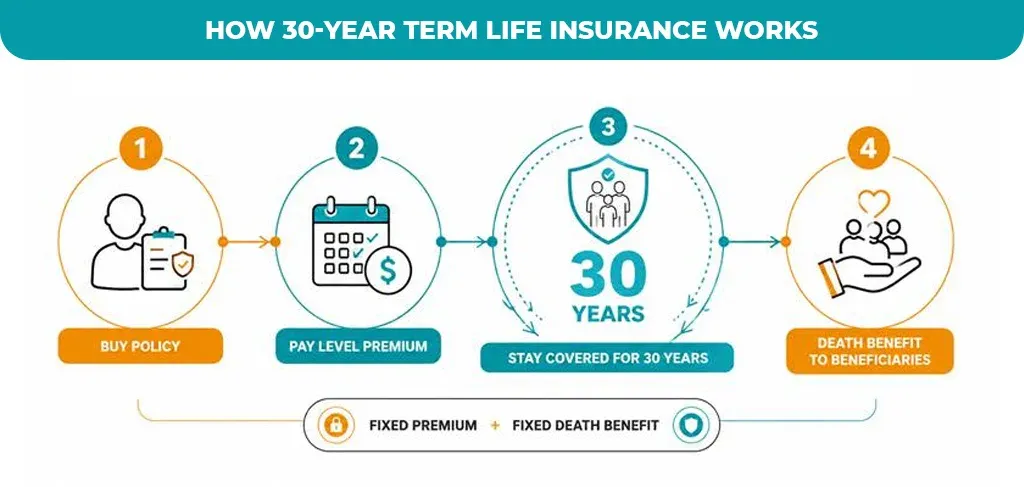
A 30-year term life insurance policy is a contract between you and an insurance company. You pay a premium on a monthly or annual basis, and in exchange, the insurer agrees to pay a stated death benefit to your named beneficiaries if you die at any point during the 30-year term. If the term ends and you are still living, the coverage simply expires.
Level Premiums
Insurers set your premium based on your age, health, tobacco use, and other underwriting factors at the time you apply. That premium is then guaranteed not to increase for the full 30 years, a structure the industry refers to as level premium term life insurance. State insurance regulators, coordinated nationally through the National Association of Insurance Commissioners (NAIC), require insurers to clearly disclose this level-premium structure and the guaranteed term length in the policy contract, so you know exactly what you are buying before you sign.
Pure Protection, No Cash Value
Term insurance, including the 30-year version, is pure protection. Unlike whole life or universal life insurance, it does not accumulate cash value that you can borrow against or withdraw. Every dollar of premium goes toward the cost of the death benefit and the insurer’s administrative costs, which is the main reason term life insurance rates are substantially lower than permanent life insurance rates for the same coverage amount.
Underwriting Locks In Your Rate for the Full Term
You go through medical underwriting only once, when you first apply. Depending on your age, health history, and the coverage amount you request, this can include a paramedical exam, blood and urine testing, and a review of your prescription and driving history. Once the policy is issued, your health class and premium are locked in, even if your health changes later. That single underwriting event is what makes a 30-year term worth buying while you are young and healthy.
Features of a 30-Year Term Life Insurance Policy
Guaranteed Level Death Benefit
The payout amount you select at purchase, whether that is $250,000, $500,000, $1 million, or another figure, stays unchanged for beneficiaries for the entire 30-year period. There is no reduction in coverage as the policy ages, which distinguishes level term from decreasing term policies sometimes sold alongside mortgages.
Fixed Premium Schedule
Because the premium is level, your monthly or annual payment is set at issue and does not rise with age or health changes during the term. This predictability is one of the main reasons long-term life insurance protection products like the 30-year term are popular with budget-conscious households: the payment you approve in your 30s is the same payment you’ll make in your 50s.
Life Insurance Conversion Options
Most 30-year term policies include a conversion privilege, which allows you to convert some or all of the term coverage into a permanent policy, such as whole life or universal life, without new medical underwriting. This matters if your health declines during the term and you later decide you want permanent coverage. Conversion windows and eligible product lines vary by carrier, so it is worth confirming the specific conversion deadline and available permanent products before you buy.
30-Year Term Life Insurance Cost: What to Expect
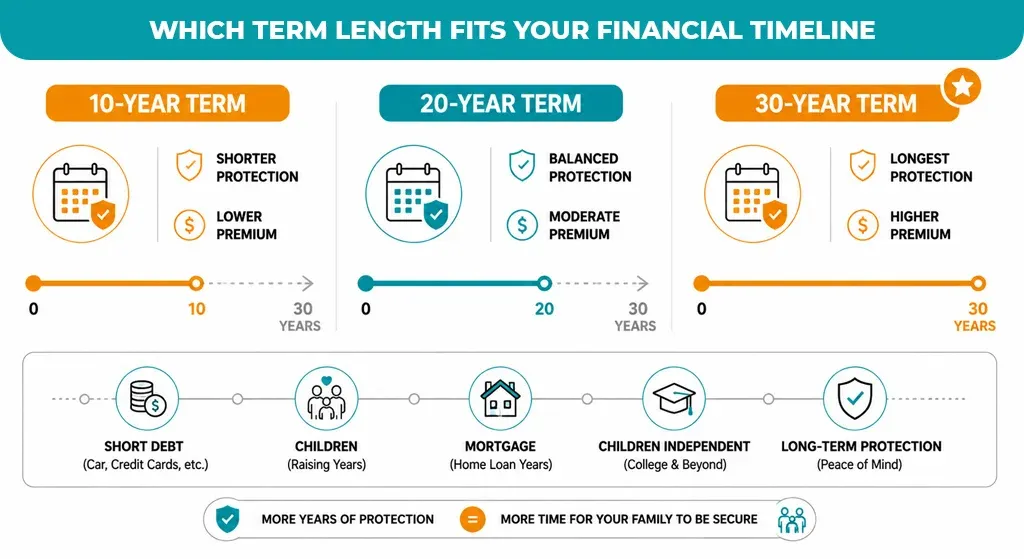
Term length is one of the biggest drivers of your premium, alongside age, health class, and coverage amount. Based on a 2026 survey of major carriers for a 40-year-old nonsmoker in average health buying $500,000 of coverage, a 30-year term costs meaningfully more per month than shorter terms for identical coverage.
| Term Length | Average Monthly Premium (Men) | Notes |
| 20-year term | $59 | Baseline used for comparison |
| 30-year term | $104 | About 76% more than the 20-year term for the same coverage |
The average 30-year term premium for the same profile is $82 per month for women, reflecting the lower average mortality risk insurers assign to female applicants at the same age and health class. The gap between a 20-year and 30-year term for a 40-year-old nonsmoker works out to roughly $35 more per month, or about $12,600 in additional premium paid across the full 30-year term, according to MoneyGeek’s 2026 rate analysis.
Age at purchase has an even larger effect than term length. According to Ramsey Solutions’ 2026 term life rate chart, a healthy 20-year-old man buying a 30-year term pays about $59.72 per month, while a 50-year-old buying the same 30-year term pays about $280.66 per month. That gap illustrates why locking in a 30-year term earlier in life, while you are young and in good health, generally produces a far lower lifetime cost than waiting.
Pros and Cons of 30-Year Term Life Insurance
Pros
- Maximum rate predictability: Your premium is locked in for three full decades, protecting you from age-based rate increases during that window.
- Lower cost than permanent insurance: A 30-year term is significantly cheaper than whole or universal life insurance for the same death benefit, since it carries no cash value component.
- Matches long-term obligations: The 30-year term lines up naturally with a 30-year fixed mortgage or the years needed to raise children from birth through early adulthood.
Cons
- Higher premium than shorter terms: A 30-year term costs more per month than a 10-year or 20-year policy with identical coverage, since the insurer is on the hook for a longer window.
- No cash value growth: There is no savings or investment component, so the policy has no surrender value if you stop needing the coverage.
- Risk of outliving usefulness: If purchased later in life, or if your financial obligations end well before the term does, you may spend years paying for coverage you no longer strictly need.
What Happens to My Term Life Insurance Policy After the 30 Years Are Up?
Policy Expiration
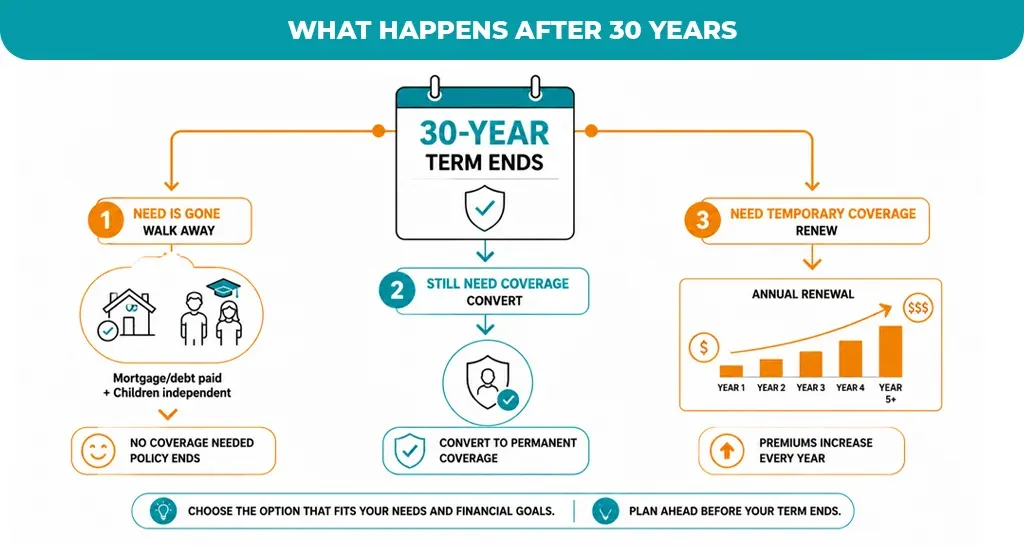
When the 30-year term ends, the coverage terminates. Premiums stop, and the death benefit is no longer in effect unless you renewed the policy or converted it to permanent insurance before expiration.
Annual Renewable Term (ART)
Many term policies are guaranteed renewable beyond the original term, typically up to a maximum age set by the carrier. If you let the policy roll into this year-to-year structure instead of replacing it, premiums are recalculated annually based on your attained age, and they rise sharply each year you renew. This makes ART a short-term bridge rather than a long-term strategy.
Conversion to Permanent Coverage
If you still need life insurance protection at the end of the term, but you would rather not requalify medically, exercising the policy’s conversion clause before it expires lets you move into a permanent policy without new underwriting, provided you act within the carrier’s conversion window.
Walking Away
If your major financial obligations, such as a mortgage or dependent children, have been resolved by the time the term ends, many policyholders simply let the coverage lapse rather than renew or convert. This is consistent with how term insurance is designed to be used: as protection tied to a specific, time-limited financial need rather than lifelong coverage.
| Data Point: Term Policies and Lapse RatesA Society of Actuaries study of industry experience found a total lapse rate for term life insurance of 6.6% during the 2004–2005 period, meaning a meaningful share of term policyholders stop paying premiums and drop coverage before the end of the term, rather than carrying it through to expiration or a claim. Because term insurance is priced to cover a temporary need, a substantial share of policies purchased today will end without a claim, either because the policyholder outlives the term or the coverage is voluntarily dropped once the underlying need has passed. |
Is 30-Year Term Life Insurance Right for Me?
Ideal Candidates
- Young parents: Adults in their 20s through early 40s with dependent children benefit most, since the 30-year window covers a child’s entire path from birth to financial independence.
- New 30-year mortgage holders: Homeowners who just signed a 30-year fixed mortgage can match their coverage length directly to their loan term.
- Younger professionals locking in health: Buying while healthy secures a lower rate class for the full three decades, before age or a future health change can raise the cost.
When to Consider Alternatives
A 10-, 15-, or 20-year term may be a better fit if you are older, your children are already approaching adulthood, or you have fewer years remaining on your major debts. Matching the term length to the actual number of years you need protection, rather than defaulting to the longest option, generally produces the lowest total cost for the coverage you actually use.
Underwriting Factors
Age, tobacco use, family medical history, driving record, and overall health all factor into whether a 30-year term is affordable, and whether it is approved at a preferred rate class. Carriers set their own maximum issue ages for 30-year term products, so availability can narrow as you get older, which is another reason this term length is generally recommended earlier rather than later in life.
Conclusion
A 30-year term life insurance policy offers level premiums, a guaranteed death benefit, and no cash value, structured specifically to match long-term obligations such as a 30-year mortgage or the full span of raising children. It costs more per month than shorter term lengths, but it locks in your rate while you are healthy and removes the need to requalify for coverage later in life. Whether a 30-year term, a shorter term, or permanent coverage fits your situation best depends on your age, your dependents, and how long your financial obligations will last.
Navigating the complexities of life insurance requires personalized guidance to ensure your family gets the exact protection they deserve. At Premier Services Agency, our licensed experts specialize in matching you with top-rated carriers, competitive rates, and customized coverage plans designed around your unique budget and goals. Do not leave your family’s financial security to chance.