


Supplemental life insurance is additional life insurance coverage purchased on top of a basic policy, typically an employer-provided group plan, to close the gap between that base amount and what a household would actually need after a death. Most employer group life insurance pays a flat amount, such as $50,000, or a multiple of salary, usually one to two times annual pay. For someone with a mortgage, children, or significant debt, that amount rarely covers more than a fraction of what dependents would need to maintain their household. Supplemental coverage can be added through an employer’s voluntary benefits program, purchased as an independent individual policy, or structured as a rider such as accidental death and dismemberment (AD&D) or child life coverage.
| Quick Answer Supplemental life insurance is extra death-benefit coverage you buy in addition to a basic policy, most often to fill the gap left by an employer’s group plan. It can come as additional group term coverage through work, an AD&D rider, a spouse or child rider, or a separate individual term or whole life policy. Whether it is worth it depends on how much coverage you already have, your debts and dependents, and whether the coverage stays with you if you change jobs. |
Key Takeaways
- Employer-provided group life insurance commonly caps out at one to two times salary or a flat amount, often around $50,000, which is frequently not enough on its own.
- Common types of supplemental coverage include additional group term life, AD&D, spouse and child riders, final expense (burial) insurance, and independent term or whole life policies.
- The DIME method (Debt, Income, Mortgage, Education) and the income-multiple approach (roughly 10 to 15 times annual income) are the two most commonly used ways to estimate how much coverage a household needs.
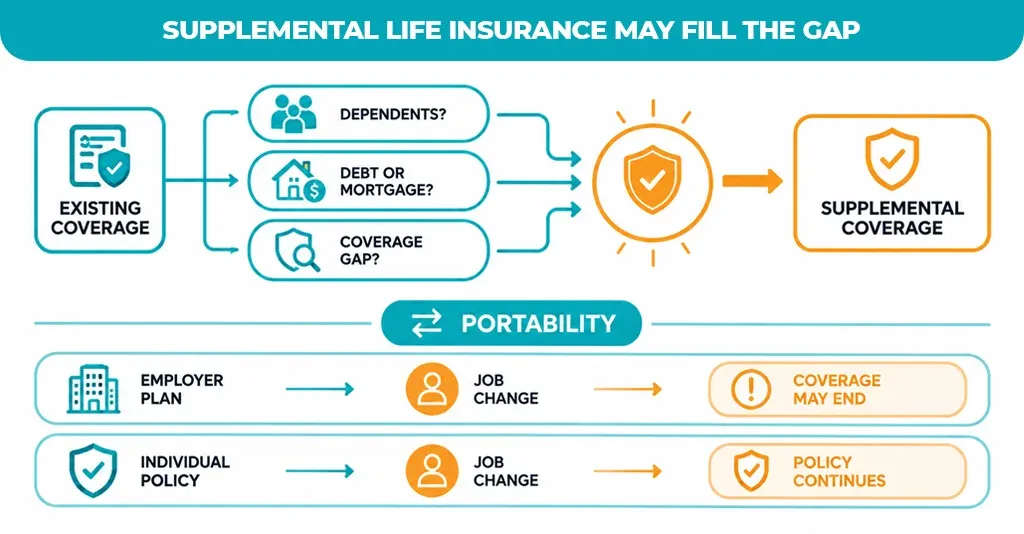
- Group supplemental coverage bought through an employer is usually not portable, meaning it typically ends when employment ends, while an individual policy stays in force regardless of your job.
- Under Internal Revenue Code Section 79, the first $50,000 of employer-paid group term life coverage is tax-free to the employee; coverage above that amount can create taxable imputed income.
What Is a Supplemental Life Insurance Plan?
Supplemental life insurance is any additional death-benefit coverage layered on top of a person’s basic life insurance to close a specific coverage gap. It is not a distinct product so much as a category: it can be extra group term coverage offered through an employer’s voluntary benefits enrollment, or a separate policy purchased directly from an insurer on the open market.
Most employer-sponsored group life insurance is structured in one of two ways: a flat dollar amount (commonly $10,000 to $50,000) or a multiple of the employee’s annual salary, usually one to two times pay, with some employers offering three or four times pay for certain roles. Internal Revenue Code Section 79 allows employers to provide the first $50,000 of group term coverage tax-free; any employer-paid coverage above that threshold generates imputed income that appears on the employee’s Form W-2, according to the Internal Revenue Service.
Supplemental Coverage Gap
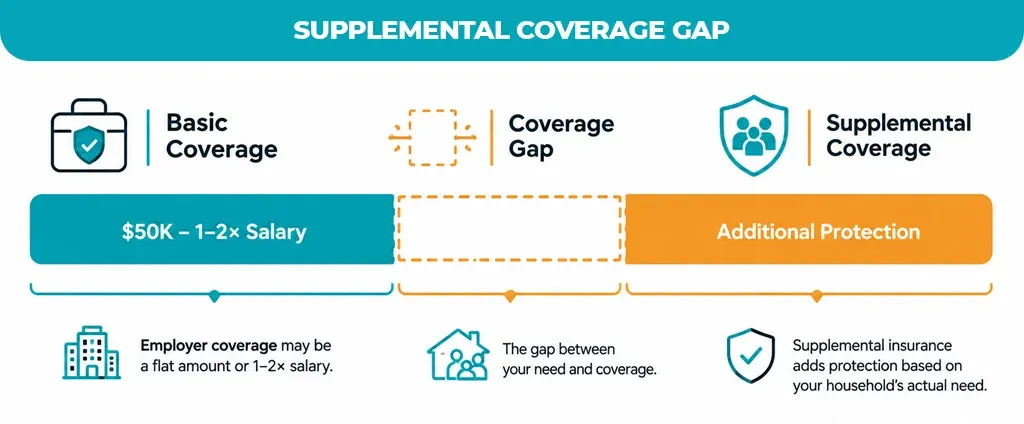
For most working adults with a mortgage, young children, or a two-income household that depends on both salaries, a flat $50,000 benefit or even two times salary falls well short of what survivors would need. That gap is well documented at the national level. LIMRA and Life Happens’ 2026 Insurance Barometer Study found that roughly 100 million American adults are either uninsured or underinsured, and that the overall coverage need gap stood at 40% of U.S. adults, though this was an improvement from 42% the prior year.
Types of Supplemental Life Insurance Available Today
Supplemental coverage spans several distinct product types, each designed to address a different gap: accidental death, a child’s final expenses, a second income earner, burial costs, or a straightforward shortfall in term coverage. Reviewing each type against your existing coverage is the fastest way to see where a gap actually exists.
Accidental Death and Dismemberment (AD&D) Insurance
AD&D pays an additional benefit, on top of any basic life insurance, if death or a serious injury such as loss of a limb or eyesight results from a covered accident rather than illness. It is commonly bundled with group life insurance in multiples of salary and is one of the least expensive supplemental riders because it only pays out under accident-related circumstances, which are statistically less common than deaths from illness or natural causes.
Supplemental Child Life Insurance
This is typically a small rider, often a flat amount such as $5,000 to $20,000, added to a parent’s group policy to help cover funeral costs and related expenses if a dependent child dies. It is inexpensive because the amounts are small and childhood mortality is low, and some employer plans include it automatically for a nominal payroll deduction.
Joint Life Insurance
A joint policy insures two people, most often spouses, under a single contract. First-to-die joint policies pay out when the first insured person dies, which can protect a dual-income household’s mortgage or shared debt. Survivorship (second-to-die) policies pay only after both insured people have died and are used more often in estate planning than as everyday supplemental protection.
Final Expense (Burial) Life Insurance
Final expense insurance is a small whole life policy, typically $5,000 to $25,000, designed specifically to cover funeral costs, outstanding medical bills, and other end-of-life expenses rather than to replace income. Because it is permanent coverage, it builds modest cash value and does not expire, which makes it a common supplemental purchase for older adults whose employer coverage ends at retirement.
Additional Term Life Insurance
This is simply more term coverage, purchased either through an employer’s voluntary benefits program or independently, to build the bulk of a household’s death-benefit protection during peak earning years, such as while paying off a mortgage or raising children. It is temporary, expires at the end of a set term (commonly 10, 20, or 30 years), and is generally the least expensive way to add a large amount of coverage.
Whole Life Insurance
Whole life is permanent coverage that lasts for life as long as premiums are paid, and it accumulates cash value that a policyholder can borrow against or, in some cases, surrender for cash. As a supplemental purchase, it is used less for pure income replacement and more as a lifelong benefit layered on top of term coverage, since it costs substantially more per dollar of death benefit than term insurance.
Voluntary supplemental coverage is also sold directly to employees through worksite benefits carriers that specialize in payroll-deducted policies, sometimes alongside disability and accident insurance. Whichever type you consider, it is worth confirming the insurer’s financial strength rating through an independent agency such as AM Best and verifying the company’s state licensing through the National Association of Insurance Commissioners (NAIC) before you buy.
Basic vs. Supplemental Life Insurance at a Glance
| Basic (Employer) Life Insurance | Supplemental Life Insurance |
| Usually free or low-cost, paid or subsidized by the employer | Employee-paid, either through payroll deduction or an outside insurer |
| Flat amount or 1–2x salary, per LIMRA and industry benefits data | Additional group coverage, riders, or an independent policy sized to the actual gap |
| Little to no medical underwriting required | Group supplemental may need simple health questions; individual policies are medically underwritten |
| Typically not portable; ends when employment ends | Independent policies are portable; group supplemental portability varies by plan |
| First $50,000 is tax-free to the employee under IRC Section 79 | Employee-paid premiums are generally not subject to the same imputed-income rule |
How Much Supplemental Life Insurance Do I Need?
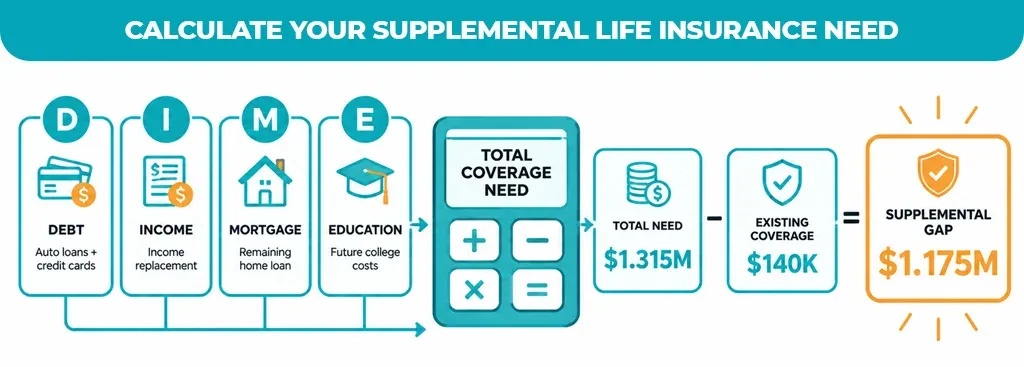
The most reliable way to size a supplemental policy is to calculate your household’s actual financial obligations using the DIME method, then subtract the coverage you already have. A simpler income-multiple approach can serve as a sanity check, but it does not account for a mortgage balance, existing debt, or future education costs the way DIME does.
The DIME Method
DIME stands for Debt, Income, Mortgage, and Education, and it adds up four categories of financial obligation to arrive at a total coverage target:
- Debt: Total non-mortgage debt, including auto loans, credit cards, and any personal or student loans that would not be forgiven at death.
- Income: Annual income multiplied by the number of years dependents would need financial support, commonly estimated at 10 to 15 times income, or 7 to 10 years of replacement income under the simpler multiple-of-income approach.
- Mortgage: The remaining balance on the home loan, so a death does not force a sale or refinance under distress.
- Education: Estimated future tuition and related costs for any children, based on the number of children and how many years until college.
A Simplified DIME Example
| DIME Component | Example Inputs | Amount |
| Debt | Auto loan + credit cards | $25,000 |
| Income | $70,000 income × 12 years | $840,000 |
| Mortgage | Remaining balance | $310,000 |
| Education | Two children, college fund estimate | $140,000 |
| Total DIME need | Sum of all four categories | $1,315,000 |
| Less existing coverage | Employer group policy (2x salary) | −$140,000 |
| Supplemental coverage gap | Amount still needed | $1,175,000 |
Is Supplemental Life Insurance Worth It?
Supplemental life insurance is generally worth it for people who have dependents, carry meaningful debt, or whose employer’s basic policy would leave a significant coverage shortfall, and it is often skippable for people who already have adequate individual coverage or minimal financial obligations. The right answer depends on weighing the coverage gap identified through DIME against the cost and portability trade-offs described below.
Pros
- Group supplemental rates through an employer are often cheaper than fully underwritten individual coverage, particularly during open enrollment windows that allow guaranteed acceptance up to a set amount.
- It closes a documented and common coverage gap: LIMRA’s research indicates a meaningful share of U.S. adults remain underinsured relative to their own stated needs.
- Riders such as AD&D or child life insurance address specific risks cheaply, without requiring a full separate policy.
- For many people, cost is lower than assumed. LIMRA’s 2026 research found that adults age 30 and younger overestimated the cost of a term life policy by 10 to 12 times the actual price, a gap that itself keeps people from buying coverage they can afford.
Cons
- Employer-sponsored supplemental coverage is typically not portable, so it generally ends when you leave the job, are laid off, or retire, at exactly the point some people most want to keep it.
- Group supplemental premiums are usually age-banded and increase every few years as you move into a new age bracket, unlike a level-premium individual term policy that locks in one rate for the full term.
- Buying supplemental coverage later, or after leaving a job that offered it, generally requires new medical underwriting, which can be costly or restrictive if health has changed.
- For a healthy applicant, an individually underwritten term policy can sometimes cost less per dollar of coverage than an employer’s voluntary supplemental option, particularly at younger ages, since individual pricing reflects the applicant’s own health rather than a pooled group rate.
What Actual Coverage Costs
Cost is one of the biggest factors in this decision, and current pricing is more affordable than many people assume. According to 2026 rate data from MoneyGeek’s analysis of quotes across roughly 30 major insurers, a healthy 40-year-old nonsmoker pays an average of $47 a month for women and $59 a month for men for a 20-year, $500,000 term policy, with most applicants paying between $30 and $100 a month depending on age, health, and coverage amount. That same analysis found that smokers pay two to four times more than nonsmokers for identical coverage, and that rates rise more steeply after age 40 than in earlier decades.
A Simple Decision Framework
| Supplemental Coverage Is Usually Worth Considering When… | Supplemental Coverage May Be Skippable When… |
| You carry a mortgage or significant non-mortgage debt | You have no dependents and minimal debt |
| You have young children or a spouse who depends on your income | Your existing individual term policy already covers your full DIME-calculated gap |
| Your only coverage is an employer’s flat $50,000 or 1x-salary policy | You have substantial liquid savings or investments earmarked for dependents |
| Group rates during open enrollment are cheaper than individual quotes for your health profile | You are near retirement with no dependents relying on income replacement |
Conclusion and Next Steps
A basic employer-provided life insurance policy is a reasonable starting point, but for most people with a mortgage, dependents, or meaningful debt, it is not a complete safety net on its own. Supplemental life insurance, whether added through a workplace voluntary benefits program or purchased independently, is designed specifically to close that gap.
Before your next open enrollment period, take three concrete steps: review your current employer benefits statement to see exactly how much basic and optional coverage you already have, run your own numbers through the DIME method to calculate your household’s actual coverage gap, and request quotes from a licensed independent agent or a direct carrier so you can compare group supplemental rates against individual term life pricing for your age and health profile. Verify any insurer’s financial strength rating through AM Best and confirm state licensing through the NAIC before finalizing a policy.