

Life insurance can cost less than a streaming subscription or more than a car payment. It all depends on your age, health, the type of policy, and how much coverage you buy.
Quick answer: Term life is the cheapest: a healthy 30-year-old pays about 11–12 a month for $100,000 of 20-year coverage, or 23–29 for $1 million, at preferred rates. Whole life costs much more: about 78–89 a month for $100,000 at age 30. Seniors buying $10,000 of final expense coverage pay roughly 33–43 a month at 60 and 98–135 at 80.
Average cost of life insurance per month
The average cost of life insurance per month depends mainly on the policy type, your age, and your health. Term life for a healthy adult under 40 often costs under $50 a month even for large coverage amounts. Whole life costs several times more for the same death benefit because it lasts for life and builds cash value.
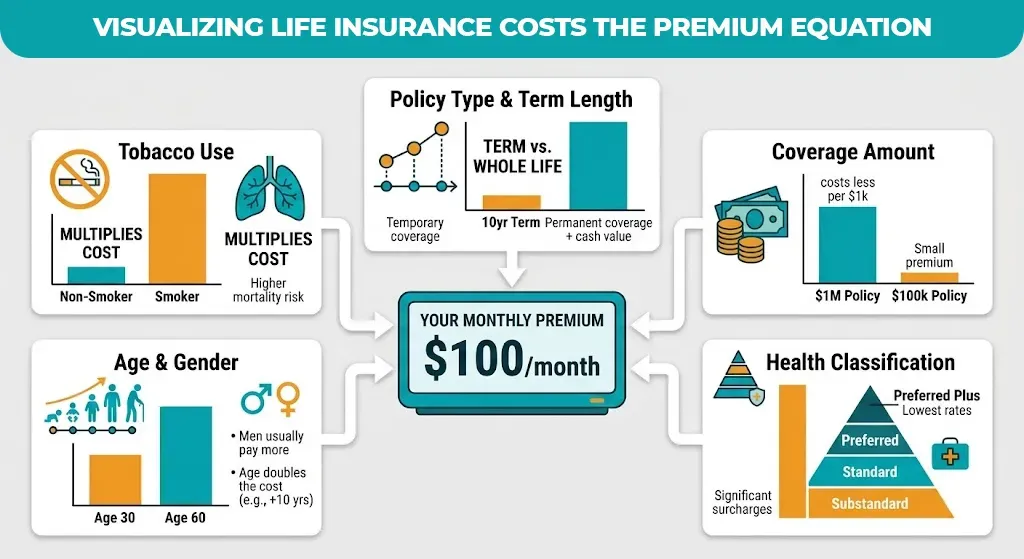
The cost equation
Monthly premium ≈ f(Coverage amount, Policy type and term length,
Age and gender, Health class, Tobacco use)
More coverage costs more in total, though larger policies cost less per $1,000; adding 10 years of age can more than double the price; and smoking can multiply it several times.
2026 benchmark averages at a glance
| Policy | Age 30 | Age 50 | Age 65 |
| $100,000, 20-year term (preferred) | 11–12 | 25–31 | 99–125 |
| $500,000, 20-year term (average health) | 31–38 | 102–137 | Not shown |
| $1,000,000, 20-year term (preferred) | 23–29 | 95–128 | 492–730 |
| $100,000 whole life (preferred) | 78–89 | 168–192 | 365–413 |
Ranges show women (lower) to men (higher). Preferred rates: Choice Mutual (valid March 9, 2026). Average-health rates: MoneyGeek (October 2026).
Note: “Preferred” rates are for healthy non-smokers who qualify for a top health class. Average-health rates are higher. Your actual quote depends on underwriting.
See Premier Services Agency’s guide to how much life insurance costs.
How much is term life insurance per month?
Term life insurance is the cheapest way to buy a large death benefit because it covers you only for a set number of years and builds no cash value. At preferred rates, a healthy 35-year-old pays about $12 a month for $100,000 of 20-year coverage and about 28–32 for $1 million.
How much is a $100,000 life insurance policy per month?
| Age | 20-year term, women | 20-year term, men | 30-year term, women | 30-year term, men |
| 25 | $11 | $12 | $13 | $15 |
| 35 | $12 | $12 | $15 | $17 |
| 45 | $19 | $21 | $24 | $30 |
| 55 | $34 | $45 | $61 | $92 |
| 65 | $99 | $125 | Not available | Not available |
Choice Mutual, preferred non-tobacco, valid March 9, 2026.
How much is a $1,000,000 life insurance policy a month?
| Age | 10-year, women | 10-year, men | 20-year, women | 20-year, men | 30-year, women | 30-year, men |
| 25 | $15 | $18 | $22 | $29 | $34 | $46 |
| 35 | $16 | $19 | $28 | $32 | $50 | $62 |
| 45 | $37 | $45 | $65 | $84 | $112 | $144 |
| 55 | $90 | $121 | $157 | $215 | $316 | $447 |
Choice Mutual, preferred non-tobacco, valid March 9, 2026.
For applicants in average health, prices are noticeably higher. MoneyGeek’s October 2026 averages for a $1 million, 20-year policy are 54–67 a month at 30, 86–109 at 40, 194–262 at 50, and 545–771 at 60. A $500,000, 20-year policy in average health averages 31–38 a month at 30.
Note: The gap between preferred and average-health rates shows why your health class matters so much. Comparing several insurers helps you find the one that rates your health most favorably.
See Premier Services Agency’s term life insurance rates and 30-year term life insurance guides.
How much is whole life insurance per month?
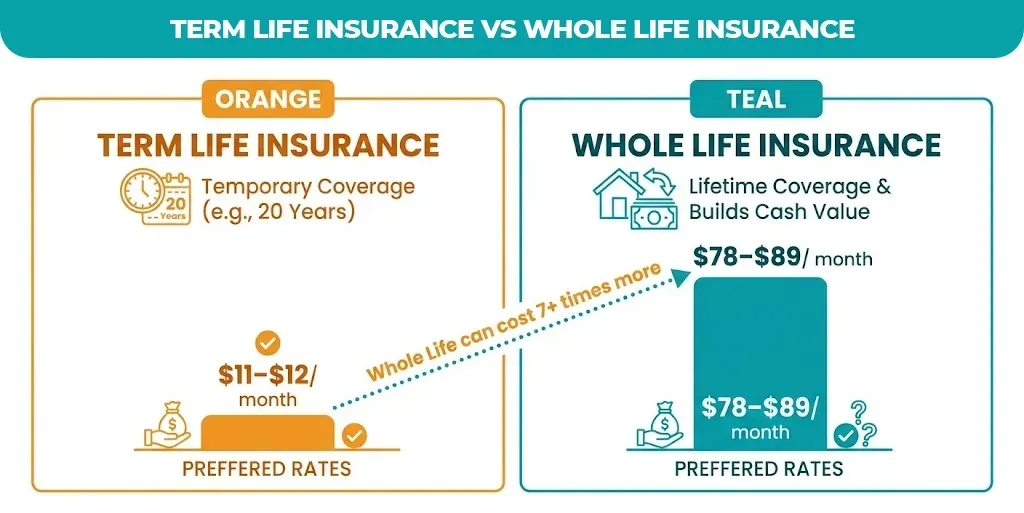
Whole life insurance costs far more than term because it covers you for life, keeps the premium fixed, and builds cash value. At age 30, 100,000ofwholelifecostsaboutseventimesasmuchas20-yeartermatpreferredrates(78–$89 vs. 11–12 a month). Seniors often buy smaller whole life policies of 10,000–25,000 to cover final expenses.
How much is a whole life insurance policy per month for $100,000?
| Age | Women | Men |
| 25 | $66 | $75 |
| 30 | $78 | $89 |
| 40 | $110 | $126 |
| 50 | $168 | $192 |
| 60 | $283 | $318 |
| 70 | $506 | $566 |
Choice Mutual, preferred non-tobacco, valid March 9, 2026. MoneyGeek’s 2026 averages for average health are higher, for example 98–103 at 30 and 555–615 at 70.
How much is $10,000 life insurance a month?
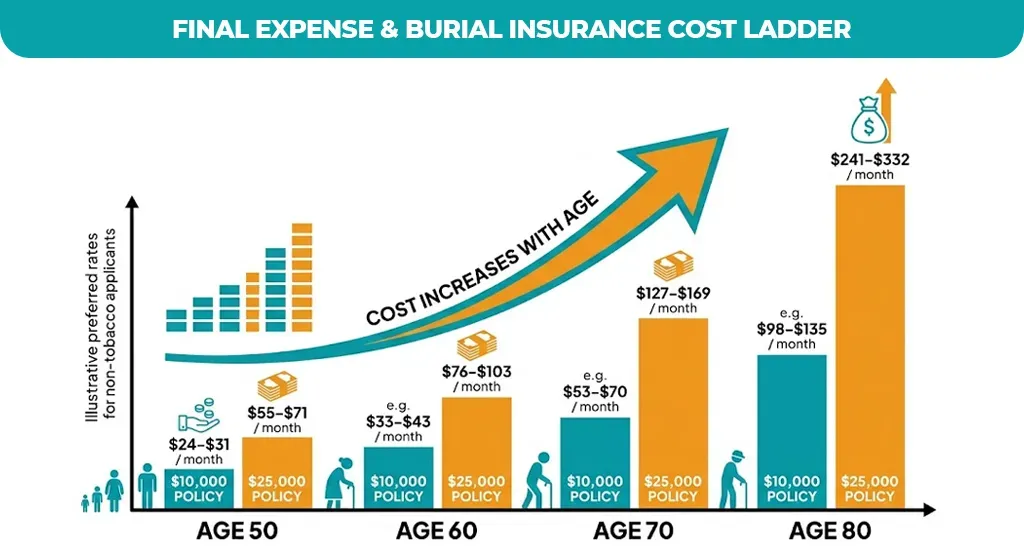
Small whole life policies for funeral and final expenses (burial insurance) are sold mostly to people 50 and older, with simplified health questions and no medical exam.
| Age | $10,000, women | $10,000, men | $25,000, women | $25,000, men |
| 50 | $24 | $31 | $55 | $71 |
| 60 | $33 | $43 | $76 | $103 |
| 70 | $53 | $70 | $127 | $169 |
| 80 | $98 | $135 | $241 | $332 |
Choice Mutual level-benefit final expense sample rates for non-tobacco applicants, valid March 9, 2026.
Permanent life insurance also includes universal and indexed universal life, which can cost less than whole life for the same death benefit but have more flexible, less guaranteed structures. See Premier Services Agency’s whole life insurance rates by age chart and affordable whole life insurance.
Specialized policies: VA, joint, senior, and mortgage life insurance
Veterans have two main VA options: VALife, a guaranteed-acceptance whole life policy up to $40,000, and VGLI, term coverage up to $500,000 with age-banded rates. Joint policies cover two people under one contract, senior policies are usually small whole life, and mortgage protection is typically term coverage sized to your loan.
How much is VA life insurance per month?
VALife (Veterans Affairs Life Insurance) is whole life coverage of up to $40,000, in $10,000 increments, for veterans with a VA service-connected disability rating (even 0%) who are 80 or younger. Acceptance is guaranteed, premiums never increase, and full coverage starts after a two-year waiting period. If you die during that period, beneficiaries get premiums paid plus interest (4.23% for deaths in 2026).
| Age at application | VALife monthly premium per $10,000 |
| 30 | $15.40 |
| 40 | $22.00 |
| 60 | $50.00 |
| 80 | $127.50 |
VGLI (Veterans’ Group Life Insurance) lets separating service members convert SGLI coverage to renewable term, from $10,000 to $500,000. You must apply within 1 year and 120 days of leaving the military; applying within 240 days means no health review. Rates rise every five years with age.
| Age band | VGLI monthly premium for $500,000 | Per $10,000 |
| 29 and younger | $30 | $0.60 |
| 35–39 | $50 | $1.00 |
| 45–49 | $95 | $1.90 |
| 55–59 | $250 | $5.00 |
| 65–69 | $690 | $13.80 |
| 75–79 | $1,925 | $38.50 |
Rates from VA.gov (VGLI rates as of July 1, 2025).
How much is joint life insurance per month?
Joint life insurance covers two people, usually spouses, under one policy:
• First-to-die: Pays when the first spouse dies, then the coverage ends. It’s typically cheaper than two separate policies, but the survivor is left without coverage.
• Second-to-die (survivorship): Pays only after both spouses have died. Because the payout is delayed, it usually costs less than insuring either spouse alone, and it’s often used for estate planning.
Joint policies are less common and harder to compare than individual policies, so get quotes for both joint and two separate policies. See Premier Services Agency’s joint life insurance guide.
How much is senior life insurance per month?
For people 60 and older, options include short-term coverage (10- or 15-year term), small final expense whole life, and guaranteed issue policies for those with serious health conditions. A $10,000 final expense policy runs about 33–43 a month at 60, 53–70 at 70, and 98–135 at 80 for healthy non-smokers. See best life insurance for seniors and life insurance for seniors over 80.
How much is mortgage life insurance per month?
Mortgage protection is usually term coverage matched to your loan:
| Option | How it works | Cost |
| Level term | Same death benefit for the whole term; your family can pay off the mortgage and keep the rest | Standard term rates |
| Decreasing term | Death benefit shrinks as the mortgage balance falls | Usually a bit cheaper than level term |
| Lender mortgage protection insurance | Often pays the lender directly | Can cost more; compare with individual term |
For a $300,000 mortgage, a 30-year level term policy is often the most flexible choice. See level term life insurance.
What drives your monthly premium
Age, gender, health class, and tobacco use set most of your price. Insurers place you in a risk class after reviewing your application, medical records, prescription history, and sometimes a medical exam. The difference between the best and worst classes can be large.
Age and gender
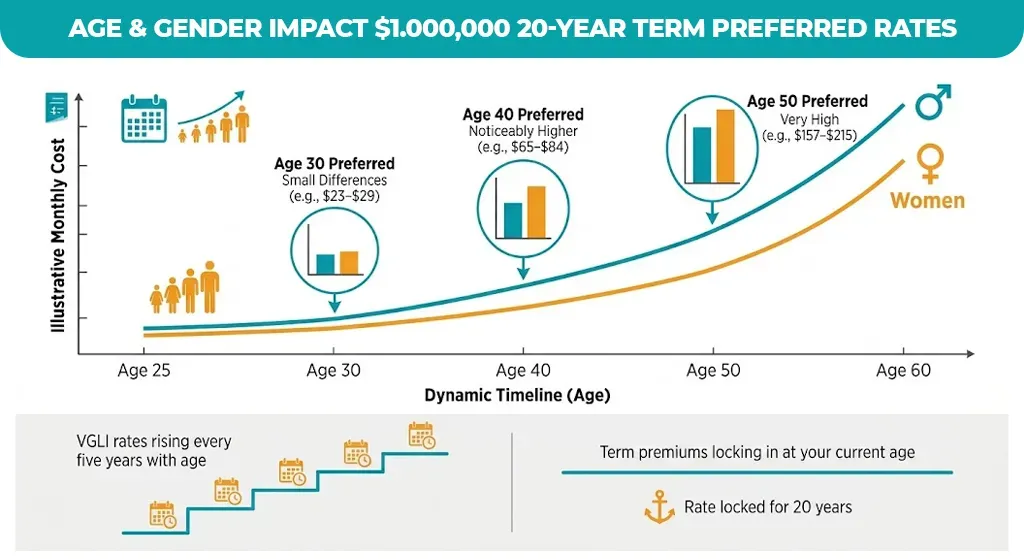
Premiums rise with age because the risk of death rises each year. For $1 million over a 20-year term at preferred rates, a 35-year-old man pays about $32 a month, a 45-year-old $84, and a 55-year-old $215. Women pay less at every age because they live longer on average.
Health classification
| Health class | Who typically qualifies | Price impact |
| Preferred Plus | Excellent health, ideal weight, great family history | Lowest rates |
| Preferred | Very good health, minor issues | Slightly higher |
| Standard Plus / Standard | Average health; some conditions or higher weight | Moderately higher |
| Substandard (table ratings) | Significant health conditions | Surcharges on top of standard rates |
Compare the preferred and average-health tables above: a $1 million, 20-year policy at 30 costs a man about $29 a month at preferred rates versus $67 on average.
Tobacco use, lifestyle, and medical history
• Tobacco and nicotine: Smokers often pay several times non-smoker rates.
• Medical history: Heart disease, diabetes, cancer history, and high blood pressure can raise rates or lead to decline.
• Lifestyle: Dangerous hobbies, risky jobs, or a poor driving record can add costs.
How to lower your monthly premium
1. Buy younger: Premiums lock in at your current age.
2. Choose a term for temporary needs and keep a whole life for permanent needs.
3. Match the term length to your actual need; a 20-year term costs less than a 30-year term.
4. Quit tobacco and ask about re-rating after a set smoke-free period.
5. Ladder policies, such as a large 20-year and a smaller 30-year policy, so coverage steps down.
6. Pay annually if the insurer offers a discount.
7. Compare multiple insurers, since each rates health conditions differently.
What happens after 10 years of paying life insurance?
It depends on the policy. A 10-year term policy reaches the end of its level period, so you can let it end, renew at much higher yearly rates, or convert it to permanent coverage. A 20- or 30-year term simply continues at the same price. A whole life policy keeps going for life and, after 10 years, has built some cash value.
Term expiration and renewal rate increases
When a term policy’s level period ends, it typically becomes an annually renewable term with premiums that rise every year based on your age, according to State Farm. For most people, renewal premiums quickly become too expensive to keep.
Converting term to permanent coverage
Many term policies let you convert to whole life before a deadline, without a new medical exam. This matters if your health has changed and you still need coverage. The new premium is based on your age at conversion.
Whole life after 10 years
• Cash value: Has grown but may still be less than total premiums paid, since early costs are recovered first.
• Policy loans: You can borrow against the cash value.
• Reduced paid-up option: You can stop paying premiums and keep a smaller, fully paid-up death benefit.
• Surrender: You can cancel for the cash value, though early surrender often returns less than you paid, and gains above premiums are taxable.
Note: Before letting any policy lapse, check conversion deadlines and paid-up options. Coverage you give up may be expensive or impossible to replace later.
See Premier Services Agency’s 10-year term life insurance guide.
Conclusion:
Life insurance can cost as little as 11–12 a month for $100,000 of term coverage at 30, or several hundred dollars a month for large whole life policies later in life. The biggest savings come from buying while you’re young and healthy, choosing the right policy type, and comparing insurers.
| Your situation | Typical monthly cost range |
| Healthy 30-year-old, $500k 20-year term | About 31–38 (average health) |
| Healthy 35-year-old, $1M 20-year term | About 28–32 (preferred) |
| 40-year-old, $100k whole life | About 110–126 (preferred) |
| 60-year-old, $10k final expense | About 33–43 |
| 80-year-old, $10k final expense | About 98–135 |
| Veteran with a VA disability rating, age 60, $10k VALife | $50 |
Compare monthly life insurance quotes at Premier Services Agency
Premier Services Agency helps individuals, families, and seniors across the United States compare term, whole life, joint, and final expense policies, so you can find coverage that fits your monthly budget. Premier Services Agency life specialists can help you estimate how much coverage you need and compare quotes from several carriers.
Get custom life insurance quotes on Premier Services Agency or call (470) 650-0470.