


Term vs. Permanent Life Insurance: Choosing the Right Budget-Friendly Policy
The two broad categories of life insurance are term and permanent, and the difference between them explains most of the price gap consumers run into when shopping for coverage.
Term Life Insurance
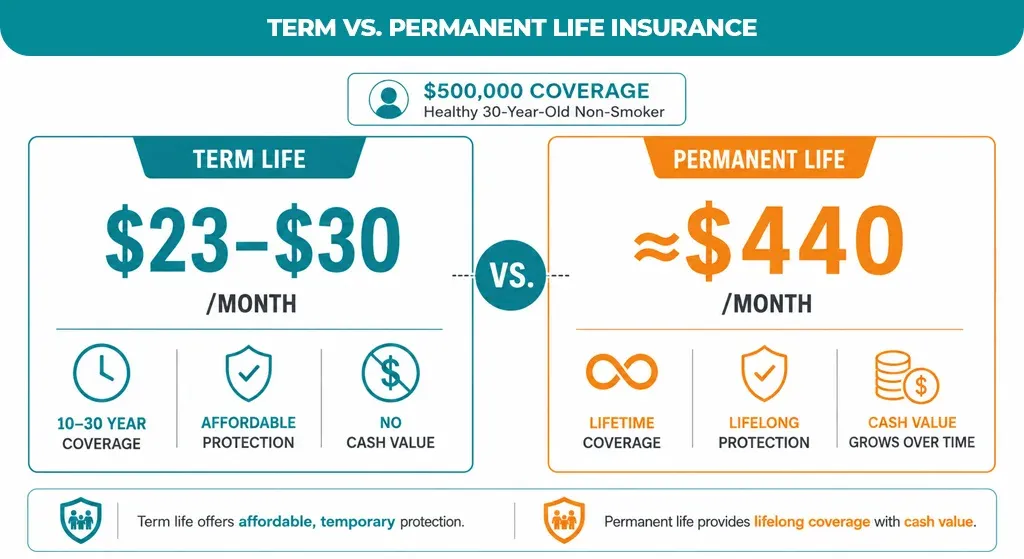
Term life insurance covers you for a defined period, commonly 10, 20, or 30 years, and pays a death benefit only if you die within that term. Because coverage is temporary and insurers don’t need to fund a lifetime guarantee or a cash value account, premiums are significantly lower than permanent policies with the same face value. This makes term the more affordable choice for most families working with a fixed budget, particularly during the years when a mortgage, young children, or other major financial obligations create the greatest need for protection.
Permanent Life Insurance (Whole Life and Universal Life)
Permanent policies, including whole life and universal life insurance, provide coverage for your entire lifetime as long as premiums are paid, and a portion of each premium builds cash value that grows on a tax-deferred basis. That lifetime guarantee and savings component come at a materially higher monthly cost than term coverage of the same size.
The table below illustrates the price gap using published 2025 rate data for a $500,000 policy on a healthy, non-smoking 30-year-old, sourced from Guardian’s life insurance cost tables:
| Policy Type | Coverage Amount | Applicant Profile | Average Monthly Cost |
| 20-year term life | $500,000 | Healthy 30-year-old male, non-smoker | ≈ $30 / month |
| 20-year term life | $500,000 | Healthy 30-year-old female, non-smoker | ≈ $23 / month |
| Whole life (permanent) | $500,000 | Healthy 30-year-old, non-smoker | ≈ $440 / month |
Choosing between term and permanent coverage generally comes down to your financial goals. If your priority is replacing income or covering debt during a defined window, such as until a mortgage is paid off or children are financially independent, term life insurance usually delivers the most coverage per dollar. If you’re planning around a lifelong need, such as estate liquidity, funding a special-needs dependent, or leaving a guaranteed legacy, permanent coverage may justify the higher premium even on a tighter budget.
The Pros and Cons of Affordable Life Insurance Policies
Pros
- Financial peace of mind: A policy protects dependents from the financial shock of losing a primary earner’s income or household contributions.
- Locked-in low rates: Purchasing while young and healthy secures a lower premium that, for level term policies, stays fixed for the length of the term.
- Tax-free death benefit: Beneficiaries generally receive the payout free of federal income tax.
- Flexible coverage lengths: Term lengths can be matched to specific financial milestones, such as the years remaining on a mortgage or until children are grown.
Cons
- Term policies expire: If you outlive the term, coverage ends with no payout unless you renew (usually at a much higher rate) or convert to a permanent policy.
- Underwriting can raise costs: Pre-existing conditions uncovered during underwriting can move an applicant into a higher-priced rate class than initially quoted.
- Simplified and guaranteed issue trade-offs: Policies with minimal or no medical exam are easier and faster to obtain, but they often carry higher premiums, lower coverage limits, or a graded death benefit that pays reduced amounts if death occurs in the first two to three years.
- Weighing these trade-offs against your health profile, budget, and how long you actually need coverage is the most reliable way to land on a policy that’s affordable without leaving gaps in protection.
Top Strategies to Lower Your Life Insurance Premiums
Buy Early
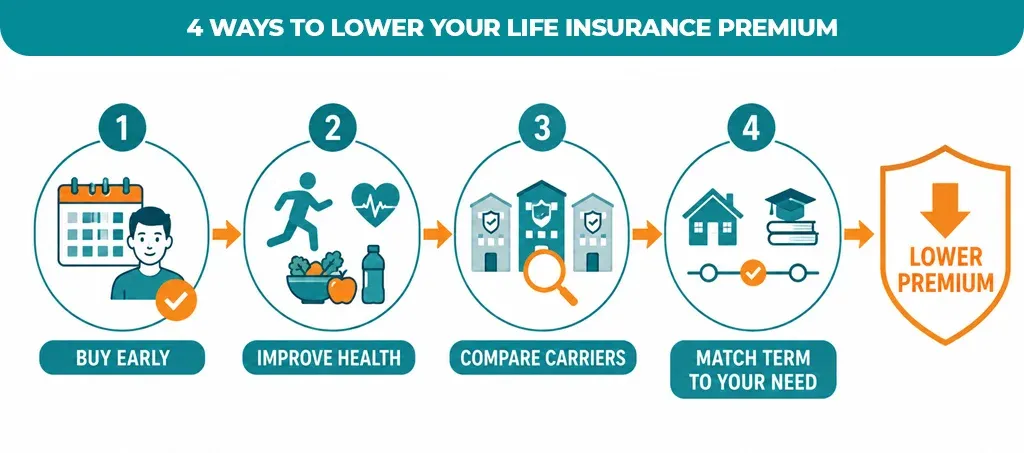
Age is the single biggest lever you control. According to the Insurance Information Institute, premiums can increase by roughly 8% to 10% for every year you delay purchasing coverage after your 30s, since insurers price policies based on mortality risk, which climbs with age. Locking in a level term policy earlier means paying less for the same coverage over the life of the policy.
Improve Your Health Metrics
Underwriting rewards measurable health improvements. Quitting smoking, managing blood pressure, and maintaining a healthy body mass index can move you into a more favorable rate class at your next application or policy renewal, which directly lowers your premium.
Shop Around and Compare Carriers
Because pricing varies by carrier even for applicants with identical health profiles, comparing quotes from multiple top-rated insurers, rather than accepting the first offer, is one of the most effective ways to find the lowest available premium for your risk profile. Checking a carrier’s AM Best financial-strength rating alongside its price helps confirm you’re comparing insurers that are equally likely to be able to pay a future claim.
Match the Term Length to Your Actual Need
Choosing a term length that lines up precisely with your financial obligations, such as the remaining years on a mortgage or until your youngest child finishes school, prevents you from paying for years of coverage you don’t need. A 30-year term costs more per month than a 20-year term for the same coverage amount, so matching duration to purpose keeps the premium as low as possible.
Common Myths and Misconceptions About Cheap Life Insurance
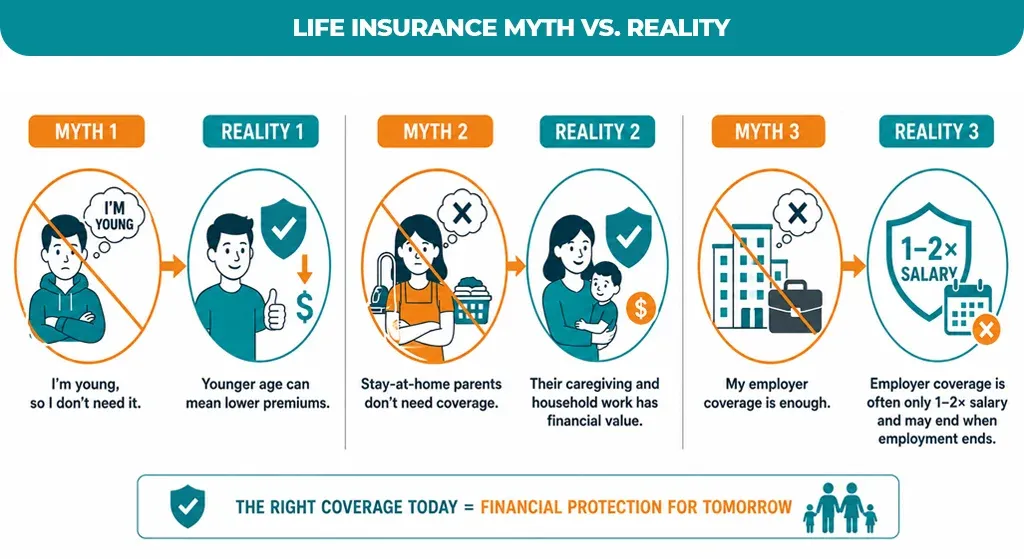
Myth 1: I’m young and healthy, so I don’t need life insurance.
Youth and good health are exactly what make coverage cheapest to lock in. Waiting doesn’t remove the need for coverage later in life; it simply means paying a higher premium once age and potential health changes catch up, as reflected in the Insurance Information Institute’s 8% to 10% per-year cost increase noted above.
Myth 2: Stay-at-home parents don’t need coverage.
A stay-at-home parent’s labor has real, measurable economic value. According to the U.S. Bureau of Labor Statistics’ American Time Use Survey, adults living in households with children under age 6 spent an average of 2.5 hours per day providing primary childcare in 2024, and non-employed parents of young children spent noticeably more time on caregiving than employed parents. If a stay-at-home parent died unexpectedly, the surviving parent would likely need to pay for childcare, housekeeping, and other services that parent provided, which is a real financial gap that life insurance can help cover.
Myth 3: My employer’s group life insurance is enough.
Employer-sponsored group life insurance is a valuable benefit, but it’s rarely sufficient on its own. According to Guardian’s 2026 Employer Guide to Life Insurance, 95% of employers only offer coverage equal to one to two times an employee’s salary, which typically falls short of what a family would need to replace income long term. Group coverage is also generally tied to your job: it usually ends when you leave the company, are laid off, or retire, leaving a gap right when you may be transitioning to new health underwriting at an older age.
Secure Your Family’s Financial Future
Affordable life insurance isn’t a myth or a marketing line; it’s a well-documented mismatch between what coverage actually costs and what most people assume it costs. Term life insurance remains the most budget-friendly way to protect a family’s income, debts, and future plans, while permanent policies serve a narrower, lifelong purpose at a higher price point. Buying early, maintaining your health, matching your term length to your actual needs, and comparing quotes across carriers are the most reliable ways to keep your premium low without sacrificing the coverage your family depends on.
Because rates and underwriting guidelines vary from one insurance company to the next, working with an independent agency like Premier Services Agency gives you access to quotes from multiple carriers instead of a single company’s pricing, along with personalized guidance to match a policy type and term length to your actual budget and goals.