


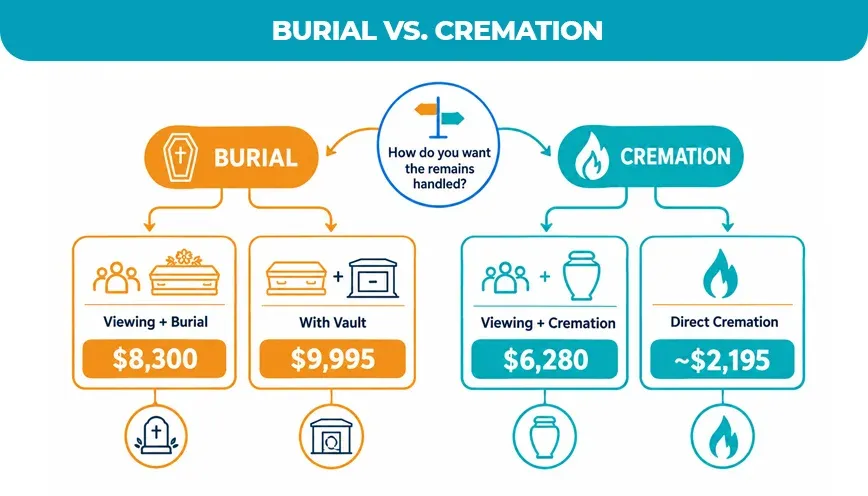
Quick Answer: A funeral with viewing and burial has a median cost of $8,300, rising to $9,995 with a burial vault, according to the National Funeral Directors Association’s 2026 General Price List Study. A funeral with viewing and cremation has a median cost of $6,280. Direct cremation, the least expensive option, averages around $2,195.
Key Takeaways
- The median U.S. funeral with viewing and burial costs $8,300; with a vault added, the median rises to $9,995.
- The median funeral with viewing and cremation costs $6,280.
- Cemetery costs for the grave space, opening and closing fee, vault, and headstone are billed separately from the funeral home and are not included in the figures above.
- Funeral costs vary by state and region. Northeastern states such as New York, New Jersey, and Massachusetts tend to run above the national median; Southern and Mountain West states tend to run below it.
- Over 60% of Americans are now choosing cremation over burial, largely because it costs less.
- Direct cremation, with no viewing or ceremony, is the lowest-cost legal disposition option and averages around $2,195.
What a Funeral Costs, and What Drives the Price
The cost of a funeral in the United States depends primarily on one decision: burial or cremation. According to the National Funeral Directors Association’s (NFDA) 2026 General Price List Study, the median cost of a funeral with viewing and burial is $8,300, and that figure climbs to $9,995 once a burial vault is included. A funeral with viewing and cremation carries a lower median cost of $6,280. Neither figure includes cemetery property, a headstone, or a monument, which are purchased separately from the cemetery rather than the funeral home.
These national medians are a useful starting point, but the number a family actually pays depends on the state, the funeral home, and the specific services and merchandise chosen. This guide breaks down the national averages, state-level differences, the cost of a funeral in Mexico, the specific line items that make up a funeral bill, and the realistic ways to lower the total cost.
National Average Funeral Cost Breakdown
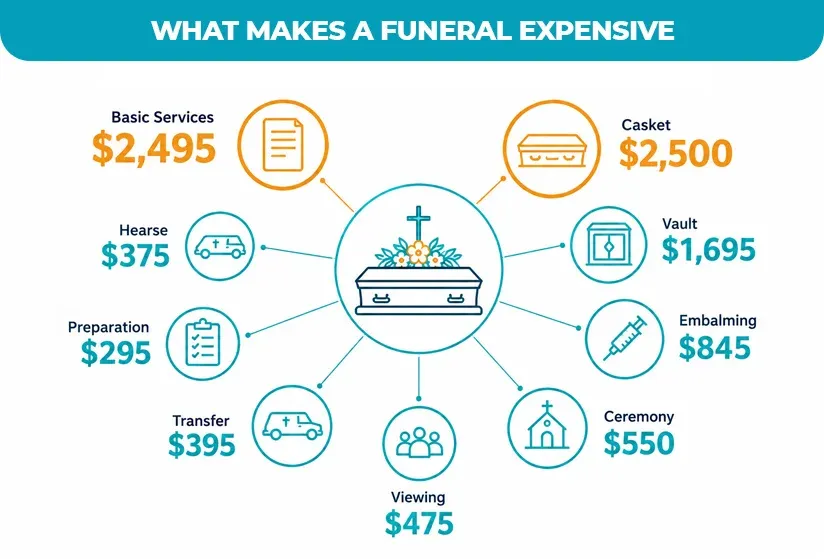
The NFDA has tracked funeral pricing since the 1960s by adding up the median cost of each line item that goes into a funeral with viewing and burial. Funeral homes are required to disclose these itemized prices on a General Price List (GPL) under the Federal Trade Commission’s Funeral Rule (16 CFR Part 453), so families can compare costs before agreeing to services.
| Line item | Median cost |
| Basic services fee (funeral director and staff, non-declinable) | ~$2,495 |
| Removal/transfer of remains to the funeral home | $395 |
| Embalming | $845 |
| Other preparation of the body (cosmetology, dressing) | $295 |
| Use of facilities/staff for viewing | $475 |
| Use of facilities/staff for the funeral ceremony | $550 |
| Hearse | $375 |
| Service car/van | $175 |
| Basic memorial printed package | $195 |
| Metal casket | $2,500 |
| Vault | $1,695 |
| Total with viewing, burial, and vault | $9,995 |
Two items on this list cannot be removed from a traditional funeral home bill: the basic services fee and, if a family chooses a cemetery burial that requires one, the vault. The casket is typically the single largest optional purchase, and NFDA data shows metal caskets can range from a few hundred dollars for a minimal model to well over $10,000 for a premium hardwood or bronze casket.
Funeral Cost by Type: Burial vs. Cremation vs. Direct Disposition
Choosing between burial and cremation is the single biggest factor in the total cost. Within each category, the presence or absence of a viewing and ceremony changes the price further.
| Funeral type | What’s included | Median/average cost |
| Traditional funeral with burial and vault | Viewing, ceremony, embalming, casket, vault | $9,995 |
| Traditional funeral with burial, no vault | Viewing, ceremony, embalming, casket | $8,300 |
| Funeral with cremation and viewing | Viewing, ceremony, embalming, cremation casket, urn | $6,280 |
| Direct cremation | No viewing or ceremony; body is cremated shortly after death | ~$2,195 |
| Direct burial | No viewing or ceremony; body is buried shortly after death | ~$5,138 (direct funeral median) |
Direct cremation and direct burial cost less because they eliminate embalming, the use of funeral home facilities for a viewing, and a full-price casket in favor of a minimal or alternative container. Families who want a memorial service can still hold one later, separate from the funeral home, at a lower cost than a funeral-home-hosted ceremony.
How Much Does a Funeral Cost by State?
Funeral costs are not uniform across the country. The NFDA’s General Price List Study data, independently compiled and republished by Dignity Memorial and other industry sources, shows the following median costs for a funeral with viewing and burial versus viewing and cremation in several frequently searched states.
| State | Funeral with burial (median) | Funeral with cremation (median) |
| Texas | $7,912 | $5,890 |
| Florida | $8,023 | $6,103 |
| Illinois | $8,280 | $6,120 |
| Kentucky | $7,615 | $5,858 |
| New Jersey | $8,573 | $6,498 |
| New York | $8,573 | $6,498 |
| California | $7,835 | $5,812 |
| Massachusetts | $8,985 | $7,023 |
- Northeastern states cost more. New Jersey, New York, and Massachusetts all sit above the $8,300 national median for burial, largely reflecting higher real estate, labor, and cemetery costs in the region.
- Southern and Mountain West states cost less. Kentucky and Texas both fall below the national median.
- Cremation is cheaper everywhere, but the gap varies by state. In Massachusetts, the burial-to-cremation gap is about $1,962. In Texas, it is about $2,022.
For large metro areas within a state, such as Houston, Dallas, or San Antonio in Texas, local reporting has found actual prices near or slightly below the statewide average; a KENS 5 (San Antonio) investigation citing Funeralocity found average local funeral costs around $7,600, close to the statewide NFDA figure of $7,912. Because the FTC Funeral Rule requires every funeral home to hand out an itemized General Price List on request.
How Much Does a Funeral Cost in Mexico?
Funeral pricing in Mexico works differently than in the United States: there is no single national median comparable to the NFDA study, and prices are set in Mexican pesos, varying widely by city and by what a family chooses to include. Mexico’s consumer protection agency, Profeco (Procuraduría Federal del Consumidor), monitors funeral home pricing nationally and has found packages covering a coffin, chapel use, transport, and related services ranging from roughly 4,041 pesos in Oaxaca to 42,250 pesos in Tijuana.
City-level examples reported from Profeco monitoring and local funeral homes include:
- Mexico City metro area: basic packages starting around 6,335 pesos, with more complete packages reaching up to 74,711 pesos.
- Cancún: a basic package with coffin, vigil, and transfer averaging around 23,000 pesos, not including the cost of a grave.
- Mérida, Yucatán: packages ranging from roughly 20,000 to 55,000 pesos depending on inclusions.
- Campeche: packages ranging from about 7,000 pesos for a basic wooden coffin and hearse service up to 38,500 pesos for a mid-range package.
Separately, Statista-published market data from 2020 estimated the average cost of cremation-related services at roughly 3,800 to 8,400 pesos and the average cost of burial-related services at roughly 40,000 pesos, with the coffin and gravestone as the largest individual line items in a burial. These figures are dated to 2020 and should be treated as a historical reference point rather than a current price, since funeral costs in Mexico, like in the U.S., have risen with inflation since then.
What Makes a Funeral Cost More or Less
Several factors move the final bill up or down, independent of state:
- Burial vs. cremation. This is the single largest cost driver, as shown in the comparison table above.
- Casket or urn selection. A minimal cremation container can cost under $100, while a premium hardwood or metal casket can exceed $10,000.
- Embalming. Embalming is not required by law in most circumstances; the FTC Funeral Rule requires funeral homes to disclose this and prohibits charging for embalming without permission unless it is legally required or requested. Skipping embalming (common with direct cremation or a quick burial) removes an $845 median line item.
- Cemetery costs. Grave space, the opening and closing fee, a vault or grave liner (often required by the cemetery, not by law), and a headstone are billed by the cemetery, separately from the funeral home, and are not part of the NFDA funeral-home medians above.
- Viewing and ceremony. Renting funeral home facilities and staff for a viewing and a separate ceremony adds over $1,000 in median fees compared with a direct disposition.
- Add-ons. Flowers, printed programs, obituary notices, catering, and transportation for guests are optional and can add several hundred to several thousand dollars depending on scope.
- Location and competition. Urban areas with higher real estate and labor costs, and regions with fewer competing funeral homes, tend to have higher prices.
How to Lower Funeral Costs
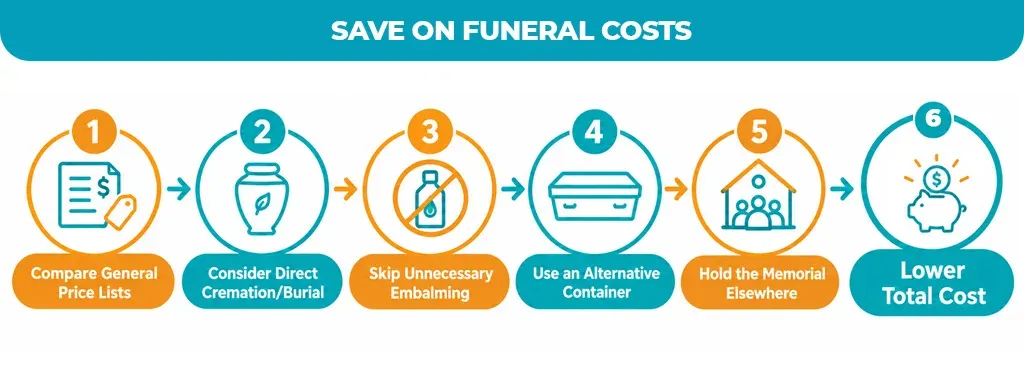
Request an itemized General Price List (GPL) from multiple funeral homes. Funeral homes are legally required to provide this over the phone or in person, and you are entitled to buy only the goods and services you want.
Choose direct cremation or direct burial. Removing embalming, a viewing, and a full-price casket cuts the cost roughly in half compared with a traditional funeral with viewing, based on the medians above.
Use an alternative container instead of a casket for cremation. Funeral homes are required to offer this option and cannot refuse to provide cremation using an alternative container.
Hold the memorial service somewhere other than the funeral home, such as a place of worship, community hall, or private residence, to avoid facility-use fees.
Compare cemetery costs separately from funeral home costs. Grave space, vaults, and monuments can often be purchased at a lower price from a different cemetery than the one a funeral home suggests. Check nonprofit and consumer resources. The Funeral Consumers Alliance (FCA), a nonprofit consumer advocacy organization, publishes funeral planning checklists and, in many areas, maintains lists of member funeral homes offering discounted pricing.
How Families Pay for a Funeral
Final expense (burial) insurance. A type of whole life insurance sold specifically to cover end-of-life costs, typically with a smaller death benefit than standard life insurance.
Pre-need funeral contracts. An agreement made directly with a funeral home to lock in services and pricing in advance; consumer advocates recommend confirming whether the funds are held in a trust or insurance policy that is protected if the funeral home closes.
Existing life insurance policies. A standard life insurance death benefit can be used for any purpose, including funeral costs. The Social Security lump-sum death benefit. A one-time payment of $255 may be available to an eligible surviving spouse or child, though the Congressional Research Service notes this amount has been fixed since the 1950s and no longer covers a meaningful share of funeral costs.
VA burial benefits. The Department of Veterans Affairs offers burial allowances and, for eligible veterans, burial in a national cemetery at no cost to the family.
State or county indigent burial assistance. Many states and counties offer limited financial assistance for low-income families through Medicaid-adjacent or local welfare programs; availability and amounts vary by jurisdiction.
Planning Ahead
Navigating funeral arrangements during a difficult time can feel overwhelming, but understanding the actual costs and your consumer rights under the FTC Funeral Rule puts you in control. Whether you choose a traditional burial or a cost-effective cremation, requesting itemized General Price Lists from multiple providers allows you to eliminate unnecessary expenses and tailor services to your exact financial comfort level.
Planning ahead through pre-need agreements, final expense insurance, or transparent family conversations relieves survivors of sudden financial strain. By separating funeral home expenses from cemetery fees, exploring veteran or local assistance programs, and focusing on what truly honors your loved one, you can secure a meaningful farewell without compromising your family’s long-term financial security.