

Most people buy life insurance after a big life change, such as marriage, a new baby, or a mortgage, but the best time is often a little earlier. Your age and health set your price, and both only move in one direction. This guide explains when you need life insurance, how the need changes at each life stage, what Dave Ramsey recommends, how much rates rise as you age, and what to ask before you buy.
Quick answer: Get life insurance as soon as someone depends on your income or the work you do at home, such as a spouse, children, or a co-signer on a loan. Buying younger also locks in lower rates: a healthy 30-year-old man pays about $29 a month for $1 million of 20-year term coverage, versus about $128 at 50 (Choice Mutual, 2026 preferred rates).
When is the right time to get life insurance?
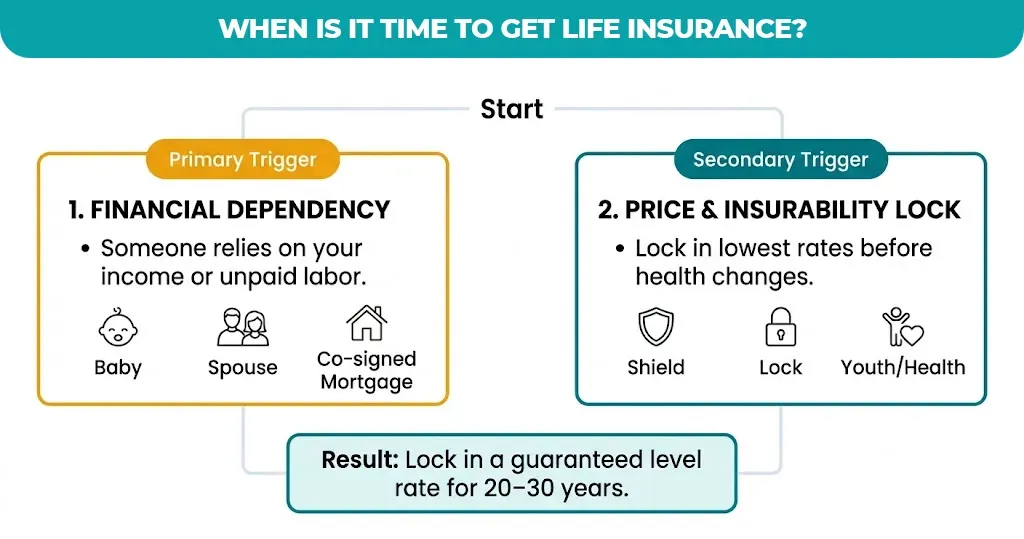
The right time to get life insurance is when someone would struggle financially if you died: a spouse, children, aging parents you support, or anyone who shares your debts. A second reason is price: buying in your 20s or 30s locks in low rates for decades, before age or a new diagnosis makes coverage more expensive.
Two timing triggers
| Trigger | What it means | Example |
| Financial dependency (primary) | Someone relies on your income or unpaid work | New baby, spouse who stays home, co-signed mortgage |
| Insurability and price lock (secondary) | You’re young and healthy, so rates are at their lowest | A 25-year-old planning to marry and buy a home within a few years |
The cost of waiting
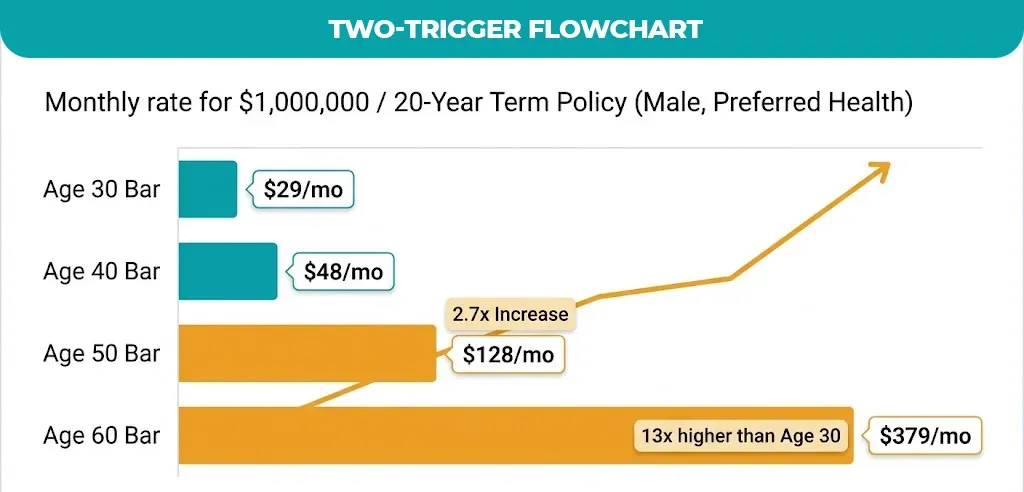
Every year you wait, you’re older, and your chances of developing a health condition rise. For $1 million of 20-year term coverage at preferred rates, a man pays about $29 a month at 30, $48 at 40, $128 at 50, and $379 at 60. A diagnosis such as diabetes or heart disease in the meantime can raise your rate class or lead to a decline.
Note: Your premium is locked in at the age and health class you have when the policy is issued, not when you first thought about buying it.
See Premier Services Agency’s guide to how much life insurance costs.
When do you need life insurance? A life stage guide
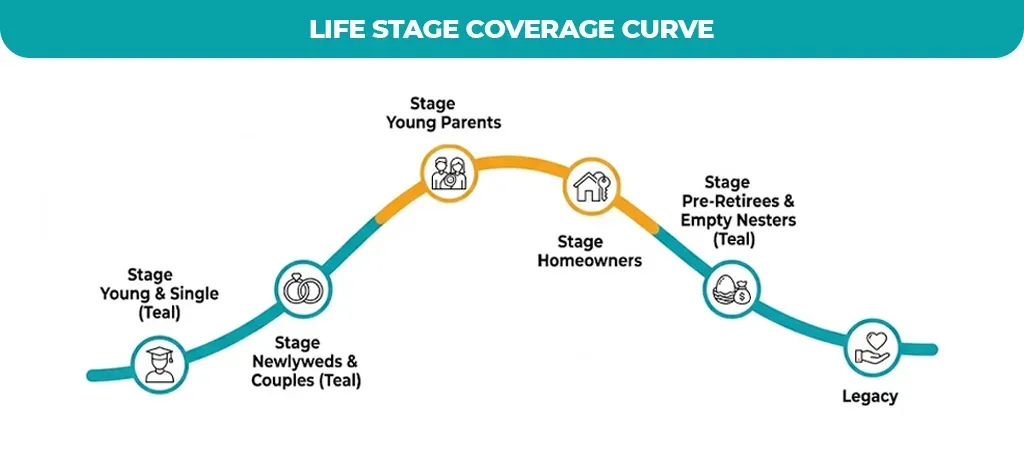
Your need for life insurance usually starts when you take on shared responsibilities and peaks while children are young and a mortgage is large. It shrinks as debts are paid and savings grow. By retirement, many people need only enough to cover final expenses.
Stage 1: Young and single
If no one depends on you, you may not need much coverage yet. But there are good reasons to get life insurance when you’re young: co-signed private student loans, parents who would cover your debts, plans to marry or have children soon, or a family history of health problems. A $100,000, 20-year term policy at preferred rates costs about 11–12 a month at 25.
Stage 2: Newlyweds and couples living together
When you share a lease, a mortgage, or financial plans, your partner may struggle to cover costs alone. Life insurance protects shared debts and helps the surviving partner maintain their standard of living.
Stage 3: Expectant and young parents
This is when most families need the most coverage. Life insurance can replace your income, pay for childcare if a stay-at-home parent dies, and fund future education. Both parents should be covered, including a parent who stays home.
Stage 4: Homeowners and mortgage holders
A mortgage is often a family’s largest debt. Choose a term length that covers the years left on the loan, such as a 30-year term for a new 30-year mortgage, so your family can stay in the home.
Stage 5: Pre-retirees and empty nesters
Once children are independent and the mortgage is nearly paid off, you may need less coverage. Many people keep a shorter term policy as a bridge until savings can fully support a surviving spouse.
Stage 6: Seniors 70 and older
At this stage, life insurance is mostly about final expenses, leaving an inheritance, or estate planning. Small whole life (final expense) policies are the most common choice.
Life stage master matrix
| Life stage | Primary financial trigger | Recommended policy type | Recommended term length | Priority |
| Young and single | Co-signed debt, locking in low rates | Small term | 20–30 years | Low to medium |
| Newlyweds and couples | Shared debts and income | Term | 20–30 years | Medium |
| Expectant and young parents | Income and childcare replacement | Term, 10–12× income | 20–30 years | Highest |
| Homeowners | Mortgage balance | Term (level or decreasing) | Match the mortgage | High |
| Pre-retirees | Remaining debts, spouse’s income | Shorter term or convert | 10–15 years | Medium |
| Seniors 70+ | Funeral, final bills, legacy | Final expense whole life | Lifetime | Medium |
See Premier Services Agency’s level term life insurance and 30-year term life insurance guides.
Dave Ramsey on when to get life insurance
Dave Ramsey’s rule is simple: buy term life insurance as soon as someone depends on your income, get about 10 to 12 times your annual income, and choose a term long enough to become self-insured. He recommends against whole life and other cash value policies.
Ramsey’s core rules
According to Ramsey Solutions:
• When: “You should buy life insurance when someone depends on you to provide income.”
• How much: “Your death benefit needs to be 10 to 12 times your annual income.” For a stay-at-home parent, it suggests 250,000–400,000.
• How long: “I recommend buying a term policy that lasts 15–20 years,” covering the years children depend on your income.
• For families: “If you and your spouse have young kids, term life insurance is the best way to protect them.”
Becoming self-insured
Ramsey’s goal is to need life insurance less over time. By paying off debt, building an emergency fund, and investing for retirement, you can be “self-insured by the time your term ends.” Ramsey Solutions says that for most people, this happens when they’re approaching retirement or when their term life insurance is ending.
Why Ramsey avoids whole life
Ramsey Solutions says, “Life insurance is only supposed to do one thing: replace your income if you die,” and “we never recommend keeping a cash value policy.” If you already have one, it advises getting term coverage first and canceling the old policy only after the new one is in place.
Note: Ramsey’s advice is aimed at income replacement. If your goal is guaranteed money for funeral costs later in life, a small final expense policy can still make sense.
See Premier Services Agency’s guide to whether term life insurance is worth it.
How age affects your price: 2026 monthly rate benchmarks
Life insurance is cheapest in your 20s and 30s and rises steeply after 40. At preferred rates, $1 million of 20-year term coverage costs a man about 48amonthat40,about2.7timesthat(128) at 50, and about three times again ($379) at 60.
Is it better to get life insurance when you’re young?
Usually, yes. Younger buyers pay less because they’re less likely to die during the term and less likely to have health conditions. A level term policy locks that low price in for the whole term, so a policy bought at 30 keeps its age-30 rate until age 50 or 60.
2026 sample monthly rates: 20-year term, preferred health
| Age | $100,000, women | $100,000, men | $1,000,000, women | $1,000,000, men |
| 20 | Not listed | Not listed | $22 | $29 |
| 25 | $11 | $12 | $22 | $29 |
| 30 | $11 | $12 | $23 | $29 |
| 35 | $12 | $12 | $28 | $32 |
| 40 | $14 | $16 | $40 | $48 |
| 50 | $25 | $31 | $95 | $128 |
| 60 | $58 | $72 | $263 | $379 |
| 70 | 20-year terms generally unavailable |
Choice Mutual, preferred non-tobacco, valid March 9, 2026.
$500,000, 20-year term, average health
| Age | Women | Men |
| 30 | $31 | $38 |
| 40 | $47 | $59 |
| 50 | $102 | $137 |
| 60 | $286 | $395 |
MoneyGeek averages for non-smokers in average health, updated October 1, 2026.
Is 40 too late for life insurance?
No. At 40, coverage is still affordable for most healthy people: about 14–16 a month for $100,000 or 40–48 for $1 million of 20-year term at preferred rates. The bigger risk is waiting longer; prices roughly double or more between 40 and 50, and health changes in your 40s can push you into a more expensive rate class.
How to get life insurance when you’re 70
At 70, long term policies are mostly off the table, but you still have options:
• Shorter term: A $1 million 10-year term policy costs about $368 (women) to $589 (men) a month at preferred rates.
• Final expense whole life: $10,000 of level-benefit coverage costs about 53–70 a month for healthy non-smokers.
• Guaranteed issue: No health questions, but smaller amounts and a two-year waiting period.
See Premier Services Agency’s term life insurance for seniors and final expense insurance.
What to ask and look for when getting life insurance
Before you buy, figure out how much coverage you need and for how long, then compare insurers on price, financial strength, and policy features like conversion. Don’t rely only on coverage through work, because it usually ends when the job does.
Questions to ask when getting life insurance
| Question | Why it matters |
| How strong is the insurer financially (AM Best, S&P)? | The insurer must be around to pay the claim decades from now |
| Is the premium guaranteed for the whole term? | Confirms your price won’t rise mid-term |
| Can I convert to permanent coverage, and until when? | Protects you if your health changes |
| What riders are included (terminal illness, waiver of premium)? | Adds benefits, sometimes at no cost |
| What exclusions apply (suicide clause, misstatements)? | Explains when a claim could be denied, typically in the first two years |
| Do I need a medical exam? | Accelerated underwriting can skip the exam for healthy applicants |
| What health class am I likely to qualify for? | The difference between classes can be large |
What to consider when getting life insurance
• Coverage amount: Use the DIME method: Debt + Income replacement + Mortgage + Education, minus savings and existing coverage. Ramsey’s shortcut is 10–12 times your income.
• Term vs. whole life: Term for temporary needs, whole life for permanent ones.
• Financial dependency: Who would struggle without your income or unpaid work, and for how long?
• Health and habits: Tobacco, weight, and medical history affect your rate class.
What happens to your life insurance when you get fired?
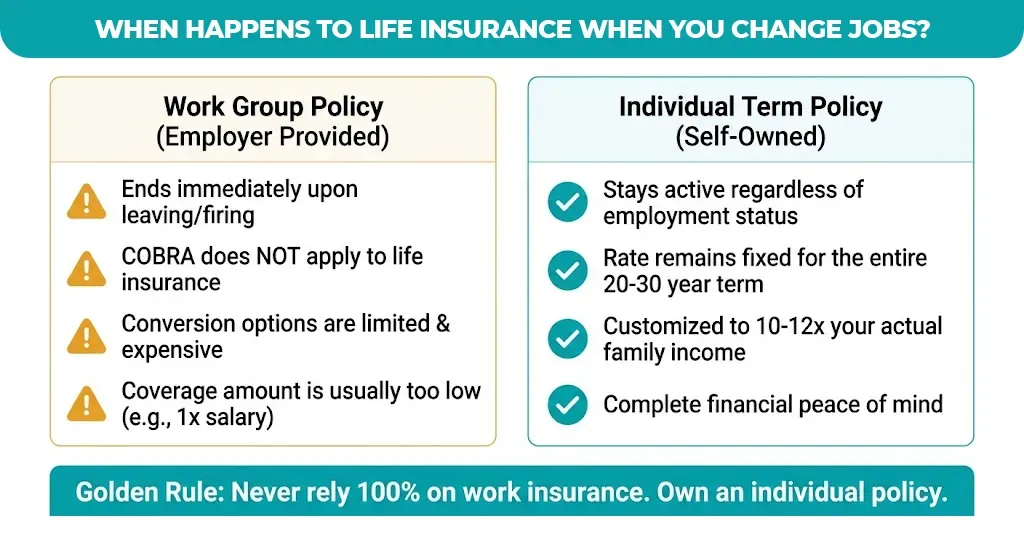
Employer group life insurance usually ends when your job ends, whether you’re fired, laid off, or quit. Many group policies let you convert to an individual policy or port the coverage within a short window (often around 31 days), but converted coverage can be expensive. COBRA covers group health plans, not group life insurance. That’s why it’s risky to rely only on work coverage: owning an individual policy means your protection doesn’t depend on your job. See Premier Services Agency’s guide to group term life insurance.
What to do when you get life insurance money
If you’re a beneficiary, the death benefit is generally not taxable income under IRC §101(a), though interest earned on it is. Practical steps:
1. Don’t rush. Put the money in a safe, insured account while you grieve and plan.
2. Pay urgent bills like funeral costs and high-interest debt.
3. Build an emergency fund and plan for lost income.
4. Talk to a fee-only financial planner before making large investments.
5. Update your own coverage and beneficiaries if your situation has changed.
Life insurance for a baby or child
Child life insurance is optional. It can lock in future insurability, often through a child rider on a parent’s policy, but Ramsey recommends against cash value policies, and many planners suggest saving for education in a 529 plan instead.
Conclusion:
The best time to get life insurance is when someone depends on you, and ideally before age or a new diagnosis raises your rate. For most families, that means term life sized to 10–12 times income during working years, then a smaller policy for final expenses later.
| Your situation | When to act | What to consider |
| Single, no dependents | Optional now; buy before major life events | Small 20–30 year term |
| Getting married or moving in together | Now | Term covering shared debts and income |
| Expecting a baby | Now, before the birth if possible | Term at 10–12× income for each parent |
| Buying a home | At closing | Term matching the mortgage |
| Changing or losing a job | Before your group coverage ends | Individual term you own |
| Age 50–60 | Soon; rates rise quickly | Shorter term or convert |
| Age 70+ | Now if you want funeral costs covered | Final expense whole life |
Compare life insurance quotes at Premier Services Agency
Premier Services Agency helps individuals and families across the United States find the right coverage at every life stage, from term policies for young families to final expense coverage for seniors. Premier Services Agency life specialists can help you estimate how much coverage you need and compare quotes from several carriers.
Get a life insurance quote on Premier Services Agency or call (470) 650-0470. See also term life insurance quotes.