


A life insurance policy is a promise that can span thirty, forty, or even fifty years. The monthly premium matters, but it is only one piece of a much bigger decision. What matters just as much, arguably more, is whether the company standing behind that promise will still be financially sound and easy to work with decades from now. That is why the top-rated life insurance companies are not simply the cheapest ones; they are the carriers that combine long-term financial strength, low customer complaint volume, and dependable claims service.
This guide breaks down the top-rated life insurance companies of 2026 using the same data professional analysts rely on: AM Best financial strength ratings, NAIC complaint index scores, and independent customer satisfaction surveys. You’ll learn how these carriers are evaluated, see how the top rated term life insurance companies stack up against permanent-coverage specialists, and get a clear framework for choosing the right policy for your household’s needs.
How We Evaluate the Top-Rated Life Insurance Companies
The Core Metrics: What Makes an Insurer “Top-Rated”?
Ranking life insurance companies isn’t about which brand advertises the most. A carrier’s marketing budget tells you nothing about whether it will still be solvent when your family eventually files a claim. Instead, analysts and consumer publications lean on three data sources that are far harder to manipulate.
- AM Best Ratings: AM Best is the leading credit rating agency for the insurance industry. Its financial strength ratings, ranging from A++ (Superior) down through weaker grades, measure an insurer’s ability to meet its ongoing financial obligations, including future claims. A carrier holding an A++ or A+ rating has demonstrated a strong balance sheet and a track record of prudent underwriting.
- NAIC Complaint Ratios: The National Association of Insurance Commissioners tracks complaints filed against every licensed insurer and weighs that volume against the company’s market share. The industry-average standard for the derived NAIC complaint index is 1.00. A score below 1.00 means the company generates fewer complaints than its size would predict; a score near zero, like the figures reported for the very top carriers, signals an unusually smooth customer experience.
- Customer Satisfaction & Composite Scores: Financial strength alone doesn’t guarantee a good experience. Independent surveys from outlets such as Insure.com and J.D. Power ask real policyholders about renewal intent, ease of billing, and trust in the company. Some ranking methodologies also reference COMDEX scores, which blend ratings from multiple agencies.
When these three data points line up a top-tier AM Best rating, a low NAIC complaint index, and strong survey results you get a genuinely top rated life insurance company, not just a well-marketed one.
Top-Rated Life Insurance Companies of 2026
The Industry Leaders Compared
Based on 2026 industry evaluations that combine AM Best ratings, NAIC complaint data, and customer survey results, the same handful of carriers consistently rise to the top of the list of top-rated life insurance companies in the USA.
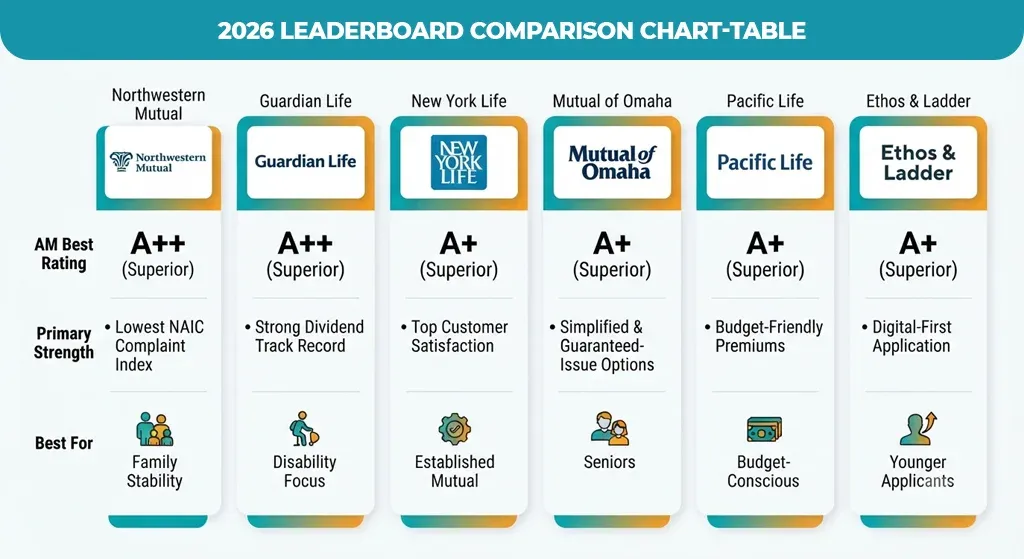
Northwestern Mutual: Northwestern Mutual holds the No. 1 overall position again in 2026, a title it also carried in the prior year’s rankings. The company carries AM Best’s highest possible A++ (Superior) rating, and its NAIC complaint index is among the lowest of any carrier in the industry, a reflection of very high policyholder satisfaction relative to its size.
Guardian Life & New York Life: These two mutual insurers are tied for second place in 2026 rankings. Both carry A++ AM Best ratings, both report low complaint volumes, and both are known for strong whole life dividend performance and high policyholder renewal rates. New York Life, in particular, posted average premiums below the industry average in recent survey data.
Mutual of Omaha: Mutual of Omaha climbed several spots in the 2026 rankings and posted the highest customer survey score of any carrier evaluated, reflecting particularly strong marks for trust and policy offerings. It’s also one of the more accessible top rated whole life insurance companies for older applicants, offering simplified-issue and guaranteed-issue products.
Tech-Forward Alternatives: Ethos & Ladder: For applicants who want to skip the medical exam and paperwork entirely, digital-first platforms like Ethos and Ladder have become popular top rated term life insurance companies for younger, healthy buyers. These platforms don’t underwrite policies themselves; instead, they connect applicants with financially strong carrier partners and use accelerated, algorithm-based underwriting to issue instant decisions.
The table below summarizes how each carrier stacks up:
| Company | AM Best Rating | Primary Strength | Ideal For |
| Northwestern Mutual | A++ (Superior) | Lowest NAIC complaint index in the industry; dividend track record | Buyers who prioritize long-term stability and are comfortable working with a financial advisor |
| Guardian Life | A++ (Superior) | Strong whole life dividend performance and low complaint volume | Whole life and disability-focused buyers |
| New York Life | A++ (Superior) | High renewal rates and below-average premiums | Buyers who want a large, established mutual carrier |
| Mutual of Omaha | A+ (Superior) | Top customer satisfaction scores and broad policy availability | Applicants who want simplified or guaranteed-issue options, including seniors |
| Pacific Life | A+ (Superior) | Below-average premiums with strong survey scores | Budget-conscious buyers who still want a top-tier carrier |
| Ethos & Ladder | Varies by underwriting carrier | Fully digital applications and instant, no-exam decisions | Younger, healthy applicants who want speed and convenience |
Matching Your Needs: Term vs. Permanent Life Insurance
Choosing the Right Structure from Top-Tier Carriers
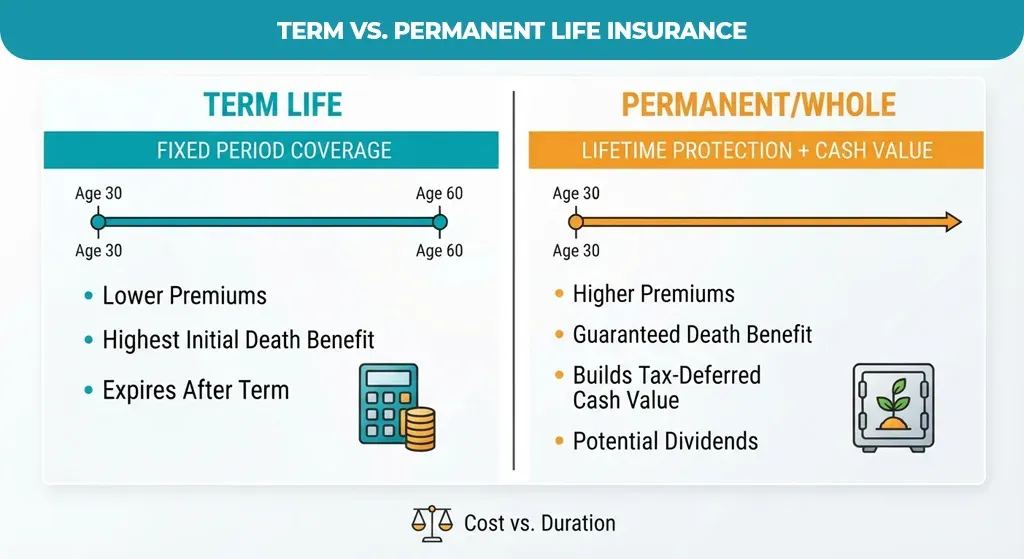
Even among the top rated best life insurance companies, the right carrier only helps you if you choose the right type of policy. Here’s how the three main structures compare.
- Term Life Insurance Provides coverage for a fixed period, typically 10, 20, or 30 years.
- Pros: Premiums are dramatically lower than permanent coverage for the same death benefit, making it the most efficient way to replace income during peak financial responsibility years.
- Cons: Coverage expires at the end of the term unless renewed (usually at a much higher rate) or converted to a permanent policy.
- Whole / Permanent Life Insurance Provides lifetime coverage as long as premiums are paid, and builds cash value that grows on a tax-deferred basis.
- Pros: Coverage never expires; the policy accumulates guaranteed cash value; mutual insurers like Northwestern Mutual and New York Life may also pay annual dividends.
- Cons: Premiums can run five to fifteen times higher than a comparable term policy.
- Universal Life: A flexible form of permanent coverage that lets policyholders adjust premium payments and death benefits within set limits as their financial situation changes.
Crucial Elements to Consider Apart from Price
Riders, Underwriting, and Conversion Options
Once you’ve narrowed down a shortlist of top-rated life insurance companies, the details of the actual policy matter just as much as the carrier’s rating.
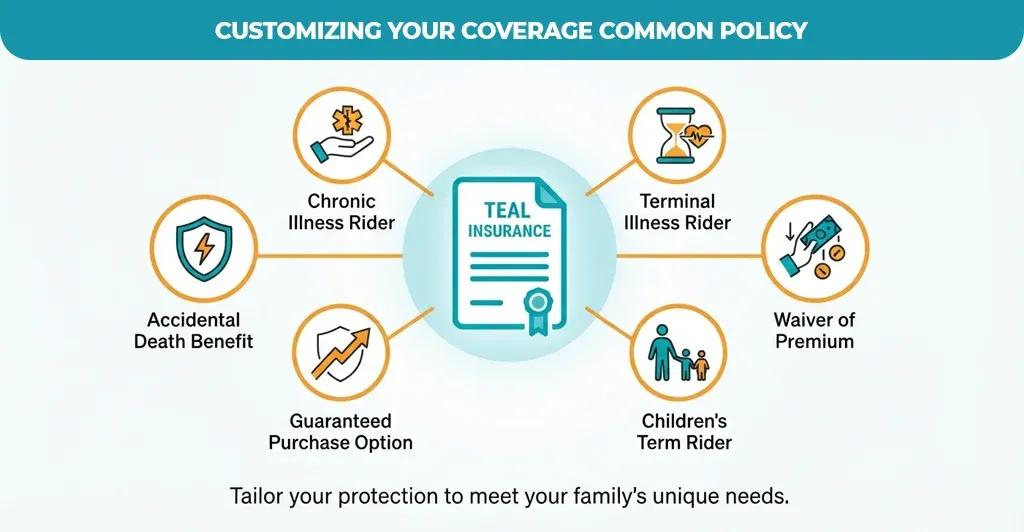
- Policy Riders: Riders let you customize a base policy without buying a separate product. Common options include chronic and terminal illness riders (which allow early access to a portion of the death benefit if you’re diagnosed with a qualifying condition), a waiver-of-premium rider (which keeps your policy in force if you become disabled and can’t pay premiums), and children’s term riders (which add a small amount of coverage for each child under one policy).
- Underwriting Speed: Many top-rated life insurance companies now offer accelerated underwriting, which uses prescription history, motor vehicle records, and other data sources to issue a decision in minutes rather than weeks, often without a medical exam. This is especially common with instant-issue term products aimed at healthy applicants under 50.
- Conversion Options: If you start with a term policy, look for one that’s convertible to a permanent policy without a new medical exam. This protects your insurability if your health changes later, letting you lock in permanent coverage at a future date based on your original risk class rather than your health at conversion time.
Underwriters also place significant weight on pre-existing conditions when assigning a risk tier, so applicants with manageable chronic conditions should still shop around; tier placement, and therefore price, can vary meaningfully from one top-rated life insurance companies carrier to the next.
Conclusion
The ultimate takeaway from evaluating the top-rated life insurance companies for 2026 is crystal clear: never compromise on institutional stability or stellar customer service for a cheap monthly sticker price. Securing a policy from an unstable or poorly reviewed carrier introduces an unnecessary gamble that your loved ones simply cannot afford to bear decades down the line. Industry leaders like Northwestern Mutual, Guardian Life, and New York Life consistently command the highest rankings because they guarantee reliable payouts, robust financial backing, and absolute peace of mind.
Taking the extra time today to thoroughly compare financial ratings, read unbiased reviews, and calculate your exact household needs is a vital investment in your family’s financial security. Reach out to an independent financial advisor, request customized quotes from multiple top-rated life insurance companies, and lock in your comprehensive protection plan while you are young and healthy.