


Key Takeaways
|
What Is Funeral Insurance and How Does It Work?
Funeral insurance, burial insurance, and final expense insurance are three names for essentially the same product: a small permanent life insurance policy sized to cover end-of-life costs rather than long-term income replacement. The policy pays a fixed death benefit to a named beneficiary when the policyholder passes away, and that beneficiary can use the money for funeral costs, outstanding medical bills, or any other expense.
Most funeral insurance plans are structured as whole life insurance, which means three things are guaranteed as long as premiums are paid on time:
- Premiums are fixed for life and do not increase as the policyholder ages.
- The death benefit does not decrease, regardless of how long the policy has been in force.
- The policy accumulates a modest cash value over time and does not expire the way term life insurance does.
This structure is what separates final expense insurance from traditional term life insurance, which is typically written for a set period, such as 10, 20, or 30 years, and is usually purchased in much larger amounts to replace income or pay off a mortgage. A funeral plan insurance policy is smaller, simpler to qualify for, and intended specifically to fund end-of-life expenses.
Funeral Insurance vs. Traditional Life Insurance
The core difference between a life insurance funeral plan and a standard life insurance policy comes down to purpose and size. Traditional life insurance is often used to replace lost income, fund a child’s education, or pay off a mortgage, and coverage amounts can run into the hundreds of thousands of dollars. A dedicated final expense policy is built around a narrower goal: covering funeral costs and immediate final bills, with coverage amounts that usually fall between $5,000 and $30,000.
Types of Funeral Insurance Plans Explained
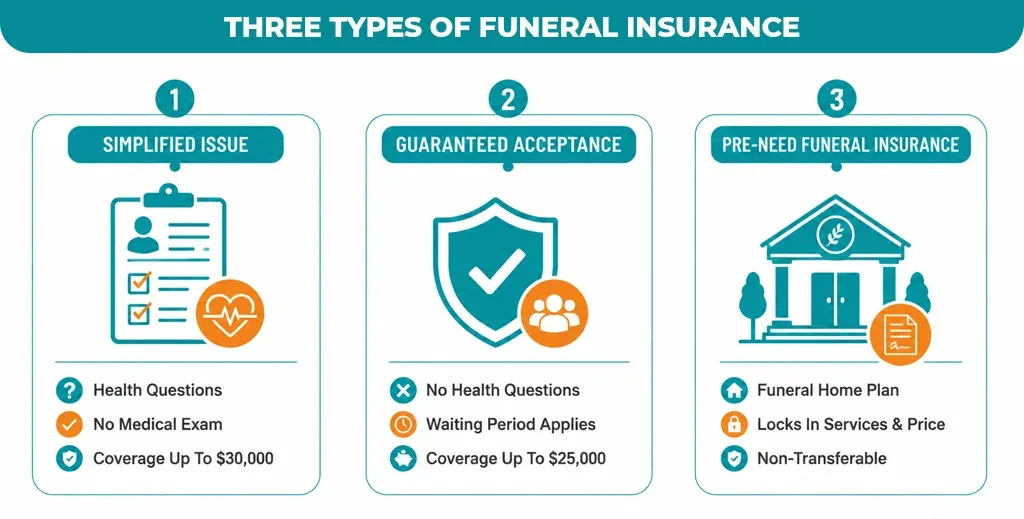
Not all funeral insurance plans work the same way. Understanding the differences between simplified issue, guaranteed acceptance, and pre-need coverage makes it easier to compare funeral insurance plans and choose the one that matches your health profile and timeline.
Simplified Issue Plans
Simplified issue final expense policies do not require a medical exam, but applicants must answer a short set of health questions on the application. Approval is typically faster than traditional underwriting because the insurer relies on the applicant’s answers, and sometimes a prescription database check, rather than lab work. This type of plan is generally more affordable than a guaranteed acceptance policy for applicants in reasonably good health.
Guaranteed Acceptance Plans
Guaranteed acceptance, also called guaranteed issue life insurance, requires no medical exam and no health questions at all. Anyone within the eligible age range is approved. Because the insurer takes on more risk by not screening for health conditions, these plans typically include a graded death benefit, meaning that if the policyholder dies of natural causes within the first two years, the beneficiary receives a refund of premiums paid plus interest rather than the full death benefit. After the waiting period ends, the full benefit applies.
Pre-Need Funeral Insurance
Pre-need funeral insurance is purchased directly through a funeral home rather than an insurance carrier. The policy is tied to a specific, itemized funeral plan, and the payout goes straight to the funeral home to lock in today’s prices for services selected in advance. This differs from a standalone final expense policy, where the death benefit is paid to a personal beneficiary who has full discretion over how the money is spent. Comparing prepaid funeral plans vs. life insurance is largely a question of flexibility: pre-need plans lock in specific services with one provider, while a final expense life insurance policy gives the family cash that can be used with any funeral home, or for other final bills.
How Much Does Funeral Insurance Cost a Month?
Monthly premiums for a funeral insurance plan depend on age, gender, health, tobacco use, and the amount of coverage purchased. As a general benchmark, a $10,000 policy tends to cost between $30 and $150 a month. Reviewing sample rates by age helps illustrate how much premiums shift over time:
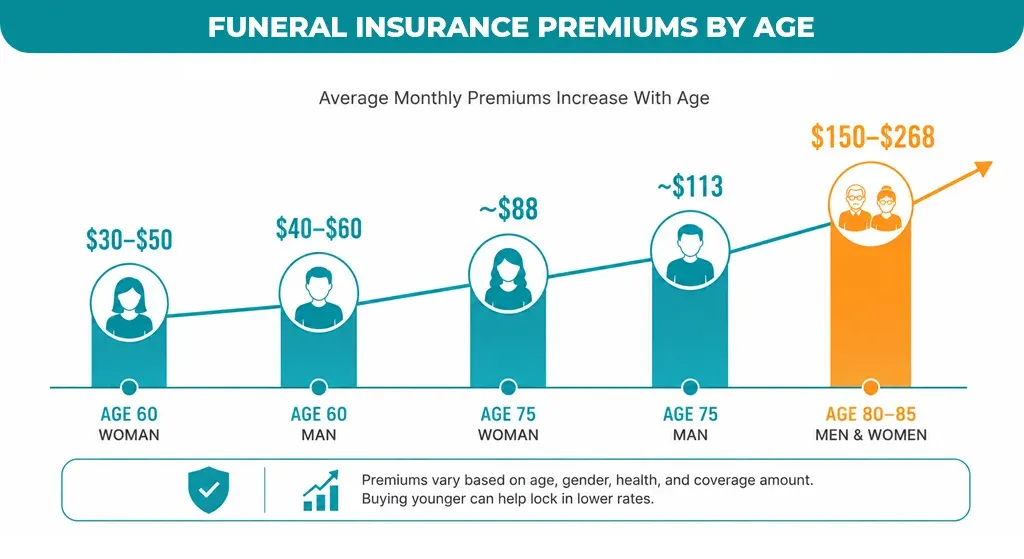
Age | Coverage Amount | Typical Monthly Premium Range |
60-year-old woman | $10,000 | ≈ $30 – $50 |
60-year-old man | $10,000 | ≈ $40 – $60 |
75-year-old woman | $10,000 | ≈ $88 (average) |
75-year-old man | $10,000 | ≈ $113 (average) |
80–85 years old | $10,000 – $25,000 | ≈ $150 – $268 |
A few patterns hold across most insurers. Premiums rise the longer someone waits to apply, since final expense insurance is priced by age at issue and locked in from that point forward. Women typically pay less than men of the same age for identical coverage. Guaranteed acceptance policies generally cost more than simplified issue policies at the same age and coverage level, because the insurer is accepting applicants without any health screening.
Key Benefits of Securing a Burial Insurance Policy
A well-matched funeral insurance plan does more than pay for a casket or cremation service. The main advantages include:
- Immediate financial relief: The death benefit is typically paid out faster than a traditional life insurance claim, helping the family avoid dipping into savings while services are arranged.
- Flexible use of funds: Beneficiaries can apply the payout to funeral costs, outstanding medical bills, credit card balances, or any other final expense, since the money is not restricted to a specific vendor.
- Guaranteed level premiums: The monthly cost locked in at purchase does not increase later, which makes budgeting predictable for retirees on a fixed income.
- Lifelong, permanent coverage: As long as premiums are paid, the policy does not expire, unlike term life insurance, which ends after a set number of years.
- Accessible underwriting: Simplified issue and guaranteed acceptance options make coverage available to seniors and people with chronic health conditions who might not qualify for larger traditional policies.
How to Select the Best Funeral Insurance Coverage for Your Needs
Choosing among the many funeral insurance plans on the market comes down to a handful of practical decisions rather than finding a single universally best funeral insurance plan, since the right fit depends on age, health, and budget.
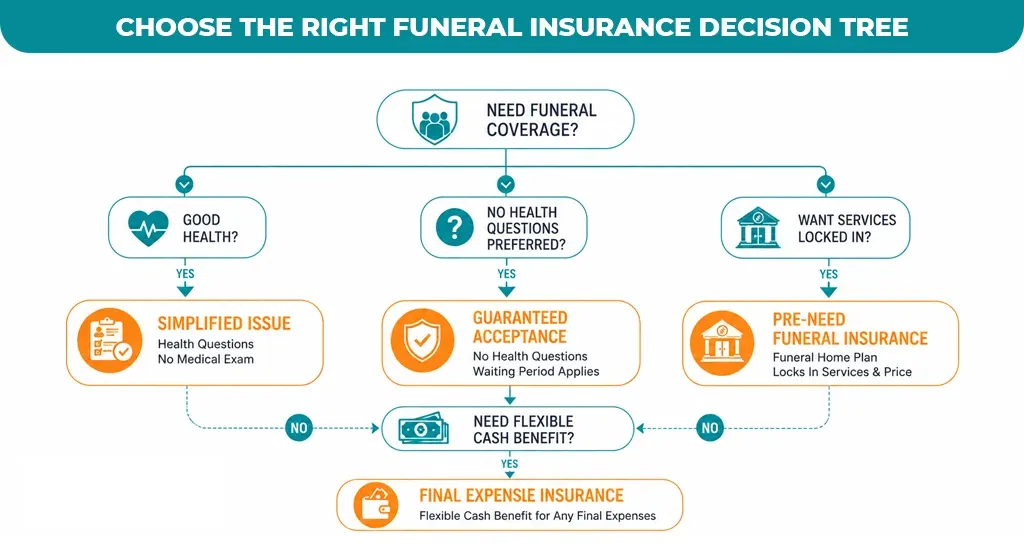
Estimate Realistic End-of-Life Expenses
Start with the type of service you or your family member would want. NFDA’s 2026 data puts the median burial funeral at $8,300 and the median cremation funeral at $6,280, not including cemetery or monument costs. Deciding between burial and cremation preferences early narrows down how much coverage actually makes sense.
Set a Comfortable Monthly Budget
Because premiums are fixed for life, it is worth choosing a monthly payment that remains comfortable well into retirement, not just at the time of purchase. Reviewing quotes at a few different coverage levels, such as $10,000, $15,000, and $20,000, shows how much the monthly premium changes at each tier.
Compare Reputable, Financially Stable Providers
Financial strength matters because a final expense policy may not pay out for decades. Checking a carrier’s rating from AM Best, a widely used independent rater of insurance company financial strength, and confirming the company is licensed with your state’s insurance department through the National Association of Insurance Commissioners (NAIC) are both reasonable due-diligence steps before purchasing. Well-known names in this market include Mutual of Omaha, Globe Life, Gerber Life, Colonial Penn, and the AARP Life Insurance Program, which is underwritten by New York Life and offers members guaranteed acceptance coverage up to $30,000 with a two-year limited benefit period. AARP itself is not an insurer; it licenses its name to New York Life for this program.
Review Waiting Periods, Graded Benefits, and Payout Terms
Before signing, confirm whether the policy is simplified issue or guaranteed issue, whether a graded death benefit period applies, and exactly how the beneficiary will be paid. These terms vary by carrier and directly affect how quickly, and how fully, the policy pays out if death occurs in the early years of coverage.
Securing Peace of Mind for Your Family’s Future
Planning ahead with a funeral insurance plan is one of the more direct ways to keep a difficult moment from becoming a financial emergency for the people left behind. Whether the right fit turns out to be a simplified issue policy, a guaranteed acceptance plan, or pre-need coverage through a funeral home, the goal is the same: a fixed premium, a guaranteed payout, and one less thing for your family to worry about.
To compare funeral insurance plans and find coverage that matches your health profile and budget, the licensed advisors at Premier Services Agency can walk you through simplified issue, guaranteed acceptance, and final expense options from multiple carriers side by side.