


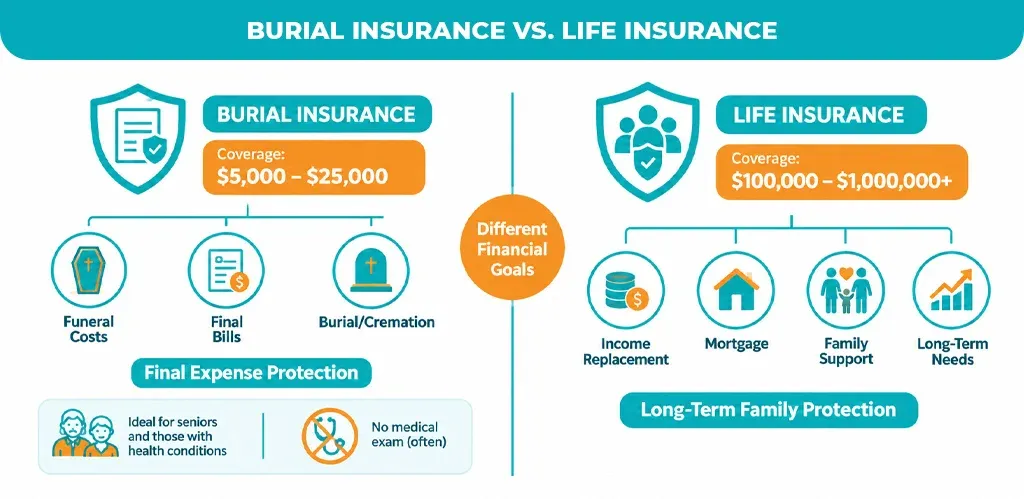
Burial insurance and life insurance both pay a death benefit to your beneficiaries, but they are built to solve different financial problems. Burial insurance, also called final expense insurance or a burial policy, is a small whole life policy, usually $5,000 to $25,000, designed specifically to cover funeral costs, medical bills, and other end-of-life expenses.
Life insurance is the broader category that includes term life, whole life, and universal life. It is designed to replace lost income, pay off a mortgage, or fund a family’s long-term needs, with death benefits that often reach $250,000 or more.
The right choice depends on your age, health, budget, and what you actually need the payout to do. This guide compares burial insurance vs. life insurance side by side, including coverage amounts, underwriting requirements, real premium data, and the situations where each product makes the most sense. You’ll also find a cost comparison table, a pros-and-cons breakdown, and answers to the questions people ask most before buying either policy.
Quick Answer: Burial Insurance vs. Life Insurance
| Burial insurance is a small, guaranteed- or simplified-issue whole life policy (typically $5,000–$25,000) built to cover funeral and final expenses, with no medical exam and fast underwriting.Life insurance is the broader category, including term and whole life, that provides larger death benefits ($100,000–$1,000,000+) for income replacement, debt payoff, and family financial support, usually requiring health underwriting for the lowest rates. Burial insurance costs more per $1,000 of coverage than term life insurance, but it is often the only option for older adults or people with health conditions who cannot qualify for traditional life insurance. |
Key Takeaways
- Burial insurance is technically a type of life insurance, specifically a small whole life policy focused on final expenses, according to Western & Southern’s 2026 guide to final expense coverage.
- The median cost of a funeral with viewing and burial is $8,300, and a funeral with viewing and cremation is $6,280, according to the National Funeral Directors Association’s (NFDA) most recent General Price List Study.
- 51% of American adults report owning some form of life insurance, per the 2026 Insurance Barometer Study from LIMRA and Life Happens.
- Term life insurance is usually far cheaper than burial insurance for healthy applicants under 60, but burial insurance guarantees or simplifies acceptance for seniors and people with health conditions.
- About three in four adults overestimate the true cost of life insurance, and adults 35 and under overestimate it by roughly 7 to 12 times the real price, per the 2026 LIMRA/Life Happens Barometer Study.
What Is Burial Insurance?
Burial insurance is a small whole life insurance policy, typically $5,000 to $25,000, designed to cover funeral costs, burial or cremation expenses, and other final bills rather than to replace lost income. It is also marketed as final expense insurance or funeral insurance; the three terms generally describe the same underlying product, though the exact name depends on the insurer.
- Coverage amounts generally range from $5,000 to $25,000, according to Aflac’s final expense product overview, though some carriers offer higher limits.
- Most policies use simplified-issue underwriting (a handful of yes/no health questions, no medical exam) or guaranteed-issue underwriting (no health questions at all).
- Coverage is permanent; it lasts for life as long as premiums are paid, and premiums are fixed at the age you buy the policy.
- Payouts are often processed within one to two business days of an approved claim, compared with weeks or longer for policies that require more extensive claims review.
- Beneficiaries receive the payout as cash and can use it for any purpose, not only funeral costs.
What Is Life Insurance?
Life insurance is the umbrella term for any policy that pays a death benefit to a named beneficiary when the insured person dies, and it includes term life, whole life, universal life, and burial or final expense policies as sub-types. Two categories matter most when comparing burial insurance vs. life insurance: term life and permanent (whole) life.
Term Life Insurance vs. Burial Insurance
Term life insurance provides coverage for a fixed period, commonly 10, 20, or 30 years, and pays a death benefit only if the insured dies during that term. It has no cash value, and it is the least expensive way to buy a large amount of coverage.
A 40-year-old nonsmoker pays an average of $35 per month for a $250,000, 20-year term policy, and about $59 per month for $500,000 in coverage, according to MoneyGeek’s 2026 term life rate analysis. Younger, healthy applicants pay less: Finder’s 2026 rate survey shows a 25-year-old man paying around $17 per month for $250,000 of 20-year term coverage.
Whole Life Insurance vs. Burial Insurance
Whole life insurance lasts for the insured’s entire life, builds cash value, and carries a fixed premium, but it costs significantly more than term life for the same face amount. MoneyGeek’s 2026 data shows a $250,000 whole life policy averaging $294 per month for a 40-year-old man, compared with about $35 per month for term coverage at the same age and face amount.
Burial insurance is a type of whole life policy, but with a much smaller face amount and looser underwriting than a standard whole life policy purchased for estate planning or wealth transfer.
Burial Insurance vs. Life Insurance: Key Differences at a Glance
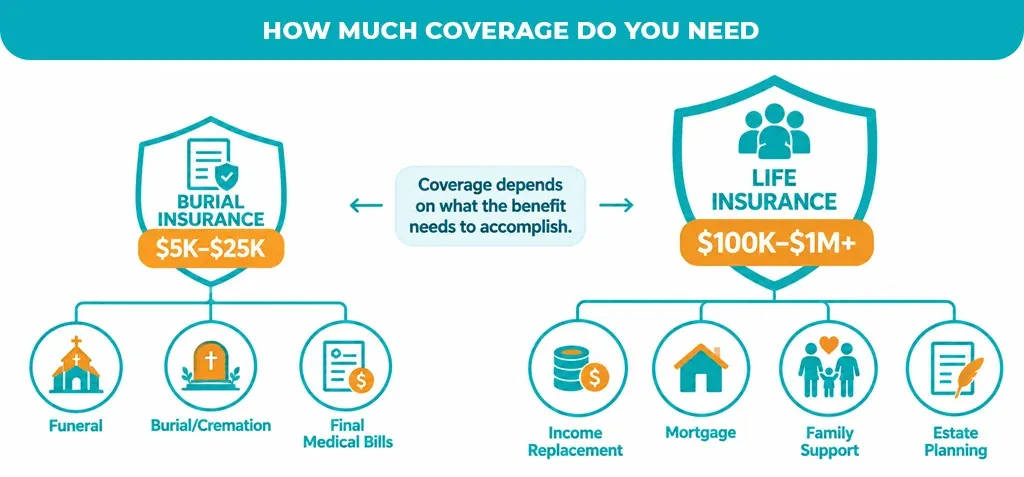
The clearest way to compare burial insurance vs. life insurance is side by side. The table below summarizes the structural differences that matter most when choosing between the two.
| Factor | Burial Insurance | Life Insurance (Term/Whole) |
| Typical coverage amount | $5,000–$25,000 | $100,000–$1,000,000+ |
| Underwriting | Simplified or guaranteed issue; no medical exam | Full medical underwriting for the best term rates; simplified issue available at a higher cost |
| Primary purpose | Funeral, burial/cremation, final medical bills | Income replacement, mortgage payoff, dependent support, estate planning |
| Policy structure | Permanent (whole life) | Term (temporary) or permanent |
| Typical buyer age | 50–85 | 18–65 for term; any age for permanent |
| Cost per $1,000 of coverage | Higher | Lower for term; higher for whole life |
| Claim payout speed | Often 24–48 hours after approval | Typically days to several weeks, depending on the policy and cause of death |
Burial Insurance vs. Whole Life Insurance: What Sets Them Apart
Burial insurance and standard whole life insurance are structured the same way; both are permanent policies with level premiums and a cash-value component, but they differ mainly in face amount, underwriting, and intended use. Standard whole life policies commonly offer $50,000 to $1,000,000 or more in coverage and typically require some medical underwriting, while burial insurance caps out around $25,000 to $50,000 and is issued with simplified or guaranteed acceptance.
In practical terms, burial insurance is a small, easy-to-qualify-for slice of the whole life insurance category, purpose-built for final expenses rather than long-term wealth transfer.
How Much Does Burial Insurance vs. Life Insurance Cost?
Burial insurance generally costs more per $1,000 of death benefit than term life insurance, but the total dollar cost is often lower because the coverage amount itself is smaller. The tables below show current benchmark data for both funeral costs and monthly premiums.
Average End-of-Life Costs
| Expense | Median Cost | Source |
| Funeral with viewing and burial (add a vault and the total rises toward $9,995) | $8,300 | NFDA General Price List Study |
| Funeral with viewing and cremation | $6,280 | NFDA General Price List Study |
Average Burial Insurance Premiums (Nonsmoker, $10,000 Policy)
| Age | Female (monthly) | Male (monthly) |
| 50 | $24 | $31 |
| 60 | $33 | $43 |
| 70 | $53 | $70 |
| 80 | $98 | $135 |
Average Term Life Insurance Premiums ($250,000, 20-Year Term, Nonsmoker)
| Age | Female (monthly) | Male (monthly) |
| 25 | ~$14 | ~$17 |
| 40 | $28 | $35 |
For a healthy person under 55, term life insurance delivers far more coverage per dollar than burial insurance. Burial insurance becomes the more practical and sometimes the only option once someone is in their 70s or 80s, or has a health condition that makes full medical underwriting difficult, since acceptance is guaranteed or simplified for many final expense products regardless of health history.
Burial Insurance vs. Life Insurance: Pros and Cons
Pros and Cons of Burial Insurance
- Pro: No medical exam; simplified or guaranteed issue.
- Pro: Fast approval and fast claims payout, often within one to two business days.
- Pro: Fixed premiums for life once the policy is issued.
- Pro: Easier to qualify for at older ages or with pre-existing health conditions.
- Con: Coverage amounts are small, generally not enough for anything beyond final expenses.
- Con: Higher cost per $1,000 of coverage than term life insurance.
- Con: Guaranteed-issue policies commonly include a two- to three-year graded benefit period, during which a death from natural causes returns only premiums paid plus interest rather than the full face amount, a standard provision used by most final expense carriers to manage risk on health-question-free policies.
Pros and Cons of Life Insurance (Term and Whole)
- Pro: Much more extensive coverage amounts for income replacement, mortgage payoff, or estate needs.
- Pro: Term life is the least expensive way to buy substantial coverage per dollar spent.
- Pro: Whole life builds cash value that a policyholder can borrow against.
- Con: Full medical underwriting can take days to weeks and may lead to higher rates or a decline for applicants with serious health conditions.
- Con: Term coverage expires; renewing at an older age costs significantly more, or may not be available at all.
- Con: Whole life premiums run several times higher than term premiums for the same face amount.
Final Expense Insurance vs. Term Life Insurance for Seniors
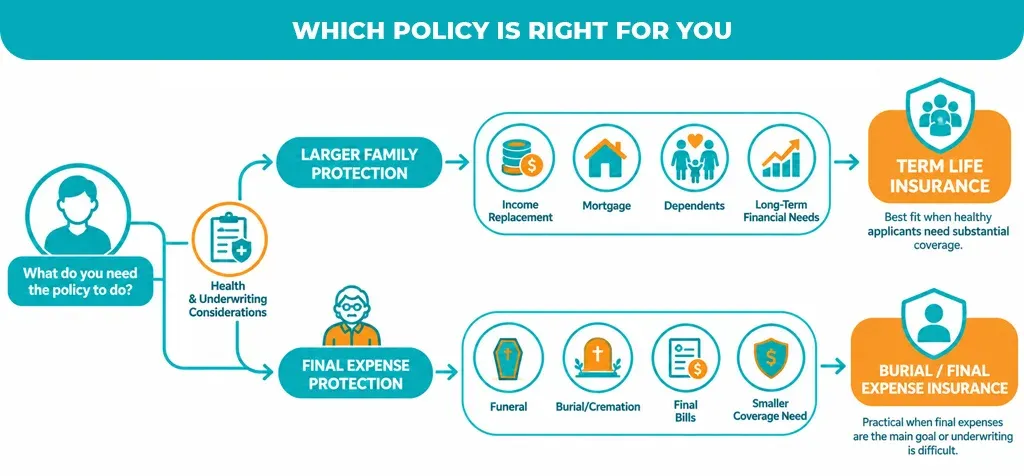
For most seniors in good health, term life insurance is cheaper per dollar of coverage, but availability narrows sharply after age 75 to 80, and few carriers issue new term policies to applicants over 80. Final expense, or burial, insurance fills that gap because acceptance typically does not depend on passing a medical exam.
- Choose term when: Term life still makes sense for a senior who is in good health, wants a larger death benefit, and can pass full medical underwriting at a competitive rate.
- Choose burial insurance when: Final expense/burial insurance is the better fit for a senior with health conditions, a need for guaranteed acceptance, or a coverage need that is limited to funeral and final costs rather than income replacement.
What to Check Before Buying Either Policy
Before comparing quotes, verify the financial strength and regulatory standing of any insurer you are considering, regardless of which product you choose.
- Check the carrier’s financial strength rating from AM Best, which grades an insurer’s ability to pay future claims.
- Review the insurer’s complaint index through the National Association of Insurance Commissioners (NAIC), which tracks complaint volume relative to company size.
- Confirm whether the policy is immediate-benefit or graded-benefit, since graded policies limit payouts for natural-cause deaths in the first two to three years.
- Ask about the free-look period, a window (commonly 10 to 30 days) during which you can cancel for a full refund if the policy doesn’t fit your needs.
- If you’re a senior being sold final expense coverage, ask how the agent’s recommendation aligns with your state’s senior insurance suitability rules, which most state insurance departments have adopted from the NAIC’s suitability framework.
The Bottom Line
Choosing between burial insurance vs. life insurance ultimately depends on your age, current health status, and whether your family requires income replacement or simply assistance with end-of-life expenses. While term life insurance provides robust financial protection for working-age adults with significant obligations like mortgages and dependents, burial insurance acts as a specialized, accessible safety net for seniors or individuals with pre-existing health conditions who cannot qualify for traditional underwriting.
By comparing quotes for both options side by side, you can ensure your final choice matches your household budget and the true scope of your financial needs. Burial insurance vs. life insurance decisions are easier when you balance immediate end-of-life costs against long-term financial security to protect your family’s future.