


Imagine participating in stock market gains without ever directly risking your principal in a market crash. It sounds too good to be true, but that upside-without-the-downside pitch is exactly what draws people to index universal life insurance, more commonly known as IUL.
As high earners and long-term savers look for ways to grow money beyond the contribution caps of a 401(k) or IRA, indexed universal life insurance policies have surged in popularity. Financial professionals increasingly position an index universal life insurance policy as a supplemental retirement vehicle for people who have already maxed out their traditional tax-advantaged accounts and want another place to accumulate cash on a tax-deferred basis.
This guide breaks down what index universal life insurance is, how the index-crediting mechanics actually work, and the real advantages and drawbacks of the product. Along the way, we’ll cover who tends to be a good fit for an IUL policy, who should look elsewhere, how to shop for indexed universal life insurance, and the most common questions people ask before committing capital to a policy.
What Is Index Universal Life (IUL) Insurance?
Permanent Life Insurance Foundation
Index universal life insurance is a form of permanent life insurance, meaning it is designed to provide coverage for the insured’s entire life rather than for a fixed term of years. The first thing to know about indexed universal life insurance is that it is more than just a savings account with a life insurance label. It is a life insurance contract first, built on the chassis of universal life insurance, which allows flexible premiums and an adjustable death benefit.
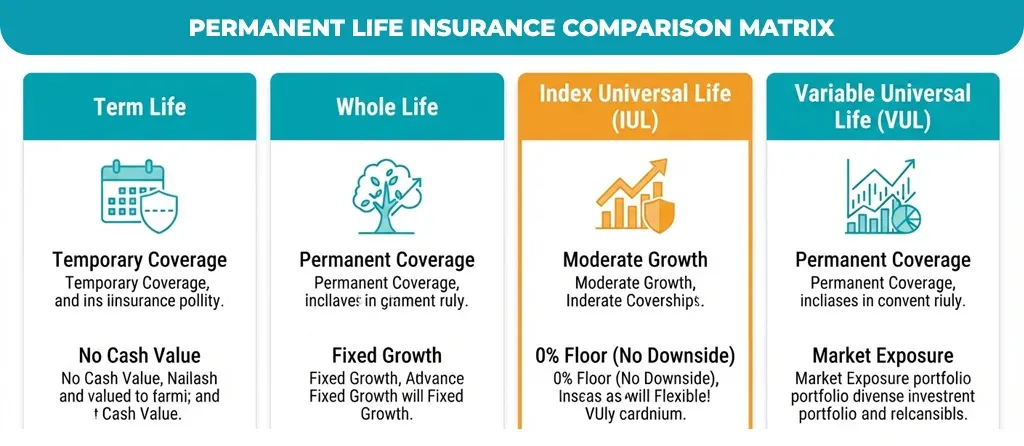
It helps to see how universal index life insurance sits relative to its permanent-insurance cousins. Term life insurance is temporary and has no cash value; it exists purely to pay a death benefit if you die within the term. Whole life insurance is also permanent, but its cash value grows at a fixed, guaranteed rate set by the insurer. Variable universal life insurance (VUL) lets the policyholder invest cash value directly in sub-accounts that behave like mutual funds, exposing principal to full market risk. Index universal life insurance sits in between whole life and VUL: it offers more upside potential than whole life, but without direct market exposure to downside risk.
The Role of the Cash Value Component
Every index universal life insurance policy has two components: the death benefit and the cash value account. The cash value functions as a living benefit of money that accumulates inside the policy and that the policyholder can access while still alive, typically through policy loans or partial withdrawals. This cash value is what distinguishes an indexed universal life insurance policy from a simple term policy, and it’s the piece that most of the marketing and financial planning conversation revolves around.
How Index-Linked Interest Works: Caps, Floors, and Participation Rates
The S&P 500 Crediting Mechanism
This is the mechanism that confuses most first-time buyers, so it’s worth slowing down. With an index universal life insurance policy, your cash value is not directly invested in the stock market. Instead, the insurer credits interest to your cash value based on the performance of an external index, most commonly the S&P 500 over a set period, usually one year.
Your money isn’t buying shares of an index fund. The insurance company is using a combination of its general account and options contracts tied to the index to determine how much interest to credit you. That structural distinction is exactly what allows the insurer to offer a 0% floor while still capping your upside.
Understanding the 0% Floor
The floor is the guaranteed minimum interest rate your cash value will be credited in any given period, and on most indexed universal life insurance policies that floor is 0%. In practice, this means that if the S&P 500 falls 20% in a given policy year, your cash value doesn’t fall with it; you simply earn 0% interest instead of losing principal due to market performance during that time.
The 0% floor is the headline selling point of index universal life insurance, and it is real. But it is not the same as a 0% cost. Administrative fees and the cost of insurance still get deducted from the cash value during a 0% floor year, so a policy can still lose overall value even when the index-crediting itself doesn’t go negative.
Navigating Caps and Participation Rates
The cap is the maximum interest rate the insurer will credit in a strong market year, regardless of how much the underlying index actually gained. A policy with a 9% cap will credit you at most 9% interest even if the S&P 500 returns 25% that year.
The participation rate determines what percentage of the index’s gain, up to the cap, actually gets applied to your account. Participation rates commonly range from 50% up to 100% or occasionally higher, and they can be adjusted by the insurer over time within the bounds set by your contract. Together, the cap and participation rate are what keep an index universal life insurance policy cost-effective for the carrier to offer a 0% floor in exchange for limiting your upside.
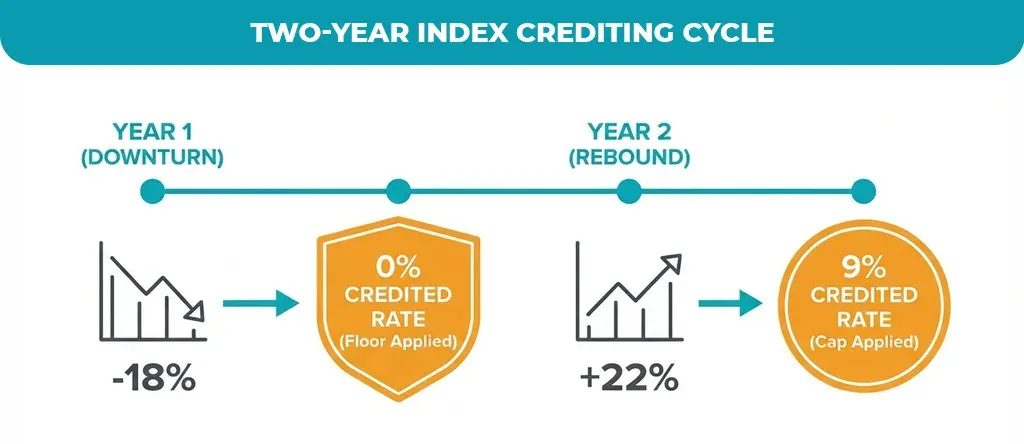
A simplified two-year cycle illustrates how the floor and cap interact:
| Policy Year | S&P 500 Index Return | Credited Rate to Cash Value |
| Year 1 (Downturn) | -18% | 0% (floor applied) |
| Year 2 (Rebound) | +22% | 9% (cap applied) |
Note that this table is illustrative only. Actual caps, floors, and participation rates vary by carrier, product, and the specific index-crediting strategy selected, and they can change at renewal.
The Core Benefits of Modern IUL Policies
Downside Market Protection
The most cited advantage of indexed universal life insurance is the 0% floor discussed above. For policyholders nervous about sequence-of-returns risk the danger of a market crash hitting right when they need to draw on savings the floor offers genuine protection against losing cash value to a bad market year.
Tax-Advantaged Growth and Policy Loans
Cash value inside an index universal life insurance policy grows on a tax-deferred basis under the framework of Internal Revenue Code Section 7702, which governs how life insurance contracts qualify for this tax treatment. Policyholders can typically access accumulated cash value through policy loans, and if the policy is structured and maintained properly, those loans can function as tax-free income during retirement, since loans are not considered taxable distributions as long as the policy stays in force.
Structural Flexibility
Universal life insurance, including the indexed variety, allows policyholders to adjust premium payments within contract limits and to modify the death benefit, choosing, for example, a level death benefit or one that increases alongside the cash value. This flexibility can be valuable as income and family circumstances change over a multi-decade horizon.
Living Benefits and Riders
Many index universal life insurance policies can be customized with riders for chronic illness, critical illness, or accelerated death benefits, letting policyholders access a portion of the death benefit early if they’re diagnosed with a qualifying condition. These riders add cost but can meaningfully expand what the policy does for a family beyond the base death benefit.
The Hidden Risks, Fees, and Drawbacks of IUL
The Reality of Caps and Index Restrictions
Every benefit above comes with a trade-off, and the cap is the most direct one. In strong bull-market years, an index universal life insurance policy will never capture the full upside of the market the way a direct equity investment would. Over a multi-decade period, capped growth can add up to a substantial gap versus a diversified stock portfolio, especially during the strongest market years.
The Danger of Policy Lapse and Underfunding
This is arguably the most serious risk associated with indexed universal life insurance, and it has drawn increasing regulatory and legal scrutiny in recent years. If a policy is underfunded, meaning premiums aren’t sufficient to cover rising internal costs nd the market delivers a string of 0% floor years, the cash value can be drawn down by fees faster than it accumulates, potentially causing the policy to lapse.
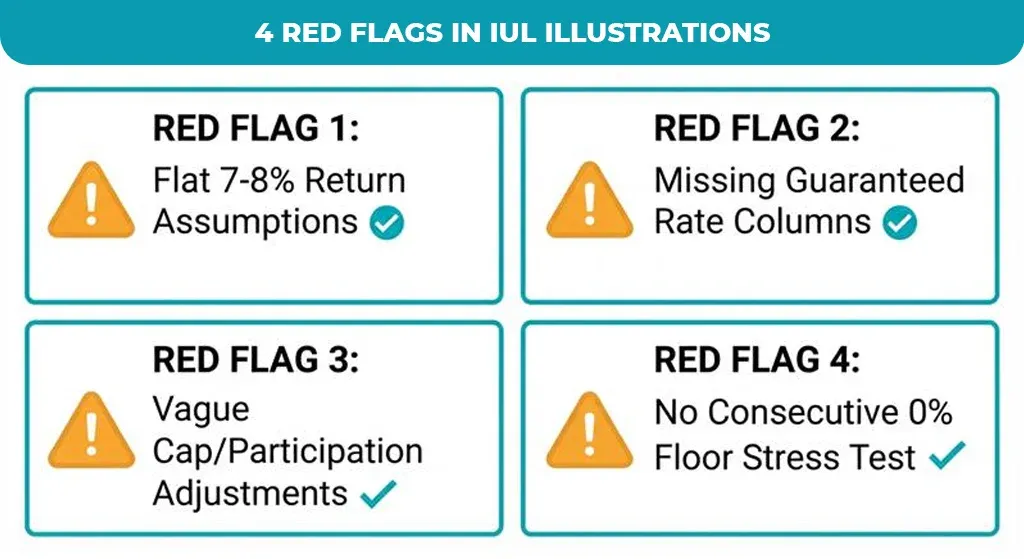
Warning signs to watch for in an indexed universal life insurance policy proposal:
- An illustration assuming a flat 7% or 8% return every single year, with no down years modeled at all.
- No ‘guaranteed’ or low-interest-rate column shown alongside the optimistic projection.
- Vague or shifting explanations of how the cap and participation rate can change after issue.
- Minimum premium funding levels that only work if caps stay at their historical best-case level.
- No stress test showing what happens to the policy after several consecutive 0% floor years.
Active Management Requirement
Unlike a set-it-and-forget-it index fund, an index universal life insurance policy needs periodic monitoring. Policyholders should review annual statements, track actual credited rates against the original illustration, and be prepared to adjust premiums if the policy is underperforming its funding assumptions.
Who Is an Ideal Candidate for IUL?
Profile of a Strong IUL Buyer
An index universal life insurance policy tends to make the most sense for high-income earners who have already maxed out their 401(k) and IRA contributions and are looking for another tax-advantaged place to accumulate savings. It can also suit business owners seeking supplemental executive benefit plans, and long-term savers who are comfortable committing to a multi-decade time horizon and have stable, predictable cash flow to fund premiums consistently.
When You Should Look Elsewhere
Indexed universal life insurance is generally a poor fit for people who simply need affordable, straightforward death benefit protection; term life insurance is far cheaper and simpler for that purpose. It’s also not well suited to short-term investors, or to anyone with tight or unpredictable monthly cash flow, since underfunding is exactly what creates lapse risk down the road.
| Feature | Whole Life | Indexed Universal Life (IUL) | Variable Universal Life (VUL) |
| Growth Potential | Low, fixed | Moderate, capped | High, uncapped |
| Downside Risk | None (guaranteed) | None (0% floor typical) | Full market risk |
| Complexity | Low | Moderate to high | High |
| Premium Flexibility | Low | High | High |
| Typical Fees | Built into guarantees | Multiple layers, rising COI | Multiple layers, rising COI |
Conclusion & Strategic Next Steps
Index universal life insurance blends permanent life insurance protection with market-linked cash value growth, offering a 0% floor against market downturns and tax-advantaged accumulation through IRC Section 7702. But that protection comes at the cost of capped upside, layered internal fees, rising cost-of-insurance charges, and real lapse risk if a policy is underfunded or illustrated too optimistically.
Before purchasing an index universal life insurance policy, audit your existing retirement savings, consult a fee-only financial planner who doesn’t earn a commission on the sale, and insist on conservative, stress-tested illustrations rather than best-case projections. An index universal life insurance policy can be a legitimate piece of a broader wealth strategy for the right buyer, but only when entered into with clear eyes about the costs and the discipline to keep it funded.