


Key Takeaways
- Credit life insurance is a form of decreasing term life insurance issued on a specific debt, according to the National Association of Insurance Commissioners (NAIC).
- The lender or financial institution is the beneficiary, not the borrower’s family.
- Premiums are commonly calculated per $100 of loan balance rather than through the age-based underwriting used in traditional life insurance.
- It is frequently offered without a medical exam, but it can cost more per dollar of coverage than a comparable term life insurance policy.
- Borrowers can typically decline credit life insurance and are not legally required to purchase it to qualify for a loan in most cases, though lenders must disclose it as optional coverage.
How Credit Life Insurance Works
Credit life insurance is generally structured as decreasing term insurance, meaning the death benefit declines over the life of the policy in step with the outstanding balance on the underlying loan. The NAIC’s statutory guidance describes several benefit structures used across the industry, including gross coverage, which insures the full scheduled loan balance on closed-end installment loans, and net payoff coverage, which pays the exact amount owed, including principal and accrued interest, at the time of death.
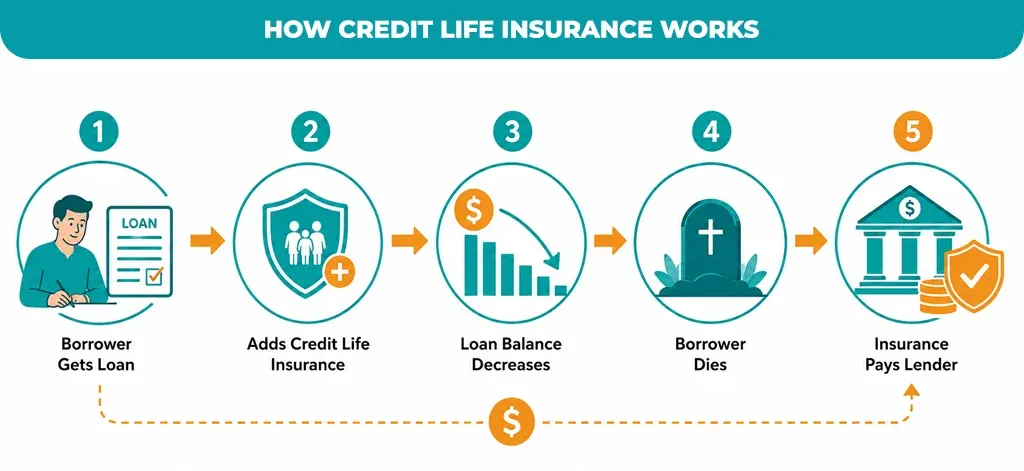
The policy is tied to a single loan, such as a mortgage, auto loan, boat loan, or personal bank loan, and it typically terminates once that loan is paid in full, refinanced, or otherwise settled. Coverage is usually issued through the lender at the time the loan is originated, and the premium is frequently rolled into the borrower’s regular monthly payment rather than billed separately.
Because credit life insurance is written for the benefit of the creditor, federal banking rules also govern how banks may offer and profit from it. Under 12 CFR Part 2, which applies to national banks, insurance recommendations must be based on the value of the coverage to the customer, and income from these sales must be credited to the bank’s own accounts rather than paid out as personal commissions to bank insiders. This structure is designed to reduce the incentive for loan officers to oversell coverage that primarily benefits the institution.
Credit life insurance is available through a range of channels beyond traditional insurers, including many credit unions. Federal credit unions and state-chartered credit unions, such as Navy Federal Credit Union and various state employees’ credit unions, commonly offer credit life and credit disability coverage as an optional add-on when members finance a vehicle, personal loan, or mortgage through the institution.
What Does Credit Life Insurance Cover?
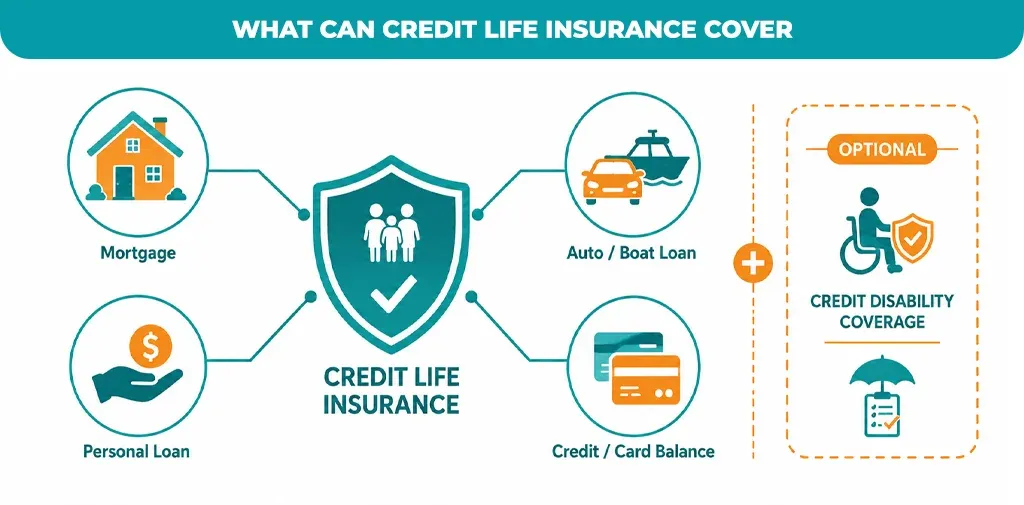
Credit life insurance generally pays a death benefit if the insured borrower dies from a covered cause while the loan and the policy are both active. Depending on the insurer and the state, some policies also offer a companion credit disability or credit accident and health rider that makes loan payments on the borrower’s behalf during a period of qualifying disability, which is a separate but related product often bundled with credit life coverage as “credit life and disability insurance.”
Eligible debts. This type of policy is most commonly attached to:
- Mortgages, sometimes marketed as mortgage credit life insurance or mortgage protection insurance
- Auto and boat loans
- Personal installment loans issued by a bank or credit union
- Certain lines of credit and credit card balances, where a similar product is sometimes sold as credit card balance protection
Common exclusions. As with most life insurance products, credit life policies contain exclusions. According to the Federal Trade Commission’s consumer guidance on credit-related insurance and standard industry practice, borrowers should expect exclusions or contestability periods for suicide within the first one to two years of the policy, and insurers may apply underwriting limitations tied to pre-existing health conditions, especially for guaranteed-issue policies that skip the medical exam. The exact exclusions, contestability period, and maximum issue age vary by insurer and by state insurance code, so the certificate of insurance is the definitive source for any individual policy.
Because eligibility is usually simplified, credit life insurance can be a practical option for borrowers who might not qualify for traditional coverage due to a health condition. However, it does not replace the broader financial protection that a personal life insurance policy provides, since the benefit is restricted to a single debt and paid to the lender rather than to dependents.
Credit Life Insurance Costs: What to Expect and How Rates Are Calculated
Credit life insurance is priced differently from most life insurance products. Rather than underwriting based on age, health, and a chosen death benefit, insurers typically use a flat premium rate per $100 of the loan’s initial or outstanding balance. This rate structure is why credit life insurance is often described as simpler to price but less individually tailored than term life insurance.
Because the same flat rate generally applies to every borrower on a given loan product, a younger, healthier borrower may pay more per $1,000 of actual coverage than they would for a medically underwritten term policy, while an older borrower or one with health conditions may find credit life insurance comparatively more accessible. States regulate these rates to prevent overcharging. As one example of how granular this regulation can get, Louisiana law caps the premium rate for declining-balance credit life insurance at 90 cents per $100 of coverage per year, with a higher cap for joint coverage on two borrowers.
Two other factors shape the total premium a borrower pays:
- Loan amount and duration. Because the premium is calculated against the loan balance, a larger loan or a longer repayment term generally increases the total premium paid over the life of the policy, even though the monthly cost is often bundled into the loan payment.
- Group versus individual coverage. Many credit life policies are sold as group credit insurance, where the lender holds a master policy and enrolls borrowers as certificate holders. Individual credit life or term life policies purchased separately from an insurance carrier may offer more flexibility in coverage amount and may be portable if the borrower refinances or pays off the loan through a different lender.
The Pros and Cons of Credit Life Insurance: Is It Worth It?
Weighing credit life insurance against a personal term life insurance policy is one of the most useful exercises a borrower can do before enrolling, since the two products solve different problems even though both can pay off a loan balance.
Pros:
- Coverage is frequently guaranteed-issue, meaning many borrowers can enroll without a medical exam or health questionnaire.
- It automatically directs a payout toward the insured debt, which can prevent a co-signer, spouse, or estate from having to cover the remaining balance out of pocket.
- The premium is usually bundled into the existing loan payment, which simplifies budgeting for borrowers who prefer not to manage a separate insurance bill.
Cons:
- Because there is limited or no medical underwriting, credit life insurance can cost more per dollar of coverage than a term life insurance policy purchased separately, particularly for younger or healthier borrowers.
- The death benefit decreases over time as the loan is paid down, but on many policies the premium does not decrease at the same pace, which can reduce the value of the coverage in the later years of the loan.
- The payout benefits the lender directly. It does not provide cash to a spouse, child, or other dependent the way a personal life insurance death benefit does.
Who Is the Beneficiary of a Credit Life Policy? Lender vs. Family
The defining feature of credit life insurance is its beneficiary structure. As Freddie Mac’s consumer education materials explain, credit life insurance payouts are made directly to the lender, while a standard life insurance policy pays the beneficiaries the policyholder names, giving the family flexibility in how the money is used.
This distinction matters because a personal life insurance policy can be used for any purpose after a death, including funeral planning, everyday living expenses, or paying down the same mortgage the borrower was worried about in the first place. Credit life insurance, by contrast, is restricted to satisfying the specific loan it was purchased to cover. The Cornell Legal Information Institute’s overview of credit insurance describes this category of products broadly as protecting the lender from loss due to a borrower’s death, disability, or unemployment.
In practice, this means a borrower who already carries adequate personal life insurance may find that a policy naming their spouse or children as beneficiaries can accomplish the same debt-payoff goal, with the added benefit of leaving flexibility in how the funds are used if the loan balance turns out to be smaller than expected at the time of death.
Credit Life Insurance vs. Term Life Insurance
Borrowers comparing credit life insurance to term life insurance are really comparing two different approaches to the same underlying concern: what happens to a large debt if the borrower dies unexpectedly. Term life insurance is underwritten individually, generally requires a health assessment for higher coverage amounts, and pays a level death benefit to the beneficiaries the policyholder names. Credit life insurance skips most underwriting, ties the benefit to a single declining loan balance, and pays the lender.
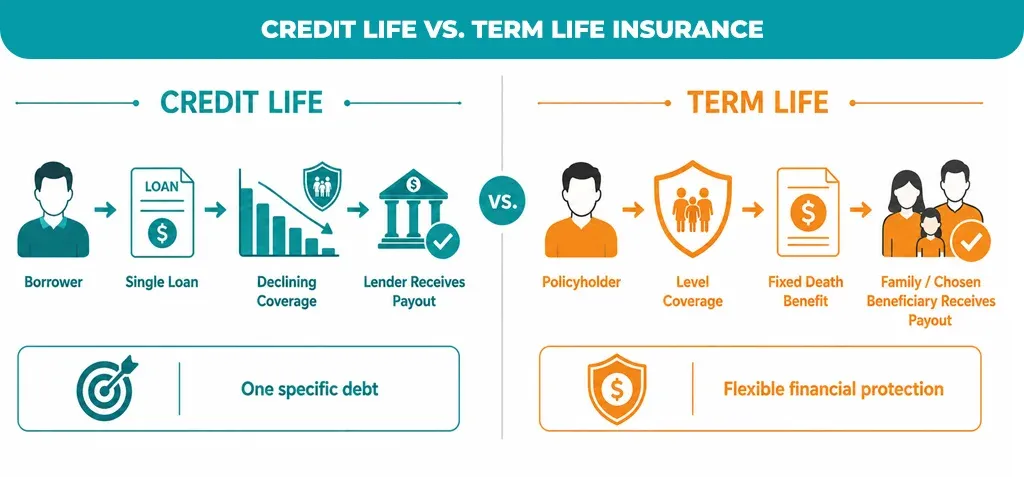
For many borrowers, a term life policy sized to cover a mortgage or major loan, in addition to other financial obligations, can provide more flexibility at a lower cost per dollar of coverage, provided the borrower can qualify medically. Credit life insurance remains a reasonable option for borrowers who cannot easily obtain traditional coverage, want the convenience of enrolling directly through their lender or credit union, or are looking for a simple way to protect a co-signer on a specific loan.
Protecting Your Financial Future with Premier Services Agency
Credit life insurance can offer a straightforward way to make sure a specific loan does not become a burden for a co-signer or family member, and its simplified enrollment can be appealing for borrowers who have health conditions that complicate traditional underwriting. At the same time, comparing its cost and structure against a personal term life insurance policy is a worthwhile step before enrolling in coverage through a lender.
At Premier Services Agency, our team can walk through your current loans, any existing life insurance coverage, and your family’s needs to help you decide whether credit life insurance, term life insurance, or a mix of the two. Visit Premier Services Agency today to get a personalized quote and speak with an experienced advisor about protecting your family’s financial future.