


Introduction
Funeral planning is the process of making the practical, legal, and financial decisions needed to honor someone who has died either in advance (pre-planning) or in the days immediately following a death. Done well, it protects grieving families from rushed decisions, unexpected bills, and disputes over a loved one’s wishes.
Losing someone is one of life’s heaviest moments, and being handed the job of arranging a final farewell while grieving can feel impossible. Families under pressure often make expensive choices they wouldn’t otherwise make, simply because no one had a plan in place. This guide walks through every stage of funeral planning from the first 24 hours after a death, to burial versus cremation, real cost ranges, your consumer rights, and how to pre-plan so your own family never has to guess.
Immediate Steps After a Death
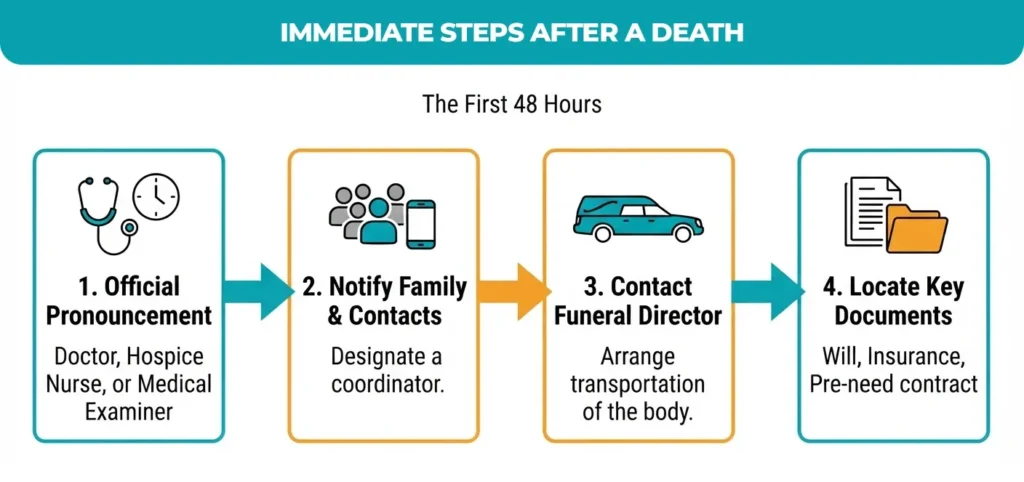
The first two days set the tone for everything that follows, so it helps to know exactly what has to happen and in what order. Whether the death occurs at home, in a hospital, or in hospice care, the core steps are the same.
- Get an official pronouncement of death. A doctor, hospice nurse, or medical examiner must formally declare the death before anything else can proceed.
- Notify immediate family and any designated emergency contacts, and ask one trusted person to help coordinate calls so the burden doesn’t fall on one grieving individual.
- Contact a licensed funeral director or mortuary to arrange transportation of the body; this can typically happen at any hour, day, or night.
- Locate key documents: the will, any pre-need funeral contract, life insurance policies, military discharge papers (DD-214) if applicable, and a list of accounts or subscriptions to cancel.
According to industry guidance from the National Funeral Directors Association (NFDA), families are generally advised to secure a death certificate within a few business days. However, local health department backlogs can extend that timeline. Ask your funeral home how long is typical in your county, since delays are common and rarely reflect anything you’ve done wrong.
Burial vs. Cremation: Weighing Your Options
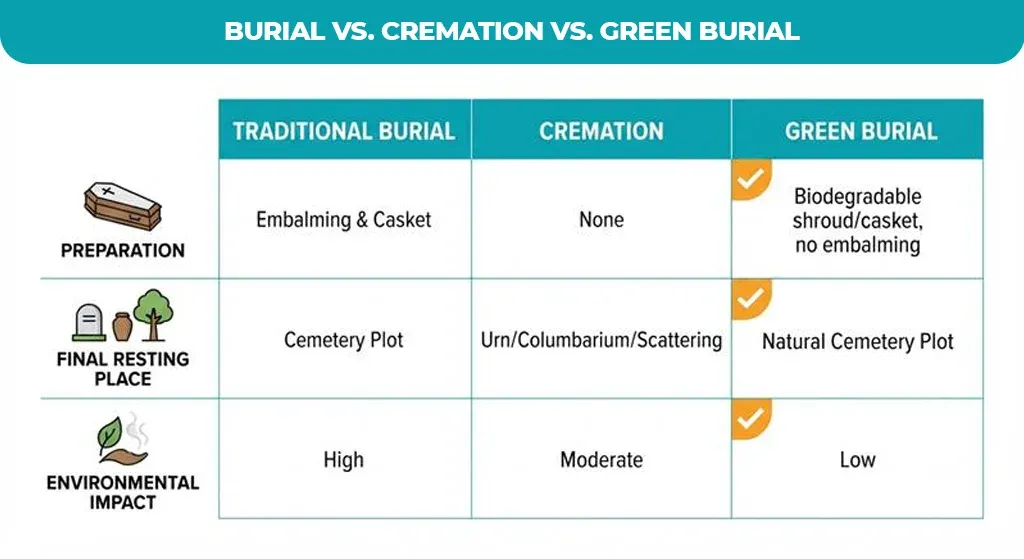
One of the biggest early decisions in any funeral plan is how the body will ultimately be cared for. There’s no universally “right” choice; the best option depends on budget, religious or cultural practice, environmental values, and what the person who died wanted.
Traditional Burial: Typically includes embalming, a casket, a burial vault or grave liner, and cemetery plot and opening/closing fees.
Cremation: Offers more flexibility on timing and can be paired with a traditional service, a memorial service afterward, or no service at all; upfront costs are usually lower than a full burial.
Green or Natural Burial: An eco-friendly option using biodegradable caskets or shrouds, without embalming chemicals or a concrete vault.
Entombment: Placement in an above-ground mausoleum crypt rather than in the ground.
If cremation is chosen, families still have many ways to memorialize their loved one: scattering ashes at a meaningful location, placing them in a columbarium niche, keeping a portion in cremation jewelry, or dividing ashes among family members.
Data from the Cremation Association of North America (CANA) has tracked a long-running rise in the U.S. cremation rate relative to traditional burial, a trend funeral homes have responded to by expanding hybrid service packages that combine a viewing with cremation afterward.
Funeral Planning Costs: What to Expect and How to Budget
It helps to have the numbers broken down into sections rather than as one daunting total because cost is typically the single biggest source of worry in funeral planning. Every funeral home is required to give you an itemized General Price List (GPL), which breaks charges into professional service fees, transportation, and merchandise like caskets or urns.
It also helps to separate direct costs paid to the funeral home or cemetery from third-party costs like flowers, obituary publication, or officiant fees, which you can often shop for independently.
| Expense Category | Average Cost Range | Mandatory vs. Optional |
| Professional service fees | $2,000 – $3,500 | Mandatory |
| Casket or container | $1,000 – $10,000+ | Mandatory (or rental) |
| Cemetery plot & vault | $2,000 – $5,000 | Only for burial |
| Cremation (direct) | $1,000 – $3,000 | Only for cremation |
| Transportation/hearse | $300 – $700 | Mandatory |
| Obituary, flowers, officiant | $200 – $2,000+ | Optional/third-party |
For a current national snapshot, check the latest NFDA Member General Price Survey, which reports median costs for an adult funeral with viewing and burial versus a funeral with cremation figures that are updated regularly and vary by state.
Ways to Fund a Funeral
- Funeral expense insurance: A small whole-life policy designed specifically to cover funeral costs.
- Prepaid funeral plans (pre-need trusts): Funds paid in advance to a funeral home or trust, locking in today’s prices.
- Payable-on-death (POD) bank accounts: Let a named beneficiary access funds immediately after death, without waiting for probate.
- Funeral home payment plans: Many funeral homes offer in-house or third-party payment plans, letting families pay over time rather than all at once.
- Personal savings or a dedicated funeral fund.
If you’re comparing the best prepaid funeral plans or looking at affordable funeral insurance plans, ask each provider directly whether funds are held in a state-regulated trust, whether the plan is transferable if you move, and what happens to any leftover balance.
Know Your Rights: The FTC Funeral Rule
The Federal Trade Commission’s Funeral Rule exists specifically to protect consumers from high-pressure or opaque funeral sales practices, and every licensed funeral home in the U.S. must comply.
- You have the right to receive an itemized General Price List (GPL) over the phone or in person, before you agree to anything.
- You can buy a casket or urn from a third-party or online retailer without the funeral home charging a handling fee.
- Funeral homes cannot require you to buy a package that includes services you don’t want.
- You must be told in writing if state law requires a specific item, like embalming, rather than being told it’s simply “required.”
Preparing Your Funeral: A Gift of Peace of Mind
Funeral pre-planning means making and often funding our own funeral decisions in advance, so your family isn’t left guessing during one of the hardest moments of their lives. It also protects against inflation, since guaranteed pre-need contracts can lock in today’s prices for services delivered years or even decades later.
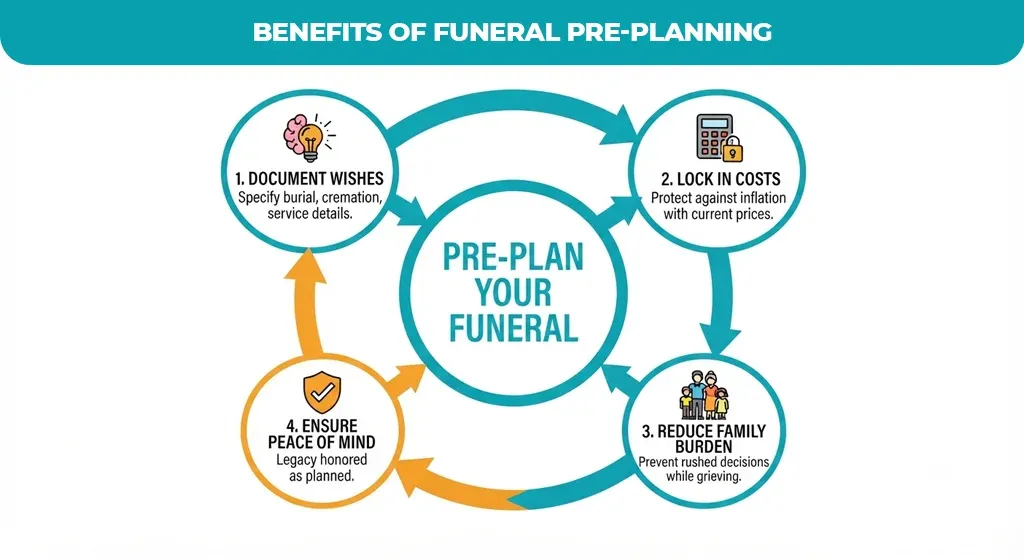
- Inventory your personal wishes: Write down specific preferences for burial or cremation, music, readings, and overall tone.
- Consult multiple providers: Compare local funeral home GPLs, prepaid funeral plans, and pre-need trust options before committing.
- Secure funding safely: Fund the plan through final expense insurance or a state-regulated trust rather than handing cash directly to a salesperson.
- Share and store the plan: Give copies to your executor, close family members, and your attorney, and note where the original is kept.
How long does it take to plan a funeral? A family making decisions after a death typically finalizes arrangements within 3–7 days, largely driven by cemetery, clergy, or crematorium scheduling. Pre-planning removes that time pressure entirely, since every decision is already made.
What High-Profile Funerals Teach Us About Planning Ahead
Public farewells for well-known figures often draw huge search interest, and looking at how they were organized shows the same core principles that apply to any family’s funeral plans just at a larger scale.
- Former Vice President Dick Cheney’s funeral, held at Washington National Cathedral in November 2025, illustrates how invitation lists, security, and a clearly published order of service keep a large, high-attention event organized and dignified.
- Wrestling icon Hulk Hogan (Terry Bollea) was honored in August 2025 with a small, private church service followed by a separate public celebration-of-life gathering- a common approach when a family wants an intimate funeral but knows many people will want to pay tribute.
- Musician Ozzy Osbourne’s send-off in July 2025 combined a public procession through his hometown of Birmingham with a separate private family funeral at his estate, a two-part structure that let fans grieve publicly while keeping the actual burial private.
The takeaway for any family: separating a private, family-only service from a larger public or celebration-of-life gathering is a practical, widely used way to manage both grief and logistics, not just something reserved for celebrities.
Conclusion
As you navigate funeral planning, remember that taking proactive steps today is one of the most compassionate gifts you can offer your family. By understanding your consumer rights, budgeting wisely, and documenting your exact wishes in advance, you transform a potentially overwhelming crisis into a peaceful, dignified tribute. Do not wait for an emergency to force your hand; secure your peace of mind and protect your loved ones from financial strain by starting your plan today.
Ultimately, refusing to wait for an emergency to force your hand allows you to secure ultimate peace of mind and protect your loved ones from unnecessary financial strain by starting your funeral planning journey right now. Taking control of these arrangements today ensures your hard-earned legacy is honored precisely as you envision, leaving behind a clear roadmap that provides comfort rather than confusion.
Start Your Funeral Plan Today
Whether you’re arranging a service this week or building your own advance funeral directives for the future, the best time to get clarity is now, not in the middle of a crisis. Request a General Price List from a licensed funeral home near you.
Ready to take the next step? Get a free quote, no-obligation funeral planning consultation, or compare prepaid funeral plans near you.