

Introduction
Few financial conversations carry as much quiet anxiety as life insurance. For millions of older adults and people managing chronic health conditions, the fear isn’t death itself, it’s rejection. A denied application, a rated policy with sky-high premiums, or a battery of medical exams that feel invasive at best and disqualifying at worst. Guaranteed life insurance exists precisely to remove that fear. It offers a path to coverage where acceptance is not a question, only a formality.
Guaranteed life insurance, sometimes called guaranteed issue life insurance or guaranteed acceptance life insurance, is a category of permanent life insurance that eliminates medical underwriting. There are no exams, no blood tests, and in most cases, no health questions at all. Approval is based on age and state of residence, not medical history.
This guide walks through what guaranteed life insurance is, who actually benefits from it, how the policies work mechanically (including the often-misunderstood graded death benefit), and a clear-eyed look at the pros and cons so you can make an informed decision rather than a fear-driven one.
What Is Guaranteed Issue Life Insurance?
Guaranteed issue life insurance is a type of permanent, guaranteed whole life insurance policy that approves every applicant within an eligible age range, typically 50 to 85, without medical exams, lab work, or health questionnaires. Coverage and premiums are fixed for life as long as the policy is described as guaranteed whole life insurance rather than a guaranteed term life insurance product, which is far less common.
What does ‘guaranteed issue’ actually mean?
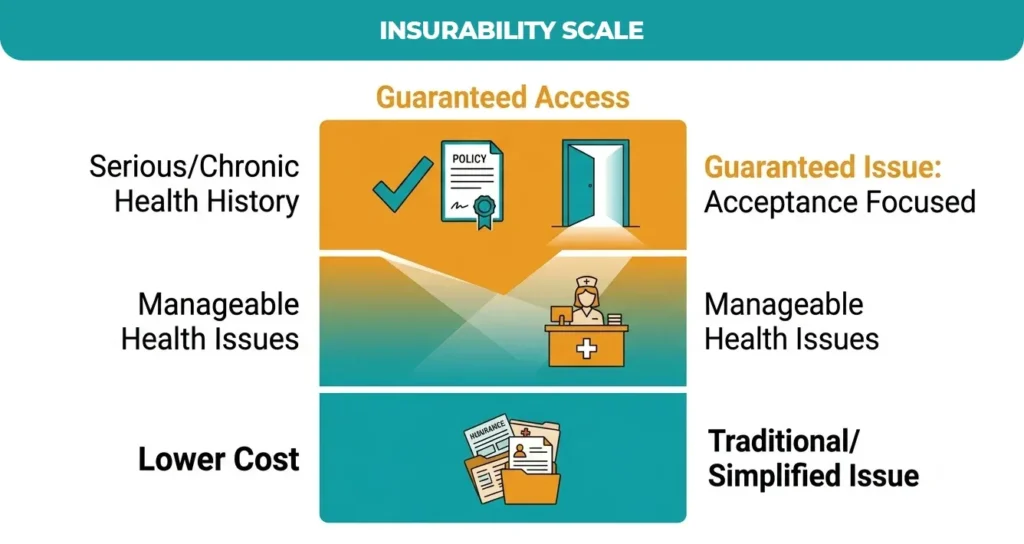
“Guaranteed issue” (sometimes marketed as guaranteed acceptance whole life insurance) means the insurer cannot decline you based on health. In our professional experience, this is the single most misunderstood feature of the product: guaranteed approval applies to whether you get a policy, not to how much the death benefit pays out immediately, a distinction the graded death benefit section below addresses directly.
Why do insurers offer this product?
Insurers offer guaranteed acceptance life insurance, no health questions products, as a deliberate trade-off. Because the carrier has no medical data on the applicant, it cannot price risk individually. Instead, it manages risk at the portfolio level by capping coverage amounts, charging higher premiums per thousand dollars of coverage, and building in a graded benefit period. Data suggests that this structure lets carriers like Mutual of Omaha, Colonial Penn, AIG, and Globe Life serve an otherwise “uninsurable” population profitably.
Traditional underwritten life insurance prioritizes the lowest possible premium for healthy applicants. Guaranteed life insurance flips that priority: it optimizes for access and simplicity first, accepting a higher cost per dollar of coverage as the price of certainty.
Who Is Guaranteed Life Insurance For?
Guaranteed life insurance for seniors is the product’s core use case, but it also serves a narrower band of younger applicants who have been declined elsewhere. As a rule of thumb, this product makes sense when traditional or even simplified issue coverage isn’t an option, not as a first choice for healthy applicants.
Ideal Candidates
- Seniors, typically ages 50–80, who want dedicated final expense coverage without a medical exam.
- Individuals managing chronic illness or a high-risk medical history, such as advanced diabetes, COPD, or a history of cancer treatment.
- Applicants who have been previously declined for a traditional or simplified issue
life insurance and need a fallback option.
Common Use Cases
- Covering funeral and burial costs, which the National Funeral Directors Association estimates can run from roughly $7,000 to $12,000, depending on services chosen.
- Paying off small remaining debts, such as a credit card balance or medical bills, so they don’t pass to a spouse or estate.
- Leaving a modest legacy or “final gift” to children or grandchildren, separate from a larger estate plan.

Secure Your Family's Future with Confidence
Don’t leave your loved ones' financial security to chance. Use our expert tools and free resources to find the perfect coverage today.
How Does Guaranteed Life Insurance Work? (The Mechanics)
Guaranteed life insurance works through a simplified application, a fixed premium structure, and a graded death benefit during the policy’s early years. Understanding all three components, not just the “no exam” headline, is essential before you buy.
The Approval Process
Most carriers offering guaranteed acceptance life insurance with no waiting period for approval (note: the waiting period applies to the death benefit, not the approval itself) can issue a policy within minutes of a completed application. Applicants typically provide only their name, date of birth, state of residence, and payment information. There is no nurse visit, no urine or blood sample, and no review of prescription history through the MIB Group database.
The Graded Death Benefit
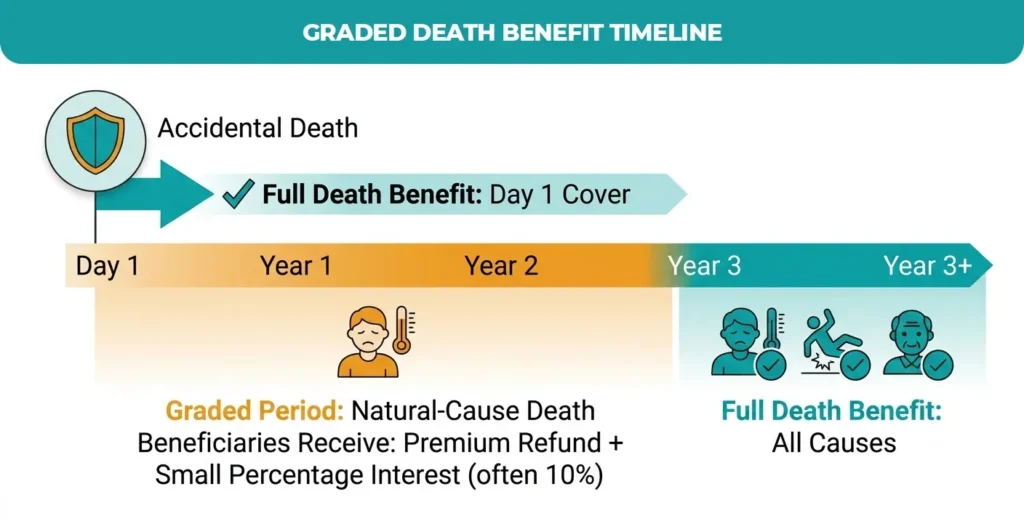
This is the single most important mechanic to understand. Nearly every guaranteed issue whole life insurance policy includes a graded death benefit with a waiting period of two to three years from the policy’s effective date.
- If the policyholder dies from natural causes (illness) during this waiting period, beneficiaries typically do not receive the full face value. Instead, they usually receive a refund of all premiums paid, plus a small percentage of interest, often around 10%.
- If the policyholder dies from an accident during the waiting period, most policies pay the full death benefit immediately. Accidental death is typically excluded from the graded limitation.
- After the waiting period ends, the policy pays the full face value for any cause of death, with no further restrictions.
Premium Stability
Premiums on guaranteed whole life insurance are level for life. Once your rate is locked in at issue, it will not increase as you age or if your health declines, a meaningful advantage over annually renewable products, and one of the clearest selling points carriers use in guaranteed universal life insurance and guaranteed whole life insurance marketing.
Guaranteed Acceptance Life Insurance’s Benefits and Drawbacks
Like any financial product built around access rather than optimization, guaranteed life insurance involves real trade-offs. Weighing them honestly is the difference between a policy that serves you well and one that disappoints your beneficiaries.
Benefits
- Guaranteed approval regardless of health conditions or age, within the eligible range.
- No medical exams, lab work, or intrusive health questionnaires.
- Permanent coverage that stays in force for life as long as premiums are paid.
- Fixed, predictable monthly costs that never increase.
Drawbacks
- Higher premiums: the cost per $1,000 of coverage is significantly above traditional underwritten policies, sometimes several times higher.
- Lower coverage limits: most policies cap out in the $5,000–$50,000 range, though some carriers advertise guaranteed issue life insurance $100k tiers for younger, healthier applicants within the guaranteed issue band. These are the exception rather than the rule.
- The graded death benefit: full payout isn’t available until after the two-to-three-year waiting period for natural-cause deaths.
- Minimal cash value: Some policies build limited cash value over time, but it typically accumulates far more slowly than in fully underwritten whole life insurance.
How to Choose the Right Policy
Selecting the right guaranteed life insurance policy comes down to matching the product to your actual financial goal, then comparing carriers on price, terms, and the fine print of the graded benefit.
Final Expense Coverage Checklist
Assess Your Needs
Ask whether you need final expense coverage or income replacement. If it’s income replacement for dependents, guaranteed issue is the wrong product category; look instead at term or fully underwritten whole life insurance.
Compare Quotes
Compare at least three carriers before purchasing. Premiums for otherwise identical face amounts can vary meaningfully between insurers such as Mutual of Omaha guaranteed life insurance, Colonial Penn, AIG, and Globe Life, even though the underlying product structure is similar across the industry.
Read the Fine Print
Specifically check the graded death benefit terms: the exact length of the waiting period, whether accidental death is fully covered from day one, and exactly how the premium-refund-plus-interest calculation works if death occurs during the graded period.
Consider a Consultation
If you’re unsure whether you’d qualify for simplified issue life insurance, speak with a licensed insurance agent before defaulting to guaranteed issue. Simplified issue policies ask a short list of health questions but skip the exam, and they often offer higher coverage limits and lower premiums than guaranteed issue for applicants in reasonably good health.
Conclusion
Guaranteed life insurance costs more per dollar of coverage than traditional underwritten policies, and its graded death benefit means full payout isn’t immediate. But for the population it’s designed for, older adults and individuals with serious health conditions who have been turned away elsewhere, it provides a vital safety net that traditional insurers won’t offer.
The real value of this product isn’t the death benefit alone; it’s the peace of mind that comes from knowing funeral costs, small debts, and final expenses won’t become a burden on the people you leave behind.
Need Clarity on Your Coverage Options?
Deciding between guaranteed issue and simplified issue life insurance can be complex. At Premier Services Agency, we help you navigate your unique health profile to find the coverage that provides the best protection for your budget.
Secure Your Family's Future with Confidence
Don’t leave your loved ones' financial security to chance. Use our expert tools and free resources to find the perfect coverage today.
FAQs
Guaranteed life insurance is a good fit for the specific situation it was built for: someone who cannot qualify for traditional or simplified issue coverage and primarily needs final expense protection. It is not a good value for healthy applicants who could qualify for cheaper, higher-coverage alternatives.
Colonial Penn’s advertised $9.95-a-month rate is a starting price for a unit of guaranteed acceptance whole life coverage, not a fixed total death benefit. The actual face amount that a premium buys depends on age and sex, and most applicants will need to purchase additional units to reach a meaningful final expense coverage amount.
Yes. Someone with a pacemaker can typically qualify for guaranteed issue life insurance without any health questions, since approval isn’t based on medical history. Depending on how long ago the device was implanted and the overall cardiac health.
There is no single “best” guaranteed life insurance carrier for every applicant; the right choice depends on your state, age, desired coverage amount, and budget. The most reliable approach is to compare quotes from at least three well-rated carriers and review the graded death benefit terms side by side rather than choosing based on advertising alone.