

Short-Term vs Long-Term Disability Insurance
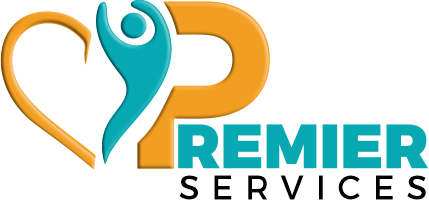
Short-term disability insurance covers brief absences from work, typically 13 to 26 weeks, and starts paying quickly. Long-term disability insurance covers serious conditions that last months or years, and benefits can continue for a set number of years or until retirement age.
What is short-term disability insurance?
Short-term disability insurance replaces about 40% to 70% of your income, according to Guardian, for a short period, usually 13 to 26 weeks. Benefits often begin after a waiting period of a week or two. It commonly covers recovery from surgery, injuries, pregnancy and childbirth, and short illnesses. Most people get short-term coverage through an employer or a state program. Read our full guide to short-term disability insurance for more detail.
What is long-term disability insurance?
Long-term disability insurance replaces about 60% to 80% of your monthly income, according to Guardian, when a disability lasts beyond the short-term period. Policygenius notes that benefit periods can last two, five or 10 years, until age 65, or for life, and a longer benefit period costs more.
What does long-term disability insurance cover?
Long-term disability insurance covers conditions that keep you out of work for an extended period, such as cancer, heart disease, back and spine disorders, serious injuries, and mental health conditions, subject to the policy’s definition of disability and exclusions. Some group policies limit benefits for mental health and substance use conditions to a set period, often two years, so check the policy wording.
What is long-term disability insurance through an employer?
Employer-provided long-term disability is a group policy your employer offers, sometimes at no cost to you. It’s usually cheaper than individual coverage, but Guardian notes that group coverage offers less flexibility and typically ends when you leave the job. If your employer pays the premium, your benefits are generally taxable. Many people add an individual policy to fill the gap. Our long-term disability insurance guide covers both options.
Short-term vs long-term disability comparison
Feature | Short-term disability | Long-term disability |
How long benefits last | Typically 13 to 26 weeks | Two, five or 10 years, to age 65, or for life |
Income replaced | About 40% to 70% | About 60% to 80% |
When benefits start | After a short waiting period, often 0 to 14 days | After a longer elimination period, often 90 days |
Common causes | Surgery, childbirth, injuries, short illnesses | Cancer, heart disease, back problems, chronic illness |
Where you get it | Employer, state program or individual policy | Employer, association or individual policy |
Sources: Guardian (income replacement and short-term duration) and Policygenius (benefit periods). Waiting periods vary by policy.
Key Disability Insurance Terms to Understand
Three terms shape how much a disability policy pays and how much it costs: the elimination period, the definition of disability and the benefit period. Understanding them is the easiest way to compare policies fairly.
What is the elimination period in a disability insurance policy?
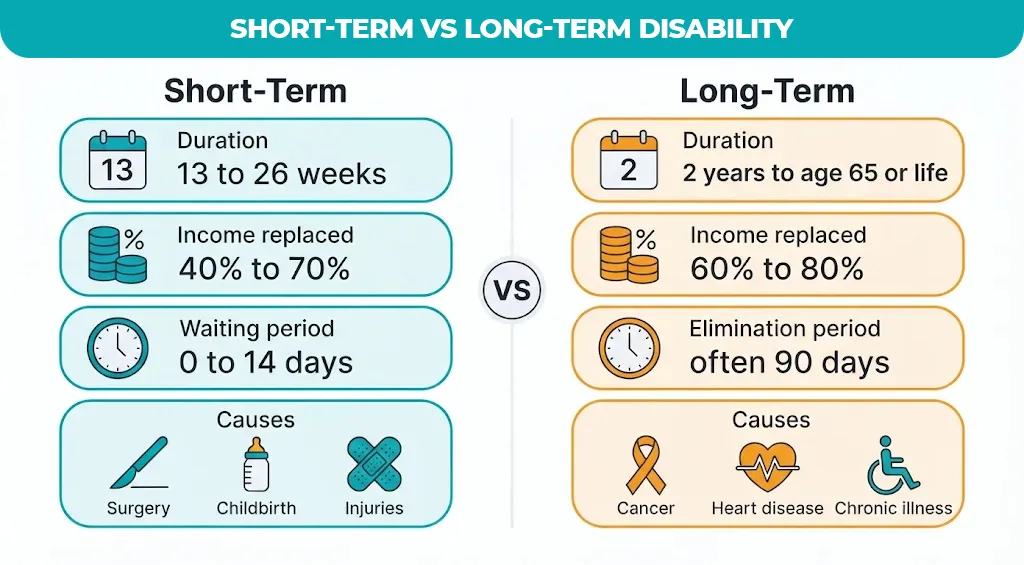
The elimination period is the waiting period between the day your disability begins and the day benefits start. It works like a deductible measured in time instead of dollars: you cover your own expenses during that period. Policygenius notes that a shorter elimination period raises your premium and a longer one lowers it.
Elimination period | Premium | Best for |
0 to 14 days (short-term) | Higher | People with little emergency savings |
30 to 60 days | Moderate | People with a month or two of savings |
90 days (common for long-term) | Lower | People with about three months of savings or short-term coverage |
180 days or more | Lowest | People with large savings or other income |
Note: Match your elimination period to your emergency fund and any short-term disability coverage. If your employer’s short-term disability pays for 13 weeks, a 90-day long-term elimination period lines up neatly with it.
What is own-occupation disability insurance?
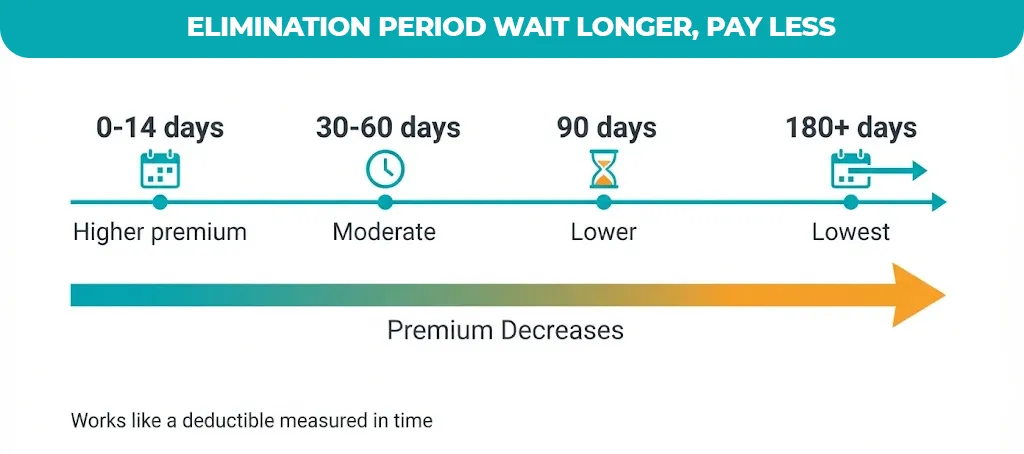
Own-occupation disability insurance pays benefits if you can’t perform the duties of your specific job, even if you could work in another field. Policygenius gives the example of a surgeon with a hand injury who can’t operate but could still teach: an own-occupation policy would still pay. This definition is especially valuable for doctors, dentists, lawyers and other specialized professionals, and it costs more.
Own-occupation vs any-occupation
Definition | When it pays | Cost |
Own-occupation | You can’t do your own job, even if you can do another | Highest |
Modified own-occupation | You can’t do your own job and aren’t working in another | Moderate |
Any-occupation | You can’t do any job you’re reasonably suited for by education, training or experience | Lowest |
Many group long-term disability policies use an own-occupation definition for the first two years and then switch to any-occupation, so read the definition section of your policy.
Other features and riders
- Benefit period: How long benefits can last, such as two, five or 10 years, or to age 65.
- Monthly benefit amount: The dollar amount or percentage of income the policy pays.
- Residual or partial disability rider: Pays a partial benefit if you can work but earn less.
- Cost-of-living adjustment (COLA) rider: Increases benefits with inflation during a long claim.
- Future increase option: Lets you buy more coverage as your income grows without new medical underwriting.
- Non-cancelable or guaranteed renewable: The insurer can’t cancel your policy as long as you pay, and a non-cancelable policy also locks your premium.
Other Types of Disability Insurance Explained
Beyond short-term and long-term policies, disability coverage comes in several other forms, depending on who provides it and what it pays for. Some protect your income, some protect a specific debt, and some protect a business.
What is group disability insurance?
Group disability insurance is coverage an employer or association buys for its members under one master policy. It’s usually cheaper than individual coverage and may require little or no medical underwriting, but benefits are often capped and coverage typically ends when you leave the group. According to the BLS, 44% of private industry workers had access to short-term disability plans and 37% to long-term disability plans in March 2026.
What is supplemental disability insurance?
Supplemental disability insurance is an individual policy that adds to the coverage you already have through work. It’s useful for higher earners whose group benefits are capped at a maximum monthly amount, and because you own it, it stays with you if you change jobs. If you pay the premiums with after-tax dollars, the benefits are generally tax-free.
What is state disability insurance?
State disability insurance (SDI) is a temporary disability program run by a state and usually funded through payroll deductions. Five states have mandatory short-term or temporary disability programs: California, Hawaii, New Jersey, New York and Rhode Island, and Puerto Rico has one as well. If you work in one of these states, you may already have some short-term coverage. Benefits and rules vary by state, so check with your state’s program.
What is Social Security Disability Insurance (SSDI)?
Social Security Disability Insurance is a federal program that pays monthly benefits to people who can’t work because of a disability and who have enough work history. The SSA’s definition is strict: you must be unable to engage in any “substantial gainful activity” because of a condition that has lasted or is expected to last at least 12 months. Benefits usually can’t begin until the sixth full month after your disability starts.
For 2027, the SSA says substantial gainful activity is $1,770 a month for non-blind individuals and $2,950 a month for blind individuals.
What is retirement, survivors and disability insurance (RSDI)?
Retirement, Survivors and Disability Insurance is the formal name for the Social Security program funded by payroll taxes. It pays retirement benefits, benefits to survivors of deceased workers and disability benefits through SSDI. When you see “RSDI” on a form or pay stub, it refers to Social Security.
What is credit disability insurance?
Credit disability insurance, also called credit accident and health insurance, makes a limited number of monthly loan payments on a specific loan if you can’t work because of illness or injury. According to the NAIC, payments go to the lender, not to you, and the primary purpose is to keep that loan current. It’s optional: except for private mortgage insurance, the NAIC says lenders can’t deny you credit if you decline optional credit insurance. Compare its cost with a traditional disability policy, which may be cheaper. Our guide to credit life insurance covers the related death benefit product.
What is mortgage disability insurance?
Mortgage disability insurance pays your monthly mortgage payment, usually for a limited time, if you become disabled. Like credit disability insurance, it protects one debt rather than your whole income. A standard individual disability policy is often more flexible, because you can use the benefit for the mortgage or anything else.
What is key person disability insurance?
Key person disability insurance is a business policy that pays the company, not the employee, if an owner or essential employee becomes disabled. The money can cover lost revenue, recruiting and training a replacement, or debt payments while the key person is out. Business owners should also look at life insurance for business owners for the same people.
Type | Who pays the benefit to | What it protects |
Individual (short- or long-term) | You | Your income |
Group | You | Your income, up to group limits |
Supplemental | You | Income above group limits |
State disability insurance | You | Short-term income in participating states |
SSDI | You (and eligible family) | Income for severe, long-term disabilities |
Credit disability | Your lender | A specific loan |
Mortgage disability | Your lender or you | Your mortgage payment |
Key person disability | Your business | Business revenue and continuity |
How Much Does Disability Insurance Cost?
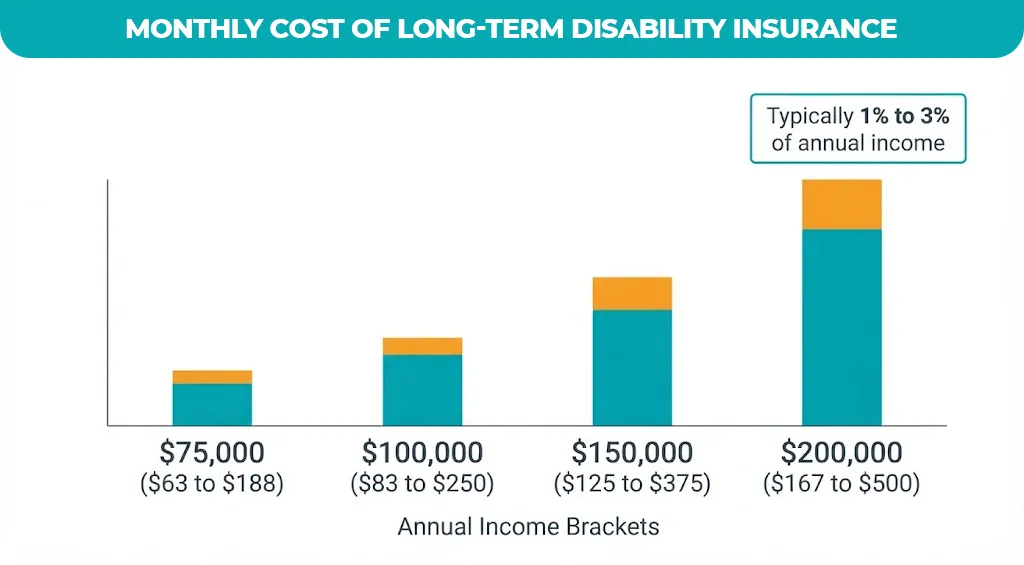
Individual long-term disability insurance typically costs about 1% to 3% of your annual income, according to both Guardian and Policygenius. For someone earning $100,000 a year, that works out to roughly $83 to $250 a month.
Disability insurance cost per month by income
Annual income | Estimated monthly premium |
$75,000 | $63 to $188 |
$100,000 | $83 to $250 |
$150,000 | $125 to $375 |
$200,000 | $167 to $500 |
Source: Policygenius sample long-term disability premiums (updated July 2024). Ranges are non-binding estimates, and final premiums are set by the insurer.
Your premium depends on:
- Age and health: Older applicants and people with health conditions pay more.
- Occupation: Jobs with physical risk or specialized skills cost more to insure. Policygenius’s sample ranges run from $54 to $163 a month for teachers to $165 to $885 a month for doctors.
- Income and benefit amount: A higher monthly benefit costs more.
- Elimination period: A shorter wait means a higher premium.
- Benefit period: Coverage to age 65 costs more than a two- or five-year benefit.
- Riders: Own-occupation, COLA and residual disability riders add cost.
Group coverage through an employer usually costs less, and your employer may pay part or all of the premium.
How much are most disability checks?
The amount depends on the source. For SSDI, the SSA reports an average monthly benefit of $1,642 for all disabled workers before the 2027 cost-of-living adjustment, rising to about $1,701 after the 3.6% increase. Private disability policies typically replace about 60% to 80% of income for long-term coverage and 40% to 70% for short-term coverage, up to each policy’s monthly maximum.
Hypothetical example
Monthly income: $5,000
Long-term policy pays: 60% of income
Monthly benefit: $5,000 x 0.60 = $3,000
Compared with average SSDI: about $1,701 a month (2027)
This example is hypothetical. Your actual benefit depends on your policy terms and, for SSDI, your earnings record.
Who Needs Disability Insurance and Why?
Anyone who depends on a paycheck to cover their living expenses should consider disability insurance. That includes most working adults, but especially sole earners, self-employed people and workers without employer coverage.
You’re a strong candidate if you:
- Are the main or only earner in your household
- Are self-employed or a small business owner with no group coverage
- Work in a specialized profession where an own-occupation policy protects your career income
- Have a mortgage, car loans or other debts you’d struggle to pay without income
- Have less than six months of expenses saved
- Earn more than your group policy’s monthly cap
You may need less coverage if you have large savings or investment income that could replace your paycheck for years, or if your employer already provides strong long-term coverage with a high monthly maximum.
Is it a good idea to have disability insurance?
For most working adults, yes. The SSA estimates that just over 1 in 4 of today’s 20-year-olds will become disabled before age 67, and SSDI is hard to qualify for and pays a modest average benefit. Private disability insurance can replace a much larger share of your income and starts sooner.
Hypothetical example: two workers, two outcomes
This example is hypothetical. Maria, 42, is a dental hygienist earning $6,000 a month. She buys an individual long-term disability policy that pays 60% of her income after a 90-day elimination period. When a back injury keeps her out of work for 14 months, her policy pays $3,600 a month after the waiting period, and she keeps up with her mortgage.
Darnell, 42, has no disability coverage and the same injury. He relies on his savings, which run out in four months. He applies for SSDI, but because his condition isn’t expected to last 12 months, he doesn’t meet the SSA’s definition of disability.
Note: Disability insurance protects income while you’re working. It’s separate from life insurance, which pays your family if you die, and from long-term care insurance, which pays for care if you can’t perform daily activities. Many families need more than one. If you’re comparing protection options, our guide to accidental death insurance explains another narrow type of coverage.
Conclusion
Disability insurance replaces part of your paycheck when an illness or injury keeps you from working. Short-term coverage handles brief absences, long-term coverage protects you through serious conditions, and features such as the elimination period, the definition of disability and the benefit period decide how well a policy works for you. Social Security and state programs help, but they rarely replace enough income on their own.
If this describes you | Consider |
Your employer offers no disability coverage | An individual long-term disability policy |
Your group benefit is capped below your needs | Supplemental disability insurance |
You’re self-employed | Individual long-term coverage, plus key person coverage if you have a business |
You work in a specialized profession | A policy with an own-occupation definition |
You want to protect one loan only | Credit or mortgage disability insurance, compared with a standard policy first |
You also want to protect your family if you die | Disability insurance plus term life insurance |
At Premier Services Agency, our licensed agents help families across the United States compare insurance options and find coverage that fits their budget. Get a free quote, call us at (470) 650-0470, or contact our team to talk through how to protect your income and your family.