


Long-term disability insurance is the one policy most working adults never think about until they need it, and by then, it’s too late to buy. Imagine losing the ability to work for a year, three years, or the rest of your career, while your mortgage, medical bills, and everyday expenses keep arriving on schedule. Most people carefully insure their homes, cars, and even their lives, yet they leave their single largest financial asset, their ability to earn an income,completely exposed.
The numbers make the risk hard to ignore. According to the Council for Disability Awareness, more than 1 in 4 of today’s 20-year-olds will experience a disabling illness or injury before they reach retirement age. Workers’ compensation won’t help here either, since it only applies to injuries that happen on the job. This guide walks through exactly how long-term disability insurance works, what it costs, how to read the fine print, and how to choose a policy that will actually pay out when you need it most.
What Is Long-Term Disability Insurance and Why Do You Need It?
Understanding Long-Term Disability Insurance Basics
At its core, long-term disability insurance (often shortened to LTD) is a policy that replaces a portion of your income, typically 50% to 70%, if illness or injury keeps you out of work for an extended period. It’s designed to bridge the gap between a short-term setback and a permanent loss of earning capacity.
There’s a persistent myth that disability mostly happens because of dramatic workplace accidents a fall from a ladder, a factory injury, something sudden and visible. The data tells a different story. The majority of long-term disability claims are actually driven by ordinary illnesses: cancer, musculoskeletal disorders like chronic back pain, cardiovascular and circulatory conditions, and mental health conditions.
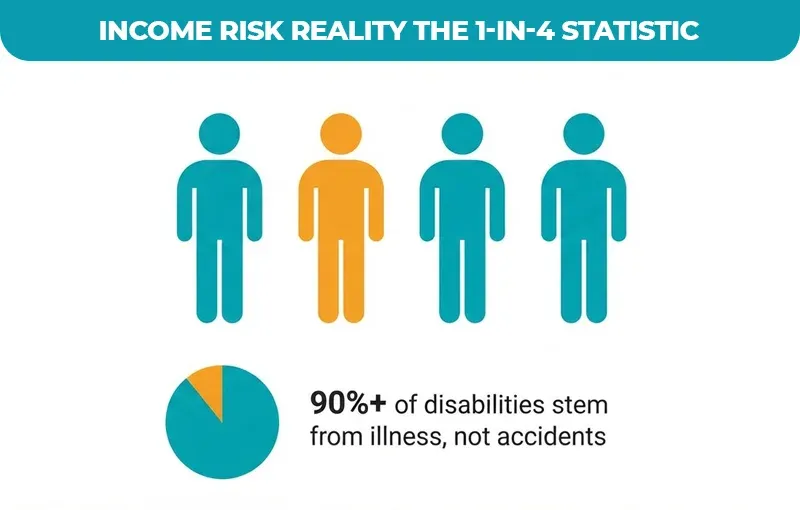
This discrepancy affects your perspective on danger. You don’t need to work construction or drive a delivery truck to be vulnerable; a software engineer diagnosed with cancer or a nurse with a degenerative spine condition faces the same income cliff.
Key statistics to understand your risk:
- Over 1 in 4 workers entering the workforce today will experience a disability before retirement, per Council for Disability Awareness estimates.
- More than 90% of long-term disabilities stem from illness, not accidents a figure widely cited using Social Security Administration and CDA data.
- Group health and auto insurance won’t replace lost wages; only disability insurance is built for that specific purpose.
If you rely on a single paycheck to cover your mortgage, retirement contributions, and family expenses, long-term disability insurance isn’t a luxury add-on; it’s the piece of your financial plan that protects everything else you’ve already built.
How Long-Term Disability Insurance Works
Navigating Elimination Periods, Benefit Periods, and Payouts
Every long-term disability insurance policy is built around three moving parts: when benefits start, how long they last, and whether the payout is taxed. Understanding these three levers is the difference between a policy that fits your life and one that quietly fails you when a claim comes in.
The elimination period is the waiting period between the day your disability begins and the day benefits actually start, comparable to a deductible, but measured in time rather than dollars. Common elimination periods run from 90 to 180 days. Choosing a longer elimination period lowers your monthly premium, but it also means a longer stretch where you’ll need emergency savings or short-term disability insurance to cover the gap.
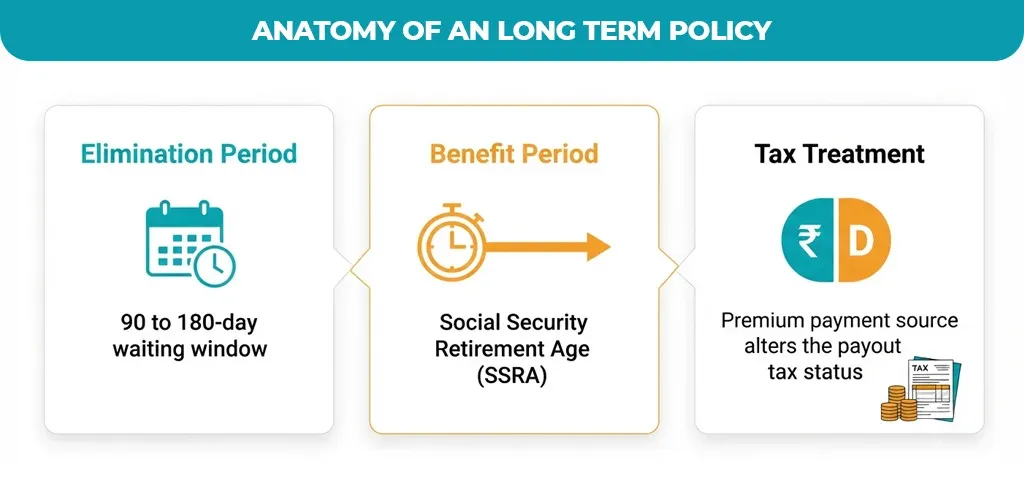
The benefit period determines how long payments continue once they start. Insurers typically offer options of 2, 5, or 10 years, or a benefit period that runs all the way to your Social Security Retirement Age (SSRA). A policy that pays until SSRA costs more, but it also protects you against the worst-case scenario: a permanent, career-ending condition.
Taxability of benefits is one of the most overlooked details in disability insurance planning:
| Who Pays the Premium | Tax Treatment of Benefits |
| You pay with after-tax dollars (individual policy) | Benefits are received tax-free |
| Employer pays the premium | Benefits are taxable as income |
| You pay with pre-tax payroll dollars | Benefits are taxable as income |
This single detail can change your real-world income replacement by thousands of dollars a year. Industry benchmarks from groups like LIMRA and major carriers such as MetLife and Guardian show that most group plans are structured as taxable benefits, while individually purchased policies are far more likely to pay out tax-free, a major reason financial planners often recommend layering an individual policy on top of employer coverage.
Own Occupation vs. Any Occupation: Decoding Policy Language
The Critical Definitions of Disability That Make or Break a Claim
If you read only one section of your policy before signing, make it the definition of disability. This single clause determines whether you actually get paid when you file a claim, and it’s where many people are blindsided.
Own occupation coverage considers you disabled if you can no longer perform the specific material duties of your own specialized job or career, even if you’re physically capable of working a different job. This distinction is critical for surgeons, dentists, specialized IT professionals, pilots, and attorneys, whose skills don’t easily transfer to another line of work.
Any occupation coverage applies a much stricter standard. Under this definition, you’re only considered disabled if you can’t perform any job reasonably suited to your education, training, and experience, not just your current one. A surgeon who can no longer operate but could plausibly work as a medical consultant might not qualify as disabled under this definition.
Hybrid or “split” definitions are extremely common in group and individual plans alike. Many policies apply the “own occupation” standard for the first 24 months of a claim, then shift to the stricter “any occupation” standard afterward, meaning your benefits can be cut off years into a claim if you’re deemed capable of some job, even one paying far less than your original career.
| Definition Type | Standard for Disability | Best Suited For |
| Own Occupation | Cannot perform duties of your specific job | High-skill, specialized, or licensed professionals |
| Any Occupation | Cannot perform any job suited to your background | Lower-cost policies, general workforce |
| Hybrid/Split (24-month) | 24 months of own occ, followed by any occ | Most group and many individual policies |
Because this clause is so consequential, it’s also the most common point of dispute in denied claims one reason a long-term disability insurance lawyer is often the first call people make when a claim is denied, or benefits are unexpectedly terminated after the “own occ to any occ” switch.
Group vs. Individual Policies: Which Is Right for You?
Comparing Employer-Sponsored Group LTD vs. Individual Coverage
Most people’s first exposure to long-term disability insurance coverage comes through an employer benefits package, but relying on that alone can leave real gaps. Here’s how the two options actually compare.
Employer-sponsored group plans:
- Pros: Often heavily subsidized or fully paid for by the employer; underwriting is usually simple, frequently with no medical exam required; easy to enroll during open enrollment.
- Cons: Benefits are usually taxable, which quietly shrinks your real income replacement; payouts are often capped at a maximum dollar amount regardless of your actual salary; coverage is non-portable, meaning it ends the moment you leave the job.
Individual disability insurance (IDI):
- Pros: Fully portable and yours to keep regardless of employer; benefits are tax-free when premiums are paid with after-tax dollars; highly customizable through riders; guaranteed renewable, meaning the insurer cannot cancel as long as you continue to pay premiums; you can cancel your insurance.
- Cons: Requires full individual underwriting, including health history and sometimes a medical exam; typically more expensive out-of-pocket than group coverage.
What Does Long-Term Disability Insurance Cost?
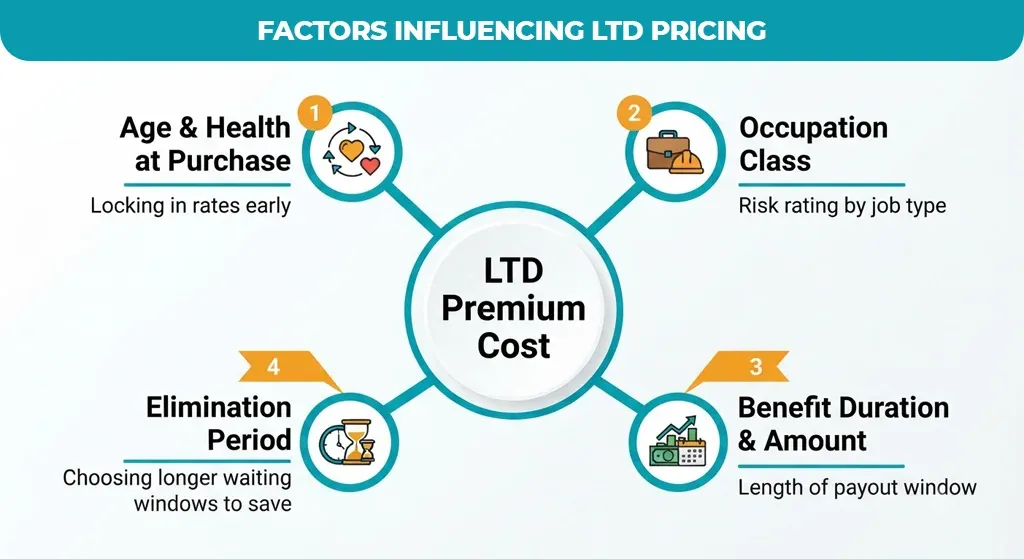
Factors That Impact Your LTD Insurance Premiums
When people search for long-term disability insurance quotes, the number that comes back can vary enormously, and for good reason. As a rough baseline, individual LTD premiums typically run between 1% and 3% of your annual salary per year, though your actual long-term disability insurance cost depends on several personal factors.
Key pricing factors:
- Age and health at purchase. Locking in a policy in your 20s or 30s, while you’re healthy, secures lower rates than waiting until your 40s or 50s.
- Occupation class. Insurers assign risk classes by job type; a desk-based professional carries a lower risk rating (and lower premium) than someone in manual labor, construction, or high-acuity medical roles.
- Benefit amount and duration. A higher monthly benefit and a longer benefit period (especially one running to Social Security Retirement Age) both increase your premium.
- Elimination period chosen. A shorter waiting period before benefits begin costs more; a longer one costs less but requires a bigger emergency-savings cushion.
Actionable ways to lower your premium without gutting your coverage:
- Extend your elimination period from 30 or 60 days to 90 days if you have adequate emergency savings to bridge the gap.
- Choose a benefit period that matches your actual risk window rather than defaulting to the longest, most expensive option.
- Buy while you’re young and healthy, and consider a Future Increase Option rider instead of over-insuring today.
- Compare quotes across multiple carriers; pricing for identical coverage can vary significantly between insurers for the same health profile.
When people ask whether the best long-term disability insurance is the cheapest option, the honest answer is no; the best policy is the one whose definition of disability, benefit period, and riders actually match your occupation and risk tolerance, at a premium you can sustain for decades.
Final Thoughts
Long-term disability insurance isn’t a box to check; it’s the financial backstop that keeps a health crisis from becoming a permanent financial crisis. Whether you’re evaluating your employer’s group plan, comparing long-term disability insurance quotes from individual carriers, or deciding whether it’s time to consult a long-term disability insurance attorney over a denied claim, the goal is the same: protect the income that funds everything else in your life.
Start by reviewing your current employer coverage, identify the gaps, especially around taxability, portability, and the “own occ to any occ” switch, and get a quote for an individual policy while you’re still young and healthy enough to lock in favorable rates. Your ability to earn a living is your most valuable financial asset. Insure it accordingly.