


Burial insurance is one of the few insurance products where the price you see on TV can be very different from the price you’ll actually pay. A healthy 65-year-old woman can buy $10,000 of immediate burial coverage for about $41 a month, but the advertised $9.95 and $1 offers rarely buy that much. This guide lays out real 2026 rates by age and sex, compares AARP, State Farm, Globe Life, and independent carriers, explains the marketing math, and shows how to figure out how much coverage you need.
Quick answer: In 2026, burial insurance costs about 24–31 a month for $10,000 of level coverage at age 50, 41–54 at 65, and 98–135 at 80 for a healthy non-smoker, with women at the lower end. Guaranteed acceptance plans, which ask no health questions, cost about 20–25% more and have a two-year waiting period.
What is burial insurance, and what does it cost?
Burial insurance is a small whole life policy, usually $5,000 to $25,000, that pays your beneficiary cash for a funeral, cremation, and final bills. Premiums are fixed for life. Most healthy seniors pay roughly $20 to $150 a month, depending on age, sex, health, and coverage amount.
Core cost drivers
| Driver | How it affects your burial insurance cost |
| Age | The biggest factor; each year older adds roughly 3–7% |
| Sex | Women pay less than men at every age |
| Health classification | Level benefit (best health) < graded benefit < guaranteed issue |
| Tobacco | Smokers pay considerably more |
| Coverage amount | More coverage costs more, with a slightly lower rate per $1,000 |
| Carrier | Prices for the same person vary widely between insurers |
Level vs. graded vs. guaranteed issue
• Level benefit: you answer health questions and qualify for full coverage from day one at the lowest price.
• Graded benefit: for moderate health issues; a reduced benefit for natural death in years one and two, then full coverage, at a higher price.
• Guaranteed issue: no health questions; natural death in the first two years refunds premiums plus interest. Highest price.
See Premier Services Agency’s guides to final expense insurance and burial insurance with no waiting period.
Average cost of burial insurance per month (2026)
The average cost of burial insurance for a $10,000 level policy ranges from about $24 a month for a 50-year-old woman to about $178 a month for an 85-year-old man. Rates are locked at the age you buy, so buying even a few years earlier can save thousands over the life of the policy.
What funerals cost
The National Funeral Directors Association’s latest benchmark puts the median funeral with viewing and burial at $8,300 and with viewing and cremation at $6,280. Cemetery plots, opening and closing, and headstones are extra. See how much a funeral costs and burial plot cost.
Monthly burial insurance cost by age (non-tobacco, level coverage)
Women
| Age | $5,000 | $10,000 | $15,000* | $25,000 |
| 50 | $14 | $24 | $34 | $55 |
| 55 | $15 | $28 | $40 | $64 |
| 60 | $18 | $33 | $47 | $76 |
| 65 | $22 | $41 | $60 | $97 |
| 70 | $28 | $53 | $78 | $127 |
| 75 | $37 | $71 | $105 | $172 |
| 80 | $50 | $98 | $146 | $241 |
| 85 | $68 | $136 | $202 | $335 |
Men
| Age | $5,000 | $10,000 | $15,000* | $25,000 |
| 50 | $17 | $31 | $44 | $71 |
| 55 | $20 | $36 | $52 | $84 |
| 60 | $23 | $43 | $63 | $103 |
| 65 | $29 | $54 | $79 | $130 |
| 70 | $37 | $70 | $103 | $169 |
| 75 | $50 | $97 | $144 | $238 |
| 80 | $69 | $135 | $201 | $332 |
| 85 | $95 | $178 | $265 | $440 |
Source: Choice Mutual sample final expense rates, valid March 9, 2026. *$15,000 rates are our estimates based on the published $10,000 and $25,000 rates.
Note: Burial insurance for seniors over 60 typically costs 33–43 a month for $10,000 at age 60. Guaranteed acceptance coverage costs more: about 43–57 a month for $10,000 at 60 (Mutual of Omaha, April 2026). See final expense insurance for seniors.
Comparing providers: AARP, State Farm, Globe Life, and independent carriers
Brand-name burial insurance is convenient, but each big brand has trade-offs. AARP’s popular term plan gets more expensive every five years, State Farm’s guaranteed issue plan is capped at $10,000 in most states, and Globe Life doesn’t publish its whole life prices. Independent final expense carriers often give more coverage per dollar for healthy seniors.
AARP burial insurance cost (New York Life)
AARP’s life insurance is issued by New York Life and has three main options:
• Level Benefit Term: ages 50–74 (members), coverage until age 80. The death benefit stays level, but the premium rises every five-year age band. For a $150,000 policy, a man’s sample monthly rate rises from $91 at 50–54 to $218 at 60–64 and $888 at 75–79.
• Permanent Life: ages 50–80, level premiums, up to $100,000 online, with a few health questions.
• Guaranteed Acceptance: ages 50–85 in most states, up to 30,000(25,000 in some states), no health questions. A natural death in the first two years generally pays 110% of premiums paid.
State Farm burial insurance cost
State Farm’s Guaranteed Issue Final Expense policy offers 10,000ofcoverage(15,000 in some states) for ages 45–80 (50–75 in New York). It’s simple to buy through a State Farm agent and can suit existing customers, but the coverage cap means many families need a second policy for a traditional burial. It isn’t offered to new customers in Massachusetts or Rhode Island.
Globe Life burial insurance cost
Globe Life is known for its “$1 for the first month” offer. The $1 applies only to the first month; the regular premium starts in month two. Its term policies are priced in five-year age bands and increase as you age; for example, a 70-year-old Nevada woman pays $59 a month for $20,000 of term, rising to about $79 at 71 when she enters a new band. Globe Life doesn’t publish whole life prices online.
Independent carriers
Final expense specialists such as Mutual of Omaha offer level plans with health questions and guaranteed acceptance plans (2,000–25,000, ages 45–85). An independent agent can compare several of them, which often finds a lower level rate than a single brand.
Provider comparison
| Provider | Main burial option | Max coverage | Underwriting | Waiting period | Pros | Cons |
| AARP / New York Life | Guaranteed Acceptance; Permanent Life; Level Benefit Term | Up to $30,000 (GA); $100,000 (permanent) | None (GA) or health questions | 2 years on GA | Trusted brand, high GA limit | Term premiums rise every 5 years; AARP membership required |
| State Farm | Guaranteed Issue Final Expense | 10,000(15,000 some states) | None | Ask the agent (typical for guaranteed issue) | Local agents, simple | Low cap; not in MA or RI for new customers |
| Globe Life | Term and whole life | Up to $100,000 (varies by age) | Health questions | None if approved | $1 first month, easy to buy | Term rates rise with age bands; whole life prices not published |
| Mutual of Omaha | Level whole life; Guaranteed Acceptance | $25,000 (GA) | Health questions or none | None (level); 2 years (GA) | Strong final expense pricing | Must compare to see best rate |
| Independent agency (multiple carriers) | Level, graded, or GA from several insurers | Varies | Matched to your health | Depends on plan | Finds best rate and immediate coverage | Must answer health questions honestly |
Sources: NerdWallet AARP review (Feb 2026) and burial insurance rankings (Oct 2026); Choice Mutual Globe Life review (June 2026).
Deconstructing “cheap” advertising: $9.95 and $1 offers
Low advertised prices usually mean one of three things: very little coverage per payment (unit pricing), a two-year waiting period (guaranteed acceptance), or a premium that rises later (term priced by age band). None of these is a scam, but the advertised number isn’t what most buyers end up paying for meaningful coverage.
Unit pricing: what $9.95 actually buys
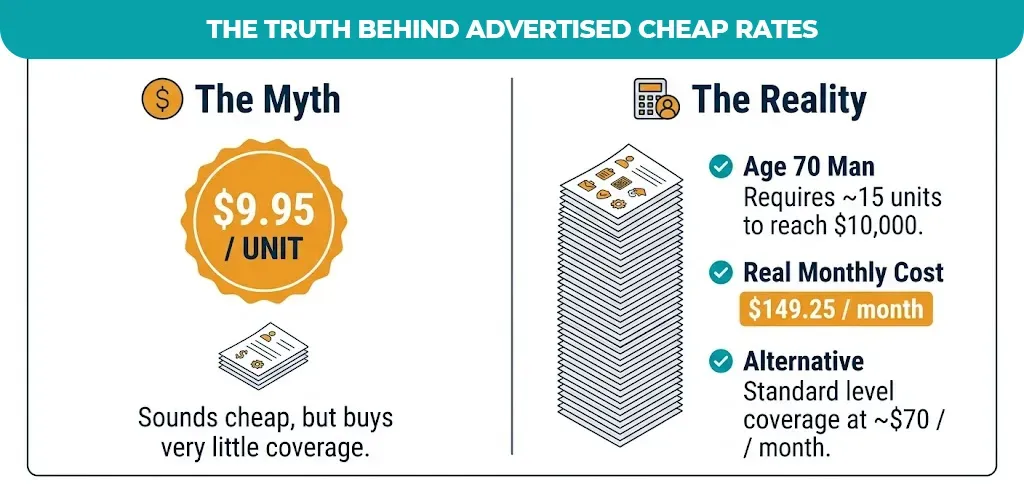
Colonial Penn’s guaranteed acceptance plan costs $9.95 per unit per month. The coverage per unit shrinks with age:
| Age | Coverage per unit (men) | Coverage per unit (women) | Cost for about $10,000 (men) |
| 60 | $1,167 | $1,515 | 9 units = $89.55/month for $10,503 |
| 70 | $689 | $1,000 | 15 units = $149.25/month for $10,335 |
| 80 | $426 | $608 | 24 units = $238.80/month for $10,224 |
Compare: a healthy 70-year-old man pays about $70 a month for $10,000 of level coverage from day one.
The two-year waiting period catch
Guaranteed acceptance plans accept everyone, but a natural death in the first two years usually pays only premiums plus interest. That’s fair for someone who couldn’t qualify elsewhere, but an unnecessary trade-off for someone who could have passed simplified health questions.
Increasing premiums in disguised term policies
Some low-priced “burial” policies are actually term insurance: the premium jumps every five years, and coverage may end at a set age such as 80 or 90. AARP’s Level Benefit Term and Globe Life’s term plans both price by age band. Before buying, ask: “Will my premium ever increase, and does coverage ever end?” A true burial (whole life) policy should answer no to both.
See Premier Services Agency’s Colonial Penn insurance reviews.
How to calculate your final expense coverage needs
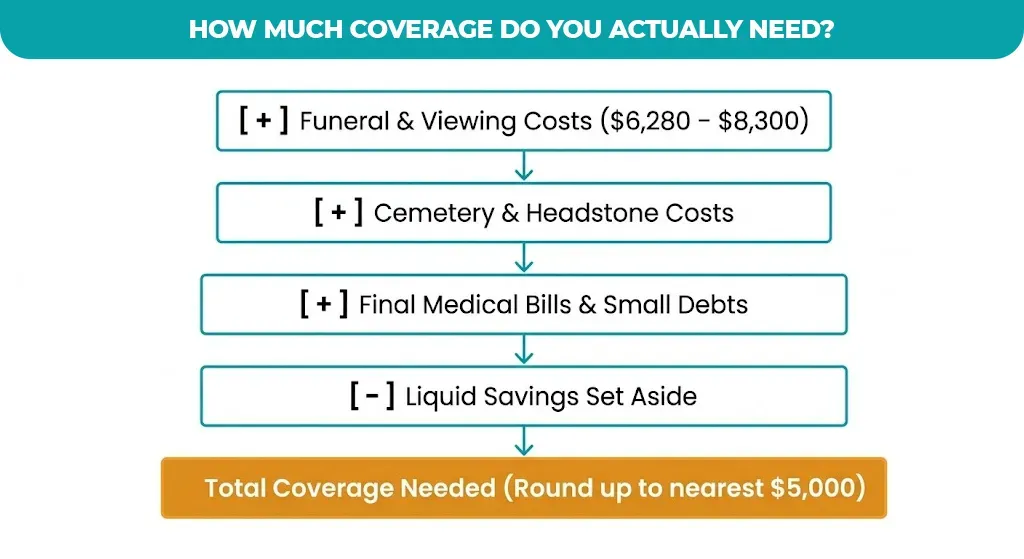
Your coverage amount should match what your family will actually pay, minus money that’s already set aside. Too little leaves a gap; too much means paying for coverage you don’t need on a fixed income.
The final expense calculator formula
Total coverage needed = Funeral or cremation costs
+ Cemetery costs (plot, opening/closing, headstone)
+ Final medical bills
+ Small debts to be paid off
– Liquid savings set aside for these costs
This works as a simple burial insurance cost calculator. Round the result up to the nearest $5,000, since policies are usually sold in those steps.
Case study 1: Cremation with a memorial service
| Item | Amount |
| Funeral with viewing and cremation (NFDA median) | $6,280 |
| Final medical bills | $1,000 |
| Small debts | $1,000 |
| Minus savings set aside | −$3,000 |
| Coverage needed | About $5,280 → 5,000–10,000 policy |
A healthy 70-year-old woman would pay about $28 a month for $5,000 or $53 for $10,000.
Case study 2: Traditional burial
| Item | Amount |
| Funeral with viewing and burial (NFDA median) | $8,300 |
| Cemetery plot, opening and closing, headstone (assumed) | $4,500 |
| Final medical bills | $1,500 |
| Small debts | $1,500 |
| Minus savings set aside | −$1,000 |
| Coverage needed | About $14,800 → $15,000 policy |
A healthy 70-year-old man would pay about $103 a month for $15,000 (estimate). Cemetery costs vary widely by location, so get local prices. Premier Services Agency’s funeral cost breakdown and cremation vs. burial cost guides can help.
Note: Medical bills, debts, and savings in these case studies are illustrative assumptions. Replace them with your own numbers.
How to get low-cost burial insurance for seniors
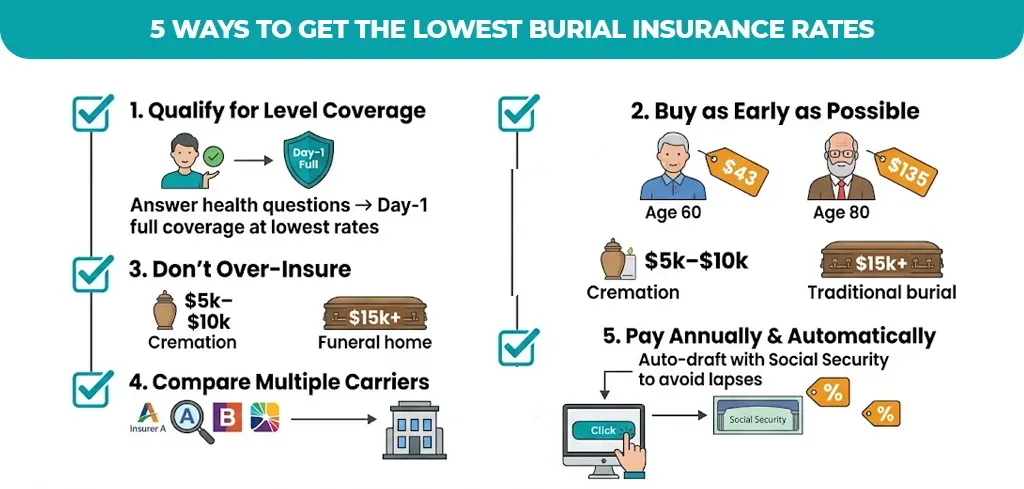
The cheapest burial insurance comes from qualifying for a level-benefit policy, buying as early as possible, buying only the coverage you need, and comparing several carriers instead of one brand.
Strategy 1: Qualify for level-benefit coverage
Answer the health questions instead of defaulting to guaranteed acceptance. At age 70, level coverage costs about $53 a month for $10,000 for a woman, versus about $64 for guaranteed acceptance, with no waiting period.
Strategy 2: Buy as early as possible
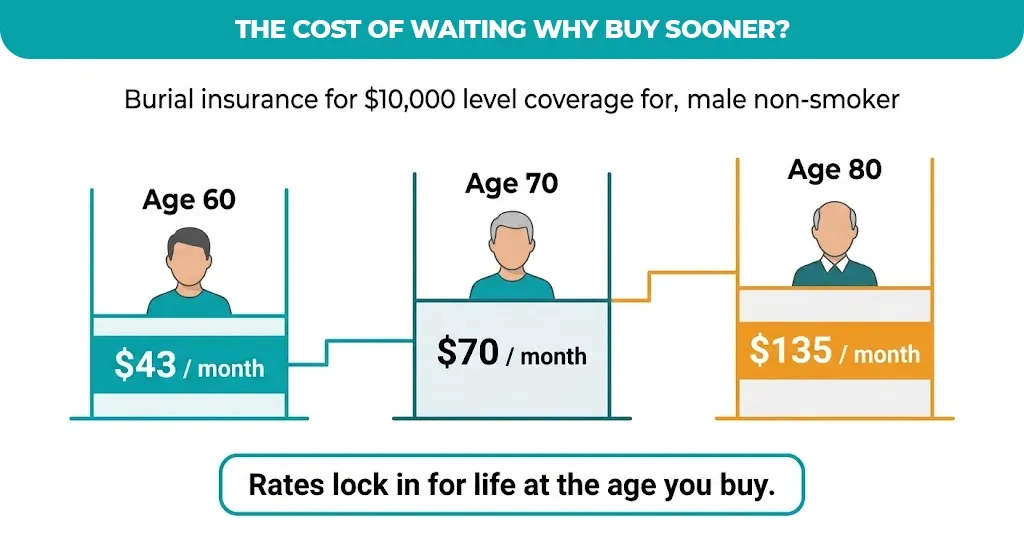
For a man, $10,000 costs $43 a month at 60, $70 at 70, and $135 at 80. Waiting 10 years can nearly double the monthly price.
Strategy 3: Don’t over-insure
Use the formula above. If cremation is your plan, 5,000–10,000 may be enough; there’s no need to pay for $25,000.
Strategy 4: Compare carriers through an independent agency
Carriers treat health conditions very differently; one may offer you level coverage while another requires a waiting period. An independent agency checks several at once and finds the lowest rate you qualify for.
Strategy 5: Pay annually and pay automatically
Annual payments are often a little cheaper than monthly, and automatic drafts timed with your Social Security deposit prevent a lapse.
See burial insurance for seniors and best life insurance for seniors.
Conclusion:
Burial insurance costs far less than most people expect when you buy the right type at the right time: often 25–70 a month for $10,000 between ages 50 and 70. The keys are to qualify for level coverage if you can, buy only what your family will actually need, and look past the advertised $1 and $9.95 offers to the full price and terms.
| Your situation | Best value option |
| Healthy, age 50–75 | Level whole life burial policy, compared across carriers |
| Planning cremation | 5,000–10,000 level policy |
| Planning a traditional burial | 15,000–25,000 level policy |
| Serious health conditions | Graded policy, or guaranteed acceptance as a last resort |
| Considering AARP term | Check how the premium rises every 5 years and that coverage ends at 80 |
| Considering $9.95 unit plans | Calculate the full price for the coverage you need |
Compare burial insurance rates at Premier Services Agency
Premier Services Agency helps seniors and families across the United States compare burial and final expense policies, so you can lock in a fixed premium and, if you qualify, full day-one coverage. Premier Services Agency specialists can match your health and budget to the right carrier.
Get instant burial insurance quotes on Premier Services Agency through the quote page, or call (470) 650-0470.