
Cremation vs. Burial Cost 2026: Which Option is Right?

Deciding between cremation and burial is one of the hardest choices a family has to make, and it usually has to be made quickly, while emotions are running high. The good news is that both options are well established, respected, and supported by funeral professionals across the country; the right choice simply depends on your budget, your beliefs, and what kind of goodbye feels right for your family.

In short: cremation reduces the body to ashes that are placed in an urn, so no burial plot is required, while a traditional burial involves preparing the body, placing it in a casket, and interring it in a cemetery plot. Cremation is generally faster to arrange and less expensive, while burial offers a permanent, physical place for the family to visit. Below, we break down what each option actually includes, how the costs compare, and how to decide which path is right for your family.

Key Takeaways

  • Cost Difference: Cremation generally ranges from $2,000 to $7,000, while traditional burials typically cost $7,000 to $12,000+ once service fees, caskets, and cemetery plots are factored in.
  • Timeline & Flexibility: Cremation offers scheduling freedom, allowing memorial services to be held weeks or months later, whereas burials usually require coordination within 3 to 7 days.
  • Final Resting Place: Burial provides a permanent, physical gravesite for family visits, while cremation leaves loved ones with options like keeping an urn, scattering ashes, or dividing them among relatives.
  • Planning Ahead: Pre-planning and final expense coverage protect grieving families from rushed decisions and shield them from rising future costs.

Cremation Features and Highlights

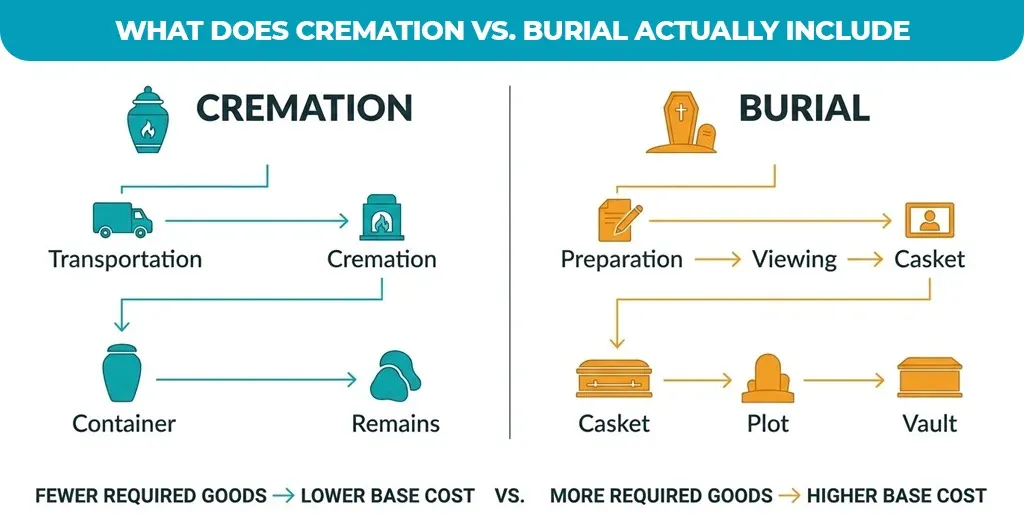
Cremation is generally the simpler and more affordable of the two paths, and its popularity has grown steadily because it gives families more control over timing and cost. A cremation provider typically manages transportation, paperwork, and the cremation itself, so families are left with fewer logistics to coordinate.

What a typical cremation includes:

  • Transportation of the deceased to the cremation facility
  • A basic or alternative cremation container (a casket is not legally required)
  • The cremation process itself, carried out in a specialized chamber
  • Processing of the remains into a fine, ash-like consistency
  • Return of the remains in a temporary container or an urn of your choosing
  • Several certified copies of the death certificate

Most cremations are completed within roughly one to two weeks of death, with the family typically receiving the remains a few business days after the cremation itself. Because there is no urgency around burial, families are free to hold a memorial service right away, several weeks later, or not at all. Many choose to scatter the ashes in a meaningful location, keep the urn at home, divide the remains among relatives, or place them in a columbarium niche.

Burial Features & Highlights

A traditional burial is the more familiar, ceremony-centered option, and it usually involves a wider team of people, a wider range of items to purchase, and a tighter schedule than cremation.

What a typical burial includes:

  • Transportation and preparation of the deceased, generally including embalming
  • A viewing or visitation period at the funeral home, often two to four hours
  • A funeral service, which may include an officiant, readings, and music
  • Transportation to the cemetery, typically by hearse
  • A graveside service attended by family and friends
  • A burial vault or grave liner and the casket’s placement in the ground

Cemeteries add their own charges on top of what the funeral home bills, including the plot itself, opening and closing the grave, and often a required vault or liner. Many families also budget for a permanent headstone and ongoing grounds maintenance. Because a body isn’t embalmed indefinitely, burial services usually happen within three to seven days of death, which means funeral homes have to coordinate several vendors on a compressed timeline.

Cremation vs. Burial: Feature-by-Feature Comparison

Every family weighs these two options a little differently, but the decision usually comes down to five recurring factors: cost, flexibility, personal preference, long-term upkeep, and religious or cultural expectations. Here’s how cremation and burial stack up on each one.

Secure Your Family's Future with Confidence

Don’t leave your loved ones' financial security to chance. Use our expert tools and free resources to find the perfect coverage today.

FeatureCremationBurial
Typical total costRoughly $2,000–$7,000Roughly $7,000–$12,000+
Best suited forBudget-conscious, flexible familiesFamilies who want a traditional service
TimelineFlexible; can wait weeks or monthsUsually 3–7 days after death
Biggest strengthLower cost and scheduling freedomPermanent gravesite and familiar ritual
Biggest drawbackNo physical gravesite to visitHigher cost and a tighter timeline
Environmental footprintEnergy used during the cremation processEmbalming chemicals, metal, and land use
Typical end resultUrn with cremated remains, kept, scattered, or divided among familyFull funeral with a permanent burial plot

Cost

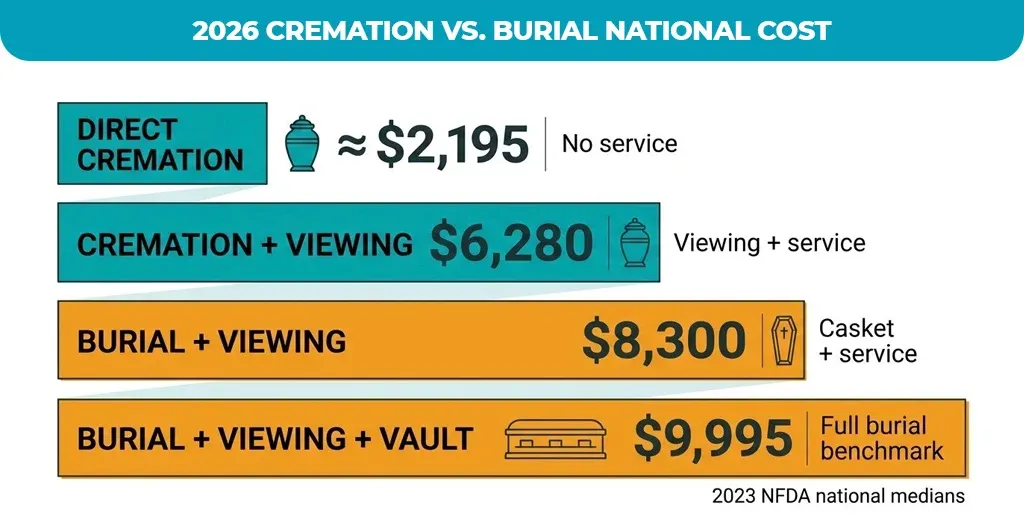
Cost is usually the single biggest difference between the two options, and the gap can easily run into the thousands of dollars. A direct cremation, with no viewing or formal service beforehand, is generally the least expensive route, while a traditional burial with viewing, a casket, and a vault sits at the higher end of the spectrum.

cremation cost

Expense CategoryEstimated Burial CostEstimated Cremation Cost
Professional service fees$2,500+$1,000–$2,000
Casket/container$2,000–$10,000+$100–$1,000
Cemetery plot & vault$2,000–$5,000+$0–$1,500 (optional)
Total average range$7,000–$12,000+$2,000–$6,000+

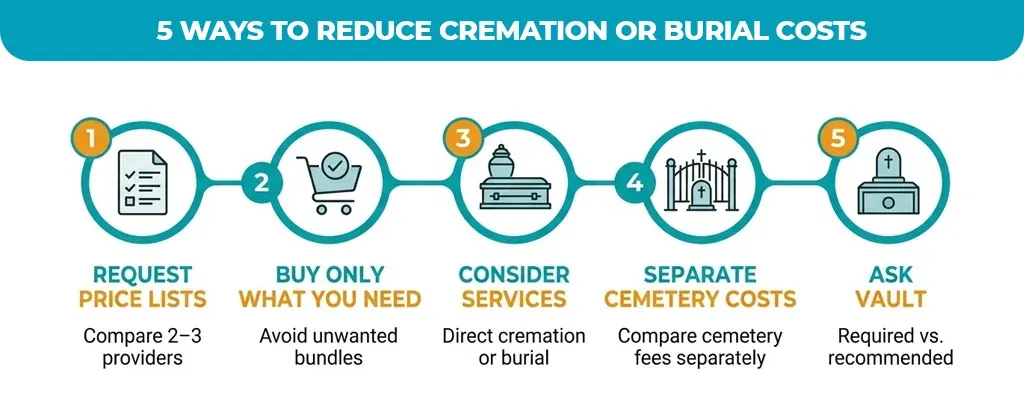
Several factors push costs up or down within either category: the casket or container you choose, whether the cemetery requires a vault, your local market (funeral pricing varies a great deal by city and state), whether you go the direct route or add a full traditional service, and extras like flowers, printed materials, and travel for out-of-town relatives. A middle-ground option, green burial, skips embalming and metal caskets in favor of a biodegradable approach; it’s usually cheaper than a traditional burial, though it still carries plot and interment costs that direct cremation doesn’t.

Flexibility & Timing

Because cremated remains don’t need to be interred right away, cremation gives families room to plan a memorial for whenever it makes sense days, weeks, or even months later- once distant relatives can travel in. Burial, by contrast, generally has to happen within a week or two of death, which means the family is coordinating a funeral home, cemetery, clergy, and other vendors all at once, often while still absorbing the loss.

Personal Preference

Some families gravitate toward cremation because it feels simpler and more personal; remains can be kept close, scattered somewhere meaningful, or divided among siblings so each person has their own way to remember their loved one. Others feel that burial’s structure, with a viewing, a formal service, and a place to return to, provides more closure and a stronger sense of ritual. Neither preference is right or wrong; it comes down to what brings your family peace.

Long-Term Considerations

Cremated remains don’t require any ongoing maintenance, and a family that later relocates isn’t leaving a loved one behind in a distant cemetery. A gravesite, on the other hand, becomes a lasting place of remembrance for future generations, but it also comes with recurring costs: headstone upkeep and annual cemetery maintenance fees that many families underestimate when they’re first planning.

Cultural & Religious Requirements

Many modern faith communities now accept cremation, and it tends to work well for families with mixed religious backgrounds. That said, some traditions still require burial specifically, and some families choose burial simply to honor older relatives’ expectations, even when their own preference might lean the other way. This is one area where there often isn’t a universally ‘better’ option; it depends entirely on what your family and community expect.

Common Pain Points and Praise from Loved Ones

Every option comes with trade-offs. Here’s what families most often appreciate and what tends to catch them off guard with each choice.

Cremation

  • Meaningful savings that can be redirected toward a celebration-of-life event or family needs
  • The freedom to schedule a memorial when it’s convenient for everyone, rather than rushing
  • The option to scatter remains somewhere the person loved, such as a favorite beach or trail
  • Less pressure to make big decisions immediately after a loss
  • The ability to divide remains so more than one family member has a place to remember them

What sometimes catches families off guard:

  • Missing having one specific gravesite to visit or leave flowers at
  • Younger children sometimes finding cremation harder to process than a traditional funeral
  • Urns that sit at home for years while the family decides on a final resting place
  • Extended family feeling they didn’t get a proper chance to say goodbye without a viewing
  • A fast timeline that can feel abrupt to relatives who wanted more time

Burial

What families appreciate:

  • A viewing that gives everyone a real chance to say a final goodbye
  • A permanent gravesite the family can return to for anniversaries and holidays
  • A traditional service that brings the wider community together
  • Children and grandchildren having a specific place to visit while grieving
  • The funeral home coordinating most of the moving pieces on the family’s behalf

What sometimes catches families off guard:

  • Total costs that can climb well past $10,000 once extras are added
  • A tight, days-long window to make major decisions while still in shock
  • A compressed schedule that makes it hard for distant relatives to attend
  • A cemetery location that becomes difficult to visit regularly over time
  • Ongoing maintenance fees that add up year after year

cremation vs burial

How to Choose

There’s no single right answer; the best choice is the one that fits your family’s finances, beliefs, and sense of closure. A few questions can help narrow it down:

Cremation tends to be the better fit if you:

  • Want to keep costs lower and put more of your budget toward a celebration of life
  • Have family spread across different cities, states, or countries
  • Prefer a simple process without multiple back-to-back services
  • Like the idea of scattering remains somewhere meaningful, or dividing them among relatives
  • Value flexibility and timing over following a traditional format

Burial tends to be the better fit if you:

  • Want a traditional funeral with a viewing and a formal service
  • Need a permanent, physical place the family can visit for years to come
  • Follow religious or cultural traditions that call for burial
  • Prefer having one funeral home coordinate every detail on your behalf
  • Find comfort in established rituals and a set place for remembrance

Whichever direction feels right, the single most helpful thing you can do is plan ahead. Deciding now and putting it in writing spares your family from making rushed, expensive decisions while they’re grieving, and options like final expense insurance or a funeral trust can help lock in today’s costs before inflation drives prices higher.

If you’d like help thinking through cremation, burial, or final expense coverage for your own family, Premier Services Agency is glad to walk you through your options with no pressure and no obligation.

Conclusion

Deciding between cremation and burial ultimately comes down to balancing your family’s budget, cultural beliefs, and personal preferences for closure. Because this choice is often thrust upon grieving families under tight timelines, taking the time to discuss your wishes beforehand can alleviate immense emotional and financial stress.

Whether you opt for the flexibility and lower cost of cremation or the permanent structure and traditional ritual of a burial, planning ahead ensures your final goodbye truly reflects what matters most to your family. If you need guidance on navigating these options or want to explore final expense coverage to protect your loved ones from future costs, Premier Services Agency is available to help walk you through your choices with no pressure or obligation.

Secure Your Family's Future with Confidence

Don’t leave your loved ones' financial security to chance. Use our expert tools and free resources to find the perfect coverage today.

FAQs About Cremation Vs. Burial

Cremation generally ranges from $2,000 to $7,000, whereas a traditional burial typically costs between $7,000 and $12,000+, creating an average gap of several thousand dollars between the two options.

While direct cremation is usually the least expensive path, adding complex services, high-end urns, or specialized memorials can narrow the gap, though basic cremation still avoids major expenses like cemetery plots, vaults, and headstones.

Burial involves significantly more physical components and professional services, including embalming, a casket, a cemetery plot, opening and closing the grave, a required vault or liner, and a permanent headstone.

Yes, cremation offers total scheduling flexibility, allowing families to hold a traditional viewing or service beforehand, host a celebration of life weeks later, or scatter ashes after a memorial gathering.

Cremation is typically the better financial fit if you are looking to minimize immediate expenses, want to avoid recurring cemetery maintenance costs, or prefer to redirect your budget toward a flexible celebration of life.