


Most of us attend only a handful of funerals in our lives, so it’s normal to feel unsure about what to wear, what to say, or what to do when a service follows a faith that isn’t your own. Funeral etiquette exists to make that easier: it lets you focus on comforting the family instead of worrying about getting it wrong.
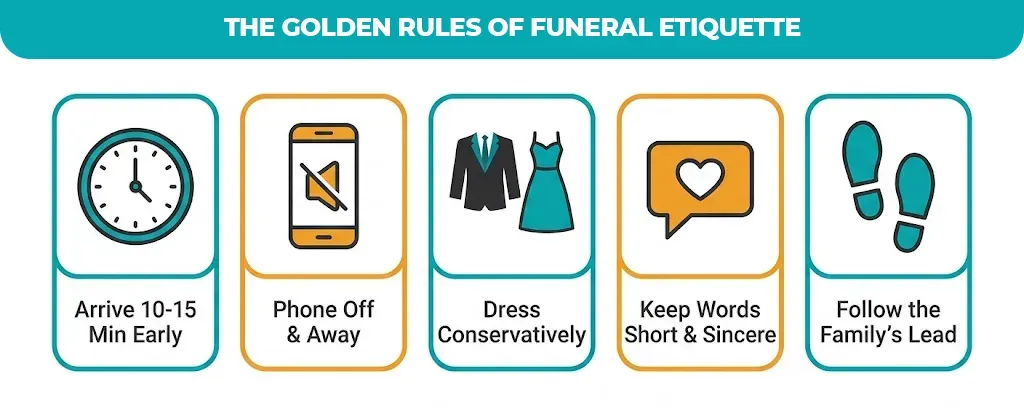
Quick answer: Good funeral etiquette comes down to five things: arrive early, dress conservatively, silence your phone, keep your words to the family short and sincere, and follow the lead of the family and officiant. When a service follows an unfamiliar tradition, watch what others do and ask the funeral director if you’re unsure.
Core rules of funeral etiquette
Funeral etiquette rests on respect for the person who died and care for the people grieving. Arrive on time or early, dress modestly, keep your phone silent and out of sight, and let the family set the tone. If in doubt, choose the quieter, simpler option.
Universal funeral etiquette rules and guidelines
- Arrive 10–15 minutes early for the service. If you’re late, enter quietly and sit near the back.
- Silence your phone completely and put it away. Don’t photograph, record, or post on social media unless the family has invited it.
- Keep condolences short. “I’m so sorry for your loss” or “She meant a great deal to me” is enough; a brief memory is a gift.
- Don’t ask about the cause of death or offer advice about grief.
- Sign the guest book with your full name and how you knew the person, which helps the family later.
- Follow the program and the officiant: stand, sit, and pray when others do, or simply sit respectfully.
- Don’t bring young children unless the family has said they’re welcome; take a crying child out quietly.
The “no crying” myth
There is no funeral etiquette rule against crying. Tears are a natural, honest response to loss, and families are usually comforted to see how much someone was loved. The only consideration is volume and timing: if you become overwhelmed during a eulogy or prayer, it’s considerate to step out briefly so the speaker can be heard. Some traditions, including many African American homegoing services, welcome open and expressive grief.
Who should attend?
• Public services (listed in the obituary): anyone who knew the person or knows the family well, including coworkers, neighbors, and friends.
• Private or family-only services: attend only if personally invited. Send a card or attend a public memorial instead.
• Acquaintances and coworkers: attending the visitation is a meaningful middle ground.
If you can’t attend, a sympathy card, a phone call, or a meal delivered later is just as kind.
Visitation vs. funeral service etiquette
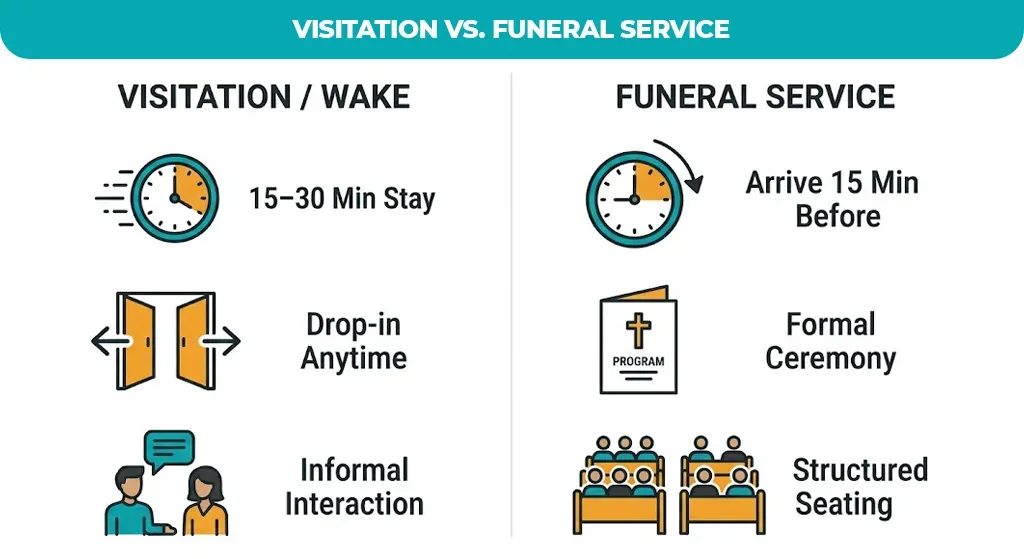
A visitation (also called a wake or viewing) is an informal gathering, often the evening before, where you come and go to offer condolences. The funeral service is a formal ceremony with a set start time, a program, and seating in order of closeness to the deceased. You can attend either or both.
Visitation, wake, and viewing etiquette
Arrive any time during the posted hours and stay 15–30 minutes; you don’t need to stay the whole time.
Greet the immediate family briefly. Introduce yourself if they may not know you: “I’m Sarah, I worked with your dad at the hospital.”
Approaching the casket is optional. If it’s open, you may pause for a moment of reflection or prayer, then step aside. You don’t have to touch the body or view it if you’re uncomfortable.
Keep conversation quiet and move away from the receiving line to visit with others.
Funeral service etiquette
• Seating order: the immediate family sits in the front rows, usually on the right facing the front: spouse or partner and children first, then parents and siblings, then grandchildren and close relatives. Pallbearers often sit on the front left. Friends and coworkers sit behind the family.
• Processional: the officiant leads, followed by the casket and pallbearers, then the immediate family in order of closeness. Guests stand when the family enters.
• During the service: follow along with readings and hymns, and join in only as you’re comfortable.
• Recessional: stay seated until the casket and family have left, then follow row by row.
• Funeral procession: if you drive to the cemetery, turn on your headlights, stay in line, and follow the funeral home’s directions.
Visitation vs. funeral service
| Factor | Visitation / wake / viewing | Funeral service |
| Purpose | Offer personal condolences; see the family | Formal tribute, religious or secular rites |
| When to arrive | Any time during posted hours | 10–15 minutes before the start |
| How long to stay | 15–30 minutes is fine | The full service |
| Attire | Neat and conservative; business casual often acceptable | Formal and conservative |
| Interaction | Talk directly with the family | Little interaction until after the service |
| Casket | Often open (viewing) or closed with photos | Open or closed; often closed during the service |
| Seating | Informal | Family in front; guests behind |
For more on the service itself, see Premier Services Agency’s guide to funeral ceremony planning.
Funeral etiquette clothing: what to wear
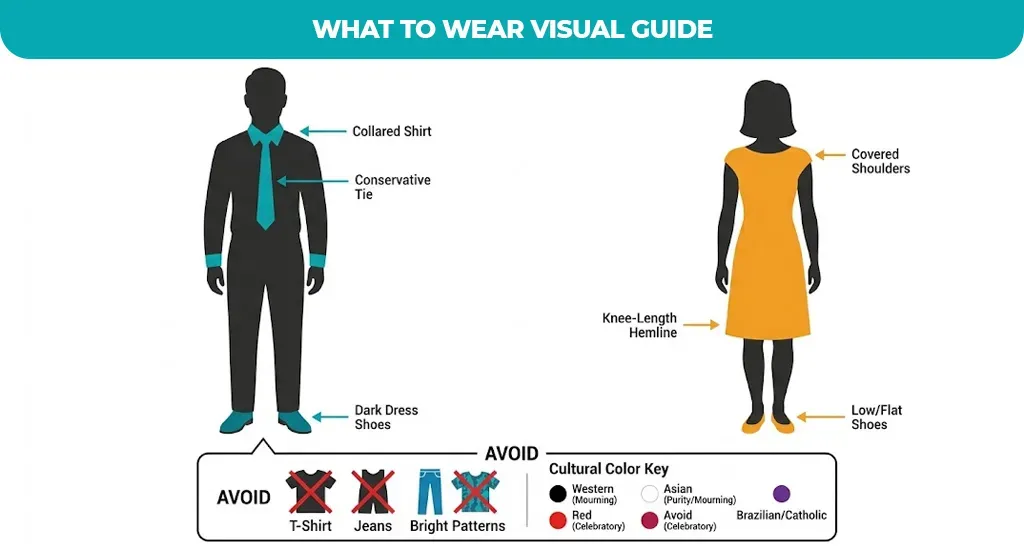
Wear dark, muted, conservative clothing: black, charcoal, navy, or dark brown, with modest cuts. Avoid bright colors, loud patterns, and anything casual or revealing unless the family has asked for something different. A “celebration of life” may invite brighter colors, but only if the family says so.
Men’s and women’s guidelines
• Men: a dark suit or dark slacks with a sport coat, collared shirt, and a conservative tie; dark dress shoes and socks.
• Women: a dark dress or skirt at or below the knee, dress pants, or a suit; covered shoulders for religious services; low or closed-toe shoes; minimal jewelry.
• Children: neat, dark or muted clothing; a nice sweater or dress is fine.
• Avoid: jeans, athletic wear, T-shirts with logos, very short hemlines, sequins, and strong fragrance.
Dress code by tradition
| Tradition | What to wear | Notes |
| Most Protestant and nondenominational | Dark, conservative | Follow any family request for colors |
| Catholic | Dark, conservative; shoulders covered | Formal, especially for a funeral Mass |
| Jewish | Dark, modest; men cover heads | Kippahs are usually provided at the door |
| African American homegoing | Formal; often all black or white, sometimes family colors | Dressing your best honors the deceased |
| Hindu | White or light colors | Black is generally avoided |
| Buddhist | White or muted colors, depending on tradition | Ask the family |
| Celebration of life | As requested, sometimes bright or themed | Only if the family specifies |
| Military | Dark civilian clothes; service members may wear uniform | Veterans may wear medals or a cover |
See Premier Services Agency’s full guide to what to wear to a funeral and celebration of life services.
Religious and cultural funeral etiquette
When you attend a funeral outside your own tradition, you’re a guest: you aren’t expected to perform rituals, only to be respectful. Dress modestly, follow when others stand or sit, and participate in prayers only as you’re comfortable. The customs below are the ones guests most often ask about.
Jewish funeral etiquette for non-Jews
Jewish funerals usually take place quickly, often within a day or two of death, and are simple and dignified.
• Head covering: men, and in many congregations women too, wear a kippah (yarmulke). Non-Jewish guests are welcome to wear one; they’re usually provided at the entrance.
• Closed casket: there’s typically no viewing. The casket is a plain wooden one and stays closed.
• No flowers: flowers aren’t part of Jewish mourning tradition. Instead, donate to a charity the family names or send food to the shiva home.
• At the cemetery: mourners and guests may be invited to place a shovelful of earth on the casket. It’s an honor, not an obligation.
• Shiva: the family observes a mourning period, traditionally seven days, at home. Visiting is a mitzvah (good deed). Enter quietly, let the mourners speak first, keep the visit short, and bring a kosher food platter or baked goods if appropriate.
• What to say: “I’m so sorry for your loss,” or the traditional “May you be comforted among the mourners of Zion and Jerusalem.”
Catholic funeral Mass etiquette
A Catholic funeral often has three parts: a vigil (wake), often with the Rosary; the funeral Mass; and the rite of committal at the cemetery.
Rosary vigil: guests may pray along or sit quietly. Non-Catholics don’t need to hold rosary beads.
During Mass: stand, sit, and kneel when the congregation does. If kneeling isn’t comfortable, sitting forward quietly is fine.
Holy Communion: non-Catholics should not receive Communion, according to U.S. bishops’ guidelines. You may stay seated in the pew, which is always acceptable. In many parishes, you may instead join the line and cross your arms over your chest to receive a blessing, though some dioceses discourage this. If unsure, stay seated.
Pall: a white cloth may be placed over the casket, recalling baptism.
African American funeral etiquette: homegoing celebrations
Many Black churches call the funeral a “homegoing” or “homegoing celebration,” reflecting the belief that the person has gone home to God.
Length: services are often longer than average, with music, multiple tributes, an obituary reading, and a sermon.
Expressive worship: singing, clapping, and calling out are common and welcome. Join in as you feel moved.
Attire: guests dress formally and well; some families request all white or specific colors.
Repast: a meal after the burial, often at the church, is a central part of the day. Stay if you can.
Military funeral etiquette for veterans
Eligible veterans are entitled to military funeral honors, which include at least two uniformed service members, the playing of Taps, and the folding and presentation of the U.S. flag to the next of kin.
• During Taps and the flag folding: stand silently. Civilians place their right hand over their heart. Veterans and service members may render a hand salute, including in civilian clothes.
• Rifle volley: be prepared for the three volleys if they’re part of the ceremony.
• Flag presentation: stay still and silent as the flag is presented to the family. It’s one of the most solemn moments.
• Don’t photograph the honor guard without the family’s permission.
For readings that fit many faiths, see scriptures for funerals.
Money, donations, and pallbearer etiquette
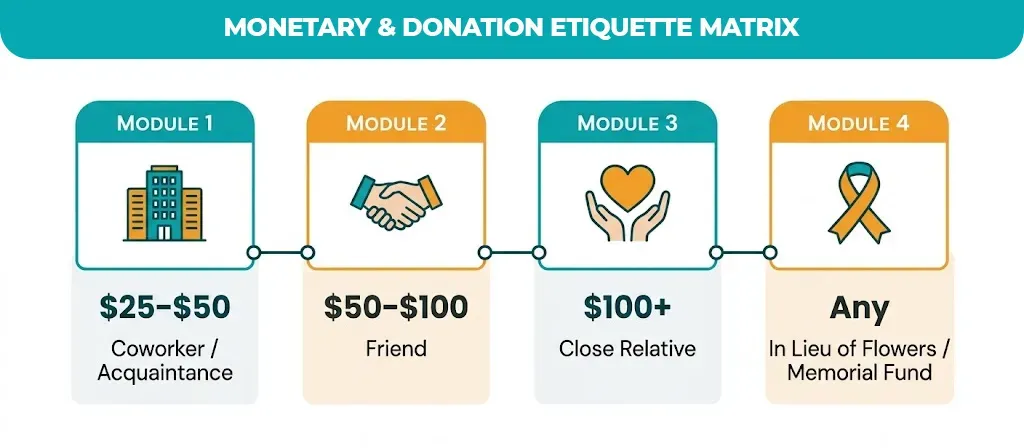
A monetary sympathy gift isn’t required, but it’s common and often deeply appreciated. Many guests give 25–100, close friends and relatives often more, and “in lieu of flowers” requests should be honored with a donation to the named charity. Pallbearers can be anyone the family chooses, women included.
Funeral etiquette for money and donations
| Relationship | Common gift | Notes |
| Coworker or acquaintance | 25–50, or a group gift | A shared office collection is common |
| Friend | 50–100 | A card with a check or gift card |
| Close friend or relative | $100 or more | Or help with specific costs |
| “In lieu of flowers” request | Any amount to the named charity | Note “in memory of [name]” so the family is notified |
| Memorial or online fundraiser | Any amount | Common when the death was sudden or the family has young children |
These ranges reflect common practice, not a rule; give what you can comfortably afford. Cash or checks go in a sympathy card, handed to a family member or placed in the card box at the service. Some cultures have specific customs, such as condolence money given in special envelopes at many Chinese and Japanese funerals; follow the family’s lead.
Do pallbearers have to be men?
No. There’s no rule in modern American funeral etiquette, or in most faith traditions, that pallbearers must be men. Families commonly choose daughters, granddaughters, sisters, and close friends of any gender. Six to eight pallbearers are typical, and the funeral home staff guides them and can use a rolling church truck so no one has to carry the full weight. Those who are close but can’t carry may be named honorary pallbearers, who walk alongside or sit in a reserved row.
Note: Being asked to be a pallbearer is an honor. If you can’t do it for health reasons, it’s fine to decline graciously and offer to serve as an honorary pallbearer instead.
Thank you notes after a funeral
The family sends handwritten thank you notes to people who gave something beyond attending: the officiant, pallbearers, musicians, people who sent flowers, food, or money, and those who helped in practical ways. Aim to send them within two to six weeks, but late notes are always better than none, and any family member can write them.
Who should receive a thank you note
• The officiant, clergy, or celebrant (often with an honorarium)
• Pallbearers and honorary pallbearers
• Eulogists, readers, and musicians
• Anyone who sent flowers, a plant, a donation, or a monetary gift
• Friends and neighbors who brought food or helped with childcare, travel, or the house
• Funeral home staff, hospice nurses, or caregivers who went above and beyond
Guests who only signed the guest book or sent a card don’t need an individual note; a thank you in the newspaper or on social media is acceptable.
Timeline
Two to six weeks after the service is a common guideline. Grief doesn’t keep a schedule, so if it takes longer, send them anyway, and it’s fine to ask a sibling or friend to help address envelopes.
Sample thank you note wording
For flowers: Thank you for the beautiful flowers you sent for Mom’s service. They brightened the room, and knowing you were thinking of us meant so much.
For a donation: Thank you for your generous donation to the American Heart Association in Dad’s memory. He would have been touched to know his name is helping others.
For food or help: We can’t thank you enough for the meals you brought last week. You took one worry off our minds when we needed it most.
For a pallbearer: Thank you for helping carry Grandpa on his final journey. It meant the world to us that someone he loved was by his side.
For the officiant: Thank you for your kind words and the care you took in leading Mary’s service. You captured her spirit perfectly, and our family is grateful.
General: Your kindness during this difficult time has been a comfort to our family. Thank you for remembering [name] with us.
For help with printed materials, see funeral program template.
Easing the burden: financial pre-planning
Behind every funeral is a set of bills that the family usually has to pay within days. The NFDA’s latest study puts the median funeral with viewing and burial at $8,300, and with cremation at $6,280, before a cemetery plot, headstone, flowers, and reception, which can push the total past $10,000. Planning ahead means the people you love can focus on grieving, not paying.
How final expense insurance helps
Final expense (burial) insurance is a small whole life policy, typically 5,000–25,000, that pays a cash benefit to your beneficiary, generally free of income tax. Premiums are fixed for life, there’s usually no medical exam, and the money can pay the funeral home, cemetery, or any final bills. Some families also prepay or pre-plan the service itself so wishes are written down. See Premier Services Agency’s guides to funeral preplanning, how much a funeral costs, and final expense insurance.
Premier Services Agency
Premier Services Agency helps families across the United States arrange final expense, burial, and life insurance. Its agents can compare coverage options and explain how much protection a family needs, so no one is caught unprepared when a loss happens.
Conclusion:
Funeral etiquette isn’t about perfection. It’s about showing up, being quietly present, and letting the family feel supported. If you remember only one thing, remember that a short, sincere word and your presence matter far more than getting every custom exactly right.
| Situation | What to do |
| Unsure whether to attend | Go to a public visitation or service; send a card if it’s private |
| Not sure what to wear | Dark, conservative clothing unless the family asks otherwise |
| Jewish funeral | Wear a kippah if offered, skip flowers, visit during shiva |
| Catholic Mass and not Catholic | Follow the posture cues; stay seated during Communion |
| Homegoing service | Dress formally, expect a longer service, stay for the repast |
| Military honors | Stand during Taps and the flag folding; hand over heart |
| Want to give money | 25–100 is common; follow “in lieu of flowers” requests |
| Writing thank you notes as family | Within two to six weeks; delegate if needed |
Learn more at Premier Services Agency
Caring for a grieving family is easier when the financial side of loss is already handled. Consult with Premier Services Agency about end-of-life planning: its agents can help you compare final expense and life insurance options so your family can focus on saying goodbye.
Visit Premier Services Agency, get a free quote, or call (470) 650-0470.