


A 20 year term life insurance policy covers the stretch of life when your family depends on you most: raising children, paying down a mortgage, and building savings. It locks in one price for two decades, and for a healthy 30-year-old, $500,000 of coverage can cost less than $20 a month.
Quick answer: 20 year term life insurance pays a fixed death benefit if you die within 20 years, for a premium that stays the same the whole time. For $500,000 of coverage, published 2026 sample rates for healthy non-smokers run about $16 to $18 a month at age 30, $24 to $28 at 40, and $54 to $69 at 50.
What Is a 20-Year Term Life Insurance Policy?
A 20-year term life insurance policy is a contract that pays your beneficiaries a set death benefit if you die within 20 years, in exchange for a premium that’s guaranteed not to change during those 20 years. If you’re alive at the end of the term, coverage ends and nothing is paid out, unless you renew or convert the policy.
The core value proposition
20-year term gives the most coverage per dollar for the years when a family is most financially exposed. It’s long enough to cover most of a child’s growing-up years or a large part of a mortgage, and short enough to stay affordable. The death benefit is generally not taxable income to your beneficiaries under IRC Section 101(a).
• Fixed cost: your premium is locked for 240 months.
• Fixed protection: the death benefit stays level for the full term.
• No savings component: there’s no cash value, which is why it costs far less than whole life.
• Flexibility at the end: many policies can be converted to permanent coverage without a new medical exam.
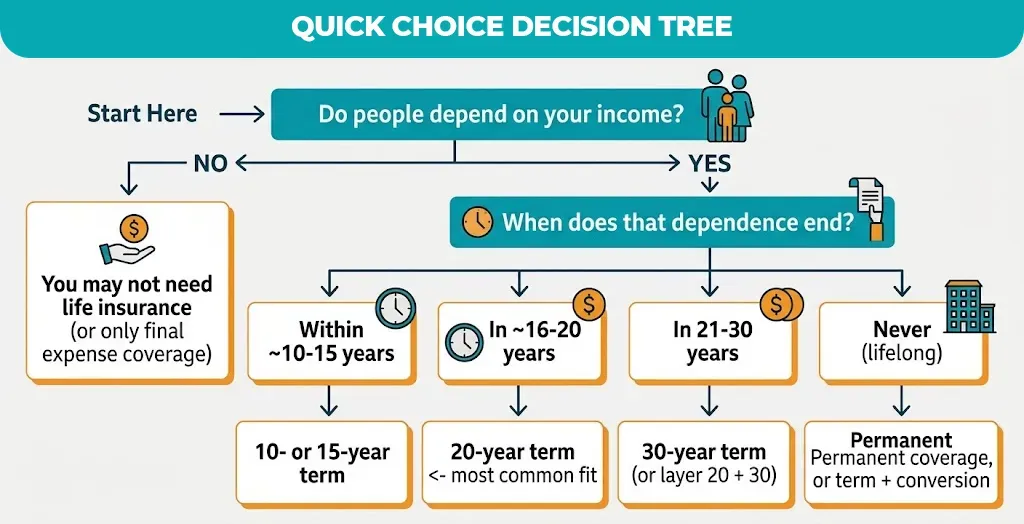
Quick choice framework: is 20-year term life insurance worth it?
Do people depend on your income?
NO -> You may not need life insurance (or only final expense coverage)
YES -> When does that dependence end?
Within ~10-15 years -> 10- or 15-year term
In ~16-20 years -> 20-year term <- most common fit
In 21-30 years -> 30-year term (or layer 20 + 30)
Never (lifelong) -> Permanent coverage, or term + conversion
For most parents of young children and homeowners in their 30s and 40s, 20-year term is worth it: it replaces income during the high-risk years at a fraction of the cost of permanent insurance. See our guide on whether term life insurance is worth it.
Core Mechanics and Features of 20-Year Level Term Insurance
A 20-year level term policy has three moving parts: a premium that stays flat for 240 months, a death benefit that stays flat for the same period, and options that kick in when the term ends. Understanding those options before you buy is what separates a good policy from one that leaves you stranded at 60.
How level premiums and fixed death benefits work over 240 months
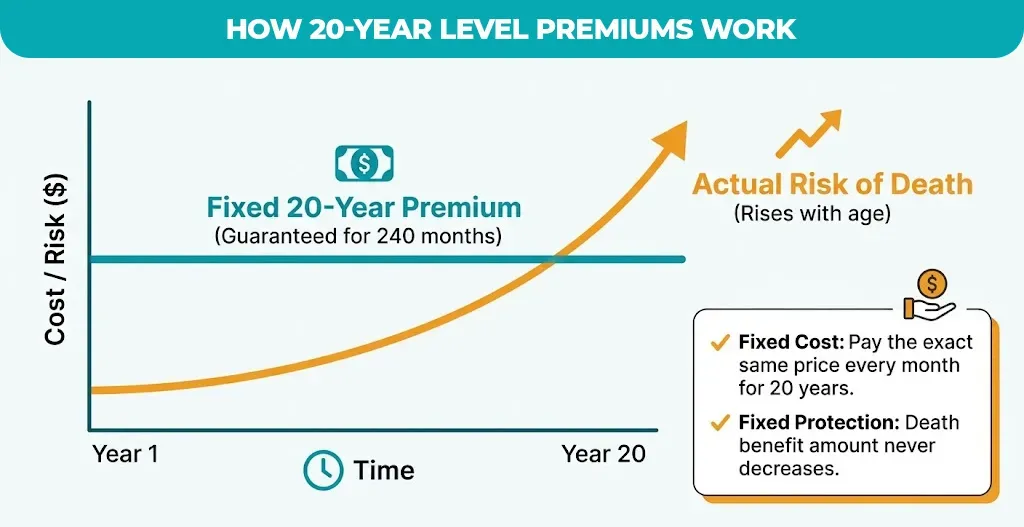
The insurer prices the entire 20 years up front and spreads the cost evenly, so you pay the same amount in year 20 as in year 1. The actual risk of death rises every year as you age (the mortality curve), so in the early years you pay a little more than your annual risk, and in the later years a little less. That averaging is what makes level term life insurance predictable.
Cost of insuring you each year ___________/
(rises with age) ____/
____/
Level 20-year premium ====================== (flat for 240 months)
|——- 20 years ——-|
Year 1 Year 20 -> term ends
Key contract features:
• Guaranteed level premium: fixed for the full term, as long as you pay on time.
• Level death benefit: the full face amount is paid whether death occurs in year 1 or year 20.
• Contestability period: in most states, the insurer can investigate and contest a claim for misstatements on the application during the first two years.
• Suicide exclusion: usually the first two years (shorter in some states), during which the policy refunds premiums instead of paying the death benefit.
• Grace period: typically about a month to pay a missed premium before the policy lapses.
Moving to permanent coverage without a medical exam
Many 20-year term policies include a conversion privilege that lets you exchange the term coverage for a whole or universal life policy from the same insurer, without new medical underwriting. The new premium is based on your age at conversion but your original health class, which is valuable if your health has changed.
Check these details before buying:
• Conversion deadline: some policies allow conversion during the entire term; others only for the first 10 or 15 years, or until a set age such as 65 or 70.
• Eligible products: some insurers let you convert only into specific permanent products.
• Partial conversion: many allow converting only part of the coverage, which keeps the permanent premium affordable.
A related feature, the guaranteed insurability rider, lets you buy additional coverage at set times without proving insurability. It’s more common on permanent policies and juvenile coverage than on term.
What happens when the 20 years end? Can a 20-year term policy be extended?
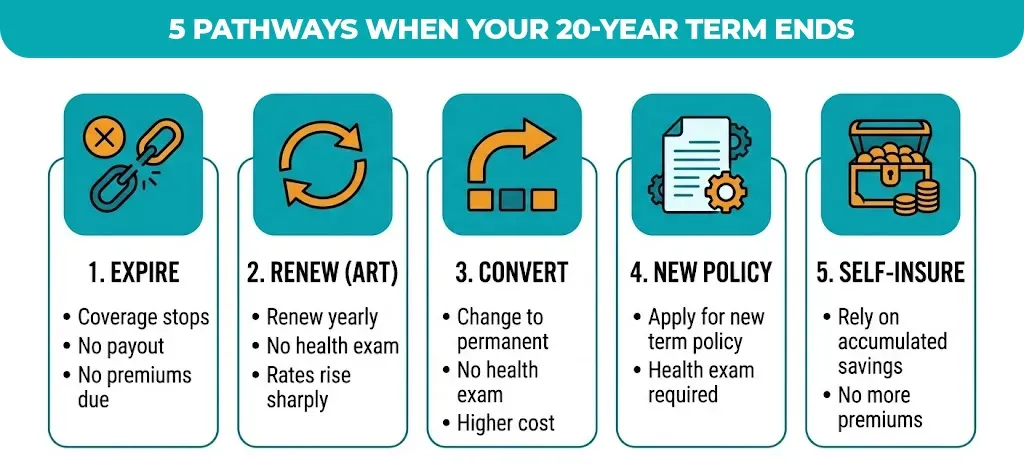
Yes, most 20-year term policies can be extended, but usually only as annual renewable term (ART) at a much higher, age-based price that rises every year. Your options at the end of the term:
1. Let it expire: coverage ends; no payout and no refund (unless it’s a return-of-premium policy).
2. Renew annually: the policy continues year to year, up to a maximum age set in the contract, but the premium resets to your attained age each year and is usually far higher than what you paid during the level period.
3. Convert: exchange it for permanent coverage without a medical exam, if you’re still within the conversion window.
4. Buy a new policy: if you’re still healthy, a new 10- or 15-year term policy is usually cheaper than renewing, but requires new underwriting.
Note: Don’t wait for the final year to decide. If your health has changed, conversion deadlines may have already passed. Review your options around year 15.
End-of-term action pathways
| Option | How it works | Health exam required? | Cost impact |
| Let the policy expire | Coverage stops on the last day of the term | No | Premiums end; no coverage |
| Annual renewable term (ART) | Coverage continues one year at a time at attained-age rates | No | Very high; rises every year |
| Convert to permanent | Exchange for whole or universal life at original health class | No (within conversion window) | High, but locked for life |
| Buy a new term policy | Apply for a new 10-, 15-, or 20-year policy | Yes | Moderate if healthy; much higher if not |
| Rely on savings (self-insure) | Use assets built during the term instead of insurance | No | No premium |
20-Year Term Life Insurance Rate Charts and Cost Benchmarks (2026)
For a healthy non-smoker, $500,000 of 20-year term costs about $16 to $18 a month at 30, $24 to $28 at 40, $54 to $69 at 50, and $140 to $199 at 60, based on Choice Mutual’s published 2026 sample rates. Rates roughly double with every five to seven years of age after 40, which is why buying earlier saves money over the life of the policy.
Rate factors: what sets your price
Age and health matter most, followed by sex, tobacco use, coverage amount, and term length.
• Age: the single biggest factor; every birthday raises the price of new coverage.
• Sex: women generally pay less because they have longer life expectancy.
• Tobacco and nicotine: smokers often pay several times the non-smoker rate.
• Health and build: height and weight, blood pressure, cholesterol, medical history, and family history determine your underwriting class (for example, preferred plus, preferred, standard plus, standard).
• Lifestyle: driving record, dangerous hobbies, and some occupations.
• Coverage amount and term length: more coverage and longer terms cost more, though the price per $1,000 usually drops as coverage rises.
20-year term life insurance rate chart by age ($500,000)
| Age | Female 20-year | Male 20-year | Female 10-year | Male 10-year | 20-year vs. 10-year cost |
| 30 | $16 | $18 | $11 | $13 | About 40% to 45% more |
| 35 | $17 | $20 | $11 | $13 | About 55% more |
| 40 | $24 | $28 | $15 | $17 | About 60% to 65% more |
| 45 | $35 | $45 | $23 | $27 | About 50% to 65% more |
| 50 | $54 | $69 | $32 | $40 | About 70% more |
| 55 | $82 | $112 | $49 | $66 | About 65% to 70% more |
| 60 | $140 | $199 | $72 | $109 | About 85% to 95% more |
Source: Choice Mutual published monthly sample rates, preferred non-tobacco, valid March 9, 2026. See also our term life insurance rates guide.
Note: These are best-case samples for healthy applicants. MoneyGeek’s 2026 averages for nonsmokers in average health are higher: about $31 (female) and $38 (male) a month at 30, $47 and $59 at 40, $102 and $137 at 50, and $286 and $395 at 60 for a $500,000 20-year policy. Your health class can easily double the price.
Jumbo policy case study: $5 million of 20-year term at age 60
A $5 million 20-year term policy at 60 costs thousands of dollars a year and requires full medical and financial underwriting. Published sample rates are scarce at this size. One independent broker’s sample (dated December 2023) shows about $2,059 a month (roughly $24,700 a year) for a 60-year-old man in excellent health, and $714 a month at age 50. For context, Choice Mutual’s 2026 samples for $1 million of 20-year term at 60 are $263 (female) and $379 (male) a month.
What to expect in underwriting for a policy this large:
• Medical exam and labs: blood and urine tests, prescription history, and often an EKG or attending physician statements at older ages.
• Financial justification: insurers cap coverage at a multiple of income or net worth that shrinks with age. The same broker cites about 20 times income for ages 51 to 60, which would mean roughly $250,000 of annual income to justify $5 million. Business or estate needs can be justified separately with documentation.
• Inspection report: an interview to verify finances, occupation, and lifestyle.
• Reinsurance and splitting: very large cases may be shared with reinsurers or split between two carriers.
Note: At 60, a 20-year term runs to 80. If the need is estate-related and lasts for life, compare the term quote with guaranteed universal life before deciding. Business owners can read our life insurance for business owners guide.
How much does a $20,000 term life insurance policy cost?
Many term carriers don’t sell 20-year policies as small as $20,000; published term rates typically start at $100,000. People looking for $20,000 of coverage usually want to cover funeral costs, and that need is better met by final expense (burial) insurance, a small whole life policy that never expires.
Choice Mutual’s 2026 sample final expense rates (non-tobacco, monthly) give a sense of the cost:
| Age | $10,000 female | $10,000 male | $25,000 female | $25,000 male |
| 50 | $24 | $31 | $55 | $71 |
| 60 | $33 | $43 | $76 | $103 |
| 70 | $53 | $70 | $127 | $169 |
| 80 | $98 | $135 | $241 | $332 |
A $20,000 policy would fall between those columns. Notice that at 50, a healthy person can buy $500,000 of 20-year term for less than $25,000 of final expense coverage, because the term policy will likely expire unused while the final expense policy is designed to pay out. See final expense insurance and burial insurance cost.
20 vs. 30 Year Term Life Insurance: Making the Right Decision
A 30-year term costs about 50% to 80% more per month than a 20-year term for the same coverage, but it protects you for an extra decade. The right choice depends on when your biggest obligations end, not on which policy is cheaper today.
Comparing 20 vs. 30 year term life insurance costs
For $500,000 of coverage, the monthly gap between 20- and 30-year terms grows with age.
| Age | 20-year (F / M) | 30-year (F / M) | 30-year costs more by |
| 30 | $16 / $18 | $24 / $29 | About 50% to 60% |
| 35 | $17 / $20 | $28 / $34 | About 65% to 70% |
| 40 | $24 / $28 | $38 / $49 | About 60% to 75% |
| 45 | $35 / $45 | $59 / $76 | About 70% |
| 50 | $54 / $69 | $93 / $123 | About 70% to 80% |
| 55 | $82 / $112 | $173 / $228 | About double |
Source: Choice Mutual sample rates, preferred non-tobacco, valid March 9, 2026. 30-year rates weren’t listed for age 60.
Total premiums over the life of each policy for a 35-year-old man:
20-year term: $20 x 240 months = $4,800 (coverage to age 55)
30-year term: $34 x 360 months = $12,240 (coverage to age 65)
The 30-year policy costs more in total, but buying a new 10-year policy at 55 to cover the gap would cost about $66 a month at today’s sample rates, if you’re still healthy enough to qualify. Read more in our 30-year term life insurance guide.
Matching policy length to major liabilities
Choose the term that ends when your last major financial obligation ends.
• Children: if your youngest is 2, a 20-year term covers them to 22, roughly through college. If you’re planning more children, a 25- or 30-year term may fit better.
• Mortgage: match the term to the years left on the loan. A new 30-year mortgage points to a 30-year term; a mortgage with 18 years left fits a 20-year term.
• Retirement: if you expect to have enough savings to be self-insured by a certain age, the term only needs to last until then.
• Business loans or partnerships: match the term to the loan or buy-sell horizon.
Why 20-year term is often the sweet spot in your 40s and 50s
At 40 to 50, a 20-year term carries you to age 60 to 70, which is when many people’s children are independent, mortgages are paid, and retirement savings are at their peak. A 30-year term bought at 50 would run to 80, and that extra coverage gets expensive: about $123 versus $69 a month for a 50-year-old man at $500,000. For many people in their 40s and 50s, 20 years matches the actual need.
Note: You don’t have to choose just one. “Laddering” means buying two policies, such as $500,000 of 20-year and $250,000 of 30-year term, so coverage steps down as debts shrink. It often costs less than one large 30-year policy.
20-year vs. 30-year term decision blueprint
| Financial milestone or need | Recommended term | Core rationale | Premium impact |
| Youngest child under 3, new 30-year mortgage | 30-year (or ladder 20 + 30) | Covers both the mortgage and the children’s dependence | Pay about 50% to 80% more for 10 extra years |
| Children in grade school, 20 years left on mortgage | 20-year | Both obligations end in about 20 years | Lower monthly cost |
| Age 45 to 55, kids in high school | 20-year (or 15-year) | Covers to around retirement age | 30-year would be much more expensive |
| Business loan or buy-sell agreement | Match the loan or agreement term | Coverage tracks the liability | Varies |
| Want coverage for life | Permanent, or convertible 20-year term | Term will end; conversion keeps options open | Higher for permanent |
| Unsure about future needs | 20-year with a long conversion window | Lower cost now, option to keep coverage later | Lower now; flexibility later |
Buyer’s Blueprint: Securing Your 20-Year Term Policy with Premier Services Agency
Figure out how much coverage you need, confirm 20 years is the right length, then compare carriers, because the same applicant can get very different prices from different insurers.
Step 1: Calculate income replacement needs with the DIME method
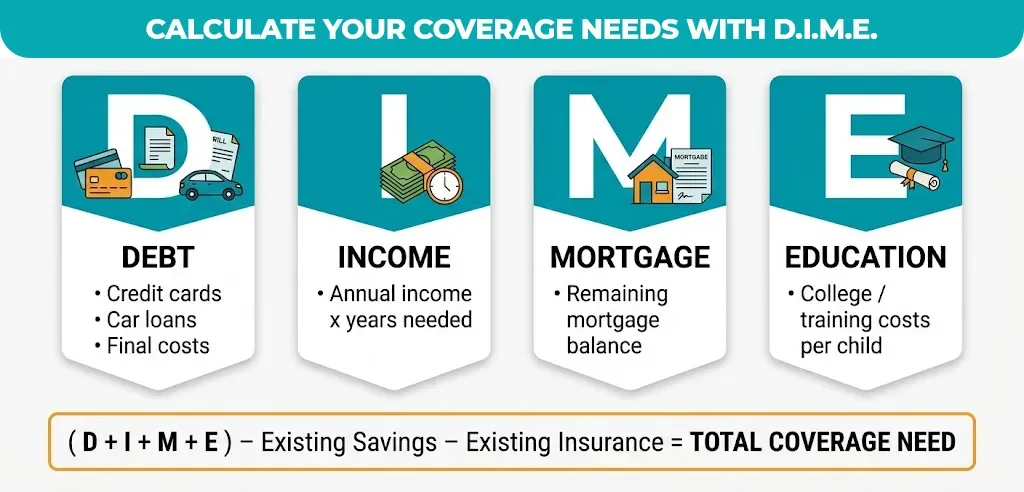
DIME stands for Debt, Income, Mortgage, and Education, the four things life insurance typically needs to cover.
D Debt Credit cards, car loans, personal loans, final expenses
I Income Annual income x years your family needs it
M Mortgage Remaining mortgage balance
E Education Expected college or training costs per child
——————————————————-
Total need – existing savings – existing life insurance
= coverage to buy
Example (hypothetical): a 38-year-old earning $80,000 with a $260,000 mortgage, $20,000 in other debts, and two children:
| Item | Amount |
| Debt | $20,000 |
| Income ($80,000 x 10 years) | $800,000 |
| Mortgage | $260,000 |
| Education (2 x $50,000) | $100,000 |
| Less savings and group life coverage | -$180,000 |
| Coverage need | $1,000,000 |
Step 2: Use a 20-year term life insurance calculator to confirm length and amount
A 20-year term life insurance calculator does the DIME math for you and shows how the need changes over time. As your mortgage shrinks and your children grow, your need falls, which is why many families ladder policies instead of buying one large one. Run the numbers again if you have another child, buy a bigger home, or change jobs.
Step 3: Navigate medical underwriting and no-exam options
Fully underwritten policies with a medical exam usually give the best rates if you’re healthy; no-exam policies are faster but can cost more or cap coverage.
• Fully underwritten: application, phone interview, paramedical exam (height, weight, blood pressure, blood and urine), and prescription and medical records checks. Typically a few weeks.
• Accelerated underwriting: some insurers waive the exam for healthy applicants using data (prescription history, MIB, motor vehicle records). Faster, with similar pricing for those who qualify.
• Simplified issue (no exam): health questions only; usually smaller amounts and higher prices. See life insurance with no medical exam.
Note: Answer every application question accurately. Misstatements discovered during the two-year contestability period can lead to a denied claim.
Step-by-step blueprint to compare carriers with Premier Services Agency
Premier Services Agency is an independent agency that helps individuals and families compare term life insurance from multiple carriers. A typical review:
1. Share your details: age, health, tobacco use, coverage amount, and the length you need.
2. Compare 20-year term rates from several carriers side by side, along with 15- and 30-year options.
3. Check conversion terms: how long the conversion window lasts and which permanent products are available.
4. Choose an underwriting path: traditional exam or no-exam, based on your health and timeline.
5. Apply and set reminders: note the conversion deadline and the term end date, and review coverage every few years.
Conclusion:
20-year term life insurance is the most common choice for families because it covers the years when dependents need the most protection, at a price most budgets can handle. Since every year of age and every new health issue raises the price, the cheapest time to buy is usually now.
| Your situation | Best next step |
| Young children, mortgage with about 20 years left | 20-year level term |
| Newborn and a new 30-year mortgage | 30-year term, or ladder 20- and 30-year policies |
| Age 45 to 55, kids in their teens | 20-year term to around retirement |
| Want flexibility to keep coverage for life | 20-year convertible term with a long conversion window |
| Needs $5 million or more | Full underwriting with financial documentation; compare GUL too |
| Only need funeral coverage | Final expense whole life instead of term |
| Term ending and health has declined | Convert before the conversion deadline |
| Term ending and you’re healthy | Shop a new shorter term, or self-insure if savings are enough |
Compare 20-Year Term Rates at Premier Services Agency
The difference between a good quote and a great one often comes down to which carrier views your health most favorably. Premier Services Agency life insurance advisors can compare 20-year term options from multiple carriers, explain conversion privileges, and help you find coverage that fits your budget.
• Get custom term quotes on Premier Services Agency
• Call (470) 650-0470 to speak with a licensed advisor
• Learn more about term life insurance and term life insurance quotes