


Most traditional life insurance policies require decades of recurring payments, locking you into a long-term financial commitment. In contrast, a single premium life insurance policy asks for a single lump-sum payment upfront and then leaves you free of future bills.
Whether you have recently inherited wealth, sold a business or property, or are looking to strategically reposition a portion of your retirement savings, this unique approach to permanent coverage offers a distinct alternative. This guide explores how single premium life insurance functions, the primary product variations available, the critical tax regulations you need to know, and who benefits most from this strategy.
How Does Single Premium Life Insurance Operate?
Single premium life insurance is a form of permanent life insurance funded with one lump-sum payment instead of monthly, quarterly, or annual premiums. That single deposit does two jobs at once: it purchases a guaranteed death benefit, and it seeds a cash value account that grows on a tax-deferred basis for as long as the policy is in force.
Because the entire premium is paid upfront, a single premium life insurance policy is, by design, fully funded from day one. There’s no year-three lapse risk because you forgot a payment, and no need to keep proving insurability through ongoing billing. The insurer takes the lump sum, deducts the cost of insurance and any fees, and the remainder becomes the starting cash value that compounds over time.
This structure is fundamentally different from a traditional drip-funded whole life or universal life contract, where the insurer is betting on decades of incoming premiums to keep the policy solvent. With single premium life insurance, that bet is settled on day one, which is exactly why the tax code treats it differently, a point we’ll come back to in the MEC section below.
Core Variations: Whole Life vs. Universal vs. Variable Single Premium Plans
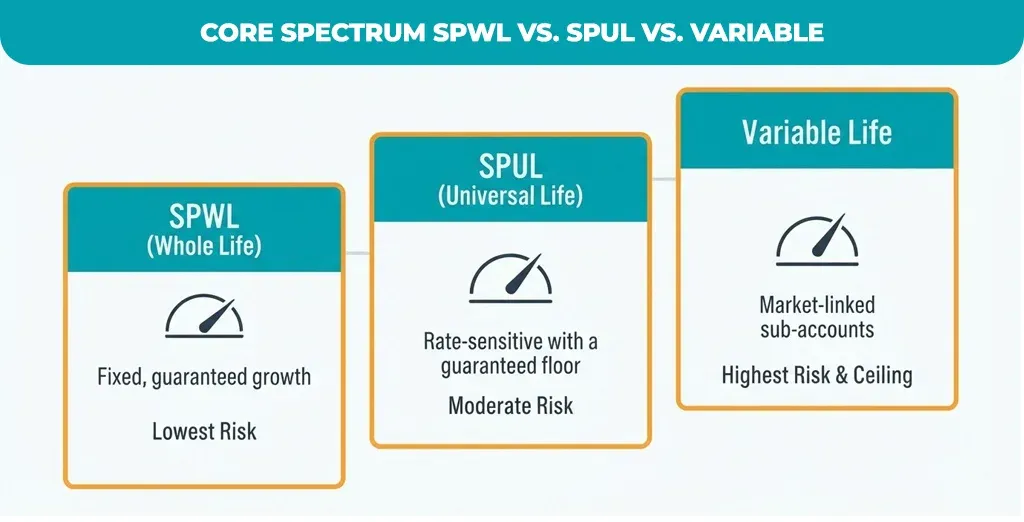
“Single premium” refers to the method of payment rather than the product. The underlying policy chassis still comes in three main flavors, each with a different risk and growth profile.
Single Premium Whole Life Insurance (SPWL)
A single premium whole life insurance policy locks in a guaranteed death benefit and a cash value that compounds at a fixed, contractually guaranteed interest rate. This is the most conservative version of the product: returns are modest but predictable, and the insurer bears the investment risk, not you. It’s the version most often marketed as “best single premium life insurance” for retirees who want zero surprises.
Single Premium Universal Life Insurance (SPUL)
Single premium universal life insurance trades some of that rigidity for flexibility. Cash value growth is tied to a current interest rate the insurer declares periodically, usually with a guaranteed floor so your account can’t lose value even in a low-rate environment. Some SPUL contracts are indexed to a market benchmark, offering a bit more upside than traditional SPWL while still capping downside risk.
Single Premium Variable Life Insurance
This is the aggressive end of the spectrum. Cash value is invested in sub-accounts that behave like mutual fund equities, bonds, or a mix, so growth potential is higher, but so is the risk. Unlike SPWL or SPUL, a single premium variable life policy can lose cash value if the underlying investments perform poorly, making it a fit only for buyers who are comfortable with market volatility inside an insurance wrapper.
| Key Takeaway• SPWL = guaranteed, fixed growth, lowest risk.• SPUL = flexible rate with a guaranteed floor, moderate risk.• Single premium variable life = market-linked sub-accounts, highest risk and highest ceiling. |
Key Advantages: Why Choose a One-Time Payment Policy?
- No future bills, ever. A single premium life insurance policy is paid in full at issue, which removes the single biggest cause of policy lapse: a missed premium. Coverage simply cannot lapse for nonpayment because there’s nothing left to pay.
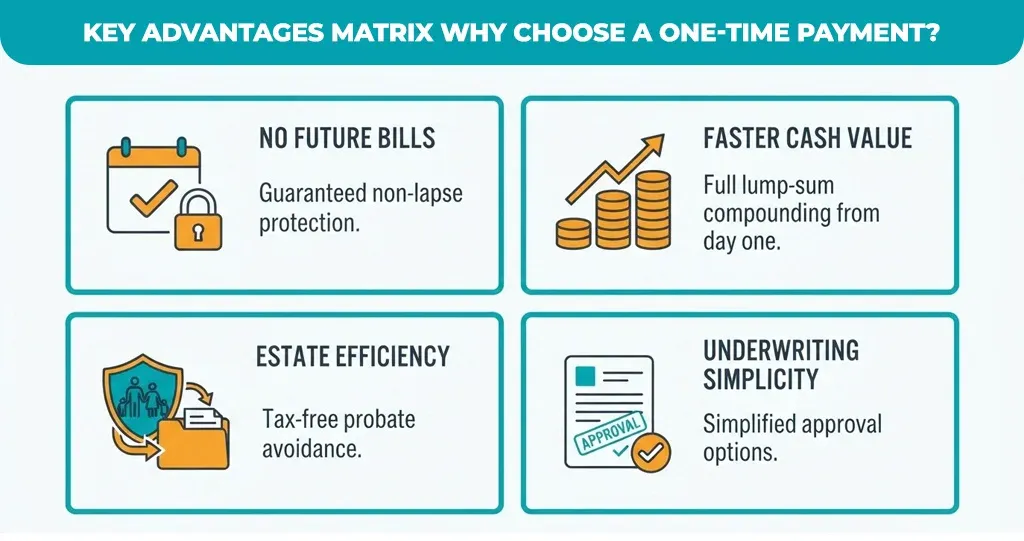
- Faster cash value growth. Because the full premium is invested from day one instead of trickling in over years, the cash value account typically builds up much faster than in a comparable drip-funded policy, giving you earlier access to funds through policy loans or partial withdrawals.
- Estate planning efficiency. A single premium life insurance policy can convert a lump sum of cash or a low-yield asset into a larger, income-tax-free death benefit for heirs, paid directly to named beneficiaries outside of probate a common tool in multi-generational wealth transfer strategies.
- Underwriting simplicity for some buyers. Guaranteed-issue and simplified-issue single premium life insurance policies exist for older applicants or those with health complications, trading a smaller death benefit for a faster, easier approval process.
The Catch: Understanding MECs and Tax Implications
This is the section most buyers skip and later regret. Because a single premium life insurance policy is entirely funded in one deposit, it will almost always be classified by the IRS as a Modified Endowment Contract, or MEC.
The IRS Seven-Pay Test
The Technical and Miscellaneous Revenue Act of 1988 (TAMRA) created the “seven-pay test” to distinguish genuine insurance from thinly disguised investment accounts. In short, if the cumulative premiums paid into a policy during its first seven years exceed the amount that would have been needed to pay it up over that same seven-year period, the policy fails the test and becomes a MEC. A single premium life insurance policy pays the entire premium in year one, so it fails this test automatically and permanently; there is no way to “undo” MEC status once triggered.
Potential Drawbacks and Risks to Consider
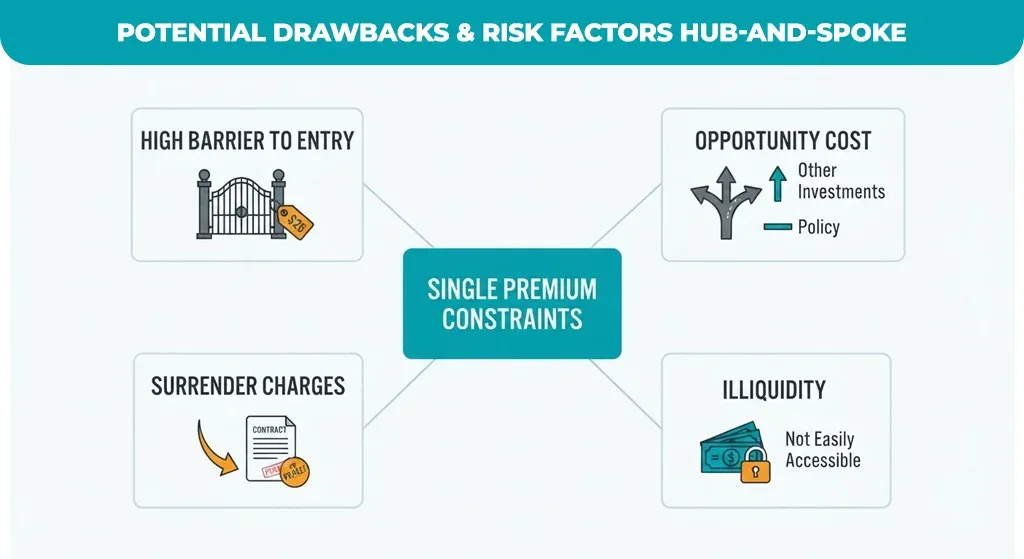
- High barrier to entry. Insurers typically require a substantial minimum deposit, often several thousand dollars at minimum, and frequently far more, which prices out buyers who want coverage without tying up a large sum of capital.
- Opportunity cost. Once the lump sum is inside the policy, it’s committed. Redeploying it into real estate, equities, or an emergency fund later generally means triggering surrender charges, taxable gains, or both.
- Surrender charges. Most single premium life insurance policies impose a surrender charge schedule, often lasting several years, that can significantly erode the amount you get back if you cancel the policy early.
- Illiquidity. While policy loans provide some access to cash value, the policy is not designed as a liquid, easily-tradable asset; it’s built for people who don’t expect to need this money for other purposes.
What is the cost of a single premium life insurance policy?
There’s no single answer to what a single premium life insurance policy costs or what single premium life insurance rates look like, because pricing depends on age, health, gender, the death benefit requested, and which single premium life insurance companies you’re comparing. As a general pattern, older applicants and larger death benefits both raise the required lump sum, while younger, healthier applicants can secure more coverage per dollar deposited. If you want an accurate single premium life insurance quote, the only reliable path is running an illustration with a licensed agent or comparing quotes across several single premium life insurance companies side by side, since minimum deposits, crediting rates, and fee structures vary meaningfully between carriers.
Conclusion
Single premium life insurance is a specialized tool, not a mass-market product. It trades liquidity and flexibility for a guaranteed death benefit, accelerated tax-deferred cash value growth, and the peace of mind that comes from never owing another premium. For the right buyer often someone repositioning a windfall into a guaranteed legacy that trade-off is a compelling one. For someone who simply needs affordable, maximum protection on a monthly budget, it almost never is.
Because the MEC rules, surrender charge schedules, and underwriting requirements vary by carrier and by individual health and financial circumstances, this article is educational, not personalized advice. Before committing a lump sum, sit down with a certified financial planner or licensed insurance professional, run an actual policy illustration, and confirm exactly how a single premium life insurance policy fits into your broader estate and retirement plan.