


For most people, life insurance premiums are not tax deductible. The IRS treats premiums on a policy covering your own life as a personal expense, whether it’s term, whole, or universal life. In exchange, the death benefit your beneficiaries receive is generally free of federal income tax.
Quick answer: No, you generally can’t deduct premiums on personal life insurance; IRS Publication 529 says, “You can’t deduct premiums you pay on your life insurance.” Exceptions include employer-paid group-term life insurance, executive bonus plans, policies donated to charity, and premiums paid as alimony under divorce agreements made before 2019. Businesses can’t deduct premiums when they’re directly or indirectly the policy’s beneficiary.
Are Life Insurance Premiums Tax Deductible?
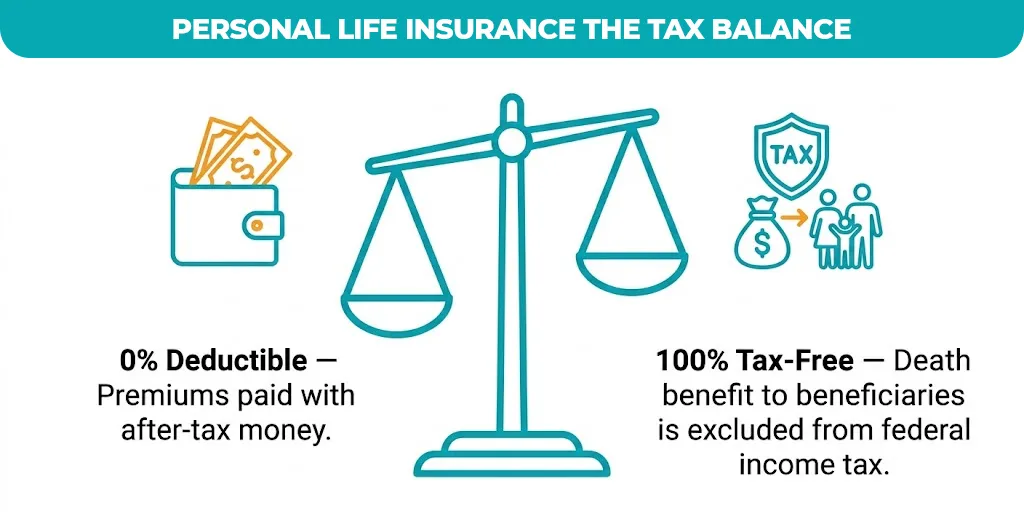
For personal life insurance, the deductible share of premiums is zero. You pay premiums with after-tax dollars, and in return the policy’s death benefit is generally paid to your beneficiaries free of federal income tax.
The trade-off: after-tax premiums, tax-free benefit
Under Internal Revenue Code § 101(a), amounts received under a life insurance contract because of the insured’s death are generally excluded from gross income. The IRS confirms that life insurance death proceeds “aren’t includable in gross income and you don’t have to report them.”
So while you can’t write off a $60 monthly term premium, a $500,000 death benefit paid to your family generally arrives without federal income tax. For most families, that’s the more valuable tax advantage.
What percentage of personal life insurance premiums is deductible?
Usually 0%. That’s true for:
• Term life insurance
• Whole life insurance
• Universal and indexed universal life insurance
• Final expense and burial insurance
• Policies bought by self-employed people or business owners to cover their own families
Being self-employed doesn’t change this. A policy that protects your family is still a personal expense, even if you run a business.
Note: State tax rules usually follow federal rules on this point, but check your state’s guidance or ask a tax professional if you’re unsure.
IRS Rules for Personal Life Insurance
Personal life insurance premiums aren’t deductible because the tax code doesn’t allow deductions for personal, living, or family expenses, and life insurance protecting your family falls into that category. Separately, Internal Revenue Code § 264(a)(1) blocks a deduction for premiums on any life insurance policy when the taxpayer is directly or indirectly a beneficiary, which mainly matters for businesses.
Are term life insurance premiums tax deductible?
No. Term life insurance premiums for a policy on your own life, your spouse, or anyone else in your family are personal expenses. IRS Publication 529 is explicit: “You can’t deduct premiums you pay on your life insurance.” This applies whether you pay monthly or annually and whether you bought the policy yourself or through an agency.
Whole and universal life: tax-deferred growth, but no deduction
Permanent policies offer tax advantages, just not a premium deduction:
• Tax-deferred cash value: cash value grows without yearly income tax.
• Policy loans: loans from a policy that isn’t a modified endowment contract (MEC) are generally not taxable, according to Tax Facts.
• Dividends: dividends on participating policies are generally treated as a return of premium and aren’t taxable until they exceed the premiums you’ve paid.
• Surrender: if you cancel the policy, the amount you receive above your cost basis (generally the premiums paid) is taxable as ordinary income.
• Lapse with a loan: if the policy lapses with a loan outstanding, the loan can become taxable to the extent the cash value exceeds your basis.
Do you have to claim a life insurance policy on your taxes?
Usually not. You don’t report owning a policy or paying premiums. You do need to report certain events:
• Death benefit received: generally not reported or taxed. The IRS says beneficiaries “don’t have to report” death proceeds, but any interest paid with them is taxable.
• Interest on proceeds: if the insurer pays interest on a delayed claim or on installments, that interest is taxable income.
• Surrender gains: if you cash out for more than your basis, the gain is taxable. Insurers generally report this on Form 1099-R.
• Group-term coverage over $50,000: the imputed cost appears on your Form W-2.
Tax status of common life insurance events
| Event | Tax deductible? | Taxable income? | Rule |
| Paying premiums on a personal policy | No | No | Personal expense; IRS Pub. 529 |
| Death benefit paid to beneficiary | Not applicable | Generally no | IRC § 101(a) |
| Interest added to death benefit | Not applicable | Yes | IRS guidance on life insurance proceeds |
| Cash value growth | Not applicable | No, while it stays in the policy | Tax-deferred inside the policy |
| Policy loan (non-MEC) | Not applicable | Generally no | Not a distribution under IRC § 72 |
| Loan or withdrawal from a MEC | Not applicable | Yes, gains first, plus a possible 10% penalty | IRC § 7702A and § 72 |
| Surrender for more than basis | Not applicable | Yes, on the gain | Ordinary income |
| Policy transferred for value | Not applicable | Possibly, on part of the death benefit | IRC § 101(a)(2) transfer-for-value rule |
For more on taxes after a death, see are life insurance proceeds taxable and is life insurance taxable.
When Life Insurance Premiums Can Be Tax Deductible
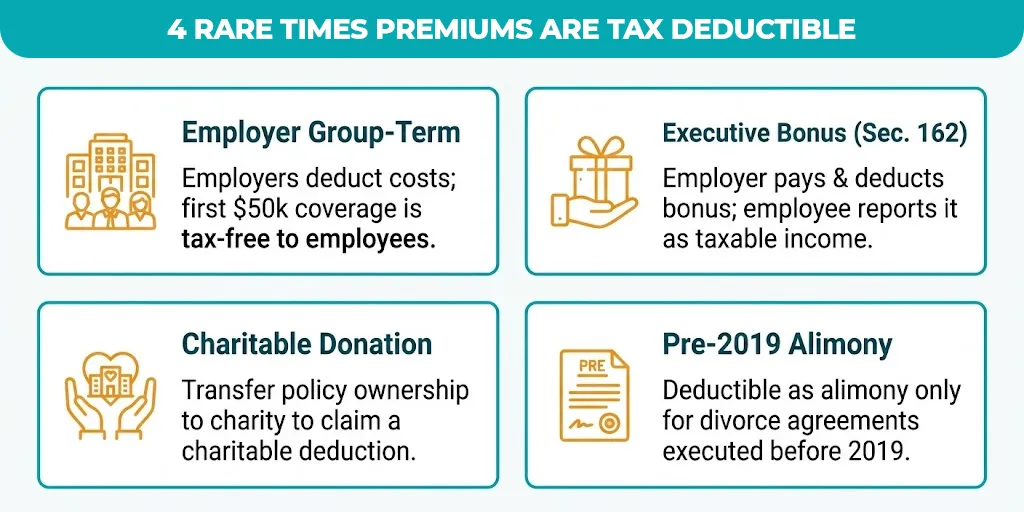
There are a few situations where life insurance premiums are deductible, or where paying for coverage creates a tax benefit. Most involve an employer paying for coverage, a charity owning the policy, or older divorce agreements.
Exception 1: Employer-provided group-term life insurance
Employers can generally deduct the cost of group-term life insurance they provide to employees as a business expense, as long as the employer isn’t directly or indirectly a beneficiary. For employees, IRS guidance under Internal Revenue Code § 79 says the first $50,000 of employer-provided group-term coverage has no tax consequences.
Above $50,000, the cost of the extra coverage, figured using the IRS premium table rather than actual cost, must be included in the employee’s wages. According to IRS Publication 15-B, it’s subject to Social Security and Medicare taxes and shown on Form W-2 in boxes 1, 3, and 5 and in box 12 with code C. Employer-paid coverage on a spouse or dependent with a face amount of $2,000 or less is excluded as a de minimis fringe benefit.
The employee doesn’t deduct anything, and the $50,000 exclusion may not apply to key employees if the plan favors them. See group term life insurance.
Exception 2: Executive bonus plans (Section 162)
In an executive bonus plan, a business pays the premium on a policy that the employee owns, with beneficiaries the employee chooses. Because the payment is compensation, the business can generally deduct it as a reasonable compensation expense under § 162, and the employee reports it as taxable income. The death benefit generally remains income-tax-free to the employee’s beneficiaries. Some employers “double bonus” an extra amount to help cover the employee’s tax.
Exception 3: Donating a policy to charity
If you transfer ownership of a policy to a qualified charity, you may be able to claim a charitable deduction. Kiplinger explains the deduction is generally “the lesser of the adjusted ‘cost basis’ or the fair market value of the policy.” Cash you give the charity afterward to pay the premiums is generally deductible as a charitable gift if you itemize.
Simply naming a charity as beneficiary, while keeping ownership, doesn’t produce an income tax deduction. And IRS Publication 526 notes you can’t deduct a contribution if the charity pays premiums on a policy that benefits you, your family, or someone you choose.
Alimony under divorce agreements made before 2019
IRS Publication 529 notes you may be able to deduct, as alimony, premiums you pay on life insurance policies assigned to your former spouse. That treatment only applies to divorce or separation agreements executed before 2019. For agreements executed after 2018, alimony isn’t deductible. A pre-2019 agreement modified later keeps the old treatment unless the modification expressly says the new rules apply, according to IRS Topic 452.
Exceptions at a glance
| Situation | Who gets the tax benefit | Main requirement | Key limit |
| Group-term life from an employer | Employer deducts; employee excludes first $50,000 | Employer isn’t the beneficiary; plan meets § 79 rules | Coverage over $50,000 is taxable to the employee |
| Executive bonus plan | Employer deducts the bonus | Employee owns the policy; pay is reasonable compensation | Employee pays income tax on the bonus |
| Policy donated to charity | Donor, as a charitable deduction | Charity owns the policy; donor itemizes | Lesser of basis or fair market value; charitable deduction limits apply |
| Alimony premiums | Payer spouse | Agreement executed before 2019; policy assigned to former spouse | Not available for agreements executed after 2018 |
Business Life Insurance Tax Rules
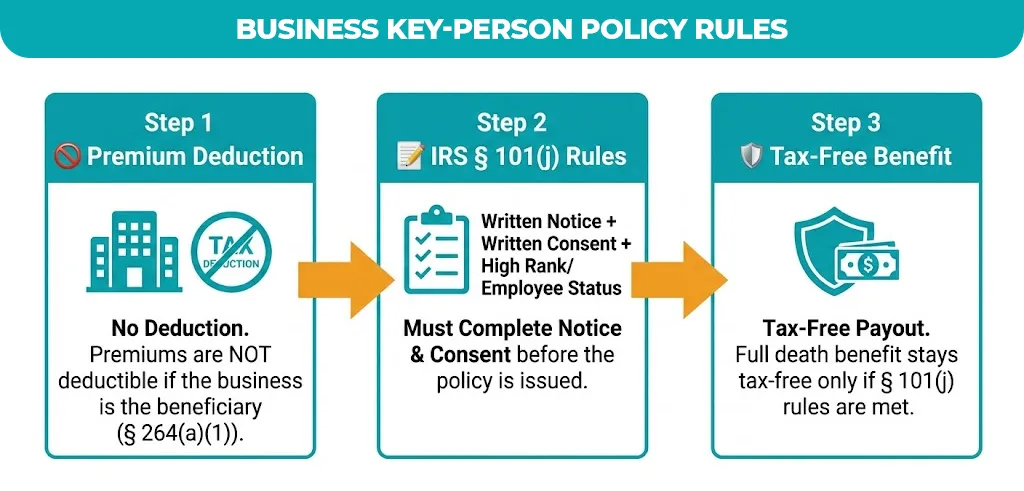
Businesses face the same core rule: if the business is directly or indirectly a beneficiary of the policy, it can’t deduct the premiums. Whether the death benefit is tax-free to the business depends on meeting specific IRS notice and consent rules.
Key-person life insurance
Key-person insurance is a policy a business buys on an owner or important employee, with the business as owner and beneficiary. Because the business is the beneficiary, § 264(a)(1) blocks a deduction for the premiums. IRS Publication 535 (2022) also says you can’t deduct the cost of life insurance coverage for you, an employee, or anyone with a financial interest in the business if you’re directly or indirectly the beneficiary. This applies to sole proprietors, partnerships, LLCs, S corporations, and C corporations.
The upside is that the death benefit can be received tax-free, but only if the business follows § 101(j) for employer-owned life insurance. Before the policy is issued, the employee must:
• Be told in writing that the employer intends to insure their life, and the maximum face amount
• Give written consent, including that coverage may continue after they leave the job
• Be told in writing that the employer will be a beneficiary
The insured must also fit an exception, such as being a director or highly compensated employee when the policy was issued, or an employee within 12 months before death. If these rules aren’t met, the tax-free amount is limited to the premiums the business paid, and the rest is taxable. Businesses with employer-owned policies also generally file Form 8925 each year.
Buy-sell agreements
Owners often fund buy-sell agreements with life insurance, so surviving owners or the business can buy a deceased owner’s share. Premiums are generally not deductible, whether the business owns the policies (entity redemption) or the owners own policies on each other (cross-purchase). The death benefit is generally tax-free when the rules are followed.
Split-dollar arrangements
In a split-dollar arrangement, an employer and employee share a policy’s costs and benefits. These are taxed under detailed Treasury regulations, either as an economic benefit the employee reports as income or as a loan from the employer. The employer generally doesn’t get a straightforward premium deduction. Because the rules are complex, split-dollar plans should be set up with a tax advisor.
Estate taxes and irrevocable life insurance trusts
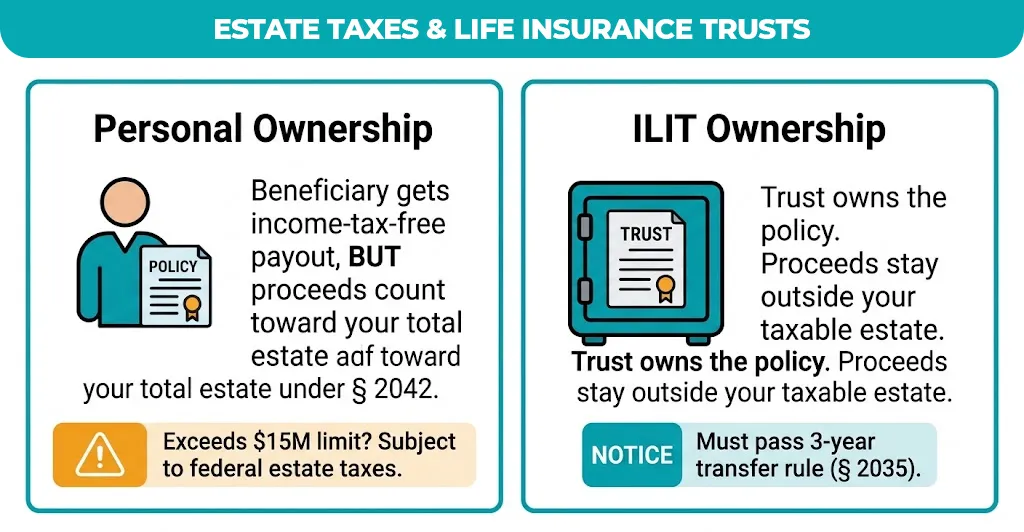
The death benefit is usually free of income tax, but it can still count toward your taxable estate. Under § 2042, proceeds are included in your gross estate if they’re payable to your executor or if you held any incidents of ownership, such as the right to change beneficiaries or borrow against the policy.
For 2026, the federal estate tax basic exclusion amount is $15 million per person, according to the IRS, so most estates won’t owe federal estate tax. For larger estates, an irrevocable life insurance trust (ILIT) can own the policy so the proceeds stay outside the estate. Two cautions:
• Three-year rule: under § 2035, if you transfer an existing policy to a trust and die within three years, the proceeds are pulled back into your estate. Having the trust buy a new policy avoids this.
• Gifts to pay premiums: money you give the trust to pay premiums counts as gifts; the 2026 annual gift tax exclusion is $19,000 per recipient.
Some states have their own estate or inheritance taxes with much lower thresholds.
Business policy tax comparison
| Business policy setup | Premium deductible by the business? | Taxable income to the employee? | Death benefit tax-free? |
| Group-term life for employees | Generally yes, if the employer isn’t the beneficiary | Only the cost of coverage over $50,000 | Yes, to the employee’s beneficiaries |
| Executive bonus plan (§ 162) | Yes, as compensation | Yes, the bonus amount | Yes, to the employee’s beneficiaries |
| Key-person insurance | No | No | Yes, if § 101(j) notice and consent rules are met |
| Buy-sell funding | No | No | Generally yes |
| Split-dollar arrangement | Depends on the structure | Economic benefit or loan treatment | Depends on the structure |
| Owner’s personal policy paid by the business | Only if treated as compensation | Yes, if treated as compensation | Generally yes |
See life insurance for business owners.
How to Choose Tax-Smart Life Insurance Coverage
Since personal premiums usually aren’t deductible, the tax-smart move is to choose the right policy type, the right owner, and the right beneficiary. That’s where coordinating with a tax professional and an insurance agent pays off.
Step 1: Separate personal and business needs
List what you need coverage for. Personal needs, like replacing income or paying off a mortgage, call for a personal policy you pay for with after-tax dollars. Business needs, like protecting against the loss of a key person or funding a buy-sell agreement, call for a business-owned policy set up to meet the IRS rules.
Step 2: Consider tax-deferred cash value only if it fits
If you want lifelong coverage and long-term savings, whole life or indexed universal life offer tax-deferred cash value and generally tax-free policy loans. They cost much more than term, so compare them against other tax-advantaged options like a 401(k), IRA, or HSA first. See term vs. whole life insurance and cash value life insurance.
Step 3: Coordinate ownership with your CPA and estate attorney
Who owns the policy and who’s the beneficiary can change the tax result:
• Personal coverage: you usually own it and name family members.
• Larger estates: an ILIT may own it to keep proceeds outside your estate.
• Key-person coverage: the business owns it, after completing § 101(j) notice and consent.
• Executive bonus: the employee owns it, and the business pays the premium as compensation.
Step 4: Compare policies from several insurers
Once you know the structure, compare premiums, cash value projections, and riders from multiple insurers.
Comparing coverage with Premier Services Agency
Premier Services Agency helps individuals, families, and business owners compare term, whole life, and universal life policies from multiple insurers. An agent can help you match a policy to your goals, and you can share the options with your CPA or estate attorney to confirm the tax treatment before you buy.
Conclusion
Personal life insurance premiums aren’t tax deductible, but the death benefit is generally income-tax-free, which is the bigger tax advantage for most families. Deductions are limited to specific cases: employer-paid group-term coverage, executive bonus plans, policies donated to charity, and alimony under pre-2019 agreements. Businesses can’t deduct premiums on policies where they’re the beneficiary. Because ownership, beneficiaries, and estate size change the result, review your plan with a tax professional.
| Your situation | Tax treatment |
| Personal term, whole, or universal life | Premiums not deductible; death benefit generally tax-free |
| Self-employed buying coverage for your family | Still a personal expense; not deductible |
| Employer-provided group-term life | First $50,000 tax-free to you; employer generally deducts |
| Employer pays your personal policy as a bonus | Employer deducts; you pay tax on the bonus |
| Business owns a key-person policy | Premiums not deductible; benefit tax-free if § 101(j) is met |
| Donating a policy to charity | Possible charitable deduction if you itemize |
| Premiums required by a pre-2019 divorce agreement | May be deductible as alimony |
| Large estate | Consider an ILIT to keep proceeds outside the estate |
Compare Life Insurance With Premier Services Agency
The right policy, owner, and beneficiary can make a big difference in how your coverage is taxed. Premier Services Agency can help you compare term, whole life, and universal life options from multiple insurers.
• Get a quote: request life insurance quotes
• Talk to an agent: call (470) 650-0470
• Get in touch: use the contact page