


Yes, you can buy burial insurance for your parents, as long as your parent knows about the policy and signs the application. Many adult children do it so a sudden funeral bill doesn’t fall on them or drain family savings. The median funeral with viewing and burial cost $8,300 in the most recent NFDA survey, before adding a plot or headstone.
Quick answer: Adult children have insurable interest in their parents, so you can own and pay for a burial policy on your mom or dad and name yourself as beneficiary. Your parent must consent and sign. In 2026 sample rates, $10,000 of coverage costs about $33 to $43 a month at 60, $53 to $70 at 70, and $98 to $135 at 80 for a non-smoker.
Can You Buy Burial Insurance for Your Parents?
Yes. You can buy burial insurance for a parent, own the policy, pay the premiums, and be the beneficiary, as long as your parent agrees and signs the application. What you can’t do is take out a policy on a parent without their knowledge; that’s considered insurance fraud.
Why families buy burial insurance for elderly parents
Burial insurance (also called final expense insurance) is a small whole life policy, usually $5,000 to $25,000, meant to cover the funeral and other end-of-life bills. The National Funeral Directors Association’s 2023 member survey put the median cost of a funeral with viewing and burial at $8,300, or $9,995 with a vault, and a funeral with cremation at $6,280. Those figures don’t include the cemetery plot, opening and closing the grave, or a headstone, which can push the total well past $10,000.
A policy on a parent can:
• Pay the funeral home within days, instead of waiting for an estate to settle.
• Keep siblings from having to split the bill or use credit cards.
• Protect a surviving parent’s savings.
• Cover medical bills or small debts left behind.
See our guide to how much a funeral costs.
What are the downsides of burial insurance?
The main downsides are cost per dollar of coverage at older ages, a two-year waiting period on guaranteed issue plans, and small face amounts.
• Expensive at older ages: a $10,000 policy for an 80-year-old man runs about $135 a month in 2026 sample rates. Over several years, total premiums can approach or exceed the death benefit.
• Waiting periods: guaranteed issue policies usually pay only a refund of premiums (sometimes with interest or a small extra percentage) if death from natural causes happens in the first two years.
• Limited coverage: most policies top out at $25,000 to $50,000.
• Slow cash value: small whole life policies build very little cash value, so they’re not a savings tool.
For many families, those trade-offs are worth it for the certainty that the funeral is paid for.
How to Buy Burial Insurance for a Parent: The Legal Rules
Three things must be in place: insurable interest, your parent’s consent and signature, and a clear setup of who owns, who’s insured, and who receives the money. Getting these right at the start avoids claim problems later.
Insurable interest: why adult children qualify
Insurable interest means you’d suffer a financial loss if the insured person died, and close family members, including adult children, generally meet that test. As a child, you’re likely to pay for or arrange your parent’s funeral, which is the kind of financial stake insurers look for. Insurable interest only needs to exist when the policy is bought.
Parent consent and signature rules
Your parent must know about the policy, answer the health questions (if any), and sign the application. Depending on the insurer, that can mean:
• A paper or electronic signature on the application.
• A recorded phone interview where your parent confirms their identity and agrees to the coverage.
• Answering health questions themselves, in their own words.
Power of attorney usually isn’t enough. According to MoneyGeek, a power of attorney generally doesn’t let someone sign a life insurance application on another person’s behalf, because the insured must personally consent. If your parent can no longer understand or consent, for example with advanced dementia, many insurers won’t issue a new policy. In that case, look at a preneed funeral contract, savings, or Medicaid planning instead.
Note: Talk with your parent first. Explain why you want the policy, who will pay, and who the beneficiary will be. A parent who understands the plan is more comfortable answering the health questions honestly, which matters if the insurer reviews the application during a claim.
Setting up the policy: owner, insured, and beneficiary
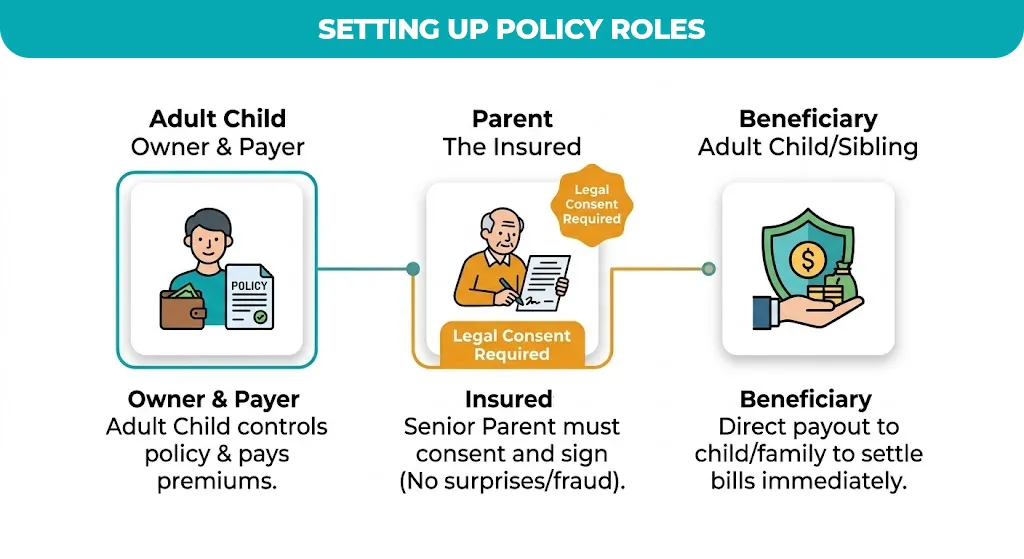
The usual setup is: you (the adult child) are the owner and payer, your parent is the insured, and you are the beneficiary. As owner, you control the policy, receive the notices, and can change the beneficiary. Because you’re the beneficiary, you’ll receive the death benefit directly and can pay the funeral home.
Siblings who share the cost often name one sibling as owner and list each as a co-beneficiary, or name one beneficiary who agrees to handle the funeral. Write down the arrangement so everyone knows the plan.
Burial insurance for parents in New York State
New York has fewer burial insurance options than most states, because of stricter state regulation. According to Choice Mutual, only a few carriers sell final expense coverage there, guaranteed acceptance plans are limited to ages 50 to 75 in New York (versus up to 85 elsewhere), and coverage above 75 requires health questions. If your parent lives in New York, the policy is based on where they live, so shop for New York-approved plans.
USAA burial insurance for parents
USAA offers a guaranteed issue whole life policy underwritten by Mutual of Omaha subsidiaries, sold to USAA members. When it launched in 2021, it covered ages 45 to 85 (50 to 75 in New York) with $2,000 to $25,000 of coverage and no health questions. During the first two years, a death from natural causes pays 120% of premiums paid rather than the full benefit. Your parent must meet USAA’s membership rules; check current terms with USAA.
Policy roles at a glance
| Policy role | Who usually fills it | Legal requirement | Common pitfall to avoid |
| Owner | Adult child | Insurable interest at purchase | Not telling siblings who controls the policy |
| Payer | Adult child (or siblings) | None beyond paying on time | Missed payments causing a lapse; set up autopay |
| Insured | Parent | Must consent and sign; answer health questions honestly | Applying without the parent’s knowledge |
| Beneficiary | Adult child, or a sibling who will handle the funeral | Named on the application | Naming the parent’s estate, which can delay payment |
Simplified Issue vs. Guaranteed Issue for Parents
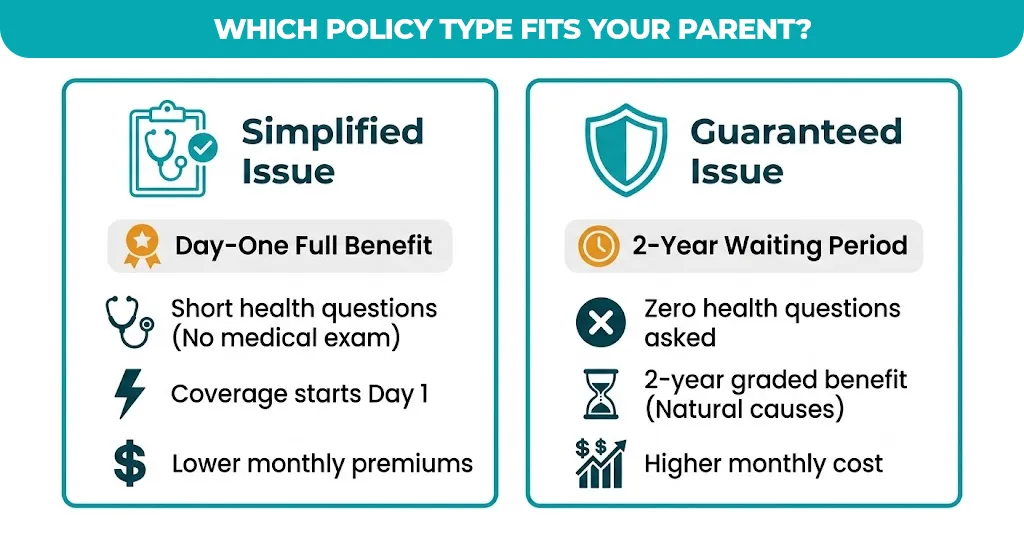
If your parent can answer a short health questionnaire favorably, a simplified issue policy usually gives full coverage from day one at a lower price; if not, guaranteed issue accepts everyone but limits the payout for the first two years. Neither type requires a medical exam.
Simplified issue final expense
Simplified issue policies ask health questions, usually yes-or-no, and may check prescription and medical databases, but don’t require an exam. If your parent qualifies for a level (day-one) plan, the full death benefit is payable from the first day of coverage. Some carriers also offer graded or modified versions for parents with moderate health issues, which pay a partial benefit in the first year or two.
Typical questions ask about:
• Hospitalizations, nursing home care, or hospice in the past one to two years
• Cancer, heart attack, stroke, or heart surgery in recent years
• Kidney failure, dialysis, or organ transplants
• Alzheimer’s or dementia
• Oxygen use for COPD
• Insulin use and diabetic complications
Guaranteed issue burial insurance
Guaranteed issue (guaranteed acceptance) policies ask no health questions, so your parent can’t be turned down within the eligible age range, usually 45 or 50 to 80 or 85. The trade-off is a graded benefit period: according to MoneyGeek, most guaranteed acceptance policies have a two-year period in which a death from natural causes pays a refund of premiums (sometimes with interest) instead of the full benefit. Accidental deaths are generally covered in full from day one. These plans also cost more per dollar of coverage.
Coverage for unhealthy parents
Many health conditions don’t rule out day-one coverage; it depends on how well controlled the condition is and how recent any events were. General patterns:
| Condition | Often qualifies for day-one coverage when… | Often needs graded or guaranteed issue when… |
| Diabetes | Controlled with oral medication or insulin, no complications | Diabetic complications (neuropathy, amputation, kidney damage) |
| Heart disease | Heart attack or stent several years ago, stable now | Recent heart attack, congestive heart failure, or surgery in the past year or two |
| COPD | Mild, no oxygen use | Oxygen use or recent hospitalizations |
| Stroke | Several years ago with full recovery | Recent stroke |
| Cancer | Treatment ended several years ago, no recurrence | Active treatment or recent diagnosis |
| Dementia or Alzheimer’s | Rarely | Usually declined for simplified issue; guaranteed issue if your parent can still consent |
| Dialysis or terminal illness | Rarely | Guaranteed issue |
Underwriting rules vary widely by insurer, which is why comparing several carriers matters for a parent with health issues. Read more about no medical exam burial insurance and guaranteed issue insurance.
Note: Always answer health questions honestly. Most policies have a two-year contestability period, and an insurer that finds misstatements during that time can deny the claim.
Simplified issue vs. guaranteed issue compared
| Feature | Simplified issue (day-one) | Guaranteed issue (two-year graded period) |
| Health questions | Yes | No |
| Medical exam | No | No |
| Approval | Based on answers and database checks | Guaranteed within the age range |
| Full benefit starts | Day one (level plans) | After two years for natural-causes deaths |
| Price | Lower | Higher |
| Typical ages | About 45 or 50 to 85 (some carriers up to 89) | About 45 or 50 to 80 or 85 |
| Ideal parent profile | Healthy to moderately ill | Serious health conditions that make other coverage unavailable |
Burial Insurance for Parents by Age
The younger and healthier your parent is when the policy starts, the lower the premium, and the premium stays level for life. Options narrow after 80 and drop off sharply after 85.
Burial insurance for parents over 50 and over 60
In their 50s and 60s, most parents qualify for day-one coverage at the lowest rates, and can often buy $25,000 or more. For $10,000 of coverage, 2026 sample rates run about $24 to $31 a month at 50 and $33 to $43 at 60 for non-smokers. This is the best time to lock in coverage, because the premium is set for life at the age of purchase.
If your parent is in their 50s or early 60s and still working, also compare a small term or whole life policy; see our guide to life insurance for parents.
Best burial insurance for parents over 70 and over 80
At 70, coverage is still widely available; by 80, prices roughly double, and fewer guaranteed issue plans accept new applicants. $10,000 costs about $53 to $70 a month at 70 and $98 to $135 at 80 in 2026 sample rates. The best policy at these ages is usually a simplified issue plan with day-one coverage, if your parent qualifies. MoneyGeek notes that many guaranteed acceptance providers stop accepting new applicants after age 80.
Burial insurance for parents over 85 and age 90
At 85, guaranteed issue is still available from a few carriers; from 86 to 89, only a handful of insurers offer coverage, and all require health questions. According to Choice Mutual, guaranteed acceptance plans are available only at 85 and below, and five carriers offer coverage at ages 86 to 89, with maximums from $10,000 to $50,000 depending on the carrier. Sample 2026 rates for $10,000 at 89 are about $260 a month for a woman and $357 for a man (non-tobacco). Choice Mutual states that 90 is the maximum age for new applicants, so options effectively end there.
Note: At 85 and older, total premiums can catch up with the death benefit within a few years. Compare the cost with setting aside savings or a preneed funeral contract, which can lock in today’s funeral prices.
Age and eligibility at a glance
| Age group | Main goal | Typical maximum coverage | Typical monthly cost for $10,000 (non-tobacco, F / M) |
| 50 to 59 | Lock in the lowest lifetime rate | $25,000 to $50,000 | $24 to $28 / $31 to $36 |
| 60 to 69 | Day-one coverage before health changes | $25,000 to $50,000 | $33 to $41 / $43 to $54 |
| 70 to 79 | Find a day-one plan if healthy | $25,000 to $50,000 | $53 to $71 / $70 to $97 |
| 80 to 85 | Simplified issue if possible; guaranteed issue as backup | Often $25,000; some less | $98 to $136 / $135 to $178 |
| 86 to 89 | Health questions required; few carriers | $10,000 to $50,000 by carrier | About $171 to $260 / $236 to $357 |
| 90+ | Generally no new coverage | Not available | Consider savings or a preneed plan |
Rates from Choice Mutual published sample rates, valid March 9, 2026. Ranges reflect ages at the start and end of each group.
How Much Does Burial Insurance for Parents Cost?
A $10,000 burial policy for a healthy, non-smoking parent costs about $24 to $31 a month at 50, $53 to $70 at 70, and $136 to $178 at 85, according to Choice Mutual’s 2026 sample rates. Guaranteed issue costs more, and men pay roughly 30% more than women at the same age.
Monthly rates for $5,000 to $25,000 of coverage
| Parent’s age | $5,000 (F / M) | $10,000 (F / M) | $15,000 (F / M) | $25,000 (F / M) |
| 50 | $14 / $17 | $24 / $31 | $35 / $44 | $55 / $71 |
| 55 | $15 / $20 | $28 / $36 | $40 / $52 | $64 / $84 |
| 60 | $18 / $23 | $33 / $43 | $48 / $63 | $76 / $103 |
| 65 | $22 / $29 | $41 / $54 | $59 / $79 | $97 / $130 |
| 70 | $28 / $37 | $53 / $70 | $78 / $103 | $127 / $169 |
| 75 | $37 / $50 | $71 / $97 | $105 / $144 | $172 / $238 |
| 80 | $50 / $69 | $98 / $135 | $145 / $200 | $241 / $332 |
| 85 | $68 / $95 | $136 / $178 | $196 / $280 | $335 / $440 |
Source: Choice Mutual published monthly sample rates, non-tobacco, valid March 9, 2026. See also our burial insurance cost guide.
How much is a $10,000 burial policy for a healthy vs. unhealthy parent?
For a parent who doesn’t qualify for simplified issue, guaranteed issue costs noticeably more. Published guaranteed issue rates are easiest to find for $15,000, so this comparison uses that amount:
| Parent’s age | Simplified issue, $15,000 (F / M) | Guaranteed issue, $15,000 (F / M) |
| 50 | $35 / $44 | $54 / $70 |
| 60 | $48 / $63 | $75 / $94 |
| 70 | $78 / $103 | $113 / $145 |
| 80 | $145 / $200 | $227 / $290 |
| 85 | $196 / $280 | $249 / $290 |
Sources: simplified issue from Choice Mutual (non-tobacco, valid March 9, 2026); guaranteed issue from MoneyGeek’s 2026 averages for nonsmokers. The two sources use different carriers, so treat this as a general comparison. MoneyGeek gives about $60 (female) and $80 (male) a month for $10,000 of guaranteed issue coverage at 65.
What affects your parent’s premium
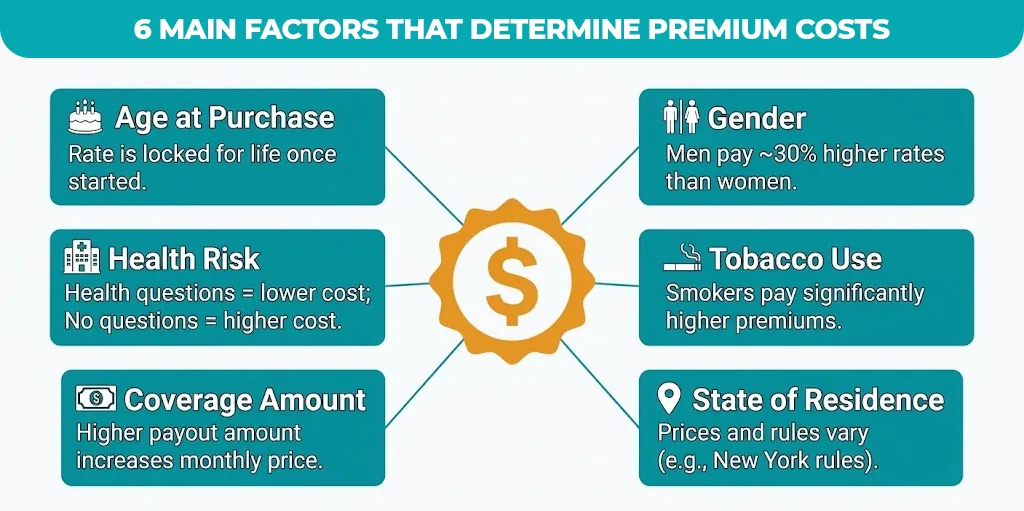
• Age at purchase: the biggest factor; the rate is locked in for life once the policy starts.
• Sex: men pay about 30% more, according to Choice Mutual.
• Health and underwriting type: day-one simplified issue is cheapest; graded and guaranteed issue cost more.
• Tobacco use: smokers pay substantially more.
• Coverage amount: larger policies cost more, but the price per $1,000 usually drops slightly.
• State: availability and pricing vary, and New York has fewer options.
• Insurer: rates for the same parent can differ significantly between carriers.
Note: Add up what the premiums would total over your parent’s expected lifetime. If the total would far exceed the death benefit, setting aside the same money each month in a savings account may make more sense, especially for parents in their late 80s.
How to Get Coverage for Your Parents, Step by Step
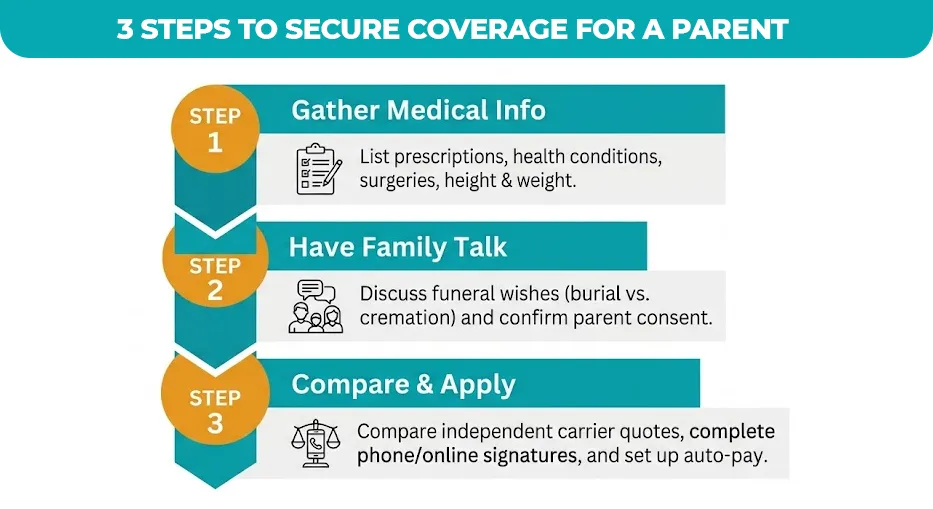
Gather your parent’s health details, talk openly as a family, then compare several insurers before applying. The process usually takes a short phone call and a few days to a few weeks for approval.
Step 1: Gather your parent’s medical history and prescriptions
Underwriting is based on health history, so have the details ready before you request quotes.
• A list of current prescriptions with dosages
• Diagnoses and approximate dates (heart attack, stroke, cancer, diabetes)
• Hospital stays or surgeries in the past few years
• Height and weight
• Tobacco or nicotine use
Step 2: Have an open conversation about end-of-life wishes
Talking about a parent’s funeral can be hard, but it makes every later decision easier. Ask what they want (burial or cremation, type of service, religious traditions), whether they already have a policy or a preneed contract, and how they’d feel about you owning a policy on their life. Explain that the goal is to protect the family from a sudden bill, not to profit from their death.
Questions to cover:
• Do you already have life insurance, a preneed contract, or savings set aside?
• Do you prefer burial or cremation?
• Who should handle arrangements?
• Are you comfortable answering health questions with an agent on the phone?
Step 3: Compare independent brokers and single-company options
An independent agency can compare several insurers’ underwriting rules, which matters most for parents with health conditions; a single company can only offer its own product. One carrier may approve your parent for day-one coverage while another offers only a graded plan. Direct-mail and TV offers are often guaranteed issue plans, so check whether your parent could qualify for a less expensive simplified issue policy first.
Comparing carriers with Premier Services Agency
Premier Services Agency is an independent agency that helps families compare burial and final expense insurance from multiple carriers. A typical process:
1. Share your parent’s age, state, health details, and coverage goal.
2. Compare day-one, graded, and guaranteed issue options from several carriers.
3. Set up the policy: you as owner and payer, your parent as insured, and the right beneficiary.
4. Complete the application with your parent present to answer health questions and sign.
5. Set up automatic payments so the policy doesn’t lapse, and keep the policy documents where the family can find them.
Learn more about burial insurance, final expense insurance, and senior burial insurance.
Conclusion:
Buying burial insurance for your parents is legal, common, and often the simplest way to keep a funeral bill from landing on you or your siblings. The earlier you start, while your parent is younger and healthier, the lower the premium and the better the chance of day-one coverage.
| Your parent’s situation | Best option |
| 50 to 70 and in fair or good health | Simplified issue with day-one coverage, $10,000 to $25,000 |
| 70 to 85 with controlled conditions | Shop several carriers for a day-one or graded plan |
| Serious health conditions, 85 or younger | Guaranteed issue with a two-year graded period |
| 86 to 89 | Simplified issue from the few carriers that accept these ages |
| 90 or older | Savings or a preneed funeral contract |
| Lives in New York | Shop New York-approved plans; guaranteed issue only to age 75 |
| USAA member | Compare USAA’s guaranteed issue plan with simplified issue options |
| Can no longer consent | A new policy usually isn’t possible; consider savings or preneed planning |
Compare Burial Insurance Quotes at Premier Services Agency
Finding the right policy for a parent often comes down to which insurer looks most favorably at their health. Premier Services Agency final expense advisors can compare options from multiple carriers and help you set up the policy correctly.
• Compare burial insurance quotes at Premier Services Agency
• Call (470) 650-0470 to consult with Premier Services Agency