


Whole life insurance is often sold as two products in one: lifelong protection for your family and a savings account you can borrow from. Both parts are real, but they come at a price, and the savings side grows slowly for the first several years.
Quick answer: Whole life insurance is permanent coverage with a fixed premium, a guaranteed death benefit, and a cash value that grows at a guaranteed rate, tax-deferred. Part of every premium pays for the insurance and the insurer’s costs; the rest builds cash value you can borrow against or withdraw. A healthy 35-year-old pays about $92 to $106 a month for $100,000 of coverage.
What Is Whole Life Insurance and How Does It Work?
Whole life insurance is a permanent life insurance policy that lasts your entire life, charges the same premium every year, and builds a cash value account alongside the death benefit. As long as premiums are paid, the insurer guarantees to pay the death benefit whenever you die, and the cash value grows tax-deferred at a rate written into the contract.
Whole life insurance definition: the three pillars
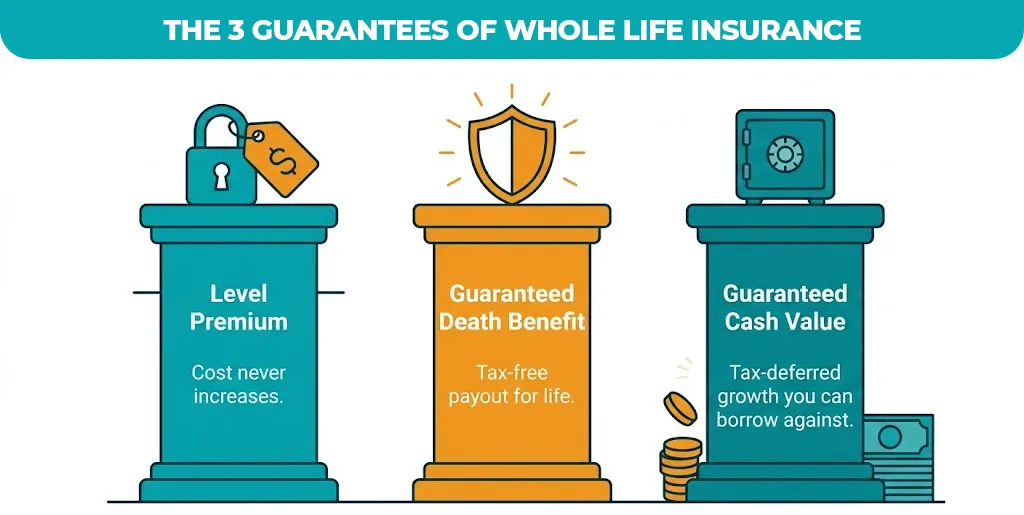
Every traditional whole life policy rests on three guarantees.
| Pillar | What it means | Why it matters |
| Level premium | The premium is set at purchase and never increases | Predictable cost for life, even as your health and age change |
| Guaranteed death benefit | Paid to beneficiaries whenever you die, as long as the policy is in force | Generally income-tax-free under IRC Section 101(a) |
| Guaranteed cash value | A savings component that grows at a guaranteed rate, tax-deferred | You can borrow against it, withdraw from it, or surrender for it |
In participating policies from mutual insurers, a fourth element can add value: dividends, which are not guaranteed but can be used to buy more coverage or grow cash value faster.
What’s the downside of whole life insurance?
The main downside is cost: whole life costs several times more than term for the same death benefit, and the cash value builds slowly in early years. For $100,000 of coverage at 35, published 2026 sample rates are about $92 to $106 a month for whole life versus $12 for 20-year term. Other downsides:
• Slow early cash value: the first-year cash value is often zero, and early years go mostly to insurance costs and expenses.
• Surrender losses: canceling in the first several years usually returns less than you paid in.
• Rigid premiums: missing payments can cause the policy to lapse or reduce coverage.
• Modest returns: cash value growth is typically lower than long-term returns from stock index funds, though it’s guaranteed.
Whole life works best when you need coverage that never expires (estate planning, a lifelong dependent, guaranteed final expenses) or you value guaranteed, conservative cash growth alongside the coverage. Compare it with our term vs whole life insurance guide.
How a Whole Life Insurance Policy Works
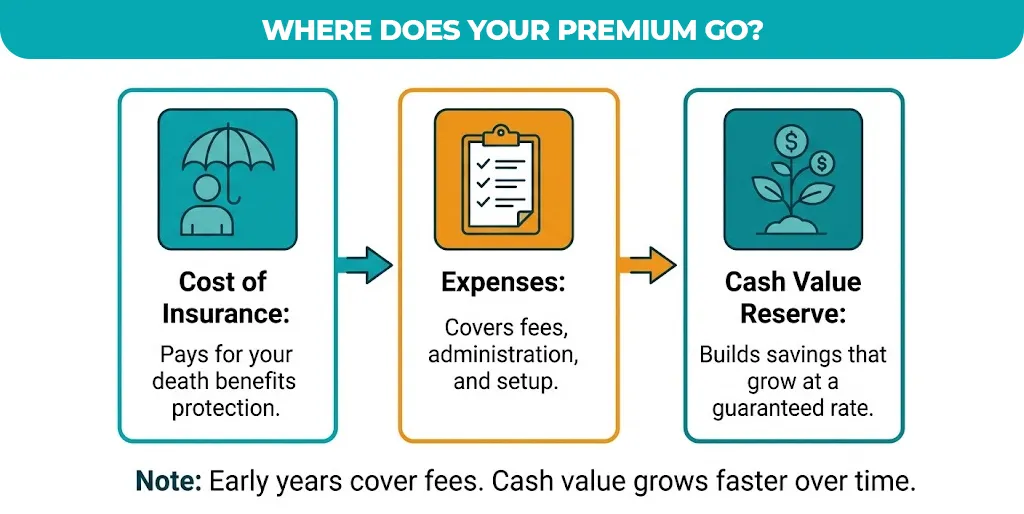
When you pay a whole life premium, the insurer splits it between the cost of providing the death benefit, its expenses, and the policy’s cash value reserve. Because the premium is level for life, you overpay for insurance in your younger years, and that excess, plus guaranteed interest, is what builds the cash value.
Anatomy of premium allocation
In whole life, the cost of insurance and fees are built into the fixed premium rather than shown as separate monthly deductions, as they are in universal life. Conceptually, each premium goes three ways:
Annual premium (fixed for life)
|
+–> Mortality cost (cost of insurance) – the price of the death benefit at your age
+–> Expenses – commissions, underwriting, administration
| (heaviest in the first years)
+–> Cash value reserve – grows at the guaranteed rate, tax-deferred
(plus dividends in participating policies)
Early on, expenses and insurance costs take most of the premium, which is why many policies show little or no cash value in year one. Over time, more of each premium stays in the policy, and growth compounds.
How long is whole life insurance, and how long do you pay?
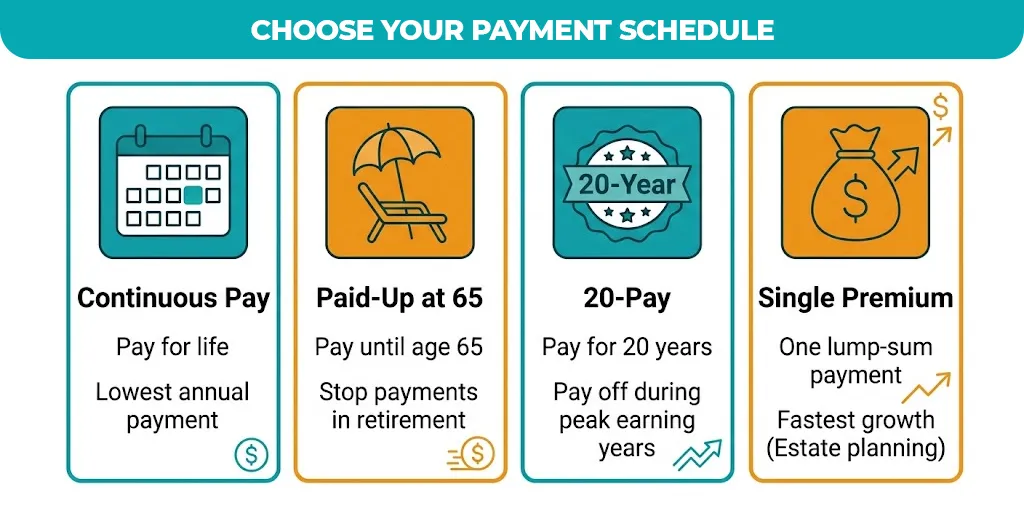
Whole life coverage lasts your entire life; policies are designed to mature at an advanced age, commonly 100 or 121. If you reach maturity, the policy typically pays out its value to you. How long you pay depends on the premium schedule you choose:
| Payment schedule | How long you pay | Premium size | Best for |
| Continuous pay (pay to 100 or 121) | For life | Lowest annual premium | Most buyers who want the smallest payment |
| Paid-up at 65 | Until age 65 | Higher | People who want no premiums in retirement |
| 20-pay | 20 years | Higher | Paying off coverage during peak earning years |
| 10-pay | 10 years | Highest | Business owners or high earners; faster cash value |
| Single premium | One payment | Large lump sum | Estate planning; usually becomes a MEC |
Once a limited-pay policy is paid up, the coverage and cash value continue for life with no further premiums.
Participating vs. non-participating policies
Participating whole life, sold mostly by mutual insurers, may pay annual dividends; non-participating policies, usually from stock companies, don’t, but often have lower premiums. Dividends reflect the insurer’s actual results (mortality, investment returns, and expenses) compared with the conservative assumptions built into the premium. They’re never guaranteed, but they can significantly increase cash value over time.
Common dividend options:
• Paid-up additions (PUAs): buy small amounts of extra, fully paid coverage that also build cash value. The most common choice for growth.
• Premium reduction: apply the dividend to lower your next premium.
• Cash: receive the dividend as a check.
• Accumulate at interest: leave it with the insurer to earn interest (the interest is generally taxable).
• Loan repayment: use dividends to pay down a policy loan.
What does whole life insurance cover?
Whole life pays the death benefit for nearly any cause of death once the contestability period has passed, as long as the policy is in force. Most policies have a two-year contestability period and a suicide exclusion (typically two years, shorter in some states). The beneficiary can use the money for anything:
• Funeral and final expenses
• Paying off a mortgage or other debts
• Replacing income for a surviving spouse
• Estate taxes or estate equalization among heirs
• Funding a special-needs trust
• Leaving a legacy or charitable gift
Whole life policy mechanics blueprint
| Policy component | How it works | Guarantee status | Financial impact on owner |
| Premium | Fixed amount for the payment period you choose | Guaranteed | Predictable, but high relative to term |
| Death benefit | Paid at death to beneficiaries | Guaranteed (reduced by any unpaid loans) | Generally income-tax-free |
| Cash value | Grows each year at the contract rate | Guaranteed minimum values | Tax-deferred; usable through loans and withdrawals |
| Dividends | Declared annually by participating insurers | Not guaranteed | Can buy paid-up additions and boost growth |
| Surrender value | Cash value minus any surrender charges and loans | Guaranteed table in the policy | Early surrender often returns less than premiums paid |
| Policy loans | Borrow against cash value; interest charged | Loan availability guaranteed; rate set by contract | Reduces death benefit if not repaid |
Cash Value Accumulation, Loans and Investment Strategy
Whole life cash value starts slowly, often at zero in year one, then compounds; in published projections for a $100,000 participating policy bought at 30, cash value doesn’t pass total premiums paid until roughly year 20. You can use it while living through policy loans, withdrawals, or surrender, but each option affects the death benefit.
Does whole life insurance build cash value?
Yes, but slowly at first. Choice Mutual’s 2026 projections for a $100,000 participating policy (preferred non-tobacco, expected values including dividends) for a 30-year-old man paying $1,013 a year:
Year Premiums paid Projected cash value
1 $1,013 $0
5 $5,065 $2,564
10 $10,130 $8,259
20 $20,260 $24,272
30 $30,390 $48,894
The early gap is the cost of insurance and front-loaded expenses. After year 20, growth accelerates because the cash value itself is compounding. These are projections that assume dividends continue; guaranteed values are lower. See our guide to cash value life insurance.
How to use a whole life insurance policy while you’re living
There are three main ways to access cash value: borrow against it, withdraw from it, or surrender the policy.
• Policy loans: the insurer lends you money using your cash value as collateral. There’s no credit check and no required repayment schedule, and for a non-MEC policy the loan generally isn’t taxable while the policy stays in force. Interest accrues, and any unpaid balance is subtracted from the death benefit.
• Withdrawals and partial surrenders: some whole life policies let you surrender paid-up additions or part of the policy for cash. Amounts up to your basis (premiums paid) are generally tax-free for non-MEC policies; this permanently reduces the death benefit.
• Full surrender: cancel the policy and take the cash surrender value. Any amount above your basis is taxable as ordinary income, and coverage ends.
Direct vs. non-direct recognition loans: with direct recognition, the insurer adjusts the dividend on the borrowed portion of cash value (often lower). With non-direct recognition, your dividend is the same whether or not you’ve borrowed. The type is set when the policy is issued, so ask before you buy if you plan to borrow.
The “infinite banking” concept: some advocates suggest overfunding a dividend-paying whole life policy (often with paid-up additions) and borrowing against it to finance purchases, real estate, or business needs, then repaying the loan to the policy. It can work for disciplined, high-cash-flow owners, but it requires years of funding before meaningful cash is available, loan interest is real, and an unpaid loan that grows too large can cause the policy to lapse and trigger taxes.
Note: If a policy lapses or is surrendered with an outstanding loan, the loan is treated as a distribution. If the total exceeds your basis, you can owe income tax even though you received no new cash.
How does whole life insurance work as an investment?
Whole life is better described as a conservative, guaranteed savings vehicle with insurance attached than as an investment. Using the same Choice Mutual projection, the internal rate of return on cash value alone (ignoring the death benefit) works out to roughly:
| Years held | Projected cash value vs. premiums | Approximate annual return on cash value |
| 10 | $8,259 vs. $10,130 paid | Negative (about -3.8%) |
| 20 | $24,272 vs. $20,260 | About 1.7% |
| 30 | $48,894 vs. $30,390 | About 2.9% |
For comparison, investing the same $1,013 a year at a hypothetical 7% average annual return would grow to about $102,000 after 30 years, though stock returns aren’t guaranteed, can be negative, and are taxable outside retirement accounts. The whole life policy also provides $100,000 or more of death benefit the entire time, which the investment account doesn’t. That trade-off is the core of the term vs permanent debate.
Avoiding MEC status: IRC 7702 and the 7-pay test
If you pay more into a policy in its first seven years than the IRS “7-pay test” allows, the policy becomes a modified endowment contract (MEC). The rule is in IRC Section 7702A, which works with the Section 7702 definition of life insurance. A MEC keeps its income-tax-free death benefit, but:
• Loans and withdrawals are taxed gains-first, as income.
• Taxable distributions before age 59½ can face a 10% additional tax.
• A material change, such as increasing the death benefit, can restart the test.
Insurers monitor MEC limits and will usually warn you or refund excess premium. Single-premium and some 10-pay designs are more likely to become MECs.
Cash value access methods comparison
| Method | Tax status (non-MEC) | Impact on death benefit | Interest or fees | Ideal use case |
| Policy loan | Generally not taxable while in force | Reduced by unpaid loan and interest | Loan interest (fixed or variable) | Short-term needs you plan to repay |
| Withdrawal or PUA surrender | Tax-free up to basis; gains taxable | Permanently reduced | Possible fees | Permanent need for some cash |
| Full surrender | Gains above basis taxable as income | Coverage ends | Surrender charges in early years | You no longer need the coverage |
| Dividends as cash | Generally not taxable until they exceed premiums paid | No change | None | Supplemental income from an older policy |
| Life settlement (sell the policy) | Complex; partly taxable | Transferred to the buyer | Broker and settlement fees | Older owners who no longer need coverage |
Real Costs and Cash Value Benchmarks (2026 Price and Growth Tables)
A $100,000 whole life policy costs about $66 to $75 a month at 25 and $219 to $245 at 55 for healthy non-smokers, based on Choice Mutual’s 2026 sample rates. That’s roughly 5 to 9 times the price of 20-year term at the same ages.
How much does a $100,000 whole life insurance policy cost?
| Age | Whole life female | Whole life male | 20-year term female | 20-year term male | Whole life vs. term (male) |
| 25 | $66 | $75 | $11 | $12 | About 6x |
| 35 | $92 | $106 | $12 | $12 | About 9x |
| 45 | $134 | $155 | $19 | $21 | About 7x |
| 55 | $219 | $245 | $34 | $45 | About 5x |
Source: Choice Mutual published monthly sample rates, preferred non-tobacco, valid March 9, 2026. Standard health classes and tobacco users pay more. See our whole life insurance rates by age chart.
2026 whole life cost and cash value growth chart ($100,000, preferred health)
| Issue age | Annual premium (F / M) | Projected cash value, year 10 (F / M) | Projected cash value, year 20 (F / M) |
| 30 | $890 / $1,013 | $7,221 / $8,259 | $21,547 / $24,272 |
| 40 | $1,262 / $1,473 | $11,086 / $12,603 | $31,778 / $35,727 |
| 50 | $1,923 / $2,229 | $17,126 / $19,348 | $47,295 / $52,740 |
| 60 | $3,234 / $3,696 | $27,111 / $30,434 | $71,233 / $77,701 |
Source: Choice Mutual whole life cash value charts (participating whole life, preferred non-tobacco, expected total cash value including dividends, valid March 9, 2026). Projections aren’t guaranteed; guaranteed values are lower.
What is the cash value of a $10,000 whole life insurance policy?
Very little in the early years. Small whole life policies, often sold as final expense coverage, build cash value slowly because the policy is designed mainly to pay a death benefit. An illustrative chart from Funeral Advantage (Lincoln Heritage) for a $10,000 policy bought at 40 shows:
| Policy year (age) | Cash value |
| 1 (41) | $0 |
| 5 (45) | $286 |
| 10 (50) | $894 |
| 20 (60) | $2,402 |
| 30 (70) | $4,290 |
| 40 (80) | $6,336 |
| 50 (90) | $8,018 |
The chart doesn’t state the premium or whether values are guaranteed, so treat it as a rough guide. Your policy’s actual values are in the table of guaranteed values in your contract, or available from your insurer. The takeaway: a small final expense policy is for paying funeral costs, not for building savings. See final expense insurance.
Whole life vs. term life vs. universal life
| Feature | Whole life | Term life | Universal life |
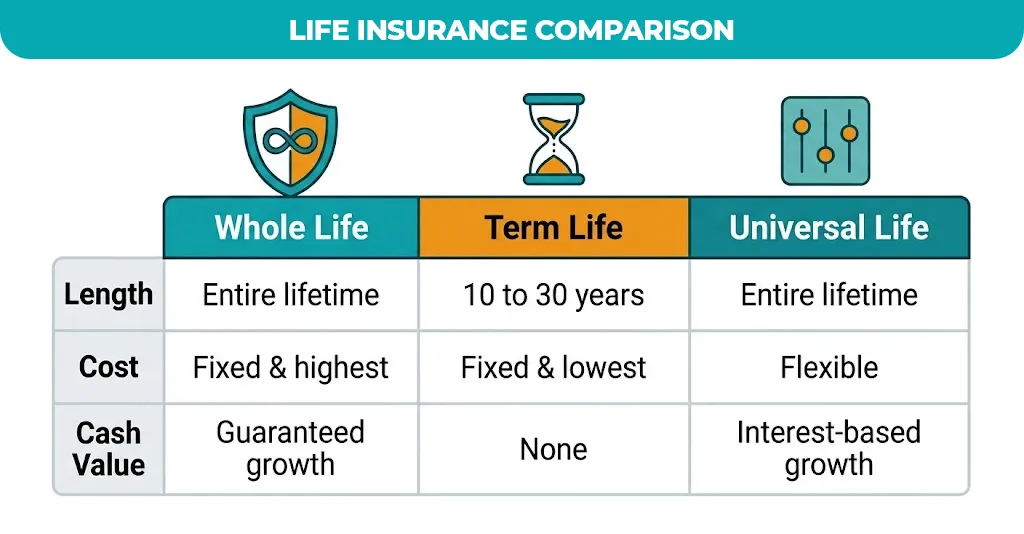
| Coverage length | Lifetime | 10 to 30 years | Lifetime if adequately funded |
| Premium | Fixed and highest | Fixed for the term; lowest | Flexible; can rise if underfunded |
| Cash value | Guaranteed growth, plus possible dividends | None | Credited interest; minimum guarantees vary |
| Death benefit | Guaranteed | Guaranteed during term | Guaranteed only with no-lapse design or full funding |
| Complexity | Moderate | Simple | High |
| Best for | Lifelong needs and guaranteed savings | Income replacement during working years | Flexible premiums, estate planning |
Read more about universal life insurance and term life insurance.
Navigating Whole Life Coverage with Premier Services Agency
Buy whole life for a permanent need you can name, from an insurer and payment schedule you can sustain for decades. The steps below help you decide whether whole life fits, and how to structure it.
Step 1: Separate permanent needs from temporary ones
Use whole life for needs that never end; use term for needs that do.
| Need | Lasts | Better fit |
| Replacing income while children are young | 15 to 25 years | Term |
| Paying off a mortgage | Until the loan is paid | Term |
| Final expenses | For life | Small whole life (final expense) |
| Lifelong dependent (special-needs child) | For life | Whole life, often with a trust |
| Estate taxes or equalizing an inheritance | For life | Whole life or guaranteed universal life |
| Guaranteed, conservative savings alongside coverage | Long term | Whole life, after retirement accounts are funded |
Many families combine both: a large term policy for the working years and a smaller whole life policy for lifelong needs.
Step 2: Choose between mutual (dividend-paying) and stock carriers
Mutual insurers are owned by policyholders and usually sell participating policies that may pay dividends; stock insurers are owned by shareholders and more often sell non-participating policies with lower, fully guaranteed premiums.
• Choose participating if you want potential dividends and long-term cash value growth, and you’re comfortable that dividends aren’t guaranteed.
• Choose non-participating if you want the lowest guaranteed premium and don’t care about dividends.
• For either, check the insurer’s financial strength ratings from independent agencies and, for participating policies, its dividend history.
Step 3: Structure the payment schedule
Choose continuous pay for the lowest annual premium, or a limited-pay schedule to finish paying before retirement. Paid-up-at-65 and 20-pay policies cost more each year but leave you with no premiums later, and they build cash value faster. A 10-pay policy builds cash value fastest but is the most likely to approach MEC limits.
Step-by-step blueprint to compare carriers with Premier Services Agency
Premier Services Agency is an independent agency that helps individuals and families compare whole life insurance from multiple carriers. A typical review:
1. Define the need: what the policy is for and how much coverage it requires.
2. Set a budget you can maintain for the full payment period.
3. Compare quotes for participating and non-participating policies, and for different payment schedules.
4. Review illustrations: compare guaranteed and non-guaranteed values side by side, and ask about loan terms (rate, and direct vs. non-direct recognition).
5. Apply and review periodically: check dividends, beneficiaries, and loan balances every year or two.
Learn more about whole life insurance and whole life insurance quotes.
Conclusion:
Whole life insurance works by trading a higher, fixed premium for lifelong coverage and a guaranteed, tax-deferred cash value. It’s a strong fit when a need lasts for life or when guaranteed savings matter more to you than higher potential returns. If your need is temporary, term coverage plus your own investing usually delivers more for the money.
| Your situation | Best fit |
| Need coverage only while raising children | Term life |
| Want guaranteed funeral coverage | Small final expense whole life |
| Lifelong dependent | Whole life, often with a special-needs trust |
| Large estate or business succession | Whole life or guaranteed universal life |
| Want no premiums in retirement | Paid-up-at-65 or 20-pay whole life |
| Plan to borrow against cash value regularly | Participating whole life; ask about non-direct recognition loans |
| Already maxing retirement accounts and want conservative growth | Participating whole life, structured to avoid MEC status |
| Tight budget | Term now; convert part later if needed |
Compare Whole Life Quotes at Premier Services Agency
The right whole life policy depends on the insurer, the payment schedule, and how you plan to use the cash value. Premier Services Agency advisors can compare whole life options from multiple carriers and walk you through guaranteed and projected values before you commit.
• Compare whole life quotes at Premier Services Agency
• Call (470) 650-0470 to consult with Premier Services Agency