


If you earn well, max out your 401(k), and earn too much for a Roth IRA, someone has probably pitched you a “max funded IUL.” The pitch is appealing: market-linked growth, no losses in down years, and tax-free retirement income.
Some of that is true, and some of it depends on assumptions that may not hold. A max funded IUL is a real, legal planning strategy, but it’s also a complex insurance contract with fees, caps, and lapse risk that the pitch often glosses over.
Quick answer: A max funded IUL is an indexed universal life policy designed with the smallest death benefit the tax code allows for the premium you pay, so more of each dollar goes to cash value. It must stay under the IRC §7702A 7-pay limit to avoid becoming a modified endowment contract. It’s best suited to high earners who have already maxed out retirement accounts.
What Is a Max Funded IUL?
A max funded IUL is an indexed universal life (IUL) policy deliberately designed to hold as much cash value as possible relative to its death benefit. The policyholder pays the most premium the tax code allows for the smallest death benefit that still qualifies as life insurance under IRC §7702. Because the insurer charges cost of insurance on the death benefit, a smaller death benefit leaves more of each premium dollar working as cash value.
The core mechanism
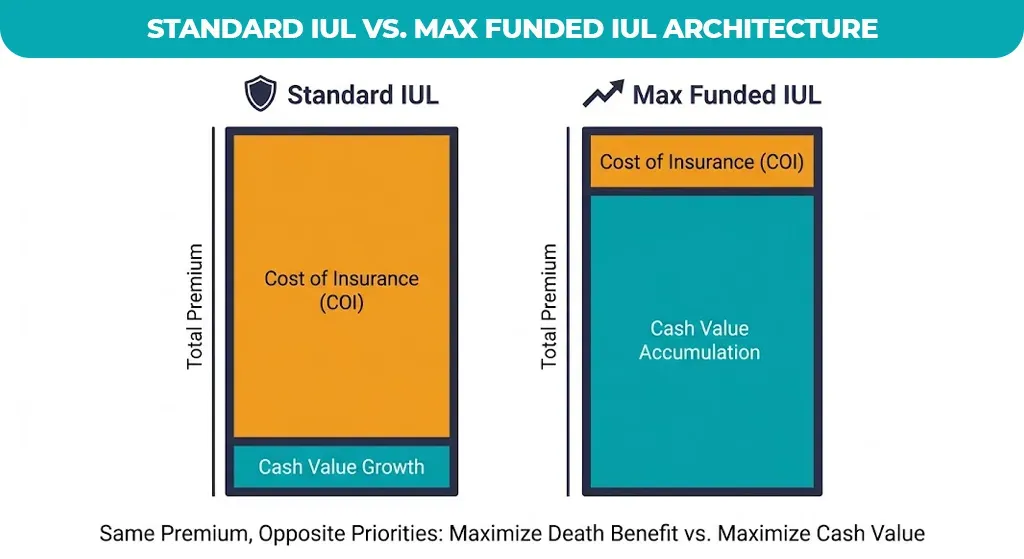
Every universal life policy charges a cost of insurance (COI) based on the “net amount at risk,” the gap between the death benefit and the cash value. A standard IUL is designed for a large death benefit at a low premium, so COI eats a large share of each payment. A max funded IUL flips the priorities:
| Standard IUL | Max funded IUL | |
| Goal | Lowest premium for a given death benefit | Most cash value for a given premium |
| Death benefit | As high as the premium supports | As low as §7702 allows |
| Premium | Low, near the minimum | High, near the MEC limit |
| COI as a share of premium | Higher | Lower |
| Main use | Permanent death benefit | Tax-advantaged accumulation and retirement income |
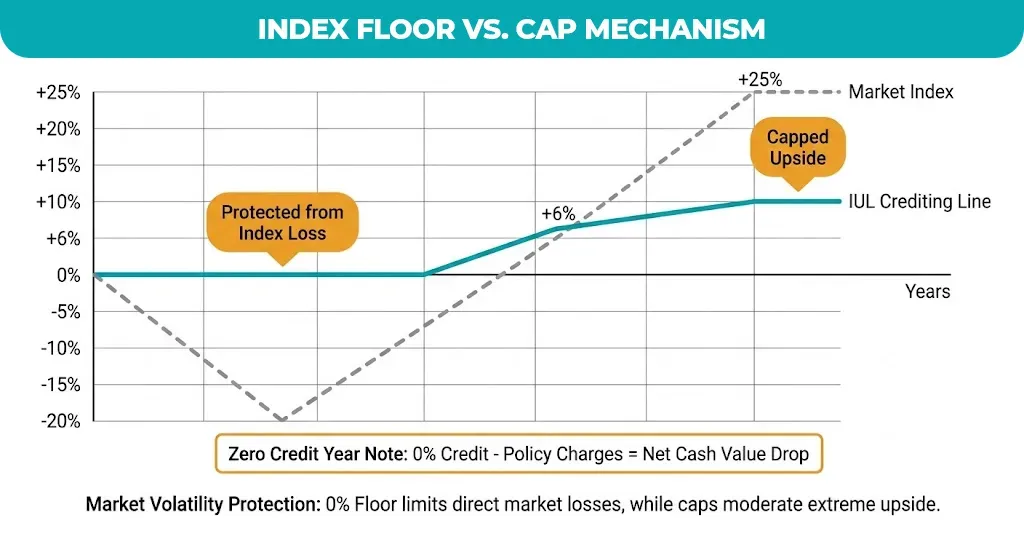
The cash value earns interest linked to a market index, usually the S&P 500, with a floor (often 0%) that prevents index losses and a cap that limits gains. In retirement, the owner takes income mainly through policy loans, which aren’t taxed while the policy stays in force and isn’t a modified endowment contract.
Note: “Max funded IUL account” is informal shorthand. You don’t open an investment account; you own a life insurance contract whose cash value is credited based on an index. Your money is never directly invested in the stock market.
How a Max Funded IUL Works: IRC §7702, MEC Limits, and Policy Mechanics
Two tax rules set the boundaries of a max funded IUL. IRC §7702 decides whether the contract counts as life insurance at all, which sets the minimum death benefit for the cash you put in. IRC §7702A sets the 7-pay limit; fund faster than that and the policy becomes a modified endowment contract (MEC) with less favorable taxes. A max funded design sits just inside both limits.
How does a max funded IUL work?
To qualify as life insurance under §7702, a policy must pass one of two tests:
1. Cash value accumulation test (CVAT). The cash surrender value can never exceed the net single premium needed to fund the policy’s future benefits.
2. Guideline premium test plus cash value corridor. Total premiums can’t exceed the guideline premium limit, and the death benefit must always be at least a set percentage of the cash value.
The corridor percentages in §7702(d) show how much death benefit you must carry for each dollar of cash value:
| Attained age | Minimum death benefit as % of cash value |
| 40 or younger | 250% |
| 40–45 | 250% falling to 215% |
| 45–50 | 215% falling to 185% |
| 50–55 | 185% falling to 150% |
| 55–60 | 150% falling to 130% |
| 60–65 | 130% falling to 120% |
| 65–70 | 120% falling to 115% |
| 70–75 | 115% falling to 105% |
| 75–90 | 105% |
| 90–95 | 105% falling to 100% |
A max funded design chooses a test and a death benefit that let the highest premium fit without breaking these rules. Your agent or the insurer’s illustration software does this calculation.
The 7-pay test and MEC rules (IRC §7702A)
The 7-pay test compares what you pay in during the first seven contract years with the premiums that would fully pay up the policy in seven level annual payments. If you pay more than that cumulative limit, the policy becomes a modified endowment contract (MEC).
Why it matters:
| Non-MEC life insurance | Modified endowment contract (MEC) | |
| Death benefit | Generally income-tax-free under §101(a) | Generally income-tax-free under §101(a) |
| Withdrawals | Taxed only to the extent they exceed your investment in the contract (basis first) | Taxed income-first |
| Policy loans | Generally not taxed while the policy is in force | Treated as taxable distributions, income-first |
| Early-access penalty | None | A 10% additional tax can apply to taxable amounts before 59½ |
These rules come from IRC §72(e): for non-MEC life insurance, amounts are taxed only to the extent they exceed your basis, while §72(e)(10) applies the income-first and loan-as-distribution rules to MECs. A material change to the policy, such as a reduction in death benefit within the first seven years, can trigger a new 7-pay test.
Note: Becoming a MEC can’t usually be undone after a short correction window. A good illustration shows the 7-pay limit each year so you can see how close you are.
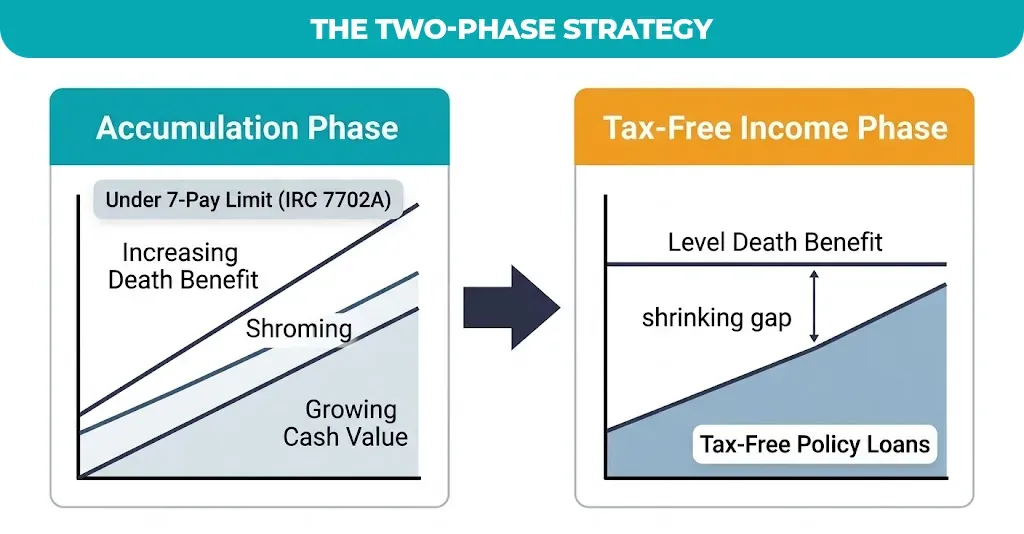
The two-phase strategy: Option B, then Option A
Many max funded IULs use a two-phase death benefit design:
1. Accumulation phase: Option B (increasing death benefit). The death benefit equals a base face amount plus the cash value, so the net amount at risk stays level while cash value grows. This keeps the policy inside §7702 as large premiums go in.
2. Income phase: switch to Option A (level death benefit). When contributions stop, typically at retirement, the death benefit stays level. As cash value grows inside a fixed death benefit, the net amount at risk shrinks, which lowers COI charges and can support larger loan-based income.
| Working years (Option B) | Retirement (Option A) |
|---|---|
| High premiums, near MEC limit | → Premiums stop |
| Death benefit = face + cash | Death benefit held level |
| Net amount at risk ~ flat | Net amount at risk shrinks |
| Cash value grows | Policy loans fund income |
Standard IUL vs. max funded IUL: structural comparison
| Feature | Standard (death-benefit-focused) IUL | Max funded IUL |
| Design priority | Maximize death benefit per premium dollar | Maximize cash value per premium dollar |
| Death benefit | Large | Minimum allowed by §7702 |
| COI as a share of premium | Higher | Lower |
| Early cash value as a share of premium paid | Lower | Higher, though still reduced by early fees and surrender charges |
| Tax-free income potential | Limited | Higher, if funded and managed well |
| MEC risk | Low | Must be monitored every year |
For background on the product, see our index universal life insurance guide.
Max Funded IUL vs. 401(k) and Roth IRA
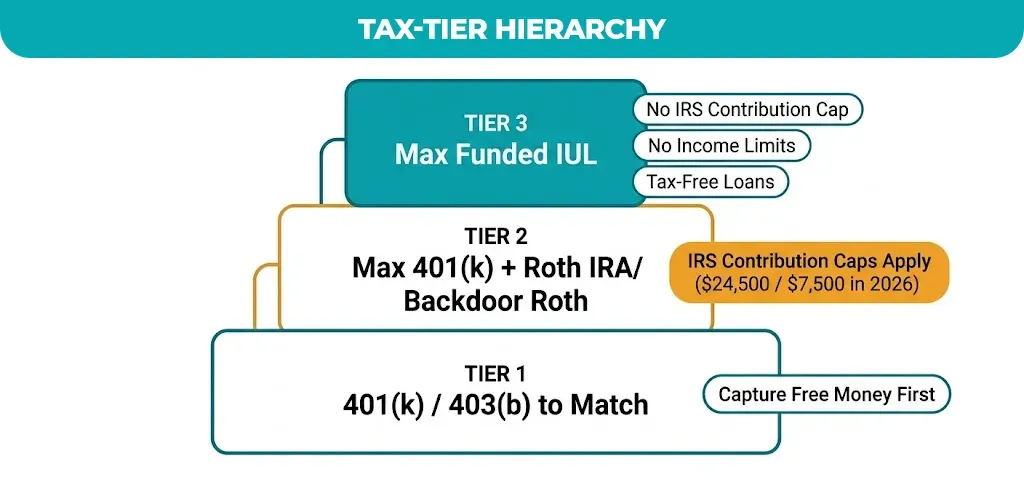
A max funded IUL isn’t a replacement for a 401(k) or Roth IRA; it’s usually a supplement after those are maxed out. The 401(k) offers employer matches, higher growth potential, and simple low-cost index funds. A max funded IUL offers no IRS contribution cap, no income limit, a 0% index floor, and loan-based access before 59½, in exchange for insurance costs, caps on returns, and more complexity.
Contribution limits, income restrictions, and liquidity
For 2026, the IRS limits are:
• 401(k): $24,500 in elective deferrals; 8,000catch-upat50+(32,500 total); $11,250 catch-up at ages 60–63.
• IRA (traditional or Roth): $7,500; $1,100 catch-up at 50+.
• Roth IRA income phase-out: 153,000–168,000 (single) and 242,000–252,000 (married filing jointly).
A max funded IUL has no IRS dollar cap and no income limit. The practical limit is the policy’s §7702 and 7-pay limits, which depend on the death benefit, your age, and your health. Access is also different: 401(k) and IRA withdrawals before 59½ may face a 10% additional tax, while a non-MEC IUL’s cash value can be borrowed at any age. In early years, though, surrender charges and low cash value limit what you can actually access.
Tax treatment
| Traditional 401(k) | Roth 401(k) / Roth IRA | Max funded IUL (non-MEC) | |
| Contributions | Pre-tax | After-tax | After-tax |
| Growth | Tax-deferred | Tax-free if rules are met | Tax-deferred |
| Retirement income | Taxed as ordinary income | Tax-free qualified withdrawals | Withdrawals up to basis tax-free; loans generally not taxed while in force |
| Required minimum distributions | Yes | Not for Roth IRAs during the owner’s life | None |
| At death | Taxable to most beneficiaries | Tax-free to beneficiaries if qualified | Death benefit generally income-tax-free (§101(a)) |
Note: The IUL’s tax-free income depends on the policy staying in force for life. If it lapses or is surrendered with loans outstanding, the gain above your basis can become taxable in a single year.
Volatility protection: index exposure vs. a 0% floor
In a 401(k) or IRA invested in an S&P 500 index fund, you get the full market return, including losses. In an IUL, a floor (often 0%) means a down year credits nothing rather than a loss, but a cap and participation rate limit gains. NerdWallet’s illustrative example uses a 10% cap with a 0% floor.
| S&P 500 index change (excluding dividends) | Index fund in a 401(k) | IUL with a 10% cap, 0% floor, 100% participation |
| −20% | −20% (plus dividends) | 0% credited, minus policy charges |
| +6% | +6% (plus dividends) | +6% credited, minus policy charges |
| +25% | +25% (plus dividends) | +10% credited, minus policy charges |
IUL crediting typically excludes dividends, and policy charges still come out in zero-credit years. That’s why a 0% floor doesn’t mean your cash value can’t fall.
Addressing “max funded IUL Fidelity” and brokerage misconceptions
Retail brokerages don’t usually issue max funded IULs. Fidelity, for example, sells Fidelity Term Life, issued by Fidelity Investments Life Insurance Company; its life insurance page describes term coverage, not indexed universal life. IUL policies are issued by life insurance companies and sold through licensed agents. If you search for “max funded IUL Fidelity,” you’re likely looking for an IUL to sit alongside a Fidelity brokerage or 401(k) account, which you’d buy separately from an insurer.
Max funded IUL vs. 401(k) vs. Roth IRA: master comparison
| Feature | Traditional 401(k) | Roth IRA | Max funded IUL |
| 2026 contribution cap | $24,500 (+ catch-ups) | $7,500 (+ $1,100 at 50+) | No IRS dollar cap; limited by §7702/7-pay |
| Income eligibility | None | Phases out at 153k–168k single, 242k–252k joint | None |
| Employer match | Often | No | No |
| Market loss risk | Full | Full | Index floor (often 0%), but charges still apply |
| Upside | Full market | Full market | Limited by caps and participation rates |
| Costs | Fund and plan fees | Fund fees | COI, admin fees, premium loads, surrender charges |
| Early access | 10% additional tax before 59½, with exceptions | Contributions anytime; earnings rules apply | Loans at any age; limited by surrender charges early |
| Tax-free retirement income | No (taxable) | Yes, if qualified | Yes, via loans, if the policy stays in force and isn’t a MEC |
| Death benefit | Account balance | Account balance | Insurance death benefit plus tax advantages |
Max Funded IUL Pros and Cons: Real Risks and Downside Analysis
The main advantages of a max funded IUL are tax-advantaged growth and loan-based income, a 0% index floor, no IRS contribution cap, and a permanent death benefit. The main risks are complexity, front-loaded fees, long surrender charge periods, caps that the insurer can lower, and the possibility of a lapse late in life if the policy is underfunded or over-borrowed.
The advantages
• Tax-advantaged income. Non-MEC policy loans are generally not taxed while the policy stays in force.
• Downside floor. Index credits are typically floored at 0%, so a market crash doesn’t directly reduce credited interest.
• No IRS contribution cap or income limit, unlike 401(k)s and Roth IRAs.
• No required minimum distributions.
• Permanent death benefit, generally income-tax-free to beneficiaries under §101(a).
• Living benefits. Many policies offer riders that accelerate the death benefit for chronic or terminal illness.
The disadvantages and risks
• Complexity. Caps, participation rates, spreads, multipliers, and loan types make policies hard to compare.
• Front-loaded fees. Premium loads, administrative fees, and COI charges are heaviest in early years.
• Surrender charges. Canceling in the early years can cost a significant share of your cash value; the surrender schedule often runs a decade or longer, so check yours.
• Cap and participation rate changes. NerdWallet notes that “the cap can change while your policy is in force.” Insurers can lower caps or participation rates within contract limits.
• Rising COI. The cost of insurance rises with age. Policies built on optimistic assumptions may need extra premiums later.
• Loan risk. Loan interest compounds. If loans plus interest grow larger than the cash value, the policy can lapse and trigger a large tax bill.
• Illustration risk. Illustrations assume a constant crediting rate every year; real index returns vary.
Can you lose money in a max funded IUL?
Yes. The 0% floor protects credited interest from index losses, but policy charges come out every month regardless. In a year with 0% credited interest, the cash value falls by the amount of those charges.
Hypothetical example:
Cash value at start of year: $200,000
Index return: -15% -> 0% credited (floor)
Annual policy charges (COI,
admin, rider costs): -$3,000
Cash value at end of year: $197,000
Three consecutive zero-credit years with similar charges would reduce the cash value by roughly $9,000 before any loan interest. You can also lose money by surrendering early, when surrender charges exceed your gains, or by letting a heavily borrowed policy lapse.
Is a max funded IUL worth it?
| Likely a good fit | Usually not a good fit |
| High, stable income with a long time horizon (15+ years) | Not yet capturing the full employer 401(k) match |
| Already maxing out 401(k), IRA, and HSA contributions | No emergency fund |
| Income too high for direct Roth IRA contributions | Uncertain ability to fund large premiums for years |
| Needs permanent life insurance as well | Wants simple, low-cost investing |
| Willing to review the policy every year | Unlikely to monitor caps, loans, and charges |
A max funded IUL works best as one layer in a retirement plan, after cheaper and simpler tax-advantaged options are used.
Calculators, Carrier Selection, and How to Find a Max Funded IUL
A max funded IUL calculator estimates future cash value and retirement income, but the only reliable numbers come from an insurer’s official illustration for your age, health, and premium. Choose a carrier based on cap history, COI schedules, loan options, and financial strength, not just the highest illustrated income.
How to use a max funded IUL calculator
| Input | What it means | Tip |
| Age and health class | Drives COI charges | Get a realistic health class before modeling |
| Annual premium | How much you’ll contribute | Keep it under the 7-pay limit |
| Funding years | How long you’ll pay in | Many designs fund 5–20 years |
| Assumed crediting rate | Average annual interest credited | Run a conservative case (4%–5%) as well as the illustrated rate |
| Loan rate and type | Fixed, variable/indexed, or wash loans | Model a scenario where the loan rate exceeds the credited rate |
| Income start age and years | When and how long you’ll borrow | Leave a buffer so the policy doesn’t lapse late in life |
Note: Always ask for at least three illustrations: the carrier’s maximum illustrated rate, a rate 1–2 points lower, and the guaranteed column. If the plan only works at the maximum rate, it’s too fragile.
30-year cash value and income illustration blueprint
A well-built illustration should let you check each phase:
Years 1-7 Funding under the 7-pay limit; Option B death benefit
Check: premiums vs. 7-pay limit, surrender value each year
Years 8-20+ Continued funding or a paid-up phase
Check: cash value at several crediting rates
Retirement Switch to Option A; begin policy loans
Check: loan balance vs. cash value every year
Age 90-100+ Policy still in force with a remaining death benefit
Check: no lapse under conservative assumptions
Who offers max funded IUL and how to choose a carrier
Many large life insurers issue indexed universal life, and any IUL can be designed as max funded if the carrier allows high premiums relative to the face amount. When comparing carriers, look at:
• Cap and participation rate history. How have the carrier’s caps on in-force policies changed, not just new ones?
• COI schedules. What are the guaranteed maximum charges, and has the carrier raised COI on existing policies?
• Loan options. Fixed loans, variable/indexed loans, and whether loans are non-direct recognition, meaning borrowed cash value keeps earning index credits as if no loan existed.
• Index options. Which indices, crediting periods, and any bonuses or multipliers (and their extra fees).
• Financial strength. Check ratings from AM Best, S&P, or Moody’s.
• Surrender schedule length and size.
Step-by-step design blueprint with Premier Services Agency
1. Confirm you’re a fit: emergency fund in place, employer match captured, retirement accounts maxed.
2. Set the goal: retirement income target, funding years, and death benefit need.
3. Get underwritten for the most accurate health class.
4. Compare illustrations from several carriers at the same premium and conservative rates.
5. Check the 7-pay limit and corridor each year of the illustration.
6. Plan the Option B to Option A switch and loan strategy before you buy.
7. Review the policy annually with an in-force illustration.
Related reading: universal vs. whole life insurance and the permanent life insurance guide.
Conclusion
A max funded IUL can be a powerful supplement for high earners who have already maxed out their 401(k) and IRA, need permanent coverage, and can fund large premiums for many years. Its value depends entirely on design and discipline: staying under the 7-pay limit, using conservative crediting assumptions, managing loans, and reviewing the policy every year. Built poorly, it can cost more than it returns or lapse when you need it most.
| Your situation | What to do |
| Not yet capturing your full employer match | Prioritize the 401(k) first |
| Maxing out 401(k) and IRA, high income, long horizon | Compare max funded IUL illustrations from several carriers |
| Income too high for a direct Roth IRA | Compare a backdoor Roth with an IUL; they can work together |
| Mainly need a death benefit | A standard IUL, GUL, or term may fit better |
| Already own an IUL | Request an in-force illustration and check loans and caps |
| Pitched an illustration at the maximum rate only | Ask for conservative and guaranteed scenarios before deciding |
Design a Max Funded IUL with Premier Services Agency
The difference between a strong max funded IUL and a weak one is in the design. Premier Services Agency‘s licensed agents can help you compare illustrations across carriers, check the 7-pay and corridor limits, and stress-test the plan at conservative crediting rates before you commit.
• Request a custom illustration: start on our quote page.
• Talk to Premier Services Agency wealth advisors: call (470) 650-0470.
• Learn more first: read our index universal life insurance guide and term vs. permanent life insurance.
Consult with Premier Services Agency to see whether a max funded IUL fits your retirement plan.