


How Does Burial Insurance With No Waiting Period Work?
A no-wait, or day-one, final expense policy is built around simplified issue underwriting. Instead of a stack of medical records, the insurer asks a series of yes-or-no health questions covering things like recent hospitalizations, major diagnoses, and tobacco use.
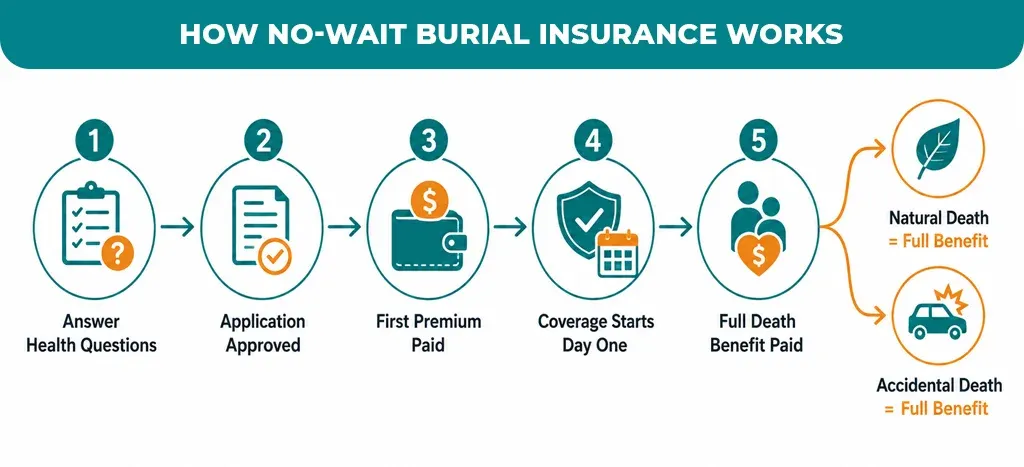
- Full benefit from day one: Once your first premium is processed and the policy is in force, the full face amount is payable for death from either natural causes or an accident.
- No medical exam required: You will not need a physical exam or lab work, though you must answer the health questions on the application truthfully.
- Different from guaranteed issue: Guaranteed issue plans accept applicants regardless of health but build in a graded death benefit, so the trade-off for skipping health questions is a waiting period.
No Waiting Period vs. Graded Benefit Policies
The table below compares how the two most common types of final expense coverage pay out.
Feature | Simplified Issue (No Waiting Period) | Guaranteed Issue (Graded Benefit) |
Health questions | Yes, a short questionnaire | None |
Medical exam | Not required | Not required |
Natural-cause death, year 1 | Full death benefit paid | Premiums paid back, plus interest |
Accidental death, year 1 | Full death benefit paid | Full death benefit paid |
Typical monthly premium | Lower, for comparable health profiles | Higher, due to unknown health risk |
Sources: Ethos Life, “Guaranteed Issue Life Insurance: How It Works & Who It’s For”; MoneyGeek, “Life Insurance Graded Death Benefits”; Choice Mutual, “How Long Does Burial Insurance Take To Pay Out.”
What requirements must I fulfill in order to receive burial insurance with no waiting period?
Underwriting for a no-wait final expense policy focuses on your answers to health and lifestyle questions rather than an exam. Carriers use those answers, along with your age, to decide whether you qualify for simplified issue rates.
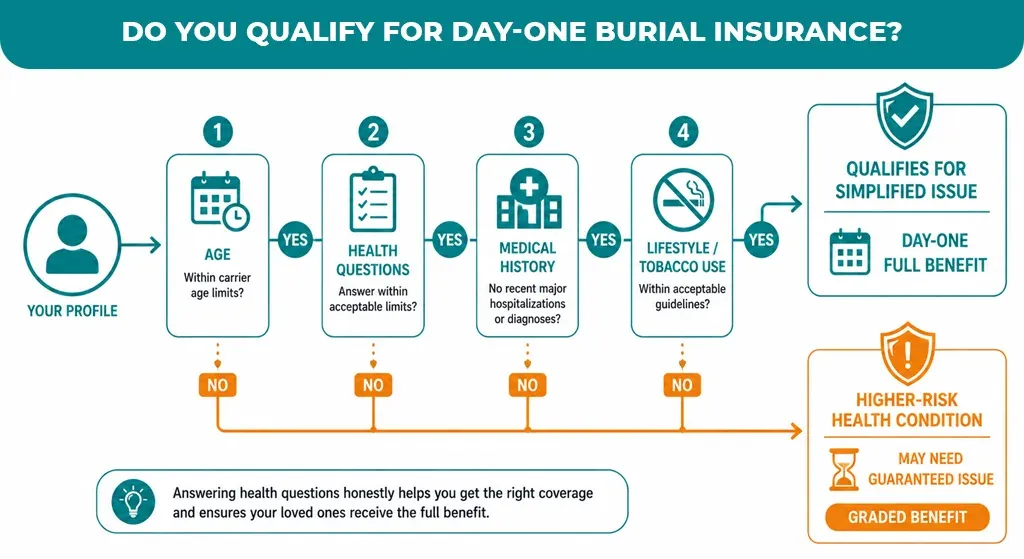
- Age range: Most carriers write final expense policies for applicants roughly between age 50 and 85, though exact age bands vary by company.
- Health questionnaire: Expect questions about major diagnoses, recent hospital stays, tobacco use, and prescribed medications.
- Manageable conditions: Well-controlled conditions such as high blood pressure or type 2 diabetes on stable medication often still qualify for day-one coverage, though approval depends on the specific carrier’s underwriting guide.
- Higher-risk conditions: Recent cancer treatment, dialysis, or oxygen-dependent COPD are more likely to result in a decline for simplified issue, in which case a guaranteed issue policy becomes the fallback option.
How To Qualify For No Waiting Period Final Expense Coverage
Answer the health questionnaire honestly. Underwriters use your answers, not a medical exam, to approve the policy. A misrepresentation discovered during the contestability period can put a claim at risk.
- Work with an independent broker. An independent agent can compare underwriting guidelines across multiple carriers to find one whose health questions your profile can pass, rather than presenting a single company’s yes-or-no answer.
- Read the fine print on “no questions asked” plans. If an application has no health questions at all, it is a guaranteed issue product, and it will carry a graded, two- to three-year waiting period by design, not immediate coverage.
- Compare simplified issue offers before defaulting to guaranteed issue. Because guaranteed issue is priced for unknown risk, most applicants who can pass health questions will find simplified issue coverage more affordable for the same face amount.
The Major Benefits of No-Wait Burial Insurance
- Immediate financial security: Once a claim is approved, many final expense insurers report releasing payment within roughly 24 to 72 hours, which is markedly faster than the weeks or months typical of larger traditional life insurance claims.
- Locked-in rates: Premiums on a whole life final expense policy are fixed at the age you are approved and do not increase as you get older, as long as the policy stays in force.
- Flexible use of funds: Beneficiaries receive a cash payout that is not restricted to a funeral home. It can go toward a casket, a headstone, hospice bills, medical debt, or any other end-of-life expense.
Key Takeaways
|
Burial Insurance With No Waiting Period Cost
There is no single answer to what is the best burial insurance with no waiting period, because affordability depends on your age, gender, health profile, and the face amount you choose. Industry pricing guides consistently show monthly premiums for a $10,000 policy rising with age, roughly as follows.
Age Band | Approx. Monthly Premium ($10,000 policy) | Policy Type Typically Available |
50 to 59 | Roughly $20 to $45 | Simplified issue, day-one coverage |
60 to 69 | Roughly $30 to $90 | Simplified or guaranteed issue |
70 to 85 | Roughly $40 to $160 or more | Simplified or guaranteed issue |
Women are commonly quoted somewhat lower premiums than men of the same age for identical coverage, largely reflecting differences in life expectancy used in actuarial pricing. Cheapest and most affordable pricing generally goes to applicants who apply earlier, in better health, and who qualify for simplified issue rather than guaranteed issue.
Common Traps to Avoid When Shopping for Final Expense Coverage
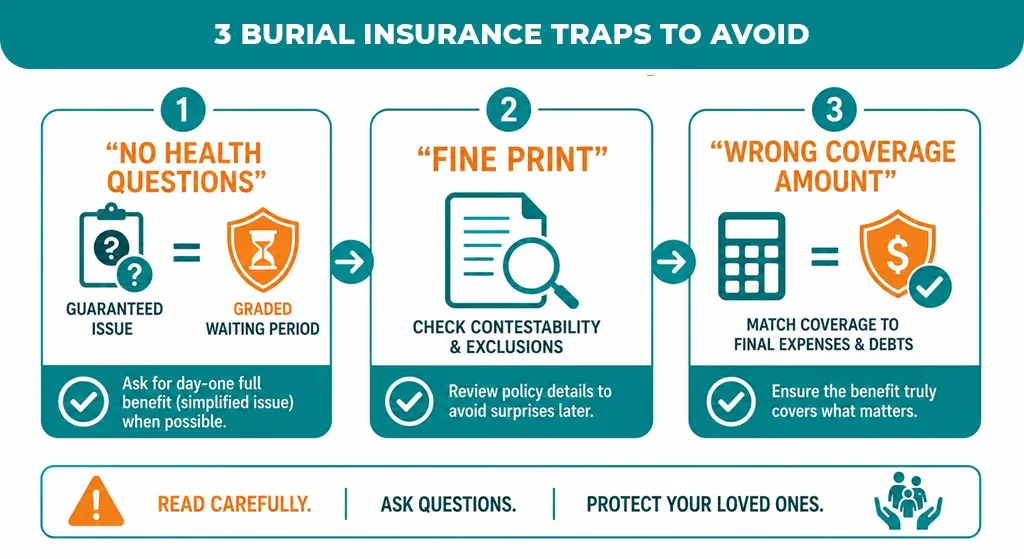
- TV ads promising “no health questions”: If an application has zero health questions, it is guaranteed issue by definition and will carry a graded waiting period, not immediate first-day coverage.
- Overlooking policy exclusions: Review the contestability clause. Most life insurance policies, including final expense plans, include a standard clause allowing the insurer to review a claim for misrepresentation for about two years after issue, and many carriers apply a separate suicide exclusion during that same window.
- Buying too little or too much coverage: Match your face amount to your actual final arrangements and any debts you want covered, rather than treating the policy as a substitute for income-replacement life insurance.
Secure Your Family’s Future
Navigating final expense options does not have to feel overwhelming. Choosing a burial insurance policy that offers day-one protection means your loved ones are covered from the very start, without the surprise of a multi-year waiting period buried in the fine print.
At Premier Services Agency, we work as an independent agency, comparing trusted, top-rated final expense carriers against your health profile and budget so you are not limited to a single company’s underwriting decision. Reach out to our team today for a personalized, no-obligation quote and take the first step toward the peace of mind your family deserves.