


Many seniors assume that life insurance is out of reach or simply too expensive once they hit retirement age. That assumption leaves a lot of families exposed, worrying about funeral costs, medical bills, or leftover debt instead of enjoying peace of mind. And it’s easy to see why the topic feels intimidating: navigating life insurance later in life means wading through unfamiliar terms, potential medical exams, and a maze of policy types that all seem to promise something different.
The good news is that term life insurance for seniors offers a straightforward, budget-friendly way to secure real financial protection for a defined period of time. It won’t cost you a fortune, it doesn’t require a finance degree to understand, and in many cases it can be approved faster than people expect.
This comprehensive guide breaks down exactly how term life insurance works for older adults, who typically qualify, how to choose the right amount of coverage, and how it stacks up against whole life insurance so you can make a confident, informed decision for yourself and the people who depend on you.
Understanding Term Life Insurance for Seniors
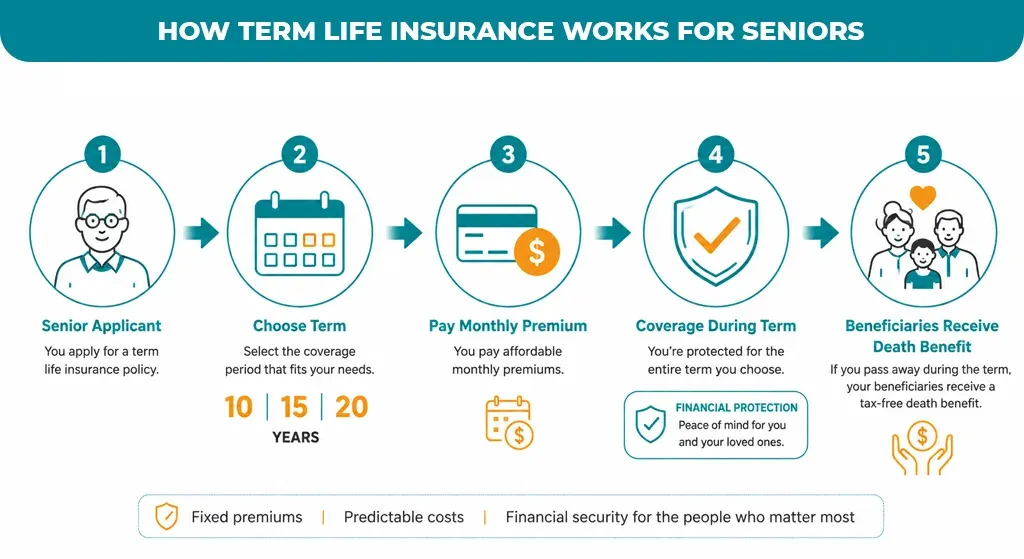
At its core, term life insurance for seniors is coverage that lasts for a specific, predetermined period, typically 10, 15, 20, or occasionally 30 years, rather than lasting for the rest of the insured person’s life. You choose a term length, a coverage amount (the death benefit), and in exchange for regular premium payments, your beneficiaries receive a tax-free payout if you pass away during that term.
One of the biggest advantages of this structure is predictability. Most senior life insurance policies sold as level term products lock in a fixed premium for the entire length of the term. That means a 68-year-old who buys a 15-year term policy will typically pay the exact same monthly premium in year one as they will in year fifteen no surprise rate hikes as you age, and no annual repricing based on your changing health.
So what happens when the term ends? Generally, you have three options:
- Let the policy expire: coverage simply ends, and no further premiums are due (this is the most common outcome, since most policyholders either no longer need the coverage or find the renewal premium too costly).
- Renew annually at a higher rate: most term policies include a guaranteed renewability clause, but renewal premiums increase significantly since they’re recalculated based on your current age.
- Convert to permanent insurance: many carriers allow you to convert some or all of your term coverage into a whole or universal life policy without a new medical exam, which can be valuable if your health has declined.
Industry data from LIMRA, the leading authority on life insurance trends, consistently shows that a large share of term policies are allowed to lapse or expire once the original financial obligation (like a mortgage or a child’s education) has been paid off, which is exactly the kind of targeted, temporary protection that makes term life such a practical fit for many seniors.
Eligibility, Age Limits, and Medical Requirements
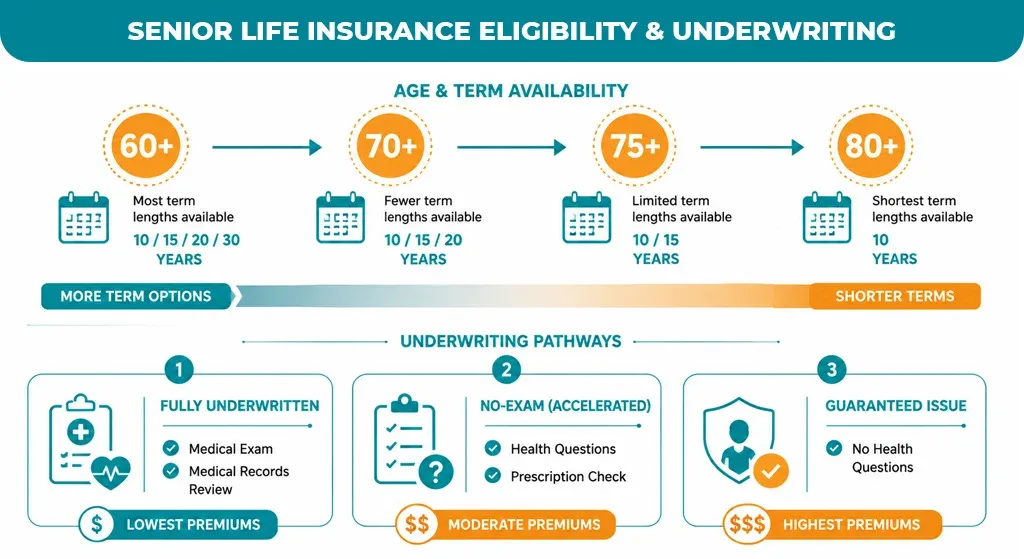
One of the most common questions we hear is simply: “Am I too old to buy life insurance?” In most cases, the answer is no. Senior life insurance eligibility varies by carrier, but many insurers offer term life insurance for seniors over 60, term life insurance for seniors over 70, and even term life insurance for seniors over 75 or term life insurance for seniors over 80, though the available term lengths shrink and premiums rise as applicants get older.
As a general rule of thumb across the industry:
- Most carriers cap new term life applications somewhere between age 75 and 85, depending on the term length requested.
- Shorter terms (10 years) are typically available to older applicants than longer terms (20 or 30 years).
- A handful of specialty carriers, including Mutual of Omaha term life insurance for seniors and AARP term life insurance for seniors (underwritten through New York Life), design products specifically with older applicants in mind.
Fully Underwritten vs. No-Exam Policies
Not every senior life insurance policy requires the same level of scrutiny. Understanding the difference between underwriting types will help you set realistic expectations for cost and approval speed:
- Fully underwritten term policies: require a medical exam, blood and urine work, and a review of your medical records and prescription history. These typically offer the lowest premiums because the insurer has the most complete picture of your health.
- Accelerated (no-exam) underwriting: uses a detailed health questionnaire along with prescription database checks and sometimes a phone interview instead of a physical exam. Approval can happen in days rather than weeks, though premiums are usually somewhat higher.
- Guaranteed issue policies: ask no health questions at all and guarantee approval, but they come with lower coverage caps, higher premiums per dollar of coverage, and are technically a form of whole life insurance rather than true term coverage, worth knowing if you’re specifically comparing term life insurance for seniors options.
Actuarial data compiled by major ratings and statistical bureaus consistently shows that age and health status are the two dominant variables in premium calculations, with tobacco use, cardiovascular history, and diabetes management among the most heavily weighted factors for applicants over 60.
Tips for Securing the Best Rates Despite Pre-Existing Conditions
- Apply while your health metrics (blood pressure, A1C, cholesterol) are best controlled; even a few months of improvement can shift you into a better rate class.
- Be upfront and accurate on your application; misrepresenting your health history can lead to a denied claim later.
- Ask about “table shaving” or condition-specific carriers that specialize in applicants with diabetes, heart conditions, or a history of cancer.
- Compare no-exam and guaranteed issue options if a fully underwritten policy isn’t accessible due to a serious diagnosis.
Determining the Right Coverage Amount and Term Length
There’s no one-size-fits-all number here, but a simple checklist can help you land on a realistic figure. When seniors ask how much senior life insurance to buy, we generally recommend adding up the following:
- Outstanding debts: any remaining mortgage balance, car loans, or credit card debt you don’t want passed on to family members.
- Final expenses: funeral and burial costs currently average well into the five-figure range in many parts of the country.
- Income replacement: If a spouse or dependent relies on your income, Social Security, or pension survivor benefits, consider how many years of replacement income they’d need.
- Legacy or gifting goals: Any amount you’d like to leave behind for grandchildren, charitable giving, or estate equalization among heirs.
Comparing Popular Term Lengths
- Short-Term Goals (10 Years): Ideal for covering a remaining mortgage balance, a specific short-term debt, or bridging the gap until a pension or retirement account fully vests. Ten-year terms also tend to have the most competitive term life insurance rates for seniors, since the insurer’s risk window is shorter.
- Longer-Term Goals (15–20 Years): Best suited for income replacement or protecting a dependent spouse over a longer horizon, especially if there’s a meaningful age gap between spouses or ongoing financial obligations that extend well into the next decade.
As a general guide, someone in their early 60s with a healthy budget might lean toward a 20-year term to cover a spouse well into their 80s, while someone in their mid-70s might prioritize a 10-year term focused purely on final expenses and estate costs.
Comparing Term Life vs. Whole Life Insurance for Older Adults
Term life insurance is temporary and cost-effective. You’re purchasing pure death-benefit protection for a set number of years, with no cash value component, which keeps premiums significantly lower than permanent alternatives. This makes it an efficient tool when you know exactly what you’re protecting against and roughly how long you need to protect it.
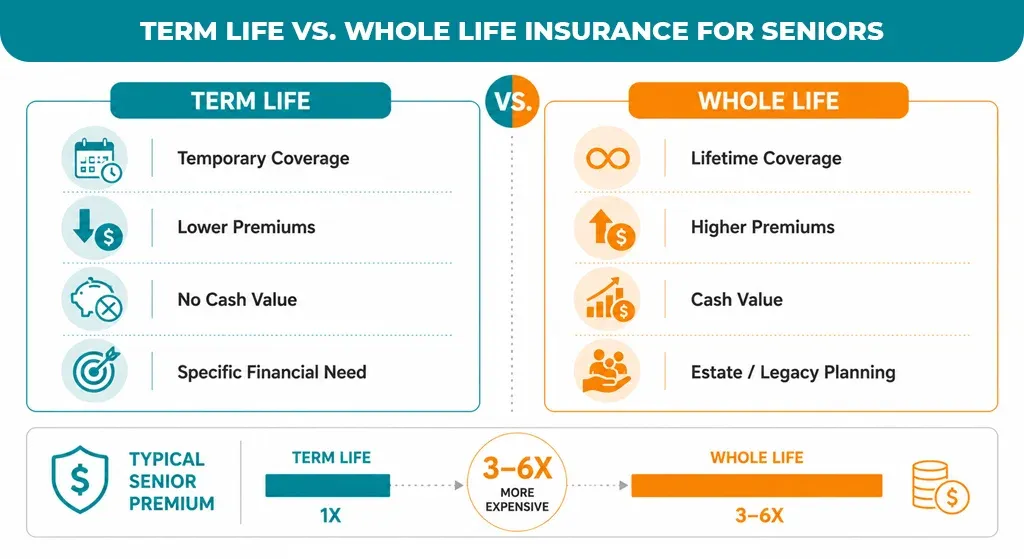
Whole life insurance, on the other hand, provides lifetime coverage as long as premiums are paid, and it builds cash value over time that you can potentially borrow against. That lifelong guarantee and savings feature comes at a real cost; whole life premiums for a senior applicant are typically several times higher than a comparable term policy, since the insurer knows a payout is essentially guaranteed to occur eventually rather than only within a defined window.
Cost comparison data across major carriers consistently shows a similar pattern for applicants between ages 60 and 75: monthly premiums for whole life coverage tend to run three to six times higher than a term policy carrying the same death benefit, primarily because whole life is priced to guarantee an eventual payout rather than covering a fixed time window.
For most seniors focused purely on covering a specific need a mortgage, a spouse’s income gap, or final expenses affordable term life insurance for seniors delivers far more coverage per premium dollar. Whole life becomes more attractive primarily for those focused on guaranteed lifetime coverage, estate planning, or leaving a tax-advantaged inheritance regardless of when death occurs.
Tips for Finding the Best Rates and Avoiding Common Pitfalls
Once you know roughly how much coverage you need and for how long, the final step is shopping smart. Term life insurance quotes for seniors can vary dramatically from one carrier to the next for the exact same coverage amount, so comparison shopping isn’t optional; it’s essential.
- Work with an independent broker who has access to multiple carriers rather than a captive agent tied to a single company’s product lineup.
- Review financial strength ratings (such as A.M. Best, Moody’s, or Standard & Poor’s) before committing to an insurer, since a low premium is meaningless if the company can’t reliably pay claims.
- Get at least three to five quotes side by side; average cost for term life insurance for seniors can differ by hundreds of dollars a year between top-rated carriers.
- Watch for the gap between cheapest term life insurance for seniors marketing and what you actually qualify for after underwriting; an eye-catching advertised rate isn’t always the rate you’ll be offered.
It’s also worth being cautious of a few common pitfalls that specifically target older applicants:
- Deceptive mailers: Postcards designed to look like official government or Medicare-related notices are a well-documented tactic used to generate life insurance leads; always verify you’re speaking with a licensed, reputable agency.
- Steep rate spikes: Some guaranteed-issue and simplified policies advertise a low starting price but include scheduled premium increases every few years; always ask specifically whether your rate is level for the entire term.
- Graded death benefits: Certain no-exam policies only pay a partial benefit (often just a return of premiums) if death occurs within the first two to three years. Make sure you understand exactly what’s covered from day one.
Conclusion
Term life insurance for seniors provides a flexible, cost-effective safety net tailored to your current life stage, whether that means paying off a remaining mortgage, replacing income for a surviving spouse, or simply making sure final expenses never become a burden for the people you love. The key is understanding your options, comparing real quotes, and choosing a policy that matches both your budget and your timeline.
Don’t navigate the complexities of life insurance alone. Contact Premier Services Agency today to speak with an experienced advisor who can compare top-rated carriers, help you find the most competitive rates, and tailor a policy that fits your exact needs. Visit Premier Services Agency now to get your free, no-obligation quote and take the first step toward real peace of mind.