


Key Takeaways
|
What Is Open Care Life Insurance?
Open Care Life Insurance (Open Care Seniors) is an independent insurance agency, not an insurance company. Based in Naples, Florida, it markets final expense, guaranteed issue, and term life insurance to adults roughly ages 18 to 90, then routes approved applicants to a partner carrier, such as Mutual of Omaha, that actually issues the policy and pays the death benefit.
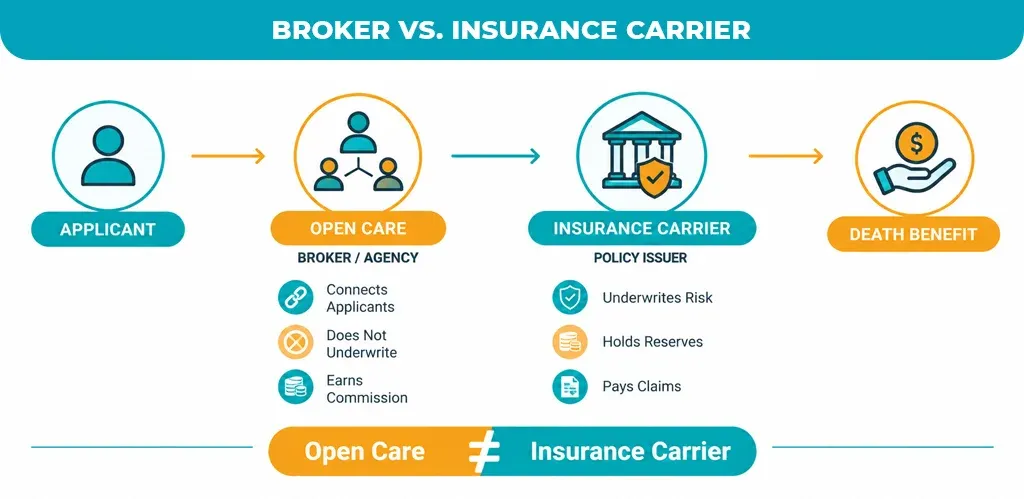
This broker-versus-carrier distinction matters because it changes who is financially responsible for your policy. An insurance carrier is the company that underwrites risk, holds reserves, and pays claims. A broker or agency, by contrast, earns a commission for connecting a buyer with a carrier and generally is not the party that pays out when a policyholder dies. This is a common and legal structure in the senior insurance market; several other well-known “senior life insurance” brands operate the same way.
One point of confusion worth clearing up: a separate, unrelated company also operates under the name “Opencare” as a dental-referral platform based in San Francisco, with its own Better Business Bureau profile. That business has no connection to life insurance and should not be confused with Open Care Life Insurance or Open Care Seniors.
Is Open Care Life Insurance Legit?
Yes. Open Care operates as a licensed insurance agency, and the policies it places come from regulated carriers. However, it is not accredited by the Better Business Bureau, carries no independent A.M. Best financial-strength rating, and has almost no visible customer reviews on Google, Yelp, or Trustpilot under its own name.
Legitimacy and transparency are two different questions. On legitimacy, there is no indication Open Care is operating outside the law; it is a licensed agency selling real insurance products from regulated carriers. On transparency, independent reviewers have raised consistent concerns. One insurance review site that audits customer-service response times and public review counts found zero reviews for Open Care Seniors across the BBB, Trustpilot, Google, and Yelp as of mid-2026, an unusually thin public record for a nationally advertised insurance brand.
It is also worth understanding what an A.M. Best rating does and does not cover. A.M. Best rates the financial strength of insurance carriers, the companies that actually hold reserves and pay claims, not insurance brokers or agencies. Since Open Care is a broker, it would not be expected to carry its own A.M. Best rating regardless of its reputation.
Consumers can also check a carrier’s licensing and complaint history through the National Association of Insurance Commissioners (NAIC), which maintains a public complaint index by company and state. Because Open Care does not disclose its full carrier network upfront, applicants generally cannot run this check until later in the application process.
A handful of factors move the price up or down from this baseline:
- Age at application. Final expense premiums are priced to be paid up over your remaining life expectancy, so the older you are when you apply, the higher the monthly cost.
- Gender and smoking status. Non-smoking women generally receive the lowest rates in this table; smokers of either gender pay meaningfully more at the same age.
- Health classification. Even on a Simplified Issue plan, your answers to the health questionnaire sort you into a rate class such as preferred, standard, or substandard, which shifts your premium within the published range.
- Coverage amount. A $25,000 death benefit costs proportionally more per month than the $8,000 or $10,000 examples above at the same age and health class.
The gap between the $7.49 teaser and a real quote is not necessarily deceptive in a legal sense, since the $7.49 rate is genuinely available to that one narrow buyer profile. It is, however, a marketing tactic common across the final expense industry, used to generate phone calls rather than to represent what most callers will actually pay. The safest approach with any “as low as” insurance ad is to request your specific quote in writing before providing payment information.
What Coverage Options Does Open Care Offer?
Open Care sells two main product lines: final expense whole life insurance, which is the focus of its television advertising, and term life insurance, which is available but less heavily marketed.
Final Expense (Whole Life) Insurance
Final expense insurance, also called burial insurance, is a small whole life policy typically ranging from $2,000 to $50,000 in death benefit. It is designed to cover funeral costs, cremation, outstanding medical bills, or small debts rather than to replace income or build significant wealth for heirs. Like other whole life products, premiums are level for life, and the policy accumulates modest cash value over time.
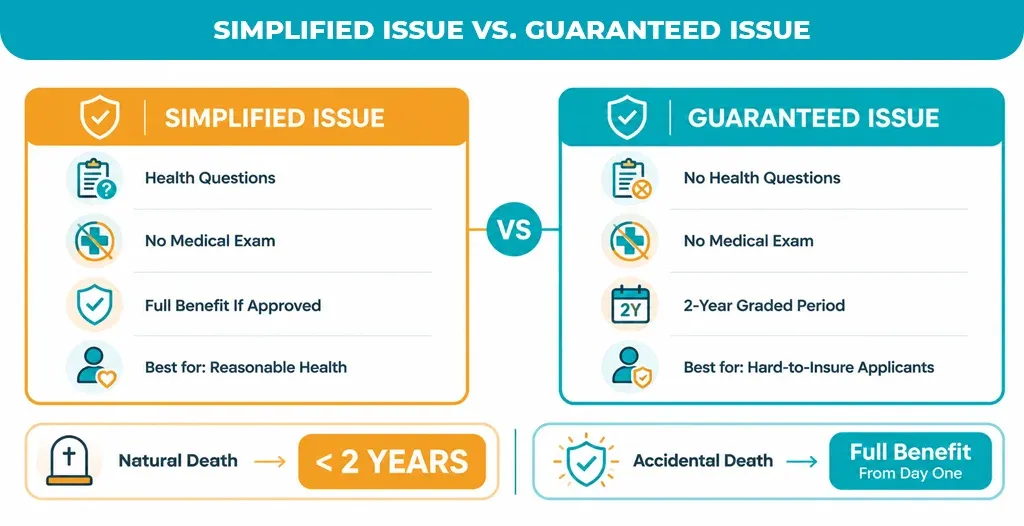
Open Care offers final expense coverage through two underwriting paths:
How Open Care Compares to Buying Direct
Open Care’s confirmed application partner, Mutual of Omaha, is one of the more established names in the final expense market, which is a point in Open Care’s favor. But because Open Care does not disclose its full carrier list, an applicant cannot know in advance whether they are being routed to the most competitively priced option among Open Care’s partners, or simply to whichever carrier pays the highest commission on that application.
Sizing the right amount of coverage is a useful independent check before comparing prices. According to the National Funeral Directors Association’s most recent General Price List study, the median cost of a funeral with viewing and burial is $8,300, while a funeral involving cremation runs a median of $6,280. Matching your final expense coverage amount to your region’s typical funeral cost, rather than to whatever round number sounds appealing in an ad, is a more reliable way to choose a death benefit than anchoring on a teaser price.
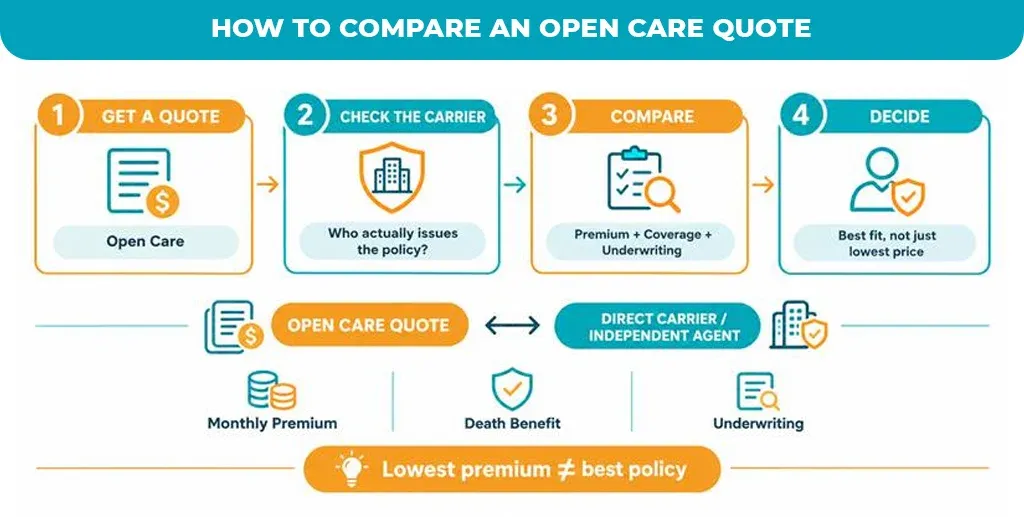
The most direct way to know whether an Open Care quote is competitive is to request pricing from at least one other source, either a direct carrier such as Mutual of Omaha or Aetna, or an independent agent who represents several A-rated companies side by side, and compare both the monthly premium and the underwriting path (Simplified Issue versus Guaranteed Issue) before deciding.
Conclusion
Navigating final expense coverage requires looking past headline teasers to find a transparent policy that matches your actual needs and budget. Open Care Life Insurance offers accessible entry points for seniors, but its broker status and hidden carrier partnerships make comparing independent options essential before signing any paperwork.
When evaluating your final expense options, always prioritize verified financial strength, clear underwriting terms, and fixed monthly premiums that won’t surprise you later. To stop guessing with your family’s financial security, secure a custom, side-by-side market comparison from a trusted independent source. Premier Services Agency shops top-rated, A-rated carriers directly for you so you know the exact underwriting company behind your policy. Visit Premier Services Agency to get a quote and get your free personalized quote today.