


| Quick Answer Whole life insurance offers fixed premiums and a guaranteed death benefit and cash value, while universal life insurance offers adjustable premiums and a death benefit that can rise or fall with market or index performance. Whole life costs more but carries less risk. Universal life costs less upfront but requires active management to stay in force. |
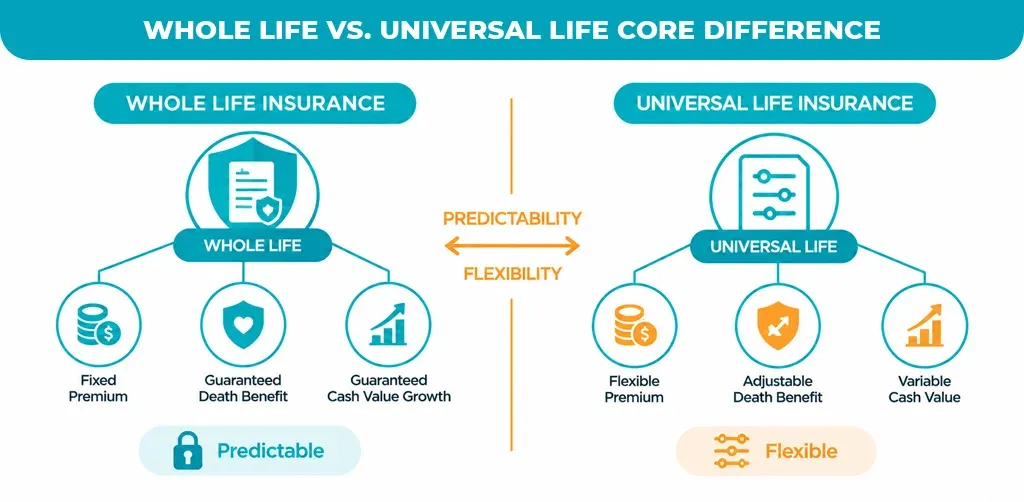
Universal life insurance and whole life insurance are both types of permanent life insurance, meaning they last for your entire life instead of expiring after a set term. The core difference is control. Whole life insurance locks in your premium, death benefit, and cash value growth rate for as long as you own the policy. Universal life insurance lets you adjust your premium payments and death benefit within limits set by the insurer, and its cash value grows based on current interest rates, a market index, or investment performance, depending on the type of universal life policy you choose.
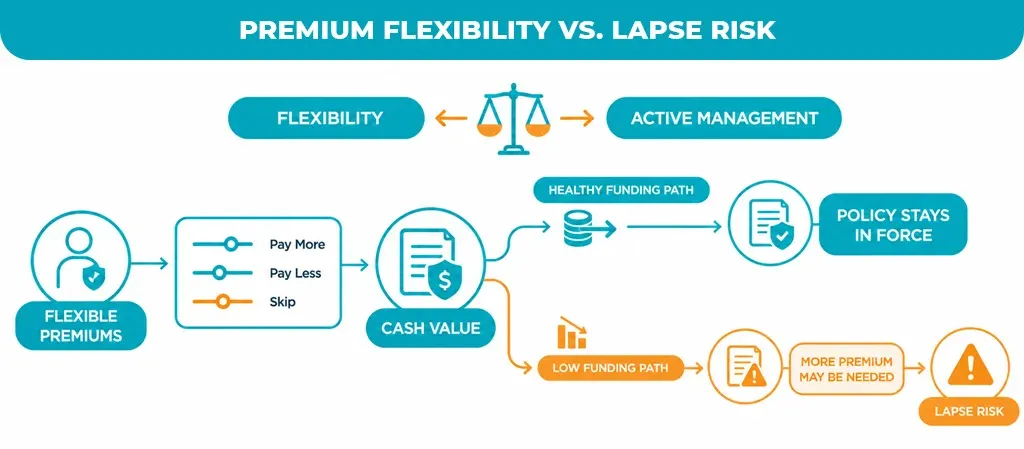
This distinction changes both the cost and the risk you take on. Whole life insurance is priced for predictability: you know what you will pay and what your beneficiaries will receive, for as long as you keep the policy active. Universal life insurance is priced for flexibility: it can cost less in the early years, but if the credited interest rate drops or you skip payments, you may need to pay more later to keep the policy from lapsing.
This article compares both policy types across cost, cash value growth, flexibility, and risk, using current industry data, so you can decide which one, if either, fits your financial plan.
Key Takeaways
- Whole life and universal life are both permanent policies with a cash value savings component, unlike term life insurance, which has no cash value and expires after a set period.
- Whole life insurance guarantees your premium, death benefit, and a minimum cash value growth rate for life. Universal life insurance lets you adjust your premium and death benefit but does not guarantee the same fixed outcome.
- At age 40, a healthy nonsmoker pays an average of $53 per month for a 20-year, $500,000 term policy, compared with $336 per month for universal life and $557 per month for whole life, according to MoneyGeek’s 2026 life insurance rate analysis.
- Indexed universal life (IUL) ties cash value growth to a market index such as the S&P 500, typically with a 0% floor and a capped upside, according to Wikipedia’s entry on indexed universal life insurance.
- Life insurance death benefits are generally not subject to federal income tax for beneficiaries, according to IRS Publication 525.
- Financial commentator Dave Ramsey recommends term life insurance over both whole life and universal life insurance, citing the higher relative cost of permanent coverage.
What Is Whole Life Insurance?
Whole life insurance is a type of permanent life insurance that provides coverage for your entire life, as long as you pay the fixed premium. It carries a guaranteed death benefit and a guaranteed minimum rate of cash value growth, and the premium never increases, according to the National Association of Insurance Commissioners (NAIC).
- Premium stays fixed for the life of the policy.
- Death benefit is guaranteed and does not decrease as long as premiums are paid.
- Cash value grows at a guaranteed minimum rate set by the insurer.
- Participating policies may pay non-guaranteed dividends declared by the insurer.
- Cash value grows tax-deferred and can typically be borrowed against or withdrawn.
What Is Universal Life Insurance?
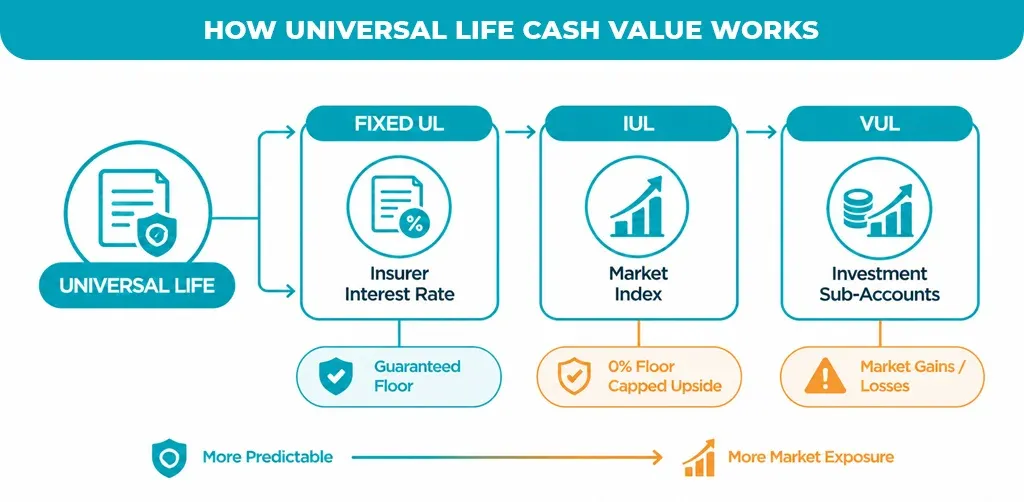
Universal life insurance is permanent life insurance that separates the cost of insurance from the savings component, giving policyholders more room to adjust premiums and death benefits within limits set by the insurer, according to the NAIC. Cash value earns interest that is credited based on the insurer’s current rates, a market index, or investment sub-accounts, depending on the policy type.
- Traditional (fixed) universal life: cash value earns interest at a rate the insurer sets periodically, with a guaranteed minimum floor.
- Indexed universal life (IUL): cash value growth is linked to a market index such as the S&P 500, usually with a 0% floor and a capped or participation-limited upside, per Wikipedia’s entry on indexed universal life.
- Variable universal life (VUL): cash value sits in investment sub-accounts the policyholder selects, so it can gain or lose value with no floor, per Wikipedia’s entry on variable universal life insurance.
- Guaranteed universal life (GUL): prioritizes a guaranteed death benefit over cash value accumulation, functioning closer to lifelong term coverage.
The NAIC’s Universal Life Insurance Model Regulation governs cost-of-insurance disclosures, cash surrender value minimums, and policyholder notices for universal life products, giving state regulators a consistent framework to review these policies.
Universal Life Insurance vs. Whole Life Insurance: Key Differences
The table below summarizes how whole life and universal life insurance differ across the factors that matter most to buyers: cost predictability, flexibility, and risk of lapse.
| Feature | Whole Life Insurance | Universal Life Insurance |
| Premium | Fixed for life | Flexible; adjustable within insurer limits |
| Death benefit | Fixed and guaranteed | Adjustable; can increase or decrease |
| Cash value growth | Guaranteed minimum rate | Based on current interest, an index, or investments |
| Risk of lapse | Low, if premiums are paid on time | Higher if cash value can’t cover insurance costs |
| Dividends | Possible with participating policies (not guaranteed) | Not applicable; some IUL/VUL policies offer index or investment gains instead |
| Best suited for | Buyers who want predictable, lifelong coverage | Buyers who want flexibility and are willing to monitor the policy |
Cost Comparison: How Much Do Whole Life and Universal Life Policies Cost?
Universal life insurance generally costs less than whole life insurance for the same coverage amount, but more than term life insurance. At age 40, MoneyGeek’s 2026 rate analysis found average monthly premiums of $53 for a 20-year, $500,000 term policy, compared with $336 for universal life and $557 for whole life.
| Policy Type ($500,000 coverage) | Age 20 (Female / Male) | Age 40 (Female / Male) |
| 20-year term life | $30 / $36 | $47 / $59 |
| Universal life | $153 / $180 | $310 / $362 |
| Whole life | $303 / $337 | $540 / $574 |
Source: MoneyGeek, 2026 life insurance rate data for nonsmokers in average health.
The gap widens at higher coverage amounts. A healthy 40-year-old man pays an average of $109 per month for a $1 million, 20-year term policy, compared with $1,115 per month for a $1 million whole life policy, more than ten times the cost of term for the same face amount, according to MoneyGeek’s 2026 million-dollar policy analysis. Universal life pricing for $1 million in coverage varies more than whole life pricing because it depends on how the policy is funded and which crediting method applies, so a personalized quote is more important for universal life than for a level-premium whole life policy.
Cash Value Growth: Whole Life vs. Universal Life
Whole life cash value grows at a guaranteed minimum rate set when the policy is issued, so growth is slow but predictable, and some participating policies add non-guaranteed dividends on top of that guaranteed base. Universal life cash value growth depends on which type of policy you own: traditional universal life follows the insurer’s current interest rate with a guaranteed floor, indexed universal life follows a market index with a 0% floor and a capped upside, and variable universal life follows investment sub-accounts with no floor at all, which means the cash value can decline.
- Whole life: lowest growth ceiling, but the floor and the premium are both guaranteed.
- Traditional universal life: floor is guaranteed, but the credited rate moves with the insurer’s current rates.
- Indexed universal life: higher upside potential than whole life, but caps and participation rates limit how much index gains actually reach the policy.
- Variable universal life: highest theoretical upside and the only version with no cash value floor, so losses are possible.
Indexed Universal Life Insurance vs. Whole Life
Indexed universal life offers higher potential cash value growth than whole life because it is linked to the performance of a market index, but it also carries more complexity and more risk of underperformance if the index has a weak multi-year stretch relative to the policy’s cap and floor. Whole life offers a guaranteed, if lower, growth rate that does not depend on market conditions. Indexed universal life insurance was first introduced by Transamerica in 1997 and has since grown as an alternative to whole life for buyers who want some exposure to market gains without a market-value floor below zero, according to Wikipedia’s entry on indexed universal life.
- Floor: IUL typically guarantees a 0% floor in a down market year, so cash value will not fall below its prior level from market losses; whole life guarantees a small positive minimum rate instead.
- Cap and participation rate: insurers limit how much index gain is credited, so IUL rarely captures the index’s full return in a strong year.
- Cost transparency: IUL shows separate charges for the cost of insurance and policy fees, while whole life bundles these costs into a single premium.
Term vs. Whole vs. Universal Life Insurance: Where Does Term Fit In?
Term life insurance is temporary coverage that expires after a set period, usually 10 to 30 years, and has no cash value, which makes it the least expensive way to buy a large death benefit. Whole life and universal life are both permanent policies with cash value, but they differ in how that cash value grows and how much control the policyholder has over premiums.
- Term life: lowest cost, no cash value, coverage ends when the term expires unless renewed or converted.
- Whole life: highest cost of the three, fixed premium, guaranteed cash value and death benefit.
- Universal life: mid-range cost, adjustable premium and death benefit, cash value growth tied to interest, an index, or investments depending on the policy type.
A common strategy for buyers who need coverage during working years but also want a permanent safety net is to combine a term policy for the bulk of their income-replacement need with a smaller permanent policy for final expenses or estate planning.
Pros and Cons of Universal Life Insurance vs. Whole Life
Whole Life Insurance: Pros
- Predictable premium and a guaranteed minimum cash value growth rate.
- Guaranteed death benefit that will not decrease.
- Potential for dividends from participating insurers, though dividends are not guaranteed.
Whole Life Insurance: Cons
- Highest premium of the three policy types compared in this article, according to MoneyGeek’s 2026 rate data.
- Cash value grows slowly in the early policy years.
- Less flexibility to adjust premiums if your budget changes.
Universal Life Insurance: Pros
- Lower premium than whole life for the same death benefit, based on MoneyGeek’s 2026 averages.
- Ability to adjust premiums and death benefit within the policy’s limits as your needs change.
- Indexed and variable versions offer higher growth potential than whole life’s fixed rate.
Universal Life Insurance: Cons
- Cash value growth is not guaranteed beyond the policy’s floor rate on traditional and indexed versions, and can be negative on variable universal life.
- Rising insurance costs or a low credited interest rate can require higher premiums later to avoid a lapse.
- More complex to understand and monitor than a whole life policy.
Who Should Choose Whole Life? Who Should Choose Universal Life?
Whole life insurance tends to fit buyers who want a guaranteed outcome and are not focused on flexibility. Estate planning needs, coverage for a dependent with special needs, and permanent business insurance obligations, such as funding a buy-sell agreement, are common scenarios where the guaranteed structure of whole life is worth the higher premium.
Universal life insurance tends to fit buyers who want permanent coverage but also want the ability to adjust premiums as income changes, or who want exposure to potentially higher cash value growth and are willing to review the policy regularly to confirm it stays funded.
Checking an Insurer’s Financial Strength Before You Buy
Because permanent life insurance is a decades-long commitment, it is worth confirming the insurer’s financial strength before buying either type of policy. Independent rating agencies such as AM Best, Moody’s, and S&P Global Ratings assess an insurer’s ability to pay future claims and publish letter-grade ratings that consumers can review before purchasing a policy. You can also check an insurer’s licensing status and complaint history through the NAIC and your state insurance department.
Bottom Line
Whole life insurance and universal life insurance both provide permanent coverage and a cash value component, but they solve different problems. Whole life insurance is the more predictable and more expensive option, built for buyers who want a guaranteed premium, guaranteed death benefit, and guaranteed minimum cash value growth for life. Universal life insurance is the more flexible and typically less expensive option, built for buyers who want to adjust their premium and death benefit over time and who are comfortable monitoring the policy so it stays funded. For most people whose primary goal is income replacement during working years, term life insurance remains the lowest-cost way to secure a large death benefit.
Ready to find out which permanent policy matches your financial goals? Don’t navigate the complexities of whole life and universal life insurance alone. Connect with an independent expert at Premier Services Agency today to compare custom quotes, review cash value projections, and secure the right coverage for your future.