


If you’ve maxed out your 401(k) and IRA and you’re still looking for a tax-advantaged place to put capital, you’ve probably run into variable universal life insurance in a conversation with a financial advisor. VUL is the only permanent life insurance product that lets you invest cash value directly in market sub-accounts, giving you equity-like upside alongside a death benefit. That upside comes with a trade-off most traditional policies don’t carry: real market risk, and the possibility that a bad decade of returns forces you to write much bigger premium checks later in life.
This guide breaks down exactly how variable universal life insurance works, walks through the sub-account and flexible death benefit mechanics, weighs the honest variable universal life insurance pros and cons, compares VUL against whole life and indexed universal life (IUL), and identifies who the policy is actually built for so you can decide whether it belongs in your portfolio.
What Is Variable Universal Life Insurance?
The variable universal life insurance definition used by regulators is straightforward: VUL is a type of permanent life insurance that combines a death benefit with a cash value account invested in market-based sub-accounts, similar in structure to mutual funds. Because policyholders bear the investment risk directly, VUL contracts are classified as securities and regulated accordingly. In the United States, the National Association of Insurance Commissioners (NAIC) oversees the insurance chassis, while FINRA and the SEC regulate the underlying variable investment component, and anyone selling VUL must hold both an insurance license and a securities license (typically a Series 6 or 7).
The “Universal” Component: Premium Flexibility
The word “universal” refers to premium and death benefit flexibility. Unlike whole life, which locks you into a fixed premium schedule, flexible premium variable universal life insurance allows you to increase, decrease, or temporarily skip premium payments as long as the policy’s cash value is sufficient to cover ongoing mortality and expense charges. Skip too many payments during a market downturn, however, and the policy can lapse.
How VUL Differs From Other Universal Life Products
In the broader universal vs. variable life insurance conversation, standard universal life (UL) credits interest from the insurer’s general account at a fixed or minimum guaranteed rate. Indexed universal life (IUL) credits are subject to floors and caps and are based on a market index. VUL is the only variant where policyholders choose and directly bear the risk of specific investment sub-accounts; there is typically no floor protecting cash value from market losses.
Core Components: Cash Value Sub-Accounts and Death Benefits
Investment Sub-Accounts
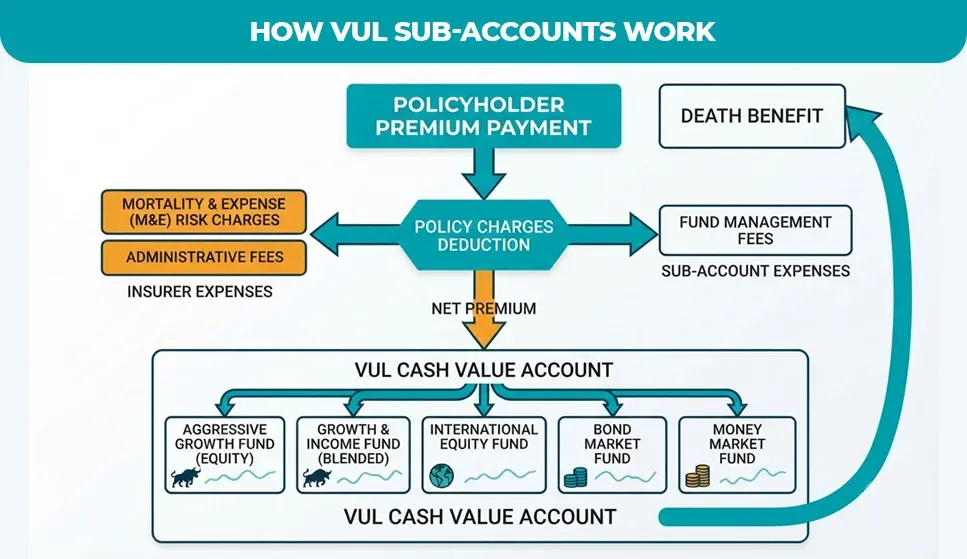
Inside a VUL insurance policy, cash value is allocated across a menu of investment sub-accounts, typically ranging from conservative money market and bond funds to aggressive domestic and international equity funds. Policyholders actively manage this allocation, rebalancing over time much as they would inside a brokerage account, which is why VUL suits investors comfortable with hands-on portfolio oversight.
Flexible Death Benefit Options
Most VUL contracts offer two death benefit structures:
- Option A (Level Death Benefit): The death benefit stays level; as cash value grows, the insurer’s net amount at risk (and therefore the cost of insurance) shrinks.
- Option B (Increasing Death Benefit): Cash value is paid on top of a level base face amount, so the total death benefit rises as the account grows at the cost of higher ongoing insurance charges.
Policy Fees and Expenses
Any accurate assessment of a VUL insurance coverage must take into consideration its multi-layered cost structure:
- Mortality and expense (M&E) risk charges compensate the insurer for guaranteeing the death benefit.
- Administrative fees: flat or percentage-based charges for policy upkeep.
- Fund management fees: expense ratios charged by each underlying sub-account.
- Surrender charges: penalties for withdrawing or lapsing the policy in its early years, often 10–15 years.
Combined, these charges typically run meaningfully higher than a comparable standalone mutual fund or ETF, which is a core reason cost-conscious investors scrutinize VUL closely before committing capital.
Variable Universal Life Insurance: Pros and Cons
Here is an evenhanded look at variable universal life insurance pros and cons based on how the product actually behaves over a full market cycle.
The Advantages
- Tax-deferred growth potential: Cash value in the sub-accounts grows tax-deferred, and if structured correctly, policy loans and withdrawals up to basis can be accessed without triggering current income tax.
- Premium flexibility: You can reduce or pause premiums during tight cash-flow years, provided the cash value cushion holds up.
- Uncapped upside: Unlike IUL, there’s no cap on sub-account returns; strong market years flow directly into cash value growth.
- Estate and legacy planning utility: The death benefit passes to beneficiaries generally income-tax-free, which supports advanced strategies like ILIT funding.
The Disadvantages
- Direct market risk: Poor sub-account performance erodes cash value with no guaranteed floor, unlike whole life or IUL.
- Premium spike risk: A prolonged downturn can force significantly higher out-of-pocket premiums later in life just to prevent the policy from lapsing, a risk FINRA has flagged in investor alerts on variable life products.
- Complex, layered fees: M&E charges, admin fees, and fund expenses compound and can materially drag down net returns if the policy isn’t actively monitored.
- Requires active management: Unlike a “set it and forget it” whole life policy, VUL needs regular sub-account rebalancing and annual illustration reviews.
VUL vs. Whole Life vs. IUL: Comparative Analysis
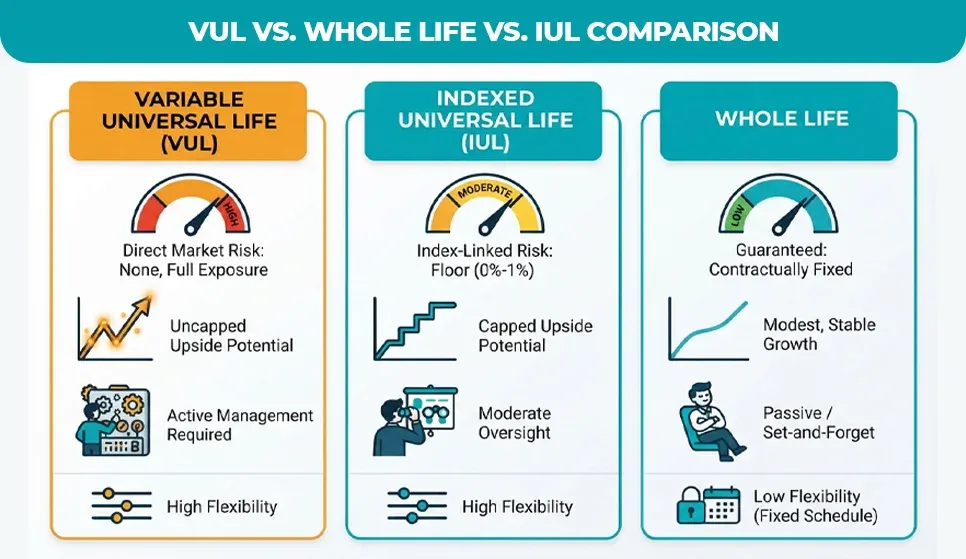
The variable universal life insurance vs. whole life and VUL-vs-IUL decision comes down almost entirely to risk tolerance and how actively you want to manage the policy. The table below lines up the three main permanent life insurance structures.
| Feature | Variable Universal Life (VUL) | Indexed Universal Life (IUL) | Whole Life |
| Cash value growth basis | Direct market sub-accounts | Index-linked, with caps/floors | Fixed, insurer-declared dividends |
| Downside protection | None, full market risk | Floor typically 0%–1% | Guaranteed, contractually fixed |
| Upside potential | Uncapped, equity-like | Capped (participation limits) | Modest, stable |
| Premium flexibility | High | High | Low fixed schedule |
| Management effort | Active, ongoing | Moderate | Passive |
| Best suited for | High risk tolerance, hands-on investors | Moderate risk tolerance | Conservative, guarantee-focused savers |
For a purely universal life insurance vs. variable comparison, note that standard (non-variable) universal life sits between VUL and whole life: it offers premium flexibility like VUL but credits interest from the insurer’s general account rather than direct market sub-accounts, so it avoids sub-account volatility entirely.
Who Should Actually Buy Variable Universal Life Insurance?
The honest answer to “is variable universal life insurance worth it?” depends entirely on the buyer profile. VUL tends to make the most sense for:
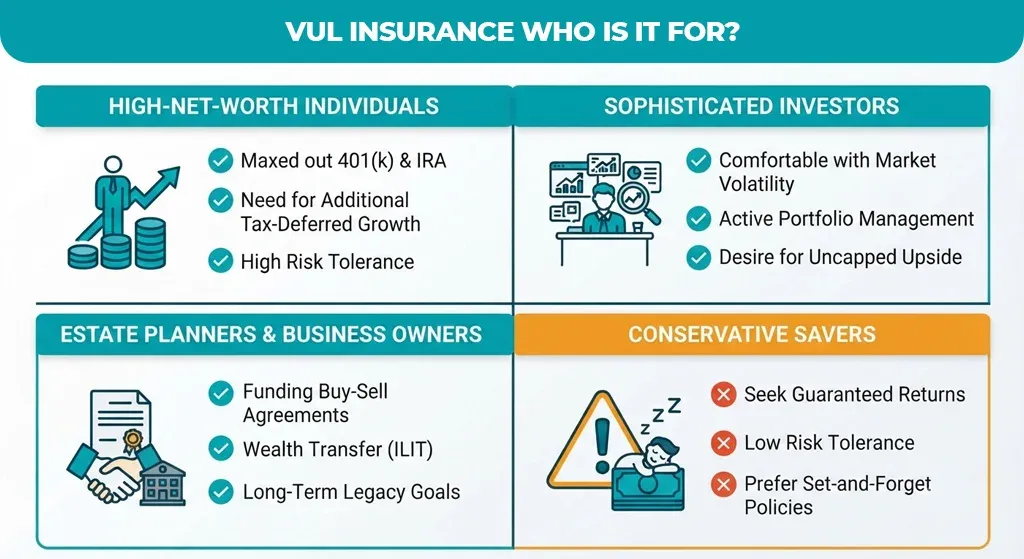
- High-net-worth individuals and business owners who have already maxed out 401(k)s, IRAs, and other tax-advantaged accounts and want an additional tax-deferred growth vehicle.
- Sophisticated investors who are comfortable actively monitoring sub-account performance and adjusting allocations, similar to managing a brokerage portfolio.
- Estate planners looking to fund an Irrevocable Life Insurance Trust (ILIT) with growth-oriented sub-accounts to transfer wealth to future generations largely outside the taxable estate.
- Employer or association members with access to group variable universal life insurance, which can offer lower-cost entry into the same sub-account structure through payroll-deducted premiums.
Conversely, buyers seeking guaranteed outcomes, a fixed premium schedule, or a purely low-maintenance policy are typically better served by whole life or IUL rather than the best variable universal life insurance products on the market, which are still built around active risk-taking.
Conclusion
Mastering variable universal life insurance requires balancing aggressive equity growth potential with the reality of direct market risk and layered structural fees. While this financial hybrid provides unmatched premium flexibility and tax-deferred wealth accumulation for sophisticated, high-net-worth investors, it ultimately demands diligent, hands-on portfolio management to prevent costly policy lapses.
Before committing your capital, ruthlessly stress-test multiple economic downturn scenarios rather than relying on idealized illustration estimates. Choosing this advanced strategy wisely ensures your permanent death benefit and accumulated cash value securely maximize your long-term legacy without unexpected financial friction.