

Funeral Preplanning: Protect Your Family and Save Money

Quick Answer

Funeral preplanning means documenting your funeral, burial, or cremation preferences in advance, with or without setting aside money to pay for them. “Planning” covers your choices; “prepaying” covers the financing, typically through a trust, an insurance-backed policy, or a payable-on-death (POD) account.

Both approaches can spare your family difficult decisions, but a prepaid funeral plan carries financial and portability risks that a written plan alone does not. Comparing a funeral home’s General Price List (GPL), understanding your funding options under Federal Trade Commission (FTC) rules, and storing your documents with your estate plan lets you capture the benefits of pre-need funeral planning while limiting its downsides.

When someone dies, the people left behind usually have days, not weeks, to make dozens of decisions: burial or cremation, casket or urn, service location, obituary wording, and how to pay for all of it. Making these calls while grieving is hard enough. Making them without knowing what the person who died would have wanted is harder still.

Funeral preplanning addresses this directly. It lets you record your wishes and, if you choose, fund them before the need arises, rather than leaving family members to guess or absorb an unplanned expense during a period of acute stress. This guide breaks down what pre-planning funeral arrangements actually involves, why “planning” and “prepaying” are two separate decisions, what the data says about the benefits and risks of each, and how to start a funeral preplanning checklist of your own.

What Is Funeral Preplanning?

Funeral preplanning, sometimes written as funeral pre-planning or pre-need funeral planning, is the process of organizing and documenting your final wishes before they are needed. At its core, it involves three categories of decisions: how your remains will be handled (burial, cremation, or an alternative disposition such as donation to science), the style and location of any service, and the personal details that make the event feel like yours, music, readings, officiants, and who you want involved.

Pre-planning funeral arrangements does not have to happen all at once, and it does not require a signed contract with a funeral home. Many people start with an informal worksheet listing their preferences and share it with family, while others work directly with a funeral home’s pre-need funeral plans representative to formalize the details in writing.
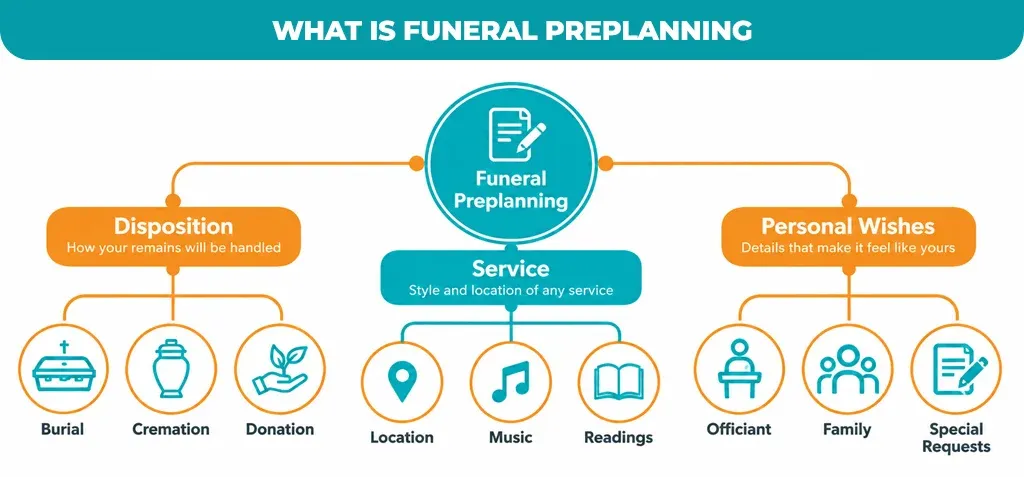
What Is Funeral Preplanning

Consumer research from the National Funeral Directors Association (NFDA) shows this kind of advance planning is becoming more structured, not less. The NFDA’s 2026 Consumer Awareness and Preferences Study, its 14th annual edition, surveyed 1,126 Americans age 40 and older and found that 93.4% would still contact a funeral director for help even as digital planning tools expand, and 44.4% said they would feel not very or not at all confident planning a funeral without a director’s guidance an increase of 7.1 percentage points over the previous year.

Disposition preferences are also shifting. NFDA’s 2026 Cremation & Burial Report projects a national cremation rate of 63.4% for 2026 against a burial rate of 31.6%, with cremation expected to reach 82.3% by 2045. That trend matters for pre-planning because your disposition choice drives most of the downstream decisions: casket versus urn, embalming versus direct cremation, and the type of service that follows.

Key Takeaway

Funeral pre-planning services can range from an informal, written worksheet to a formal pre-need contract with a funeral home. The right level of detail depends on how much certainty you want your family to have, not on whether you also prepay.

Planning vs. Prepaying: Understanding the Difference

The single most important distinction in this topic is between planning and prepaying, and the two are often confused. Planning means mapping out your logistics and preferences: what you want, who should be involved, and which provider you’d choose. Prepaying means funding those arrangements financially, ahead of time, through a dedicated vehicle. You can plan without prepaying, and in rarer cases, families prepay into a general fund without much specificity about the plan itself. The strongest approach typically combines both: a documented plan tied to a clearly structured funding method.

When people do prepay, they generally choose from three funding structures:

  • Trust accounts: Money is deposited into a trust, often managed by a third-party trustee rather than the funeral home itself, and is drawn down when services are needed. State law governs how these pre-need funeral trusts must be funded and reported.
  • Insurance-backed policies: Also called final expense or burial insurance, these are typically small whole life policies (commonly $1,000 to $50,000 in face value) assigned to a funeral home or beneficiary, and they usually do not require a medical exam.
  • Payable-on-death (POD) accounts: A standard bank or credit union account designated to pass directly to a named beneficiary at death, bypassing probate. Because these accounts are typically FDIC-insured, they carry less institutional risk than a preneed contract with a private company.

The FTC’s Funeral Rule, enforced under 16 CFR Part 453, governs how funeral providers must disclose pricing and terms, and its protections explicitly extend to pre-need contracts, not just at-need arrangements made at the time of death. Under the rule, any funeral home a consumer visits or calls must provide a General Price List (GPL) itemizing the cost of individual goods and services, and it cannot require customers to purchase a bundled package if they only want specific items. The FTC also prohibits funeral providers from charging a handling fee for caskets or urns purchased from an outside source.

Secure Your Family's Future with Confidence

Don’t leave your loved ones' financial security to chance. Use our expert tools and free resources to find the perfect coverage today.

Making Funeral Arrangements in Advance

Making funeral arrangements in advance is easiest when it is broken into a sequence of concrete decisions rather than tackled as one large task. The following framework mirrors how most funeral pre-planning services structure an initial consultation.
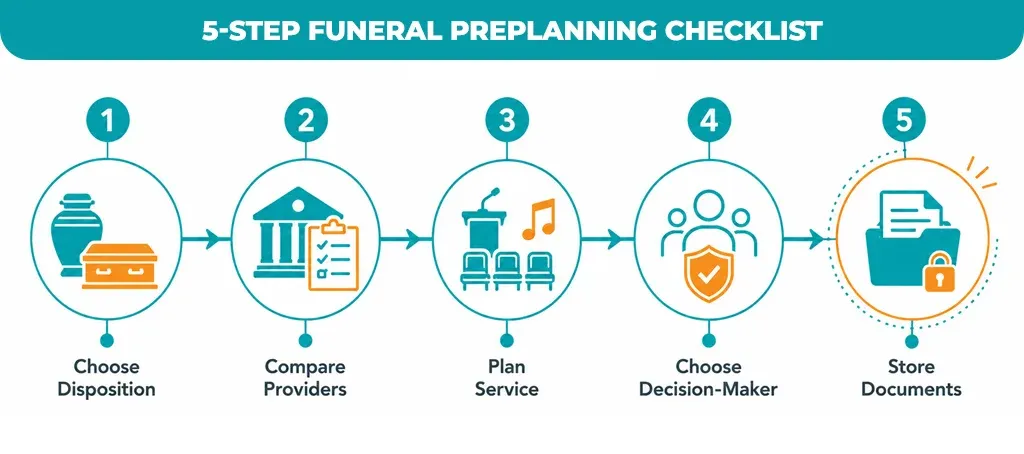
5-Step Funeral Preplanning Checklist

Decide on a disposition method

Burial, cremation, and alternative options such as donation to science each carry different cost structures, timelines, and documentation requirements. This choice shapes nearly everything that follows, including whether you need a casket, an urn, or neither.

Research and select a funeral provider

Request a General Price List from more than one funeral home before committing. Because the FTC requires providers to give this list to anyone who asks, in person or by phone, comparing GPLs side by side is one of the most effective ways to evaluate cost and service transparency before signing a pre-need funeral plan agreement.

Outline the service

Decide on the type of gathering (traditional service, celebration of life, or a private, direct disposition with no service), along with music, readings, officiants, and any specific requests, such as military honors or a particular venue.

Designate a trusted decision-maker

Name an executor or family member who will carry out your instructions, and make sure that person knows where your documents are and has copies of any pre-need contract.

Store your documents securely

Keep your funeral pre-planning worksheet or pre-need contract alongside your will and other estate planning documents, and tell at least one trusted person where to find them. A plan that cannot be located when needed provides no benefit at all.

Benefits of Preplanning a Funeral

The case for pre-planning funeral services rests on three main pillars: reduced emotional burden for survivors, a measure of financial predictability, and control over personalization.

Emotional relief for family

A documented plan spares grieving relatives from guessing at your wishes or negotiating disagreements about disposition, service style, or budget while under significant time pressure. This is consistently cited by funeral directors and consumer advocates as the primary reason people choose to preplan, even when they do not prepay.
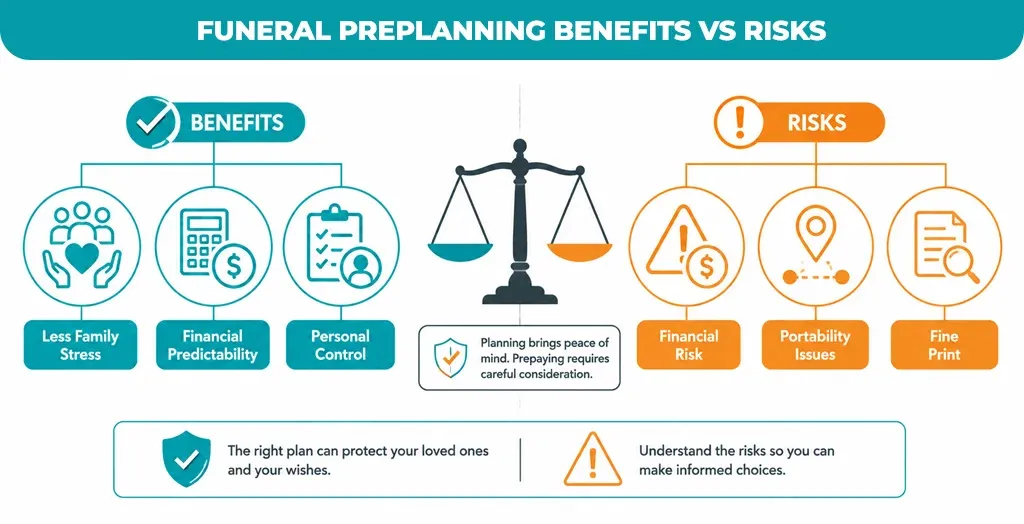
Funeral Preplanning: Benefits vs. Risks

A measure of financial predictability

Funeral costs have risen steadily. According to NFDA’s General Price List studies, the median cost of a funeral with viewing and burial rose 5.8% between 2021 and 2023, from $7,848 to $8,300, while the median cost of a funeral with viewing and cremation rose 8.1% over the same period, from $5,810 to $6,280. A guaranteed-price pre-need contract, funded correctly through a trust or insurance policy, can lock in costs for services and merchandise at today’s rates, which is the primary financial argument in favor of prepaying rather than only planning.

Personalization

Preplanning gives you the time to think through details that are easy to overlook under time pressure, such as specific music, readings, charitable memorial requests, or a non-traditional venue. NFDA’s research shows a rising share of consumers open to non-traditional formats, with 58.3% of respondents in its 2025 study reporting they had attended a funeral held at a non-traditional location.

Potential Disadvantages of Prepaid Funerals

Prepaying is where the risk in this topic concentrates, and it is worth treating separately from the act of planning itself. A written plan carries essentially no financial downside. A prepaid contract does.

Financial risk

The money in a pre-need funeral trust or insurance policy is only as secure as the institution holding it and the state’s oversight of that institution. State regulation of pre-need contracts varies widely, and enforcement gaps have led to real losses. The FBI has documented cases such as Missouri-based National Prearranged Services, whose operators diverted customer funds meant for prearranged funeral trusts and insurance policies into unauthorized investments.

Portability issues

A prepaid contract signed with one funeral home may not transfer cleanly if you move to another state or later prefer a different provider. Depending on the contract and state law, you may face administrative delays, penalties, or a partial refund rather than the full amount you paid in. This is one of the specific concerns the Funeral Consumers Alliance (FCA), a death-care industry watchdog cited by AARP, raises when it advises against buying a prepaid plan directly from a funeral home. According to FCA executive director Joshua Slocum, as cited by AARP, the risk is straightforward: you can lose money if you change your mind before you die or if you end up dying in a different state from where you originally paid.

Fine print and disclosure gaps

The Better Business Bureau (BBB) has separately warned about scams that specifically target grieving families and pre-need customers, including callers who impersonate insurance representatives or government agencies to request payment or sensitive personal information. The BBB recommends verifying that any prepaid funds are placed in a state-regulated trust or a dedicated insurance policy rather than a funeral home’s general operating account, requesting an annual statement showing where the money is held, and reporting suspicious activity through the BBB’s Scam Tracker.

Key Takeaway

If you decide to prepay, ask specifically how your funds will be held (trust or insurance), who the trustee or insurer is, and whether the contract is transferable across state lines. If a provider cannot answer clearly, treat that as a warning sign rather than an oversight.

Secure Your Family's Future with Confidence

Don’t leave your loved ones' financial security to chance. Use our expert tools and free resources to find the perfect coverage today.

Pros and Cons of Funeral Preplanning

Weighing the pros and cons of funeral preplanning side by side makes clear that the practice of planning and the practice of prepaying carry very different risk profiles.

Pros of Funeral Preplanning

Cons of Funeral Preplanning

  • Removes guesswork for surviving family members during an already stressful time.
  • Gives you complete creative power over how people remember your life.
  • Can lock in current prices on certain goods and services, offsetting future cost increases when the contract is funded through a guaranteed-price trust or insurance plan.
  • Encourages a documented, itemized comparison of funeral providers rather than a rushed, single-provider decision.
  • Ties up capital that cannot easily be redirected to a financial emergency.
  • May involve administrative hurdles or transfer fees if you relocate or change funeral homes.
  • Contract terms, growth guarantees, and refund policies can be complex or poorly disclosed.
  • Funds are only as secure as the trust, insurer, or state guaranty system backing the contract.

Consumer advocacy groups generally support the planning half of this equation without reservation, while urging more caution on prepaying. AARP’s policy research notes that a funeral is often an older consumer’s third-largest expense, behind a home and a car, and has called for the FTC to strengthen the Funeral Rule with minimum standards for prepaid contracts and a requirement that pre-need contracts be portable and written, since state-level consumer protections vary so widely. Separately, AARP has cited survey data from International Communications Research showing that roughly one-third of Americans age 55 to 64 (32%).

For consumers weighing how much a prepaid funeral plan costs against the alternative, AARP and financial planners frequently point to simpler self-funding tools a POD bank account, a dedicated final expense insurance policy, or funds earmarked within a broader estate plan as options that preserve most of the price-certainty benefit of a formal pre-need contract while avoiding the portability and provider-solvency risks tied to committing funds to a single funeral home years in advance.

Peace of Mind Starts With a Plan

Funeral preplanning will not remove grief from the equation, but it removes the guesswork, the rushed decisions, and, when funded carefully, much of the financial uncertainty that often accompanies a death in the family. The key is treating planning and prepaying as related but distinct decisions, understanding your rights under the FTC’s Funeral Rule, and choosing a funding vehicle you have vetted rather than one you were simply offered.

Navigating end-of-life decisions doesn’t have to be overwhelming. Premier Services Agency specializes in guiding individuals and families through estate planning, final arrangements, and comprehensive funeral preplanning services tailored to your unique needs. Contact Premier Services Agency today to secure your peace of mind and protect your loved ones’ future.

Frequently Asked Questions (FAQs)

For most people, documenting funeral preferences in advance is a low-risk, high-value step because it removes ambiguity for surviving family members at a difficult time. The planning portion carries little downside since it does not require spending money up front. Whether to also prepay is a separate, more consequential decision that depends on the strength of the funding vehicle and your provider's track record.

Simply documenting your wishes in a worksheet costs nothing. If you decide to pay in advance, the cost will vary depending on the goods and services you choose. As a benchmark, NFDA data puts the median cost of a funeral with viewing and burial at $8,300 and a funeral with viewing and cremation at $6,280, based on the most recent General Price List study; a basic services fee alone had a median of $2,495.

It depends on how the funds are held and how confident you are that your plans, provider, and state of residence will stay stable. A prepaid plan funded through a well-regulated trust or insurance policy can protect against future price increases. However, watchdog groups such as the Funeral Consumers Alliance, cited by AARP, advise caution, since prepaid funds are not always fully protected or transferable if you move or change providers.

Start by deciding on a disposition method (burial, cremation, or an alternative), then request and compare General Price Lists from a few local funeral homes. Outline your preferred service style and personal details, designate a trusted person to carry out your wishes, and store the finished plan with your will and other estate documents so it can be located when needed.