


Shopping for coverage usually starts with one question: how much is this actually going to cost me? Age is not the only factor that affects term life insurance rates. Insurers weigh your health, your habits, and even your job before they hand you a number. This guide walks through real rate ranges by age and gender, the underwriting factors that move your price up or down, and the specific steps that get you into a cheaper rate class before you ever apply.
This guide walks through term life insurance rate ranges by age and gender, the underwriting factors that move your price up or down, and the specific steps that get you into a cheaper rate class before you ever apply.
What Are Term Life Insurance Rates and How Do They Work?
Term life insurance rates are the premiums you pay for coverage that lasts a set period, usually 10 to 30 years. Insurers calculate your rate using your age, gender, health, and lifestyle, then lock that price for the entire term as long as you keep paying. No cash value builds up, which is why term costs far less than permanent life insurance.
A term policy is built around two decisions: how long you need coverage, and how large a death benefit your family would need if you weren’t there to provide income. You apply, go through underwriting, and get placed into a rate class. From that point forward, your premium is fixed. It doesn’t creep up as you age within the term, and it doesn’t drop if your health improves; the rate you lock in on day one is the rate you keep.
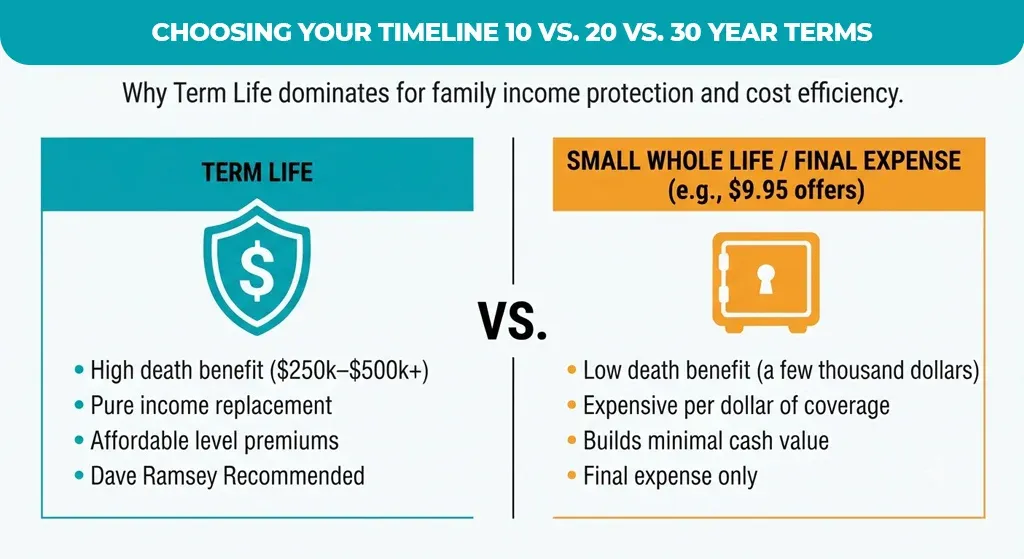
That predictability is exactly why term dominates the market. Families want a safety net that’s cheap enough to actually afford at the coverage level they need, and level premiums let them budget for it the same way they budget for a mortgage payment. Whole life insurance still has a place for estate planning or lifelong needs, but for pure income replacement, term is almost always the more efficient tool.
Average Term Life Insurance Prices by Gender and Age
Average term life insurance rates rise with age and are typically lower for women, who statistically live longer. A healthy 30-year-old might pay around $15–$16 a month for a 20-year, $250,000 policy, while a healthy 50-year-old in the same category can pay well over double that amount.
Age is the single biggest lever in your premium. Every year you wait to apply, your rate class resets against an older body of mortality data. Gender is the second major factor; women’s rates run 10–15% lower than men’s at most ages, reflecting longer average life expectancy.
Term Life Insurance Rates by Age Chart (20-Year Term, $250,000 Policy, Healthy Non-Smoker)
| Age | Female (Monthly) | Male (Monthly) |
| 25 | $13.50 | $14.80 |
| 30 | $15.00 | $16.10 |
| 35 | $16.75 | $18.90 |
| 40 | $21.30 | $24.60 |
| 45 | $31.90 | $37.20 |
| 50 | $29.80* | $35.45 |
| 55 | $52.10 | $61.75 |
| 60 | $88.40 | $104.20 |
10-Year vs. 20-Year vs. 30-Year Term Life Insurance Rates by Age
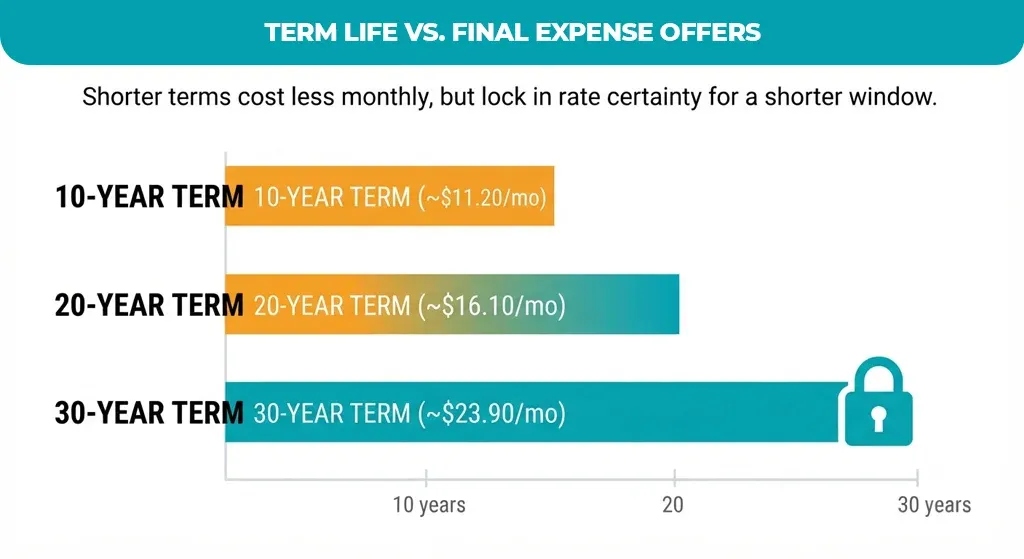
Shorter terms cost less per month because the insurer is on the hook for a shorter window, but you give up rate certainty sooner. A 30-year-old buying a 10-year term might pay close to $11 a month, while the same person locking in a 30-year term for the same coverage could pay closer to $24 a month more upfront, but guaranteed unchanged for three full decades.
| Term Length | 30-Year-Old Male, $250K |
| 10-Year Term | ~$11.20/month |
| 20-Year Term | ~$16.10/month |
| 30-Year Term | ~$23.90/month |
Key Factors That Impact Your Term Life Insurance Rates
Beyond age and gender, insurers price your policy based on your medical history, tobacco use, occupation, and hobbies. Each factor shifts you into a specific underwriting tier from preferred-plus down to substandard, and that tier, not the sticker price on a chart, ultimately sets your real premium.
Medical History and Health Profile
Underwriters pull your blood pressure, cholesterol, BMI, and any chronic conditions like diabetes or sleep apnea. Family history of early heart disease or cancer can also nudge you into a higher-risk tier, even if your own numbers look fine.
Tobacco and Nicotine Use
Smokers and vapers commonly pay two to three times what non-smokers pay for identical coverage. Some carriers now test for nicotine specifically, so occasional cigar or vape use can still trigger smoker rates even if you don’t consider yourself a regular smoker.
Occupation and Dangerous Hobbies
Commercial fishing, logging, and structural construction all carry occupational loadings. Private flying, skydiving, and scuba diving beyond recreational limitations can all result in a flat additional fee or a temporary exclusion rider.
How to Lower Your Premiums and Find the Best Rates
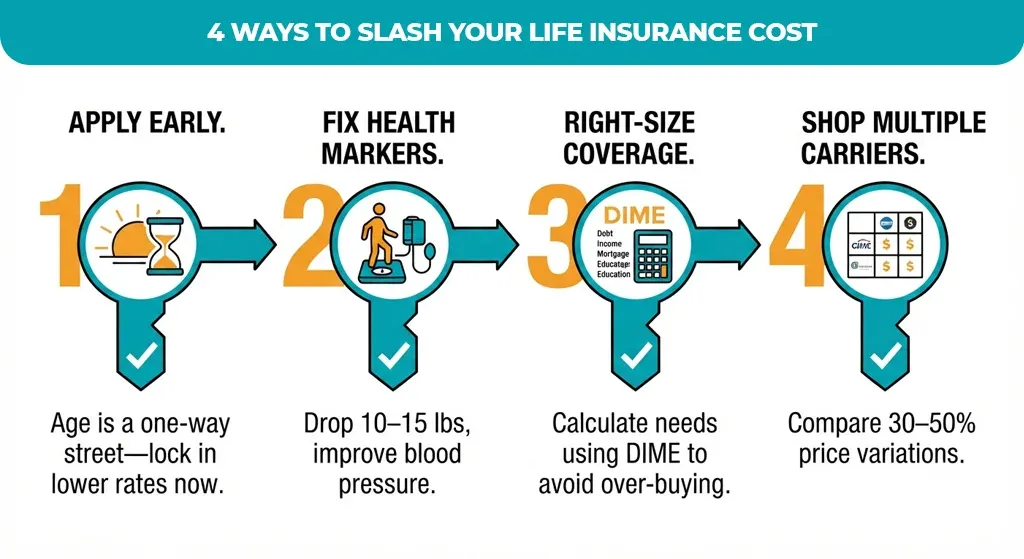
The fastest ways to lower term life insurance rates are applying while you’re younger and healthier, improving controllable health markers before underwriting, right-sizing your coverage instead of over-buying, and comparing quotes across multiple carriers since the same applicant can see 30–50% price swings between companies.
- Apply now, not later. Age is the one factor that only moves in one direction, so every year of delay adds cost permanently.
- Fix what you can before you apply. Losing 10–15 pounds, lowering blood pressure with a few months of consistent habits, or quitting nicotine for the carrier’s required period can bump you into a better rate class.
- Right-size your coverage. Use an income-replacement or DIME calculation (debt, income, mortgage, education) instead of guessing a round number; buying wastes premium every month for the life of the policy.
- Shop multiple carriers. Two companies can look at the identical 40-year-old non-smoker and land 40% apart on price because each insurer weighs risk factors differently.
- Consider a laddering strategy. Instead of one large 30-year policy, layer a 30-year term for long-term obligations with a 10 or 15-year term for shorter-term debts like a car loan. You drop the smaller policy once that debt is paid off, cutting your total premium.
Structuring Your Policy: Term Lengths and Coverage Amounts
Choose a term length that matches your longest financial obligation, typically until your mortgage is paid off or your youngest child finishes college, nd choose a coverage amount using a DIME calculation: debt, income replacement, mortgage balance, and education costs combined.
Matching your term to real milestones prevents two expensive mistakes: outliving your coverage while obligations remain, or paying for protection years after your kids are financially independent. A 20-year term suits most parents of young children; a 30-year term fits new homeowners with a 30-year mortgage; a 10-year term works for a specific, short-term debt.
Level premiums are the safeguard that makes this planning worthwhile. As long as the policy stays level-premium, the price you’re quoted today is the price you pay in year 19, not a number that creeps upward as you age within the term.
Term Life Insurance Rates for Seniors
Rates climb sharply after 60 because mortality risk accelerates. Many carriers cap new term applications around age 75–80, and coverage amounts available without extensive medical exams shrink. Seniors shopping for term life insurance rates should expect simplified-issue or guaranteed-issue policies to cost more per dollar of coverage than fully underwritten term, but they remain one of the only paths to affordable protection without a medical exam later in life.
Term Life Insurance Rates in Canada
Canadian term life insurance rates follow the same underwriting logic: age, gender, health, and smoking status, but pricing benchmarks differ by province and by insurer, and premiums are typically quoted in Canadian dollars against Canadian mortality tables. If you’re shopping in Canada, ask any quote tool whether it’s pulling US or Canadian rate tables before comparing numbers, since the two aren’t interchangeable.
Conclusion
Securing financial protection shouldn’t feel like an uphill battle, but knowing your numbers makes all the difference. By understanding how insurers calculate term life insurance rates, evaluating your exact coverage needs, and comparing multiple carriers, you can easily avoid overpaying.
Take absolute control of your family’s financial security today by locking in a policy while you are young and healthy. Reach out to a licensed professional, compare personalized quotes, and make the ultimate investment in peace of mind that protects your loved ones for decades.