

No-Exam Life Insurance: Get Coverage Without a Medical Exam

No-exam life insurance lets most people get covered without ever seeing a doctor. It skips the bloodwork, the nurse visit, and the in-person physical. Instead, insurers rely on health questions and data such as prescription history and motor vehicle records to assess risk. For many applicants, life insurance without a medical exam means coverage in days or even minutes rather than weeks.

This guide breaks down how no-exam coverage actually works, the three main policy types you’ll run into while shopping, who tends to benefit the most, what it typically costs, and the trade-offs worth weighing before you sign anything.

Key Takeaways

  • No-exam life insurance replaces the physical, bloodwork, and nurse visit with health questions and third-party data such as prescription and driving records.
  • Approval can happen in minutes or take a few days, depending on the policy type and your health profile.
  • Accelerated underwriting term policies can offer coverage into the seven figures for healthy applicants, while guaranteed issue plans typically top out between $5,000 and $25,000.
  • Guaranteed issue policies usually carry a graded benefit period of two to three years before the full death benefit applies.
  • Monthly premiums depend heavily on age, gender, coverage amount, and term length, so it pays to compare quotes across carriers before committing.

What Is No Medical Exam Life Insurance?

No medical exam life insurance is exactly what it sounds like: a policy issued without the traditional in-person physical, no bloodwork, no urine sample, and no nurse measuring your blood pressure at your dining table.

How the underwriting actually works: Instead of lab results, insurers rely on accelerated underwriting. They pull data you’ve already generated elsewhere, prescription drug history from pharmacy databases, motor vehicle records, Medical Information Bureau reports, and sometimes credit-based insurance scores. Combine that with your answers to a health questionnaire, and an algorithm, often backed by a human underwriter for edge cases, produces a decision.
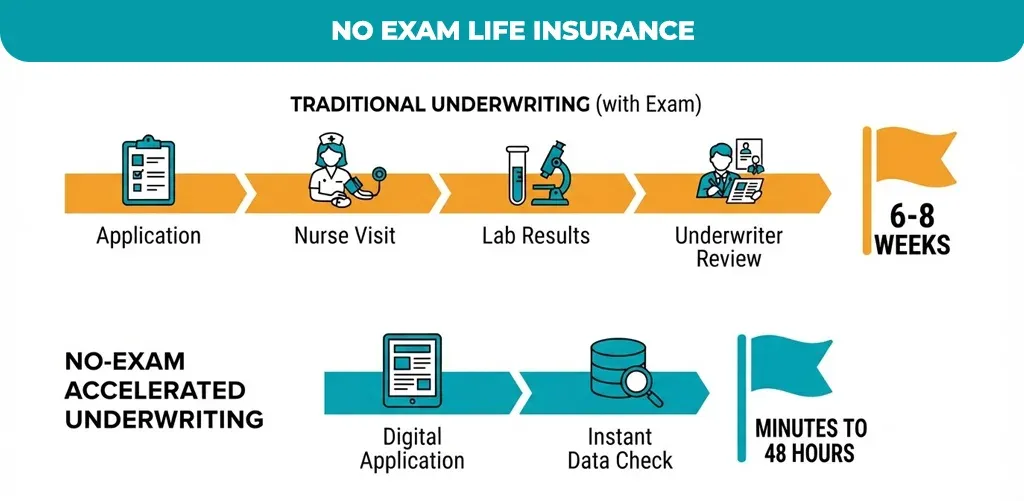
No Exam Life Insurance

Why does this exist at all? Partly convenience, partly competition. Carriers realized that a six-to-eight-week underwriting cycle was costing them customers who simply gave up or bought from a faster competitor. Digital-first insurers pushed the entire industry toward instant, app-based issuance, much like online banking pushed branches toward faster loan approvals.

Secure Your Family's Future with Confidence

Don’t leave your loved ones' financial security to chance. Use our expert tools and free resources to find the perfect coverage today.

How No-Exam Life Insurance Works

No medical exam life insurance runs entirely online. Applicants complete an application, and the insurer evaluates risk using a combination of health questions and third-party data. Depending on the policy type, a decision can come within minutes or take a few business days.

What Insurers Check Even Without an Exam

Even without a physical, insurers may still review several factors before approving coverage:

  • Health questionnaire: Applicants answer questions about medical history, medications, tobacco use, past surgeries, and family health history.
  • Prescription history: Insurers may review pharmacy databases to confirm medications and identify possible health risks.
  • Medical records: In some cases, insurers may request records from your doctor to verify a diagnosis or recent treatment.
  • Motor vehicle report: Driving history may be reviewed for risk factors such as DUIs or repeated serious violations.
  • Identity and fraud databases: Insurers may check identity verification systems and industry databases, including the Medical Information Bureau, for inconsistencies in past applications.
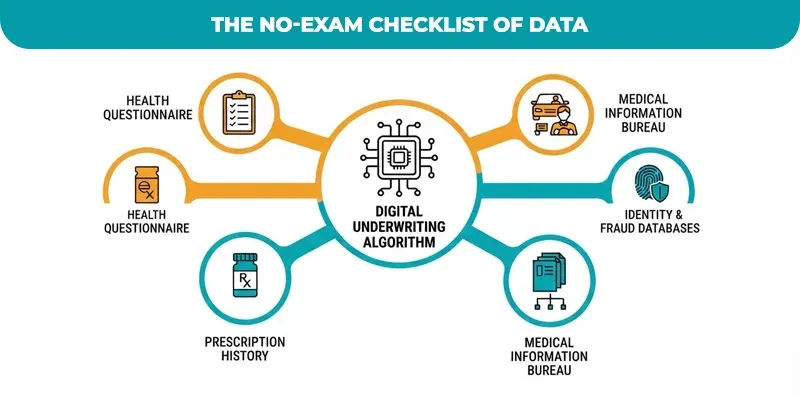
The No-Exam Checklist of Data

When You Might Still Need a Medical Exam

Choosing a no-exam policy does not automatically mean the insurer will waive the exam entirely. This may happen if you apply for a high coverage amount, report a complex or recent medical condition, or if your application does not match prescription or background data. In those cases, the insurer may move your application to full underwriting before making a final decision

Types of No-Exam Life Insurance Policies

Term Life Insurance With Accelerated Underwriting

Accelerated underwriting term life insurance is the most common no-exam option for healthy applicants. Instead of requiring a physical, insurers use data sources such as prescription history, medical databases, and motor vehicle records to evaluate risk. For eligible applicants, this approach can unlock substantial coverage at rates comparable to fully underwritten policies.

  • Best for: Income replacement, mortgage protection, and families needing higher coverage.
  • Typical coverage: Often up to $3 million or more, depending on age and health.

Simplified Issue

Here, you answer a set of yes-or-no health questions- heart disease, cancer in the last ten years, tobacco use- but there’s no lab work at all. Coverage tends to be moderate, and it’s commonly attached to permanent policies like whole life, though term versions exist too.

Guaranteed Issue

No health questions, no exam, near-automatic approval. This is the safety net for people who’d otherwise be declined, often marketed toward final expense coverage. The trade-off is a higher cost per dollar of coverage and lower maximum death benefits.

Quick Reference

Policy TypeApproval SpeedTypical Coverage LimitsBest For
Accelerated UnderwritingMinutes to 48 hours$100,000 – $1M+Healthy applicants who want long-term coverage fast
Simplified IssueSame day to a few days$25,000 – $500,000Applicants with minor health issues, moderate coverage needs
Guaranteed IssueMinutes (near-automatic)$5,000 – $25,000Seniors or high-risk applicants needing final expense coverage

How Much Does No-Exam Life Insurance Cost?

Pricing for no-exam coverage depends on your age, gender, the size of the death benefit, and how long you want the term to last. As a rule of thumb, younger applicants and shorter terms cost the least, while older applicants and 30-year terms sit at the higher end of the range. The figures below reflect typical monthly premiums for non-smoking applicants in average health, and actual rates will vary by carrier and state.
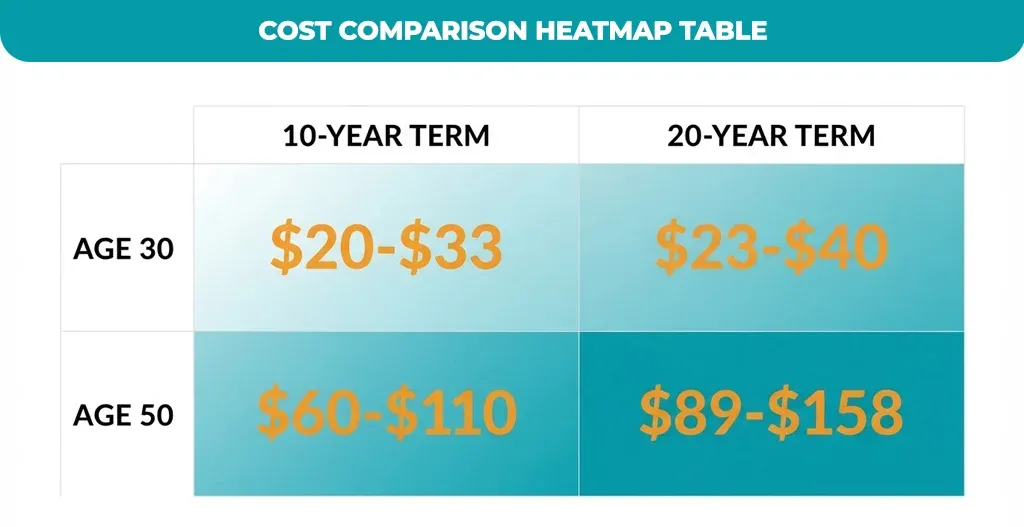

Cost Comparison Heatmap Table

Average Monthly Cost of a $500,000 No-Exam Term Life Policy

Age and Gender10-Year Term20-Year Term30-Year Term
30, Male$20-$33$23-$40$35-$70
30, Female$13-$24$17-$31$29-$54
40, Male$30-$53$38-$69$67-$119
40, Female$23-$38$29-$50$50-$91
50, Male$60-$110$89-$158$166-$304
50, Female$48-$81$70-$119$120-$217

For applicants who need a larger death benefit, a $1 million policy roughly doubles the premium at every age and term length shown above. Here’s how those numbers break down:

Average Monthly Cost of a $1 Million No-Exam Term Life Policy

Age and Gender10-Year Term20-Year Term30-Year Term
30, Male$37-$63$41-$73$62-$130
30, Female$21-$41$27-$55$48-$99
40, Male$54-$95$66-$126$121-$226
40, Female$41-$68$52-$92$93-$175
50, Male$113-$208$166-$306$317-$571
50, Female$90-$153$131-$222$233-$414

A few factors push these numbers up or down for any given applicant: nicotine use, build (height and weight), driving record, and overall health history all factor into the final quote, even without a formal exam. Comparing quotes from more than one carrier is usually the fastest way to find out where you actually land on these ranges.

Pros and Cons of No-Exam Life Insurance

The Pros

  • Speed: Many accelerated underwriting applications are approved same-day, sometimes within minutes of hitting submit.
  • Convenience: The entire process- application, questionnaire, and e-signature- happens online or over the phone, with no appointments to schedule around.
  • Accessibility: Guaranteed issue policies create a path to coverage for people with pre-existing conditions who’d be declined or heavily rated under traditional underwriting.

The Cons

  • Cost: Insurers price in the uncertainty of not verifying your health directly, so premiums for no-exam policies typically run higher than a comparable fully underwritten policy for the same healthy applicant.
  • Coverage caps: Guaranteed and simplified issue policies usually top out well below what a medically underwritten term policy could offer, often $25,000 to $500,000, versus $1 million or more.
  • Graded benefit periods: Some guaranteed issue policies pay out only a return of premiums, plus interest, if the insured dies of natural causes within the first two to three years. Full benefits kick in after that waiting period.

Who Should Think About Life Insurance Without a Medical Exam?

The Hurry-Up Group: Buying a home, co-signing a loan, or facing a lender requirement for coverage before closing? No-exam policies can bind coverage in days, not weeks.

The Health-Conscious (But Private): If needle phobia, a packed schedule, or simple distaste for medical exams has kept you from applying, this removes the barrier entirely.

The Challenged Applicant: Those managing a chronic condition, such as diabetes or hypertension, or a history that might trigger a decline or a heavily rated premium under traditional underwriting, sometimes fare better here.

The Small-Needs Applicant: If your goal is strictly covering funeral and final expenses rather than income replacement, guaranteed issue policies are built exactly for that job.

How to Apply for No-Exam Life Insurance

Applying for no-exam life insurance is usually faster and simpler than traditional underwriting. Most applicants complete the process entirely online, and some receive a decision within minutes.

  1. Complete the application. Answer questions about your health history, medications, lifestyle, and family medical background honestly and accurately.
  2. Allow data verification. The insurer reviews third-party sources such as prescription databases, motor vehicle reports, and identity verification systems to assess risk.
  3. Receive an underwriting decision. Depending on the policy type and your health profile, you may be approved within minutes or within a few business days.
  4. Activate your coverage. Once approved and your first payment is processed, your coverage begins.

Conclusion

No medical exam life insurance is a genuinely useful tool, but it isn’t a universal fix. For a healthy 35-year-old chasing a $750,000 term policy, accelerated underwriting can deliver traditional-grade pricing without the hassle. For a 68-year-old managing a health condition who mainly wants to cover funeral costs, guaranteed issue may be the only realistic path to coverage at all.

The right choice depends on your health profile, your budget, and what the coverage actually needs to accomplish for the people you leave behind. If you’re unsure which category you fall into, a conversation with a licensed independent agent, someone who can shop multiple carriers on your behalf, is worth the twenty minutes it takes.

Whatever you land on, remember this: the best life insurance policy isn’t the one with zero trade-offs. It’s the one that’s actually in force when your family needs it. Getting some protection in place today beats waiting for the perfect policy indefinitely.

Secure Your Family's Future with Confidence

Don’t leave your loved ones' financial security to chance. Use our expert tools and free resources to find the perfect coverage today.

FAQs About No-Exam Life Insurance

Yes. Accelerated, simplified, and guaranteed issue policies are all real, regulated insurance products sold by major carriers. They use data and questionnaires instead of a physical exam to assess risk.

An advertised plan at that price point is typically a guaranteed acceptance whole life policy that provides a small, fixed unit of coverage, often around $1,000-$2,000 depending on age, rather than a large death benefit. It's marketed as an entry-level starter amount, and most buyers purchase additional units to reach a meaningful payout.

In many cases, yes. Applicants with a pacemaker are often approved through simplified issue or guaranteed issue policies, sometimes with a rated (higher) premium, since traditional fully underwritten policies may be harder to qualify for with that history.

Often, yes, depending on the stage, treatment outcome, and time since diagnosis. Early-stage, successfully treated melanoma may still qualify for accelerated or simplified issue underwriting after a waiting period, while more advanced cases may need to rely on guaranteed issue coverage.

It depends heavily on age, health, and policy type, but a healthy 40-year-old non-smoker might see term rates roughly in the $30-$50 per month range through traditional underwriting, while a comparable no-exam accelerated policy could run somewhat higher. Getting exact numbers requires comparing quotes across carriers for your specific profile.