


Choosing the right healthcare coverage can feel overwhelming, but securing individual health insurance is one of the most important financial and medical decisions you will make this year. Whether you’re self-employed, transitioning off an employer-sponsored plan, or simply comparing health insurance plans for individuals that better fit your budget and lifestyle, understanding how the marketplace works is essential.
This guide walks through everything you need to know about individual health insurance plans, from the different plan structures and cost-sharing rules to subsidies, enrollment windows, and how to find the best individual health insurance for your specific situation. By the end, you’ll have a clear framework for comparing options with confidence, whether you’re shopping for affordable individual health insurance in a big city or looking for cheap individual health insurance in a rural area.
Understanding Individual Health Insurance and How It Works
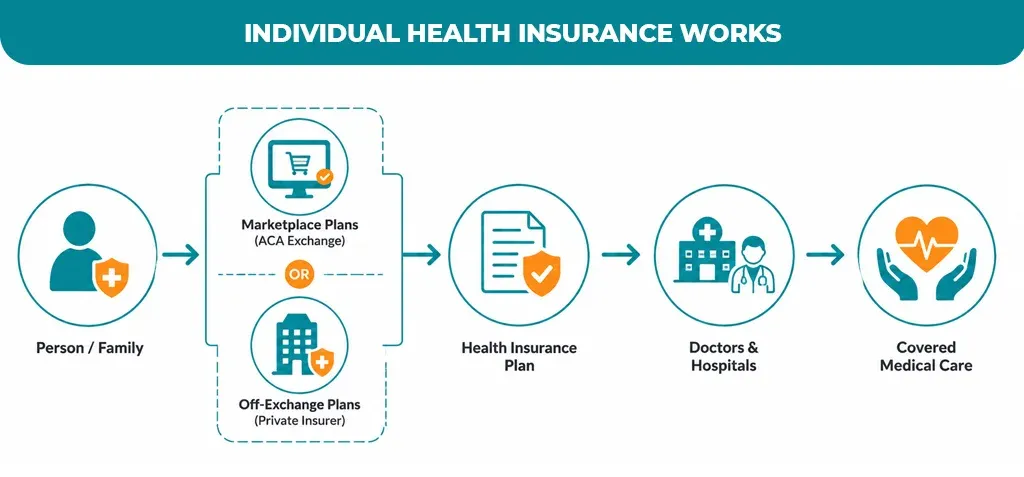
Individual health insurance is a policy you purchase on your own outside of an employer group plan or a government program like Medicare. Unlike group coverage, where a company negotiates rates for its workforce, individual health insurance plans are bought directly by a single person or family, either through the ACA marketplace or from a private insurer.
This type of coverage is especially common among:
- Freelancers and gig workers without access to employer benefits
- Independent contractors and small business owners
- Early retirees who aren’t yet eligible for Medicare
- Young adults aging off a parent’s health insurance individual plan (typically at age 26)
- Anyone between jobs or seeking more flexible, portable coverage
It’s also worth understanding the distinction between ACA-compliant marketplace plans and off-exchange plans. Marketplace plans purchased through HealthCare.gov (or a state exchange) are the only plans eligible for premium tax credits, and they must cover the ACA’s ten essential health benefits. Off-exchange plans are sold directly by insurers or brokers, follow the same consumer protections, but are not eligible for subsidies.
Key Types of Health Insurance Plans Explained
Not all individual health insurance plans work the same way. The plan “type” determines how much flexibility you have in choosing doctors and how much you’ll pay for care outside your network. Here’s how the four major structures compare:
- HMO (Health Maintenance Organization): Requires you to select a primary care physician (PCP) and get referrals to see specialists. Out-of-network care generally isn’t covered, but premiums tend to be among the most affordable individual health insurance options available.
- PPO (Preferred Provider Organization): Offers the most flexibility; you can see specialists without a referral and receive partial coverage for out-of-network providers. This flexibility usually comes with a higher monthly premium.
- EPO (Exclusive Provider Organization): No referrals needed for specialists, similar to a PPO, but out-of-network care is typically not covered at all except in emergencies.
- POS (Point of Service): A hybrid model that requires a PCP like an HMO but still offers some out-of-network benefits, similar to a PPO.
When comparing health insurance plans for individuals, HMO and EPO plans generally carry lower average monthly premiums than PPOs, according to pricing data published by HealthCare.gov and private marketplaces like eHealth. If your priority is minimizing your monthly bill and you’re comfortable staying within a defined network, an HMO or EPO may be the best individual health insurance choice.
Decoding Healthcare Costs: Premiums, Deductibles, and Out-of-Pocket Maximums
Understanding individual health insurance costs isn’t just about the monthly bill; it’s about how the plan splits expenses between you and the insurer over the full year. Four terms matter most:
- Premium: The fixed monthly cost to keep your policy active, regardless of whether you use care.
- Deductible: The amount you pay out of pocket for covered services before your insurance starts contributing.
- Copay / Coinsurance: A flat fee (copay) or percentage of the cost (coinsurance) you pay per visit or service, even after meeting your deductible.
- Out-of-Pocket Maximum: The hard cap on what you’ll spend on covered services in a plan year; once you hit it, your insurer pays 100% of covered costs.
The ACA marketplace organizes individual health insurance plans into four “metal” tiers Bronze, Silver, Gold, and Platinum which describe how costs are divided between you and the insurer, not the quality of care:
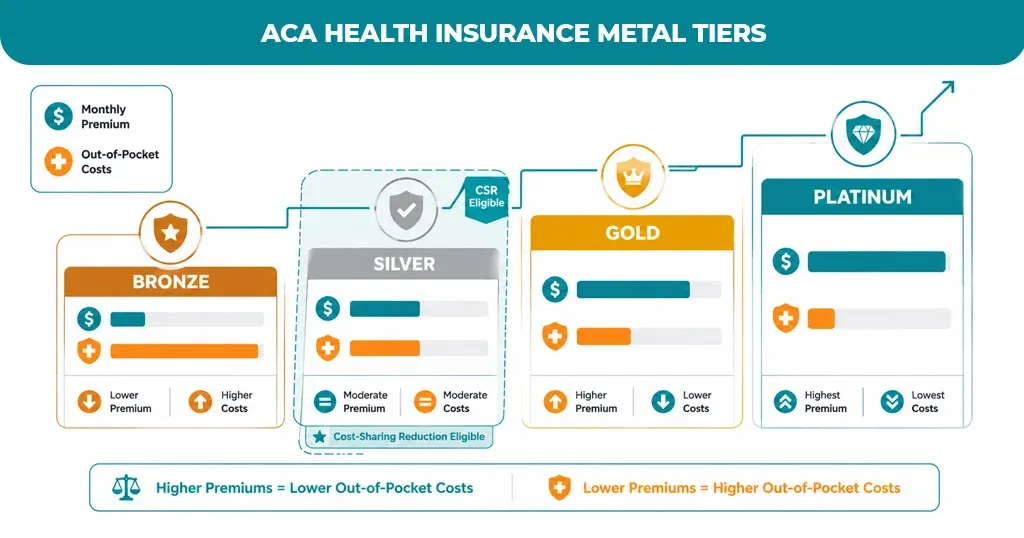
- Bronze: Lowest premiums, highest deductibles, best for healthy people who rarely need care and mainly want protection against a major medical event.
- Silver: The sole tier that qualifies for cost-sharing reductions has moderate rates and deductibles.
- Gold: Higher premiums but lower costs when you actually use care a good fit for people managing ongoing health conditions.
- Platinum: The highest premiums paired with the lowest out-of-pocket costs, ideal for frequent medical users.
A helpful way to think about it: Bronze and Silver plans favor people who rarely visit the doctor, while Gold and Platinum plans favor people with predictable, frequent healthcare needs. Comparing your expected usage against each tier’s cost-sharing structure is one of the fastest ways to identify the best individual health insurance plan for your situation.
Financial Assistance: Subsidies and Tax Credits
Many shoppers assume individual health insurance is out of reach financially, but Advance Premium Tax Credits (APTC) can significantly reduce your monthly cost. Your eligibility and savings amount are based on your household income relative to the Federal Poverty Level (FPL), which the U.S. Department of Health and Human Services (HHS) updates every year.
For 2026, HHS set the federal poverty guideline for a single person in the 48 contiguous states at $15,960 per year, and $33,000 per year for a family of four. Marketplace premium tax credits are generally available to households earning between 100% and 400% of the FPL. It’s important to note that a temporary rule that had removed the 400% income cap expired at the end of 2025, so for 2026 coverage, households earning above 400% of the FPL are no longer eligible for premium tax credits.
Beyond premium tax credits, cost-sharing reductions (CSRs) are available exclusively on Silver-tier marketplace plans for households within certain income brackets. CSRs lower your deductible, copays, and out-of-pocket maximum, not just your premium, which can make a Silver plan more affordable in practice than a Bronze plan for qualifying households. Because eligibility thresholds shift each year, it’s worth checking the current guidelines directly on HealthCare.gov or with a licensed advisor before enrolling.
When and How to Enroll in an Individual Plan
Timing matters when it comes to individual health insurance. Outside of specific windows, you generally can’t sign up for or change a marketplace plan. The two main paths into coverage are:
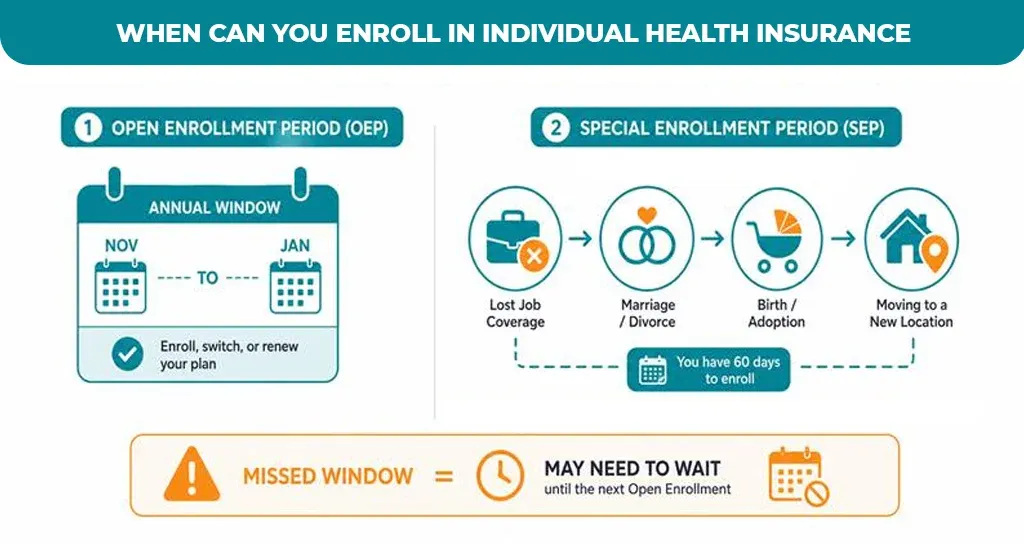
- Open Enrollment Period (OEP): The annual window (typically running from November through mid-January, though exact dates can vary by state) when anyone can enroll in or switch individual health insurance plans.
- Special Enrollment Period (SEP): A 60-day window triggered by a Qualifying Life Event (QLE) that opens enrollment outside the standard OEP.
Common Qualifying Life Events include:
- Loss of employer-sponsored coverage
- Marriage or divorce
- Birth or adoption of a child
- Moving to a new zip code or state
Missing your enrollment window can mean waiting months for coverage, so it’s worth marking these dates on your calendar and confirming the exact deadlines and any penalty guidance for your state on HealthCare.gov.
Conclusion
Navigating the complex world of individual health insurance doesn’t have to be a solo or overwhelming journey. Finding a policy that strikes the ultimate balance between affordable monthly premiums and robust, comprehensive medical coverage requires careful, strategic comparison of your daily healthcare habits, your financial budget, and the various plan structures available on the market today.
Don’t leave your health and financial security to chance. Let the expert advisors at Premier Services Agency guide you through the marketplace, compare top-tier providers, and help you unlock every subsidy you’re entitled to. Visit Premier Services Agency today to schedule your free consultation and secure the peace of mind you deserve.