


Planning for the future, or navigating the sudden loss of a loved one, brings a wave of difficult decisions. Financial concerns often weigh just as heavily as emotional ones, and for most families, the very first question is a practical one: how much does cremation cost?
Cremation has rapidly become the preferred choice for American families, but the true out-of-pocket expense remains surprisingly unclear. Depending on the provider and the type of service selected, the answer can range from a few hundred dollars to several thousand. Two families choosing cremation in the same city can end up with bills that differ by thousands of dollars for what looks, on paper, like a similar service.
This guide breaks down exactly how much does cremation cost in 2026, the hidden fees that catch families off guard, the consumer protections built into federal law, and practical ways to plan and protect your budget.
Understanding the Average Cost of Cremation in 2026
Before comparing providers, it helps to understand that “cremation cost” is not a single number; it depends heavily on what level of service is included. According to the National Funeral Directors Association (NFDA), cremation has now overtaken burial as the most common form of final disposition in the United States, with the cremation rate projected at roughly 63% in 2026 and climbing toward 82% by 2045. As demand has grown, so has the range of pricing options available to consumers.
The NFDA’s most recent data puts the median cost of a funeral with cremation, including a viewing and full service, at approximately $6,280. That figure sits well below the $8,300 median for a traditional funeral with burial, which is one of the main reasons families are increasingly asking how much it costs to cremate a person versus bury one.
But only cremations combined with a typical funeral ceremony are included in that median number. If you’re asking how much does cremation costs without services, a simple, direct cremation with no viewing, no embalming, and no formal funeral, the number drops dramatically, often to somewhere between $1,000 and $3,000 nationally, with many providers advertising direct cremation starting around $1,000 to $1,500.
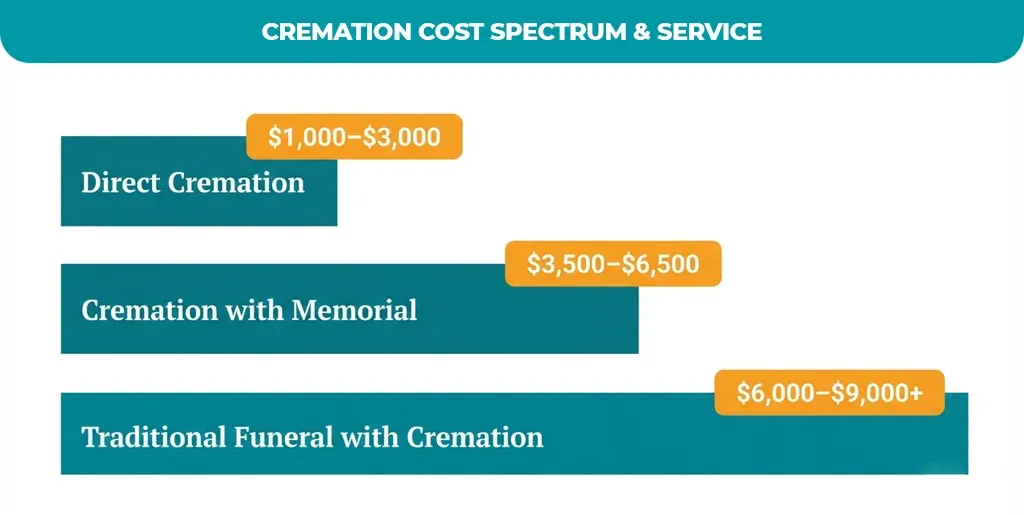
At a glance, national 2026 pricing generally falls into these bands:
- Direct cremation (no services): roughly $1,000–$3,000
- Cremation with a memorial service: roughly $3,500–$6,500
- Traditional funeral with viewing, followed by cremation: roughly $6,000–$9,000+
These are national averages. How much does cremation costs in California, New York, or other high-cost-of-living states tends to run above the median, sometimes by $1,000 or more, while states in the South and Midwest often price below it. Local market competition, whether you use a full-service funeral home or a direct cremation provider, and add-ons like urns and keepsakes all shift the final number.
Breakdown of Cremation Service Types & Their Pricing
The single biggest factor in how much it costs to be cremated is which service tier you choose. Understanding what’s actually included at each level is the key to avoiding surprises on the final invoice.
Direct Cremation
Direct cremation is the most affordable and increasingly the most popular option. It includes transportation of the deceased, the basic services of a funeral director, the cremation process itself, and a temporary or minimal alternative container. There is no viewing, no embalming, and no formal ceremony beforehand.
For families asking how much a simple cremation costs, this is the answer: providers specializing in direct-to-crematory service, sometimes called direct cremation societies, typically charge between $1,000 and $2,500 nationally.
Cremation with a Memorial Service
This mid-tier option covers the cremation process itself plus a memorial gathering held afterward, often without the body present. Costs here typically include venue rental, a celebrant or officiant fee, printed materials, and sometimes a rental urn for display during the service. Typically, total expenses fall between $3,500 and $6,500.
Traditional Funeral Service Followed by Cremation
This option most closely resembles a conventional funeral: a viewing or wake, embalming, use of a casket (often rented specifically for cremation cases), a formal funeral service, and cremation afterward. Because it includes embalming, staffing for a viewing, and casket costs, this tier is the most expensive way to be cremated, frequently exceeding $6,000 and sometimes reaching $9,000 or more depending on casket selection and venue.
Cremation Type Comparison
| Service Type | What’s Included | Typical 2026 Cost |
| Direct Cremation | Transport, basic FD services, cremation, temporary container | $1,000 – $3,000 |
| Cremation w/ Memorial | Cremation + later service, venue, celebrant fees | $3,500 – $6,500 |
| Traditional + Cremation | Viewing, embalming, casket rental, service, cremation | $6,000 – $9,000+ |
Hidden and Additional Fees to Watch Out For
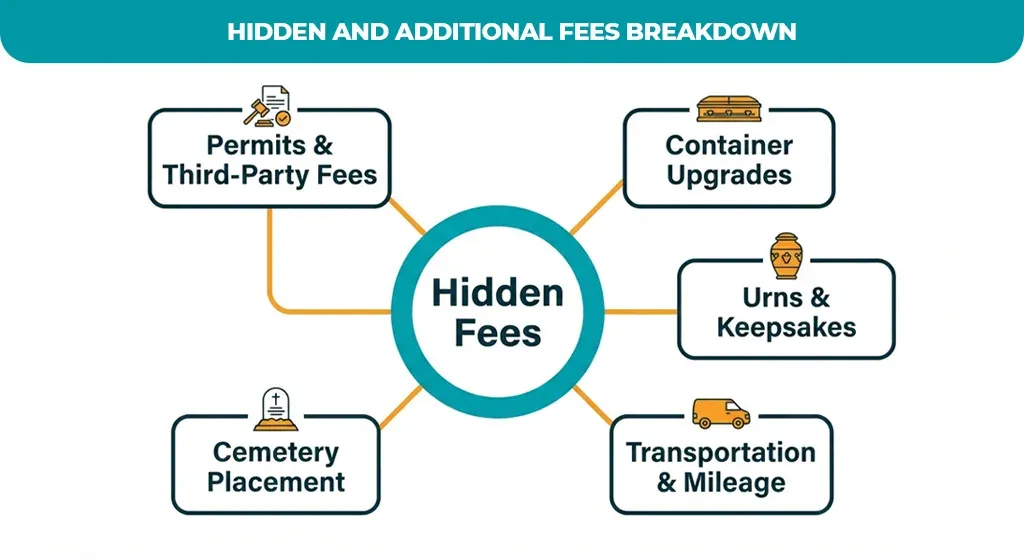
Even a straightforward direct cremation can carry extra charges beyond the base package. Knowing these ahead of time is the best way to avoid an unpleasant surprise on the final bill.
- Permits and third-party fees: Medical examiner or coroner permits, cremation authorization fees, and certified copies of the death certificate are typically passed through to the family and can add $50–$200.
- Container upgrades: Alternative containers, heavy-duty cremation caskets, or decorative units cost more than the basic container included in most packages.
- Urns and keepsakes: Permanent urns, keepsake urns, and jewelry for a small portion of ashes are almost always sold separately and can range from $50 to several hundred dollars.
- Transportation and mileage fees: If death occurs outside the provider’s standard service radius, or the body must be transported across county or state lines, expect additional mileage charges.
- Cemetery and placement fees: Columbarium niches, burial plots for cremated remains, or scattering permits are billed separately from the cremation itself and can add several hundred to several thousand dollars.
Because these line items are easy to overlook, always request a complete, itemized quote before signing any agreement, which brings us to your legal right to exactly that document.
Consumer Rights: The FTC Funeral Rule and How It Protects You
Cremation and funeral pricing can feel opaque, but federal law is designed to prevent exactly that. The Federal Trade Commission’s Funeral Rule requires every funeral home and cremation provider in the United States to give consumers a written, itemized General Price List (GPL) upon request in person or over the phone before they commit to anything.
The FTC Funeral Rule grants you the following rights:
- Receive an itemized price list for goods and services before you pay for anything.
- Buy only the individual goods and services you want; providers cannot legally require you to purchase a package deal.
- Supply your own casket, cremation container, or urn purchased elsewhere, without the funeral home charging a handling fee or refusing to use it.
- Decline embalming in most cases, particularly for direct cremation, since it is rarely legally required.
- Get price quotes over the phone without providing personal information first.
These protections mean that when you’re comparing how much does cremation costs between two providers, you are legally entitled to see, line by line, exactly what you’re paying for at each one.
Smart Ways to Plan and Save Money
Whether you’re planning for yourself or a family member, a little preparation goes a long way toward reducing both the emotional and financial burden later.
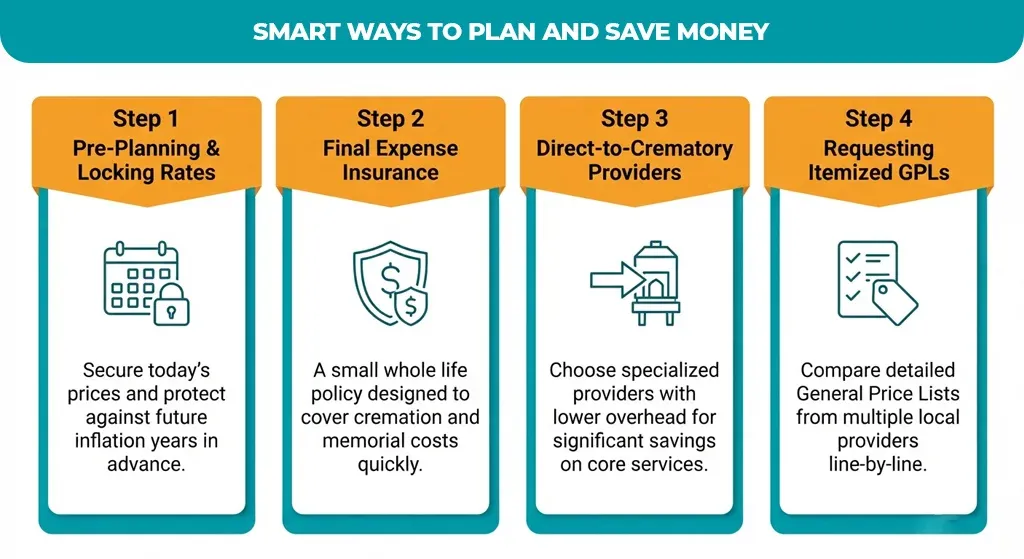
Pre-Planning and Locking in Today’s Rates
Many funeral homes offer pre-need contracts or trusts that let you lock in current pricing years in advance, protecting your family from future inflation. Review any pre-need contract carefully, and confirm whether funds are held in a state-regulated trust and whether they’re transferable if you move or change providers.
Final Expense Insurance
Final expense insurance, sometimes called burial insurance, is a small whole life policy specifically designed to cover cremation and memorial costs. Policies are typically easier to qualify for than traditional life insurance and pay out quickly, sparing family members from covering costs out of pocket while a larger estate or life insurance claim is processed.
Direct-to-Crematory Providers vs. Traditional Funeral Homes
One of the most effective ways to reduce cost is choosing a direct cremation provider rather than a full-service funeral home. These specialized providers operate with lower overhead and focus solely on cremation logistics, which is why their pricing for a simple cremation is often a fraction of what a traditional funeral home charges for the same core service.
- Request itemized General Price Lists from at least two or three providers before deciding.
- Ask directly whether the quoted price is truly all-inclusive or whether permits, containers, and death certificates are billed separately.
- Consider a membership-based cremation society, which can lower costs through pre-negotiated rates.
- Check whether your state, county, or employer offers any death benefit that can offset costs.
Conclusion
The true cost of cremation in 2026 depends almost entirely on the level of service you choose, from a simple direct cremation starting around $1,000, to a full traditional service exceeding $9,000. The good news is that federal law guarantees your right to itemized pricing, and a bit of upfront planning can meaningfully lower the financial burden on your family.
The most practical next step is also the simplest: request itemized General Price Lists from a few local providers, compare them line by line, and ask questions about any fee that isn’t clearly explained. If you’re planning, explore pre-need contracts or a final expense insurance policy now, while you have time to compare options calmly rather than under pressure.