


Life insurance for diabetics is widely available: most people with well-managed type 2 diabetes can buy traditional term or whole life coverage, and many people with type 1 can too, usually at a higher rate class. What you pay depends mainly on your A1C, your age when you were diagnosed, how your diabetes is treated, and whether you have complications.
Quick answer: Yes, people with diabetes can get life insurance. Well-controlled type 2 diabetes often qualifies for standard rates or better, while type 1 is usually rated, meaning a surcharge over standard prices. Policygenius’s sample rates for $500,000 of 20-year term at age 40 were about $60 to $75 a month for type 2 and $82 to $104 for type 1. If traditional coverage isn’t available, simplified issue and guaranteed issue policies offer smaller amounts without an exam.
Can Diabetics Get Life Insurance?
Yes. Diabetes is one of the most common conditions life insurers see, and most carriers have detailed guidelines for it. The CDC estimates that 40.1 million people in the U.S., about 12% of the population, had diabetes in 2023. Insurers can’t afford to turn that market away, so most offer coverage to applicants with stable, well-managed diabetes and no serious complications.
What insurers care about most
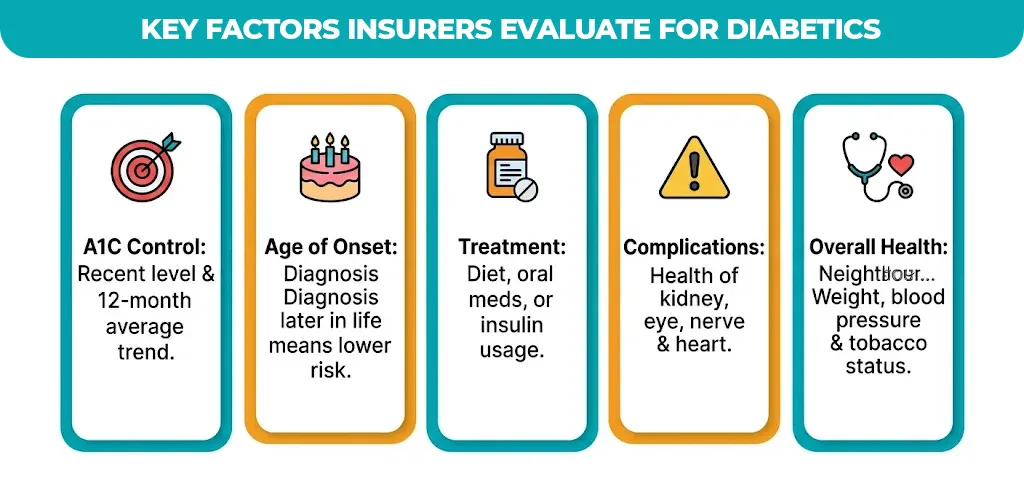
Underwriters aren’t judging the diagnosis alone. They’re estimating how diabetes affects your life expectancy, so the details matter:
• Control: Your A1C, both the most recent result and the trend over time.
• Age of onset: Diabetes diagnosed later in life is treated as lower risk than diabetes diagnosed in childhood.
• Treatment: Diet and exercise, oral medication, or insulin.
• Complications: Kidney, eye, nerve, or heart problems linked to diabetes.
• Overall health: Weight, blood pressure, cholesterol, and tobacco use.
Why approval is easier than many people expect
Better tools for managing diabetes, such as insulin pumps, have helped many applicants show consistent control. Modern Life, an insurance brokerage, notes that clients using insulin pumps may qualify for improved ratings because of more consistent blood sugar management. The more evidence you can show of stable control over time, the stronger your application.
What is the average cost of life insurance for someone with diabetes?
There’s no single average, because rates depend on your rating. Policygenius published these sample monthly rates for $500,000 of 20-year term, with rate illustrations valid as of May 1, 2024:
| Age | Type 2, woman | Type 2, man | Type 1, woman | Type 1, man |
| 30 | $47 | $51 | $52 | $62 |
| 40 | $60 | $75 | $82 | $104 |
| 50 | $121 | $171 | $196 | $278 |
| 60 | $257 | $359 | $535 | $763 |
For comparison, Choice Mutual’s 2026 sample rates for the healthiest class, preferred non-tobacco, put the same $500,000 20-year policy at about $24 a month for a 40-year-old woman and $28 for a man. The sources and dates differ, so treat the comparison as a rough guide, but it shows the general pattern: an applicant with type 2 diabetes often pays two to three times what a very healthy applicant pays, and an applicant with type 1 often pays more.
How Insurers Evaluate Diabetes
Underwriters look at four things: your A1C, how your diabetes is treated, whether you have complications, and when you were diagnosed. Each insurer weighs them differently, which is why the same applicant can get very different offers from different companies.
A1C levels
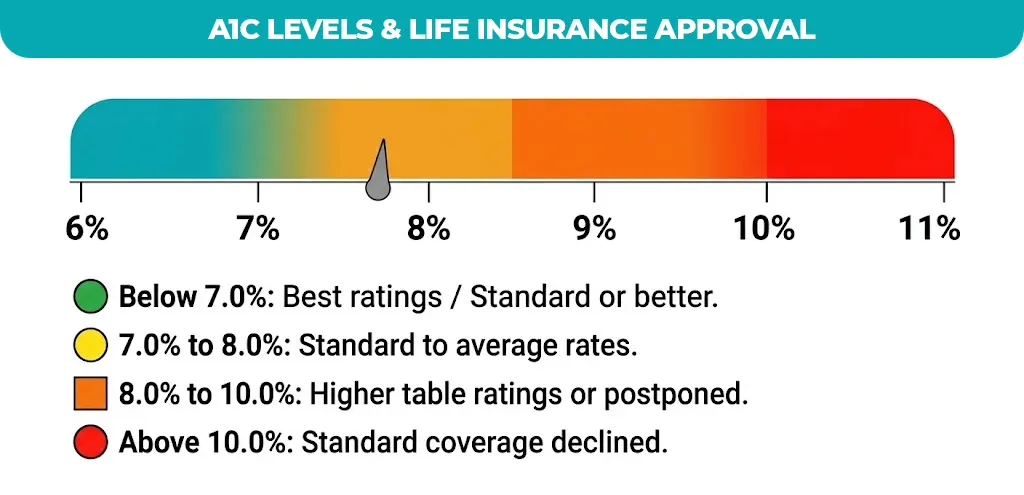
Your hemoglobin A1C shows your average blood sugar over roughly the past three months, so it’s the single most important number in your application. NIDDK notes that for most people with diabetes, the goal is an A1C below 7%. Insurers use similar benchmarks:
• Below 7%: Modern Life reports that type 2 is generally considered well controlled below 7%, and that clients with an A1C of 6% to 7% can sometimes qualify for better-than-standard ratings with the right carrier.
• 7% to 8%: Policygenius says an A1C below 7.5% may qualify type 2 applicants for average rates. For type 1, Modern Life puts the well-controlled threshold at 7.5% to 8%, depending on the carrier.
• Above 8%: Modern Life says higher ratings or postponement are likely, and that newly diagnosed applicants above 9% are often postponed.
• Above 10%: Banner Life’s March 2026 underwriting field guide lists an A1C over 10 as a decline.
Insurers usually look at more than one reading. Policygenius notes that they check both your most recent A1C and your 12-month average, so a single good result after a year of high readings won’t carry much weight.
Treatment
How your diabetes is treated tells the insurer how advanced it is:
• Diet and exercise only: Usually viewed most favorably.
• Oral medication such as metformin: Common and generally acceptable for standard or better ratings when control is good.
• Insulin: Often means a higher rating, especially at high doses. Policygenius says type 1 applicants taking fewer than 50 units of insulin a day with an A1C below 8 may qualify for lower-than-average premiums.
Complications
Complications have the biggest effect on whether you’re approved at all. Underwriters look for:
• Nephropathy (kidney disease): Often first flagged by protein, called microalbumin, in a urine test.
• Retinopathy (eye damage)
• Neuropathy (nerve damage)
• Cardiovascular disease: Heart attack, stroke, or blocked arteries.
• Severe events: Diabetic coma, insulin shock, or amputation.
Banner Life lists significant complications as a decline. On the final expense side, Choice Mutual reports that most insurers decline applicants with a history of insulin shock, diabetic coma, or amputation, while kidney damage, neuropathy, and retinopathy often lead to a policy with a waiting period.
Age of diagnosis
The later in life you were diagnosed, the better. Banner Life says its best available class for diabetes, Standard Plus, may be offered when diabetes began at age 50 or older and is well controlled. Policygenius notes that diagnosis after 50 generally means better rates, while Modern Life reports that type 1 diagnosed before age 12 may be rated as high as Table 6 or declined.
How table ratings affect price
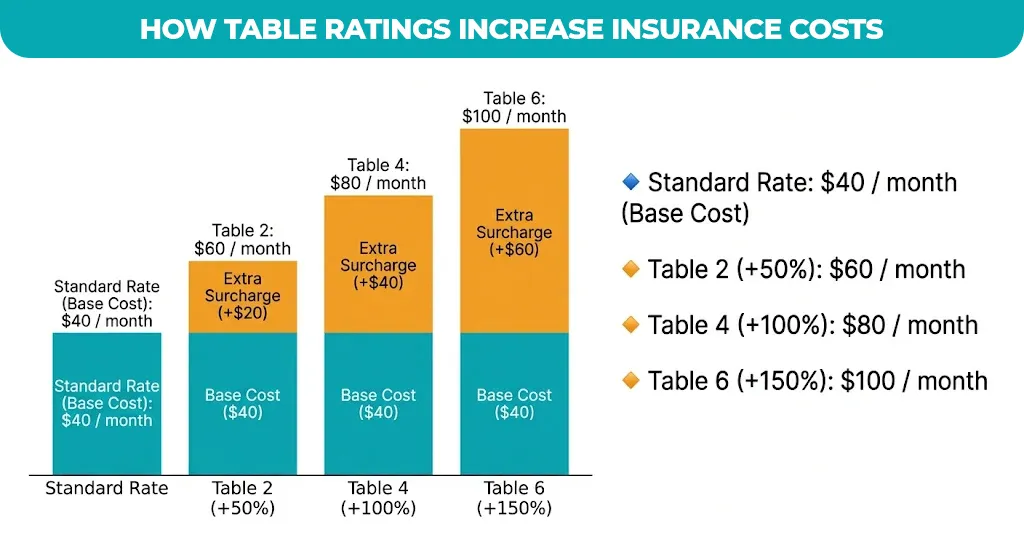
Applicants who don’t qualify for standard rates are often given a table rating, which adds a surcharge. Insurance.com explains that rates typically rise about 25% for each table level, though the exact percentages vary by insurer. Here’s a hypothetical example:
Standard monthly premium: $40
Table 2 (about +50%): $60
Table 4 (about +100%): $80
Table 6 (about +150%): $100
| A1C level | Typical treatment | Possible outcome | Estimated cost impact |
| Below 6.5% | Diet, exercise, or oral medication | Standard or better with the right carrier, especially for type 2 diagnosed later in life | Lowest available for diabetics |
| 6.5% to 7% | Oral medication | Standard, sometimes better | Near standard pricing |
| 7% to 8% | Oral medication or insulin | Standard to table rated | Roughly 0% to 100% above standard |
| 8% to 10% | Often insulin | Table rated or postponed | Higher table ratings likely |
| Above 10% | Any | Decline at many carriers | Simplified or guaranteed issue only |
These ranges summarize published broker and carrier guidance. Every insurer sets its own rules, and complications, age of onset, and other health factors can move you up or down.
Type 1 vs. Type 2 vs. Childhood Diabetes
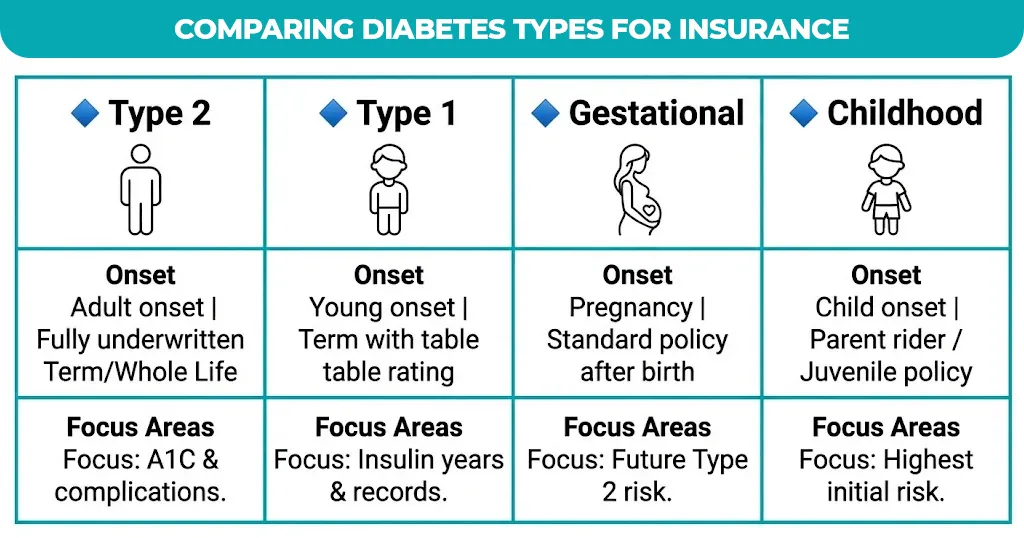
Type 2 diabetes is the easier condition to insure: it usually starts later in life and is often managed without insulin. Type 1 usually starts earlier and always requires insulin, so it’s typically rated. Children with diabetes have the hardest time qualifying for their own policy.
Life insurance for type 2 diabetics
Type 2 accounts for 90% to 95% of U.S. diabetes cases, according to Policygenius, and it’s the type insurers see most. Applicants diagnosed as adults, especially after 50, who keep their A1C under control with diet or oral medication and have no complications, often qualify for standard rates. A few may qualify for better-than-standard classes with the right carrier, though Banner Life, for example, caps diabetics at Standard Plus. Policygenius’s sample rates show type 2 applicants rated anywhere from Table 4 at age 30 to standard at age 60, reflecting how much age affects the rating.
Gestational diabetes is treated more gently. Modern Life notes that it usually resolves after birth, and applicants may qualify for standard or standard plus ratings, with some carriers offering preferred ratings once it has resolved.
Life insurance for type 1 diabetics
Type 1 is an autoimmune condition that requires insulin for life, and it usually begins in childhood or young adulthood. Because people with type 1 typically live with diabetes for more years, insurers usually rate it. Modern Life reports that type 1 ratings typically fall between Table 2 and Table 4, and Policygenius’s 2024 sample rates used Table 6 at every age.
You can improve your chances with good documentation:
• A1C results showing stable control over at least a year
• Records from your endocrinologist
• Evidence of regular eye and kidney screenings with normal results
• Data from an insulin pump or continuous glucose monitor, if you use one
Life insurance for children with diabetes
A child with diabetes is usually hard to insure with an individual policy, since childhood onset is the highest-risk group in most underwriting guides. Options to look at:
• A child term rider on a parent’s policy: Many policies let parents add coverage for their children. Ask whether the rider requires health questions about each child.
• Juvenile whole life: Some insurers offer small whole life policies for children, but applications usually ask about health conditions. A diagnosis of diabetes may lead to a decline or a rating.
• Buying early: If diabetes runs in your family but your child hasn’t been diagnosed, a small permanent policy bought now locks in insurability based on current health.
If you’re a parent with diabetes, your own diagnosis doesn’t affect a policy on your child; their policy is underwritten on their health. See our guide to life insurance for parents for more on family coverage.
| Category | Typical age of onset | Best policy options | Main underwriting hurdle |
| Type 2 | Adulthood, often middle age | Term or whole life, fully underwritten | A1C control and complications |
| Type 1 | Childhood or young adulthood | Term with a table rating; whole life | Years since diagnosis and insulin use |
| Gestational | During pregnancy | Standard term or whole life once resolved | Later risk of type 2 |
| Childhood diabetes | Childhood | Child rider on a parent’s policy; juvenile policies where available | Early onset is treated as the highest risk |
Policy Types and No-Exam Options for Diabetics
Most people with diabetes should start with fully underwritten term or whole life, because those policies offer the most coverage for the money. If your A1C is high, you have complications, or you’ve been declined, no-exam simplified issue and guaranteed issue policies are the backstop, with smaller benefits and higher prices.
Term life insurance for diabetics
Term life is the best value for most working-age people with diabetes who need a large amount of coverage, such as to replace income or pay off a mortgage. It’s fully underwritten, which usually means a health questionnaire, a medical exam with blood and urine tests, and often a request for your medical records. For people with diabetes, Banner Life’s field guide says an attending physician statement is typically required when there has been a medical consultation. See our guide to term life insurance rates for how pricing compares by age.
Whole life insurance for diabetics
Whole life offers lifetime coverage with a level premium and builds cash value. It costs much more than term for the same death benefit, but it doesn’t expire, which matters for people who may become harder to insure as they age. Smaller whole life policies sized to funeral costs, called final expense insurance, are often easier to qualify for. Our guide to whole life insurance for seniors covers those options.
No medical exam life insurance for diabetics
No-exam policies come in three main forms:
• Accelerated underwriting: Some insurers approve healthy applicants without an exam, using prescription and medical databases. Policygenius notes that people with diabetes may qualify, but it isn’t guaranteed.
• Simplified issue: No exam, but you answer health questions. Policygenius says benefits go up to about $50,000, and serious conditions can still lead to a decline. See our guide to simplified issue life insurance.
• Guaranteed issue: No exam and no health questions, so you can’t be turned down for health reasons. Policygenius says benefits max out around $25,000 and premiums are high. These policies usually have a two-year waiting period, during which a death from natural causes returns the premiums paid instead of the full benefit.
Choice Mutual reports that many final expense insurers don’t ask about diabetes specifically, and those that ask about insulin may charge more or add a waiting period. Kidney damage, neuropathy, and retinopathy often lead to a policy with a waiting period, while insulin shock, diabetic coma, and amputation lead most companies to decline.
Note: Group life insurance through an employer usually doesn’t require health questions for the basic amount, which makes it a useful supplement. But it often ends when you leave the job, so don’t rely on it as your only coverage.
| Policy type | Medical exam? | Typical maximum coverage | Best for |
| Fully underwritten term | Usually yes | High; large amounts available | Well-controlled diabetes, income replacement |
| Fully underwritten whole life | Usually yes | High | Lifetime coverage with stable control |
| Accelerated underwriting term | No | Varies by insurer | Very well-controlled diabetes with few other conditions |
| Simplified issue | No, health questions only | About $50,000 | Higher A1C or some complications |
| Guaranteed issue | No, no health questions | About $25,000 | Declined elsewhere or serious complications |
| Group life through work | No, for basic amounts | Often a multiple of salary | A supplement while employed |
How to Get the Best Rate With Premier Services Agency
The best rate for a person with diabetes comes from preparation and comparison. Show the insurer a clear record of stable control, and apply with the carrier whose guidelines fit your situation best.
Step 1: Gather your medical records
Before you apply, collect:
• Your A1C results for at least the past 12 months, and longer if they show improvement
• Your diagnosis date and type
• Your current medications and insulin doses
• Recent eye exam and kidney function results
• Names and contact details for your primary care doctor and endocrinologist
Having these ready speeds up underwriting and helps an agent judge which insurers are likely to offer the best class.
Step 2: Improve what you can before applying
If your A1C has been rising, it can pay to wait a few months while you work with your doctor to bring it down, as long as you don’t need coverage urgently. Insurers care about stability, so a steady improvement over several readings helps. Losing weight, lowering blood pressure, and quitting tobacco can all improve your rating too.
Step 3: Compare carriers before submitting a formal application
Underwriting guidelines for diabetes vary widely. One insurer may cap you at standard while another offers standard plus, and one may decline an A1C that another accepts with a table rating. An agent who works with several insurers can describe your health history informally to underwriters and see which are likely to make the best offer before you formally apply.
Step 4: Answer every health question accurately
Disclose your diabetes, medications, and any complications fully. Insurers check prescription and medical records, and a misstatement found during the contestable period, typically the first two years, can lead the insurer to deny a claim or cancel the policy.
Step 5: Prepare for the exam
Modern Life recommends avoiding exercise and staying hydrated for 48 hours before a paramedical exam, since strenuous activity can temporarily raise protein levels in blood or urine. Take your medications as usual, and schedule the exam for a time when your blood sugar is typically stable.
Step 6: Have a backup plan
If you’re declined or the offer is too expensive, ask about simplified issue or guaranteed issue coverage, and consider buying a smaller fully underwritten policy now and adding more later if your health improves. Premier Services Agency can help with each step, from reviewing your records to comparing life insurance with no medical exam when traditional coverage isn’t a fit.
Conclusion
Life insurance for diabetics is widely available, and the price depends far more on how well your diabetes is managed than on the diagnosis itself. Type 2 diabetes diagnosed in adulthood and kept under control often qualifies for standard rates or better, while type 1 usually brings a table rating. A steady A1C history, no complications, and a careful comparison of carriers are the keys to the best price.
| Your situation | Where to start |
| Type 2, A1C below 7%, no complications | Fully underwritten term or whole life; compare several carriers |
| Type 2, A1C 7% to 8% | Fully underwritten coverage, expecting standard or a table rating |
| Type 1, well controlled | Term with a table rating; document your pump or CGM data |
| A1C above 9% or recent diagnosis | Improve control first if you can wait; otherwise simplified issue |
| Serious complications or prior decline | Simplified issue or guaranteed issue final expense |
| Child with diabetes | Child rider on a parent’s policy, if available |
Compare Diabetic Life Insurance Quotes at Premier Services Agency
If you have diabetes and want to know where you’ll get the best offer, compare diabetic life insurance quotes at Premier Services Agency. Share your diagnosis, A1C history, and coverage goal, and a licensed agent can help match you with insurers whose guidelines fit your health profile.
• Request a quote: Get a quote from Premier Services Agency
• Ask a question: Contact Premier Services Agency
• Call: (470) 650-0470