


Funeral flower arrangements are floral tributes made for a visitation, funeral service, or graveside, and each type has a customary sender and a set place in the room. Choosing well comes down to three things: your relationship to the person who died, the family’s religious or cultural traditions, and your budget.
Quick answer: The immediate family usually orders the casket spray or urn arrangement. Extended family and close friends send standing sprays or wreaths, and coworkers, neighbors, and acquaintances send baskets, vase arrangements, or plants. Published florist pricing puts most baskets at $75 to $175, standing sprays at $150 to $350, and casket sprays at $200 to $500. Skip flowers entirely for a Jewish funeral or shiva unless the family says otherwise.
What Funeral Flower Arrangements Are For
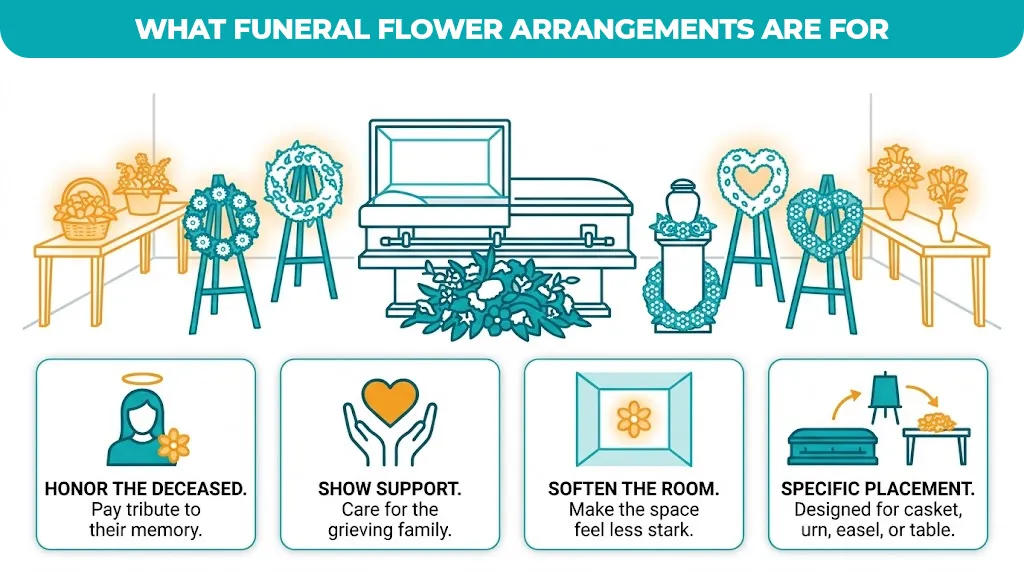
Funeral flowers do three jobs at once. They honor the person who died, they show the family that people cared enough to send something, and they soften a room that can otherwise feel stark. Arrangements are built for specific spots: on the casket, beside the urn, on an easel near the front, or on a table in the visitation room.
Match the arrangement to your relationship
The most useful etiquette rule is simple: the closer you were to the person, the more central the arrangement. The casket spray is the family’s tribute, so if you’re not immediate family, don’t order one unless the family asks you to. That still leaves plenty of meaningful options.
| Your relationship | Usual choice | Where it goes |
| Spouse, children, parents | Casket spray, urn arrangement, or casket insert | On or inside the casket, or around the urn |
| Grandchildren and siblings | Standing spray, wreath, or heart; sometimes a shared casket insert | On an easel near the casket or urn |
| Extended family and close friends | Standing spray, wreath, cross, or floor basket | Near the front of the room |
| Coworkers, neighbors, acquaintances | Basket, vase arrangement, or plant | Visitation room, or sent to the family’s home |
| A group (an office, a club, a team) | One standing spray or large basket from the group | Near the front, with a card listing the group |
What is an appropriate flower arrangement for a funeral
An appropriate arrangement is one that fits your role and the family’s wishes. Before ordering anything, check the obituary or the funeral home’s website. Many families now write “in lieu of flowers” and name a charity or memorial fund. When they do, honor that request, or send a modest arrangement to the home along with a donation.
Note: Timing matters. Flowers for the funeral home should arrive before the first visitation hours. If you learn about the death late or can’t make the timing work, send a plant or arrangement to the family’s home in the days or weeks after the service, when the house is often quieter.
Always sign the card with your first and last name, plus a few words that place you, such as “from his softball team” or “your mother’s neighbor on Elm Street.” Families often keep the cards and write thank-you notes from them, and a vague signature leaves them guessing. Our guide to funeral etiquette covers other common questions, from arrival times to what to wear to a funeral.
Types of Funeral Flower Arrangements
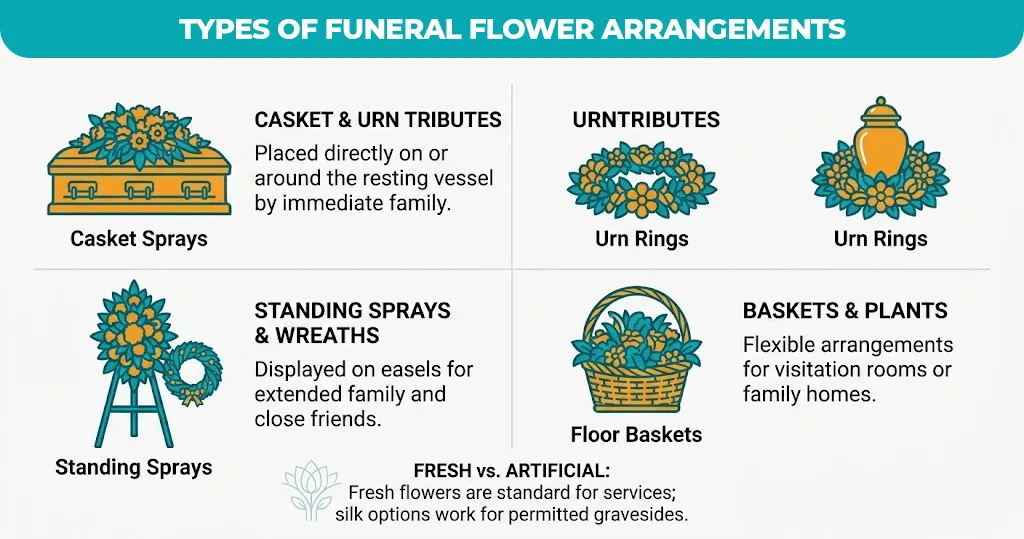
Most funeral flower arrangements fall into five groups: pieces for the casket, pieces for the urn, easel displays, baskets and table arrangements, and plants. Each has a typical sender and a typical spot, which is why florists and funeral homes ask who the order is from before they ask what you’d like.
Casket sprays and coffin tributes
A casket spray is the large arrangement that lies on top of the casket. It’s normally ordered by the spouse or children, and when there’s no spouse, siblings or grandchildren often share the cost. There are two main sizes:
• Half-couch spray: Sized for the closed lower half of an open casket, so the upper lid stays open during the viewing.
• Full-couch spray: Covers most of the length of a closed casket and needs more flowers and labor.
Families sometimes add a casket insert, a small arrangement or pillow placed inside the lid, often from grandchildren. Funeral flower arrangements for a coffin should be ordered through a florist who knows local funeral homes, because the spray has to fit the casket’s dimensions and travel to the cemetery with it.
Cremation urn arrangements
Urn arrangements frame the urn on a table, usually as a low ring or crescent so the urn stays visible. Some families add a framed photo and set the ring around both. Before ordering funeral urn flower arrangements, ask the funeral home for the urn’s base diameter so the ring fits. For a cremation funeral with no urn present, a table arrangement beside a photo serves the same purpose. If you’re still deciding between options, our overview of cremation services explains what’s typically included.
Standing sprays, wreaths, crosses and hearts
These are displayed on easels near the casket or urn and are the usual choice for extended family, close friends, and groups. A standing spray is a one-sided design that reads well from the seats. Wreaths, with their circular shape, suggest ongoing remembrance. Crosses suit Christian services, and hearts are common from grandchildren or a spouse. Confirm with the funeral home that it has easel space, since a large service can fill the front of the room.
Floor baskets, table arrangements and plants
Baskets and vase arrangements are the most flexible funeral home flower arrangements. They fit on side tables or the floor of the visitation room, and families can take them home afterward. Plants like peace lilies last for weeks, which many families appreciate. Choose an easy plant; a high-maintenance orchid can feel like one more chore.
Unique, masculine and purple arrangements
Not every tribute needs to look traditional. Masculine funeral flower arrangements often lean on deeper colors and structure: burgundy and dark red roses, rust and copper tones, deep green foliage, eucalyptus, magnolia leaves, and wood or wicker containers. Some families add a meaningful object, such as a fishing lure, a baseball cap, or a set of golf tees.
Purple flower arrangements for a funeral are another popular choice, especially for someone who loved the color. Florists can build a purple funeral arrangement from flowers like iris, stock, lisianthus, larkspur, and plum calla lilies, often softened with white or silver-green foliage. Unique funeral flower arrangements can also follow a theme: a garden-style piece for someone who loved gardening, team colors for a lifelong fan, or wildflowers for a celebration of life. Our guide to planning a celebration of life has more ideas for personal touches.
Artificial vs. fresh funeral flower arrangements
Fresh flowers are the standard for the service itself. Artificial funeral flower arrangements, usually silk, last for months and work well for graveside decoration, but cemetery rules often limit them. At VA national cemeteries, for example, fresh cut flowers are allowed year-round in cemetery-supplied containers, while artificial flowers are allowed only during periods each cemetery director sets, including at least five days before and after Memorial Day. Private cemeteries set their own rules, so call before placing anything at a grave.
| Arrangement type | Typical sender | Where it’s placed | Styles that work well |
| Full or half-couch casket spray | Spouse, children, or family together | On the casket | Roses, lilies, mixed seasonal flowers |
| Casket insert | Grandchildren or a spouse | Inside the casket lid | Small pillow or heart design |
| Urn arrangement | Immediate family | Around the urn or photo | Low ring or crescent |
| Standing spray, wreath, cross, heart | Extended family, close friends, groups | On an easel near the front | Gladioli, roses, lilies, carnations |
| Floor basket or vase arrangement | Friends, coworkers, neighbors | Visitation room | Mixed seasonal flowers |
| Plant | Coworkers, neighbors, distant friends | Visitation room or the family’s home | Peace lily, other easy-care plants |
| Artificial (silk) piece | Family | Graveside, where rules allow | Seasonal or simple designs |
Funeral Flower Meanings and Flowers to Avoid
Lilies and roses are the flowers most often linked with funerals, and white is the most common color in the room. Flower symbolism comes from tradition rather than fixed rules, so the person’s favorite flower or color is always a fine choice even if it doesn’t appear on any list.
What’s the most popular flower for funerals
Roses and lilies share that title, and sources disagree on which leads. Hollywood Forever, the Los Angeles funeral home and cemetery, describes roses as one of the most popular funeral flowers and notes that some argue lilies are more popular still. White lilies are tied closely to funerals because they’re said to symbolize dignity, peace, and grace, and the idea of innocence restored to the soul after death. Stargazer lilies, with their pink petals and strong scent, are a common variety in standing sprays and casket pieces.
Other flowers you’ll see often:
• Roses: Red roses stand for love, respect, and courage. White roses suggest peace and reverence and work for any sender.
• Carnations: Long-lasting and budget-friendly, carnations are associated with love and are a staple of standing sprays.
• Chrysanthemums: Common in American arrangements, but in parts of Europe they’re tied to death, and in China and Japan to grief. For families with those roots, ask before using them.
• Gladioli: Their tall spikes give height to standing sprays, and they’re said to represent integrity and strength.
• Orchids: Seen as a sign of lasting love and deep respect.
Color meanings
Traditional color associations can help you pick a palette, but treat them as a starting point:
• White: Peace and purity; the most common color at funerals.
• Purple: Dignity and respect; often chosen for a parent or grandparent.
• Red: Deep love; usually from a spouse or close family.
• Pink: Gentleness, grace, and sympathy; often chosen for a woman or a child.
• Yellow and bright mixes: Friendship and warmth; best for a celebration of life or when the family has asked for color.
What flowers not to get for a funeral
The biggest mistake isn’t a specific flower. It’s sending flowers when the family’s tradition doesn’t use them.
• Jewish funerals and shiva: Flowers aren’t part of Jewish funeral tradition. Dignity Memorial advises against sending flowers to the funeral home or the family’s home and suggests a shiva food basket instead, ideally kosher.
• Buddhist funerals: White or yellow flowers are acceptable, but red flowers are not.
• Hindu funerals: Flowers aren’t traditional but aren’t unwelcome.
• Muslim funerals: Practices vary by family. Some accept flowers, and placing single flowers and greenery on the grave is common.
Beyond religious customs, a few practical choices are worth avoiding:
• Red roses from someone outside the immediate family, which can read as romantic.
• Red and green combinations that look like Christmas decorations, unless the person loved the holiday.
• Heavily scented lilies in a small visitation room, where the scent and pollen can bother guests. Ask the florist to remove the pollen-bearing anthers.
• Bright, casual flowers like sunflowers at a very formal or traditional service, unless they were the person’s favorite.
• Large or fussy plants that will be hard for the family to care for or carry home.
| Flower | Traditional meaning | Common colors | When to think twice |
| Lily | Dignity, peace, innocence restored | White, pink (stargazer) | Strong scent in small rooms |
| Rose | Love, respect, courage | White, red, pink, yellow | Red roses from non-family senders |
| Carnation | Love | White, pink, red | Rarely a problem |
| Chrysanthemum | Truth (white); honor in US use | White, yellow, bronze | Families with European, Chinese, or Japanese traditions |
| Gladiolus | Integrity, strength | White, red, purple | Very small rooms, due to height |
| Orchid | Lasting love, respect | White, purple | As a plant, if the family can’t care for it |
What Funeral Flowers Cost in 2026
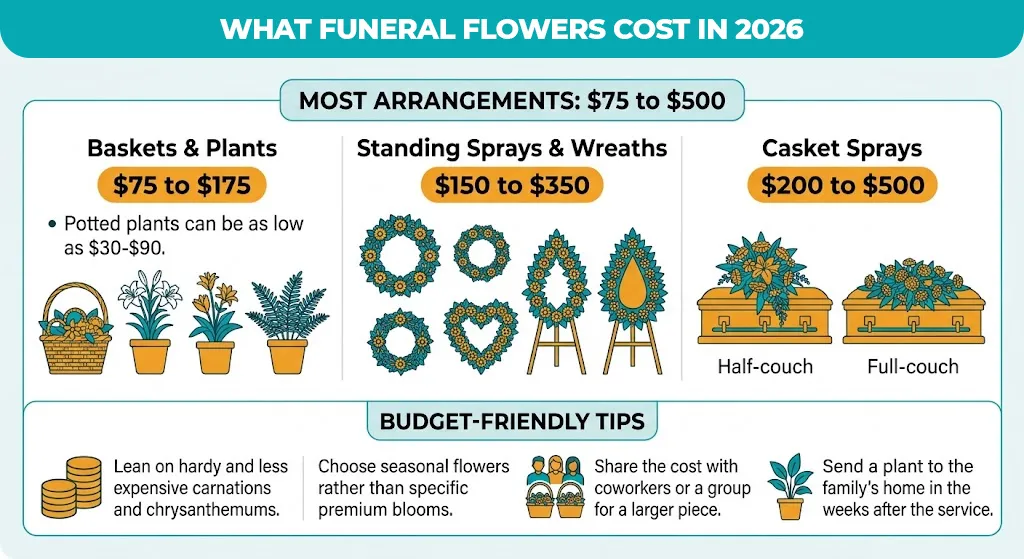
Most funeral flower arrangements cost between $75 and $500, with casket sprays at the top of the range and baskets and plants at the bottom. Prices depend on size, flower type, season, and how far the florist has to deliver. No national survey tracks funeral flower prices, so the figures below come from published florist and pricing guides and are vendor-reported.
What does the average funeral flower arrangement cost
Kremp Florist’s 2026 pricing guide gives these typical ranges:
• Baskets: $75 to $175
• Plants and small baskets: starting around $60 to $90
• Urn arrangements: $100 to $250
• Wreaths: about $100 for smaller designs, $200 to $350 for larger ones
• Standing sprays: $150 to $350, and over $400 with roses or orchids
• Crosses and hearts: $175 to $400
• Casket sprays: $200 to $500, with full-couch sprays at the higher end
• Delivery: typically $7 to $30, depending on distance to the funeral home
CostHelper figures cited by Funeral.com are close: sprays and wreaths commonly run $125 to $350, a basic vase or basket bouquet starts around $40 to $80, and potted plants run about $30 to $90 or more.
These costs add up for the family. The National Funeral Directors Association reports a 2023 median of $8,300 for a funeral with viewing and burial and $6,280 with cremation, and it notes that those medians don’t include cash-advance items such as flowers. A family casket spray, a few easel pieces, and an urn or graveside arrangement can add several hundred dollars to the bill. For a full picture, see our funeral cost breakdown.
Cheap funeral flower arrangements that still look right
If money is tight, you can still send something thoughtful:
• Choose a vase arrangement or basket instead of an easel piece.
• Ask for seasonal flowers in your color, rather than a specific design with roses or orchids.
• Lean on carnations, chrysanthemums, and greenery, which are hardy and less expensive.
• Send a modest plant to the family’s home, which often means more after the service than before it.
• Join with coworkers or relatives on one larger piece instead of several small ones.
How to make DIY funeral flower arrangements
A simple vase, basket, or urn ring is very doable at home. Casket sprays and standing easel pieces are harder because they need special frames and must travel without shifting, so most families leave those to a florist. Before you start, ask the funeral home whether it accepts arrangements dropped off by family and when it receives deliveries.
1. Buy two or three days ahead. Grocery stores, wholesale clubs, and flower markets all work. Lilies need a day or two to open.
2. Condition the flowers. Cut each stem at an angle, strip any leaves that would sit below the water, and let them drink in cool water with flower food for several hours.
3. Prepare the container. For a basket, line it with plastic and add floral foam. Let the foam sink into water on its own rather than pushing it down, which leaves dry pockets.
4. Build the shape. Start with greenery to set the outline, add three to five large focal flowers, then fill gaps with smaller flowers.
5. Finish and label. Add a ribbon if you like and attach a card with your full name.
6. Transport carefully. Set the arrangement in a box or laundry basket on the car floor, keep the car cool, and deliver during the funeral home’s receiving hours.
The figures below show a hypothetical cost comparison. Your prices will vary by store and season.
Hypothetical DIY table arrangement
Flowers (3 bunches of seasonal stems) $30 to $45
Greenery (1 bunch) $8 to $12
Floral foam, liner, and ribbon $10 to $15
Basket or vase $10 to $20
Estimated total $58 to $92
Published price for a florist basket: $75 to $175
Ordering funeral flower arrangements in Chicago, Houston and Miami
We didn’t find published data showing how funeral flower prices differ between these cities, so ask two or three local shops for quotes. The bigger differences are practical. In every city, ordering directly from a local shop near the funeral home usually works better than a national website that passes your order to a partner shop, where fees can vary by region. Funeral directors can also tell you which local florists deliver to them regularly.
• Chicago: Winter cold can damage fresh flowers in the short walk from van to door. For custom funeral flower arrangements in Chicago, give the florist two or three days and ask that pieces be delivered straight into the funeral home rather than left outside.
• Houston, TX: Heat and humidity shorten the life of fresh flowers, especially at an outdoor graveside service. For funeral flower arrangements in Houston, choose hardy flowers like carnations, chrysanthemums, and orchids, and time delivery close to the service. The metro area is spread out, so confirm the delivery zone before you order.
• Miami: Heat is a factor year-round, and the Atlantic hurricane season, June 1 to November 30, can disrupt deliveries. Funeral flower arrangements in Miami also need extra attention to tradition, since South Florida families come from many faiths and cultures. Check the obituary or ask the funeral home before sending.
| Arrangement style | Typical published price | Hypothetical DIY cost | What raises the price |
| Basket or vase arrangement | $75 to $175 | $58 to $92 | Larger size, premium flowers |
| Plant | From $60 to $90 | $25 to $50 | Larger or specialty plants |
| Urn arrangement | $100 to $250 | $60 to $120 | Size of the ring, orchids or roses |
| Wreath | $100 to $350 | Not recommended for DIY | Size, easel, flower type |
| Standing spray | $150 to $350+ | Not recommended for DIY | Roses or orchids, height |
| Casket spray | $200 to $500 | Not recommended for DIY | Full-couch size, premium flowers |
| Delivery | $7 to $30 | Your own time and fuel | Distance, same-day timing |
Planning Ahead for Funeral Costs With Premier Services Agency
Flowers are one of many decisions a family makes in the days after a death, and most of those decisions come with a bill. Planning ahead, including a final expense policy, means your family can choose the tributes they want without worrying about how to pay for them.
Why unplanned funeral costs add stress
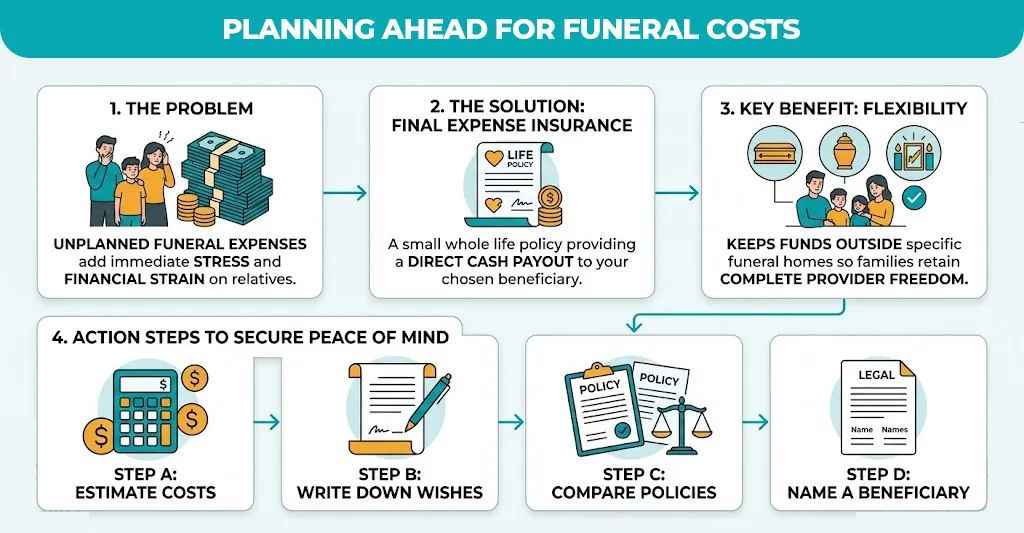
Families often arrange a funeral within days, sometimes while waiting for bank accounts or estates to be sorted out. Many funeral homes ask for payment, or an agreed way to pay, before the service, and items like flowers, obituaries, and the cemetery plot are billed separately. When nothing has been set aside, relatives end up splitting costs, using credit cards, or scaling back the service. Our guide to how much a funeral costs walks through each line of a typical bill.
How final expense insurance helps
Final expense insurance is a small whole life policy designed to cover end-of-life costs. The beneficiary receives a cash payout and can use it for anything: the funeral home’s fees, the casket or cremation, the burial plot, and the flowers and other tributes. Because the money goes to a person you choose, not to a particular funeral home, your family keeps the freedom to choose providers.
A few points to know before shopping:
• Coverage amounts: Final expense policies are usually smaller than standard life insurance, sized to funeral and burial costs plus any small debts.
• Underwriting: Some policies ask health questions, while guaranteed issue policies don’t but typically have a waiting period before the full benefit is paid.
• Price: Premiums depend on your age, health, and the amount of coverage. Our guide to burial insurance cost explains what drives the price.
Steps to set up final expense coverage
1. Estimate your costs. Decide between burial and cremation and add the extras you’d want, including flowers.
2. Write down your wishes. Note your preferred flowers, colors, music, and readings so your family doesn’t have to guess. Our funeral preplanning guide includes a checklist.
3. Compare policies. Look at coverage amounts, waiting periods, and premiums from more than one insurer.
4. Name a beneficiary and tell them. Make sure the person handling your arrangements knows the policy exists and how to file a claim.
5. Review every few years. Funeral prices rise over time, so check that your coverage still fits.
Conclusion
The right funeral flower arrangement is the one that fits your place in the person’s life and respects the family’s traditions. Family members usually take the casket spray or urn piece, close friends and relatives send easel displays, and everyone else can send a basket, a vase arrangement, or a plant. Check the obituary first, sign your card clearly, and when in doubt, a simple arrangement of white flowers or the person’s favorite bloom is always appropriate.
| Your situation | What to send |
| You’re the spouse or child | Casket spray or urn arrangement, ordered with the funeral home |
| You’re a close friend or relative | Standing spray, wreath, or floor basket |
| You’re a coworker or neighbor | Basket, vase arrangement, or plant |
| The obituary says “in lieu of flowers” | A donation to the named cause, plus a card |
| The family is Jewish | A shiva food basket instead of flowers |
| You’re on a tight budget | A small plant or a DIY vase arrangement |
| You learned about the death late | A plant or arrangement sent to the family’s home |
Talk to Premier Services Agency About Final Expense Coverage
If you’d like to spare your family the cost of a funeral, including the flowers they’d want to choose, explore final expense coverage at Premier Services Agency. A licensed agent can walk you through coverage amounts, compare policies, and answer questions about burial or cremation planning.
• Request a quote: Get a final expense quote
• Ask a question: Contact Premier Services Agency
• Call: (470) 650-0470