


A life insurance death benefit is one of the few large sums a family can receive without owing federal income tax, but interest, policy ownership, and state law can change that.
Quick answer: Life insurance proceeds paid to a beneficiary because the insured died are generally not taxable income under Internal Revenue Code §101(a). Taxes can apply to interest earned on delayed or installment payouts, to large estates when the deceased owned the policy, and to policies that were sold or are owned by a business.
Are Life Insurance Proceeds Taxable?
No, not as income in most cases. Under IRC §101(a)(1), gross income does not include amounts received under a life insurance contract, in a single sum or otherwise, if they are paid because the insured died. The IRS confirms that beneficiaries generally don’t include these proceeds in income and don’t have to report them.
Income tax and estate tax are separate questions, though. A death benefit can be income-tax-free to the beneficiary and still count toward the value of the deceased’s estate.
| Tax | Who pays | Does life insurance count? | 2026 threshold |
| Federal income tax | Beneficiary | Death benefit: no. Interest on it: yes | None; any interest is taxable |
| Federal estate tax | Deceased’s estate | Yes, if the deceased owned the policy or it paid to the estate | $15 million per person |
| State estate tax | Deceased’s estate | Usually follows federal inclusion rules | Varies; $4 million in Illinois, $7.35 million in New York |
| State inheritance tax | Beneficiary | Depends on state; Pennsylvania exempts it | Varies |
When the exclusion does not fully apply
Four situations can create tax:
• Interest earned while the insurer holds the money or pays it in installments.
• Estate inclusion when the insured owned the policy or transferred it within three years of death.
• Transfer for value when the policy was sold or transferred for something of value.
• Employer-owned policies that did not meet IRS notice-and-consent rules.
When Are Life Insurance Proceeds Taxable? (4 Major Exceptions)
Life insurance proceeds become taxable when the beneficiary earns interest on them, when they push a large estate over the estate tax threshold, when the policy was sold for value, or when an employer-owned policy missed IRS requirements. Each exception affects a different person: the beneficiary, the estate, the buyer, or the business.
Exception 1: Interest on delayed or installment payouts (Form 1099-INT)
The death benefit itself stays tax-free, but interest does not. IRC §101(c) taxes interest paid on proceeds the insurer holds for you, and many insurers also add interest for the days between death and payment. The insurer typically reports it on Form 1099-INT.
Installment options work differently under §101(d): the death benefit is spread evenly over the payment period and excluded, and anything above that share is taxable.
Note: Example: a $500,000 death benefit is paid as $54,000 a year for 10 years. Each year, 50,000(500,000 ÷ 10) is a tax-free return of principal and $4,000 is taxable interest.
Exception 2: Estate taxes and policy ownership
Proceeds count in the deceased’s gross estate if they are payable to the estate, or if the deceased held any incident of ownership at death, such as the right to change the beneficiary, borrow against the policy, or surrender it (IRC §2042). Giving the policy away does not help if death occurs within three years of the transfer; IRC §2035 pulls it back into the estate.
For 2026, the federal basic exclusion amount is $15 million per person, made permanent and inflation-indexed by the One Big Beautiful Bill Act, according to Morgan Lewis. Most families will never owe federal estate tax, but a large policy can matter in states with much lower thresholds.
Exception 3: The transfer-for-value rule
If a policy is sold or transferred for valuable consideration, the new owner’s tax-free amount is limited to what they paid plus later premiums, under IRC §101(a)(2). The rest of the death benefit is taxable income. Exceptions include transfers to the insured, to the insured’s business partner or partnership, to a corporation where the insured is a shareholder or officer, and gifts where the new owner takes over the old owner’s tax basis.
Exception 4: Corporate and company-owned life insurance (COLI)
For employer-owned policies issued after August 17, 2006, IRC §101(j) limits the business’s tax-free amount to premiums paid unless notice-and-consent rules were met before the policy was issued. Even then, an exception must apply, such as the insured being an employee within 12 months before death, a director or highly compensated employee, or proceeds going to the insured’s family or used to buy their ownership interest.
• Employee was told in writing the employer intends to insure them and the maximum face amount
• Employee consented in writing, including to coverage continuing after employment ends
• Employee was told the employer will be a beneficiary
• The business files Form 8925 each year it holds employer-owned policies
Are Life Insurance Proceeds Taxable to the Estate or to a Trust?
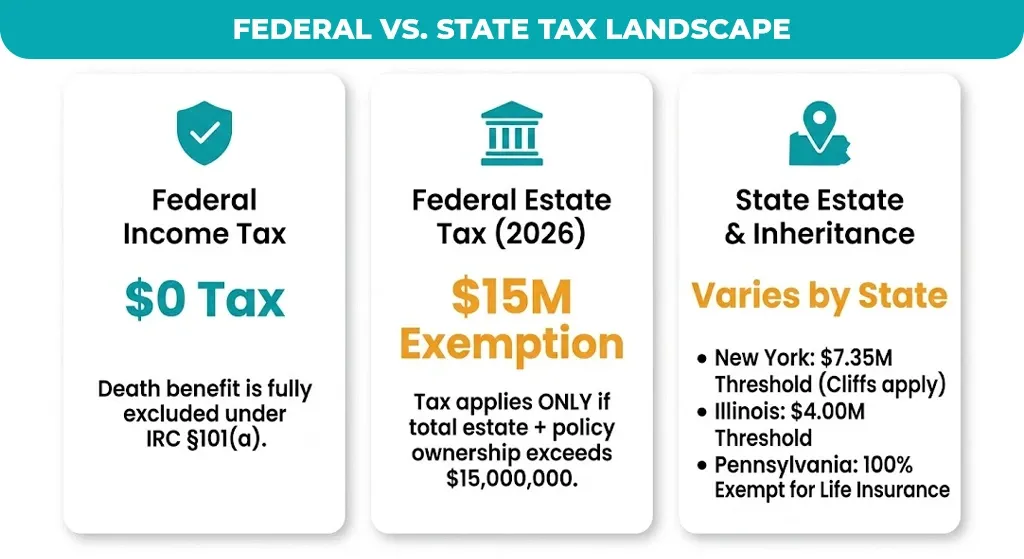
Proceeds paid to the estate are still free of income tax, but they become part of the gross estate, go through probate, and can be reached by creditors. Proceeds paid to a properly structured irrevocable life insurance trust (ILIT) are also income-tax-free and can stay outside the taxable estate entirely.
When proceeds are payable to the estate
This happens when the estate is named as beneficiary, or when every named beneficiary has died and there is no contingent. The money then waits for probate, is distributed under the will or state intestacy law, and counts toward federal and state estate tax thresholds. Naming a primary and a contingent beneficiary avoids most of these problems.
How an irrevocable life insurance trust (ILIT) works
An ILIT is a trust that owns the policy and is its beneficiary. Because the insured holds no incidents of ownership, the death benefit is not part of the insured’s estate, and the trustee distributes the money under the trust’s terms, which is useful for minor children or blended families.
1. An attorney drafts the irrevocable trust and a trustee is named.
2. The trust applies for and owns a new policy (avoiding the three-year rule that applies to transferring an existing one).
3. The insured gifts money to the trust each year to pay premiums; beneficiaries receive notice so gifts can qualify for the $19,000-per-recipient 2026 annual gift exclusion.
4. At death, the trust collects the proceeds income-tax-free and distributes or holds them as directed.
| Beneficiary designation | Income tax on death benefit | In the taxable estate? | Probate? | Creditor exposure |
| Named individual | No | Yes, if insured owned the policy | No | Low |
| The estate | No | Yes | Yes | High |
| ILIT (trust owns policy) | No | Generally no | No | Low |
Note: Investment earnings after the trust receives the money are taxable to the trust or to beneficiaries who receive distributions. Trusts reach the top federal income tax bracket at a far lower income level than individuals, so trustees often distribute income or invest for tax efficiency.
State-Specific Tax Rules (PA, FL, NC, CA, IL, NY)
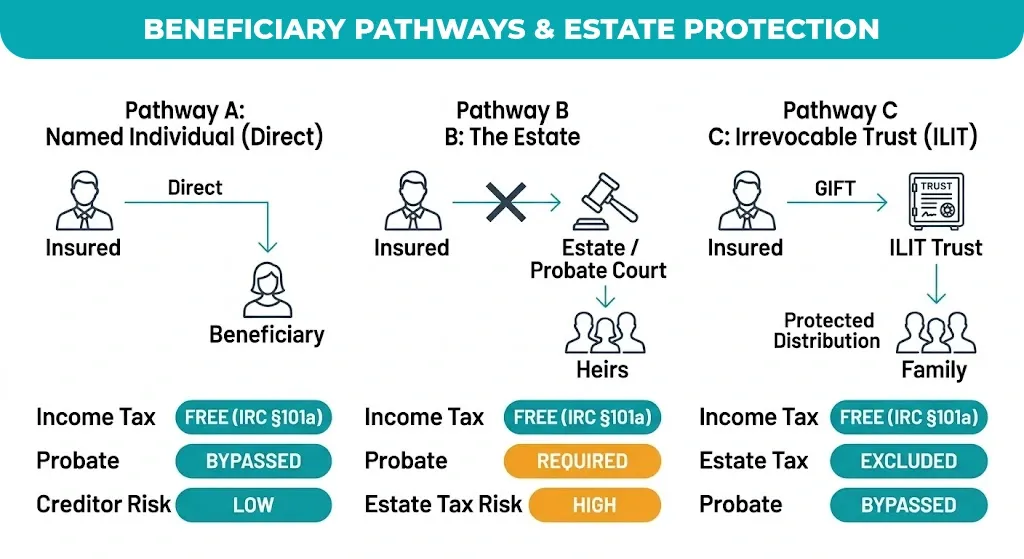
No state in this group taxes a life insurance death benefit as the beneficiary’s income. The difference is at the estate level: Illinois and New York have estate taxes with thresholds far below the federal $15 million, while Pennsylvania’s inheritance tax specifically exempts life insurance.
Are life insurance proceeds taxable in PA?
No. Pennsylvania has an inheritance tax on most assets passing at death, but life insurance on the decedent’s life is exempt. Allegheny County’s guidance states that proceeds payable to a named beneficiary or to the decedent’s estate are both exempt from Pennsylvania inheritance tax. The Department of Revenue has ruled that annuity-like products without true insurance risk do not qualify, so the exemption covers genuine life insurance only.
Florida and North Carolina
Florida has no state estate tax, inheritance tax, or personal income tax, so life insurance proceeds face only federal rules. North Carolina repealed its estate tax for deaths on or after January 1, 2013, per the North Carolina General Statutes, and has no inheritance tax.
California, Illinois, and New York
• California: no state estate or inheritance tax, according to Define Financial. Interest earned on proceeds is still taxable income.
• Illinois: an estate tax applies once the estate exceeds $4 million, and the entire estate is then taxed, per Mercer Advisors. A policy the decedent owned counts toward that total.
• New York: the 2026 basic exclusion amount is 7,350,000,andanestateabove 105%of it(7,717,500) loses the exclusion entirely, per Proskauer.
| State | Income tax on death benefit | State estate tax (2026) | State inheritance tax |
| Pennsylvania | No | None | Yes, but life insurance is exempt |
| Florida | No (no personal income tax) | None | None |
| North Carolina | No | None (repealed 2013) | None |
| California | No | None | None |
| Illinois | No | Yes, over $4 million | None |
| New York | No | Yes, $7.35 million with a cliff at 105% | None |
Note: Interest on delayed or installment payouts can be taxable at the state level wherever the state has an income tax, even when the death benefit is not.
Group Life Insurance Over $50,000: Clarifying IRS Section 79
The $50,000 rule taxes the employee while alive, not the beneficiary after death. Under IRC §79, the cost of employer-paid group-term coverage above $50,000 is added to the employee’s wages as imputed income. The death benefit itself, whatever its size, is still generally income-tax-free to the beneficiary under §101(a).
How imputed income is calculated
IRS Publication 525 sets the cost using its Table 1 monthly rate per $1,000 of coverage by age, minus anything the employee paid toward the coverage. The amount appears in Form W-2, box 12, code C, and is subject to Social Security and Medicare taxes as well as income tax.
\text{Imputed income} = \frac{\text{Coverage} – \$50{,}000}{1{,}000} \times \text{Table 1 rate} \times \text{Months} – \text{Employee contributions}
Note: Example: a 52-year-old has $150,000 of employer-paid coverage. The excess is $100,000, or 100 units. At the $0.23 Table 1 rate for ages 50 to 54, imputed income is 100 × $0.23 × 12 = $276 for the year. In a 22% bracket, that is about $61 of federal income tax, plus payroll taxes.
| Situation | Who is taxed | What is taxed |
| Employer pays for $50,000 or less of group-term coverage | No one | Nothing |
| Employer pays for more than $50,000 | Employee, while alive | Table 1 cost of the excess coverage |
| Employee dies; beneficiary is paid | Generally no one | Death benefit excluded under §101(a); interest is taxable |
Conclusion: Keep Your Family’s Payout Tax-Free
For most families, a life insurance death benefit arrives free of federal and state income tax. The taxes that do apply come from choices made long before the claim: who owns the policy, who is named as beneficiary, how the payout is taken, and whether a business or buyer is involved.
| Your situation | Likely best move |
| You’re a beneficiary choosing a payout | A lump sum avoids ongoing taxable interest; installments add it |
| No contingent beneficiary is named | Add one so proceeds avoid probate and the estate |
| Estate may exceed state or federal thresholds | Ask an estate attorney about an ILIT for new coverage |
| Policy was sold or bought for value | Review transfer-for-value exceptions with a CPA before the claim |
| Employer pays for coverage over $50,000 | Expect a small imputed income amount on your W-2 |
Structure Your Life Insurance With Premier Services Agency
The right coverage and clean beneficiary designations do more to protect your family than any tax strategy after the fact. Premier Services Agency has helped seniors and families for more than 20 years find life, burial, cremation, and funeral insurance that fits their budget and health, with plain-language guidance at every step.
• Compare term, whole, universal, and final expense life insurance options.
• Get help choosing coverage amounts and naming primary and contingent beneficiaries.
• Ongoing support for policy questions and claims after your coverage starts.
• Request a free quote online or by phone.