


| Quick Answer Return of premium life insurance is a type of term life insurance that refunds the premiums you paid if you outlive the policy term. It usually costs three to five times more than standard term coverage, according to NerdWallet, and if you die during the term, your beneficiaries receive the death benefit instead of a refund. If you cancel the policy early or let it lapse, most insurers pay back little or nothing. |
Key Takeaways
- Return of premium life insurance is term life insurance with a built-in or optional refund: if you outlive the policy, you get back the premiums you paid.
- It costs significantly more than standard term coverage about three to five times as much, according to NerdWallet so the refund is not “free.”
- If you die during the term, your beneficiaries receive the full death benefit, just as with a standard term policy; no premiums are refunded in that case.
- The refunded premium is generally not taxable because it is treated as a return of the money you already paid, not as investment income.
- Canceling the policy early, or letting it lapse, typically forfeits some or all of the refund, so ROP suits buyers who are confident they can keep paying for the full term.
What Is Return of Premium Life Insurance?
Return of premium (ROP) life insurance is a type of term life insurance that refunds the premiums you paid if you outlive the coverage term. The National Association of Insurance Commissioners (NAIC) defines it as a feature that “refunds part or all of the premiums paid if the policyholder outlives the term and no death benefit is paid,” and notes that these policies tend to cost more due to the potential for a refund.
ROP coverage is sold two ways. Some insurers offer it as a standalone term policy built around the refund feature. Others sell it as an optional rider that can be added to an existing term or universal life policy for an additional cost. Guardian Life, for example, attaches its ROP rider to a universal life policy rather than a term product, which changes how and when the refund becomes available.
Not every insurer offers this coverage. Aflac, for instance, states directly that it does not sell return of premium life insurance and instead points customers toward its term and whole life products, which is a useful reminder that ROP availability and structure vary by carrier.
How Does Return of Premium Life Insurance Work?
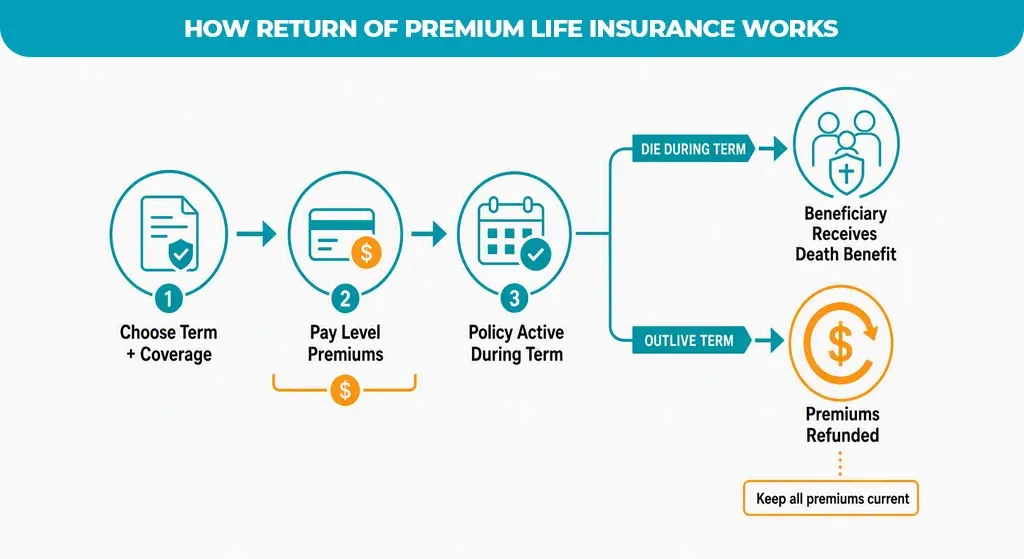
The buying process for an ROP policy mirrors a standard term life purchase. Northwestern Mutual describes it as the same underwriting process used for any term policy, including a medical exam or health questionnaire in most cases. From there, the policy runs on a simple set of rules:
- Choose a term length. Most ROP policies run 10, 15, 20, 25, or 30 years, similar to conventional term life insurance.
- Choose a coverage amount. This is the death benefit your beneficiaries would receive if you die during the term.
- Pay level premiums. Your premium stays the same for the length of the term, but it is set higher than a comparable non-ROP term policy to fund the eventual refund.
- If you die during the term, your beneficiaries receive the full death benefit, and no premium refund applies; the policy functions exactly like standard term insurance in this scenario.
- If you outlive the term and have kept every premium payment current, the insurer returns the premiums you paid, typically as a single lump sum at the end of the term.
Timing matters. Protective Life notes that some insurers pay only a partial refund, and others pay nothing, if a policyholder cancels before the term ends. Choice Mutual similarly explains that a policy that lapses due to non-payment, or is canceled early, usually forfeits the refund, and any partial refund that is offered is often “short-rated,” meaning it is calculated at less than the full pro-rated value.
Return of Premium vs. Standard Term Life Insurance
The core trade-off with ROP coverage is straightforward: you pay more up front in exchange for a guaranteed refund if you outlive the term. The table below summarizes the main differences.
| Feature | Return of Premium (ROP) Term | Standard Term Life Insurance |
| Monthly premium | Higher, roughly 3x to 5x a standard term policy (NerdWallet) | Lower, based on age, health, term, and coverage amount |
| Payout if you outlive the term | Premiums paid are refunded, usually tax-free | No payout; coverage simply ends |
| Payout if you die during the term | Full death benefit to beneficiaries | Full death benefit to beneficiaries |
| Payout if you cancel early | Often none, or a reduced, short-rated amount (Choice Mutual) | No refund; coverage ends |
| Best suited for | Budget-stable buyers who value a guaranteed refund | Buyers who want maximum coverage for the lowest premium |
How Much Does Return of Premium Life Insurance Cost?
Return of premium coverage costs meaningfully more than standard term life insurance for the same death benefit and term length. NerdWallet’s analysis states that buyers “can expect to pay three to five times as much for a return-of-premium policy compared with a standard term life insurance policy without ROP benefits.” Some insurers also deduct administrative fees from the eventual refund, so the amount returned may be slightly less than the total premiums paid.
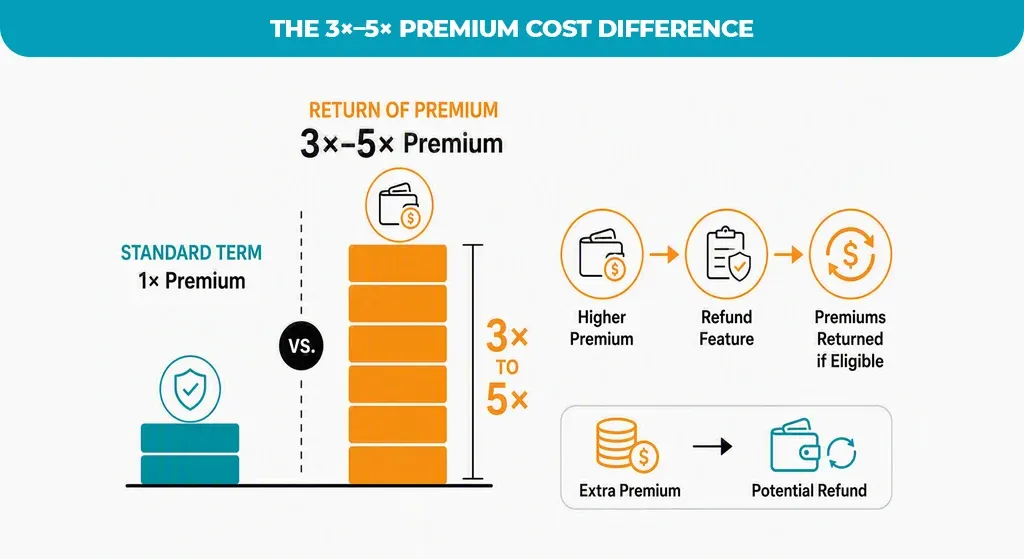
Because the refund is simply your own money coming back to you, minus whatever the insurer keeps in fees, ROP is often compared to a forced-savings arrangement rather than an investment. A publicly documented comparison of ROP policies found implied annual returns on the extra premium paid- the true “cost” of the refund feature- of roughly 2.5% to 9%, depending on the specific policy and how it was structured.
Is the Return of Premium Payout Taxable?
In most cases, no. Multiple carriers confirm that the refunded premium is treated as a return of your own after-tax dollars rather than income, so it is not subject to federal income tax. Farm Bureau Financial Services states plainly that “the lump sum received when premiums are returned is tax-free and can be used however you choose.” NerdWallet reaches the same conclusion, noting that “the money you get back isn’t taxable, as it’s simply a refund of the payments you made.”
This treatment is consistent with how the IRS generally handles life insurance cash values: withdrawals up to your cost basis, meaning the total premiums you paid, are not taxed, while amounts above that basis can be taxable. If your specific policy pays interest on top of the refunded premiums, that interest portion could be taxable, so it is worth confirming the details with a tax professional before you rely on this for planning.
Pros and Cons of Return of Premium Life Insurance
Potential Advantages
- Guaranteed refund if you outlive the term, which functions like a built-in savings component on top of term coverage.
- Full death benefit protection during the term, identical to standard term life insurance if you die while the policy is active.
- Level premiums for the length of the term, so costs are predictable and do not increase year to year.
- The refund is generally tax-free, since it is treated as a return of premiums already paid rather than investment income.
Potential Drawbacks
- Premiums run roughly three to five times higher than a comparable standard term policy, according to NerdWallet’s analysis.
- Canceling early or missing payments can forfeit some or all of the refund, depending on the insurer’s terms.
- The implied return on the extra premium is modest, in the range of about 2.5% to 9% in published policy comparisons, which may lag other uses of that money over the same period.
- NerdWallet’s guidance concludes that “for most people, return-of-premium life insurance isn’t worth the extra cost” compared with buying standard term coverage and directing the premium difference elsewhere.
Who Is Return of Premium Life Insurance Best For?
ROP coverage tends to fit a specific type of buyer rather than the general life insurance market. It can make sense if you meet several of the following conditions:
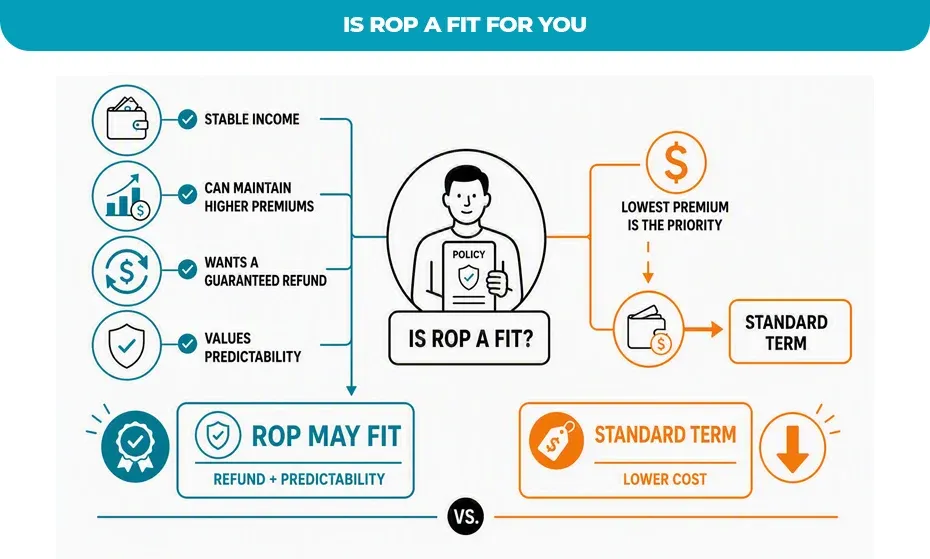
- You have stable, predictable income and are confident you can maintain the higher premium for the full term without lapsing the policy.
- You dislike the idea of paying for term coverage you may never use and want a mechanism that returns those payments if you outlive the term.
- You have already maximized other tax-advantaged savings vehicles and are looking for an additional, low-risk way to set money aside.
- You value the psychological benefit of a guaranteed refund enough to accept a lower rate of return than you might get by investing the premium difference in the market.
If your main goal is simply the largest possible death benefit for the lowest monthly cost, a standard term life insurance policy generally accomplishes that more efficiently, since none of the premium is being set aside to fund a future refund.
Return of Premium Rider vs. a Standalone ROP Policy
Insurers structure this benefit in two different ways, and the distinction affects flexibility and cost.
- Standalone ROP term policy: The refund feature is built into the base policy. You select a term and coverage amount, and the higher premium already reflects the return-of-premium benefit.
- Return of premium rider: The refund feature is added on top of another policy, such as a term or universal life contract, for an extra cost. Guardian Life’s version, for example, is attached to a universal life policy and lets you surrender the policy for up to 100% of premiums paid once you reach a defined refund milestone, giving you flexibility to exit early at certain points rather than only at the end of a fixed term.
Riders can offer more flexibility about when you access the refund, but they typically add their own separate charge on top of the base policy’s premium, so comparing the total cost against a standalone ROP policy is worthwhile before choosing between them.
The Bottom Line
Return of premium life insurance gives you a way to recover your premiums if you outlive your term, with the trade-off of a meaningfully higher monthly cost and conditions that must be met to receive the full refund. Whether it is worth it depends on how much you value a guaranteed, tax-free return of your own money versus buying lower-cost standard term coverage and directing the difference toward your own savings or investments.
Before you buy, request illustrations for both a return of premium policy and a standard term policy with the same coverage amount and term length. Compare the total premiums you would pay under each option, review the insurer’s rules for early cancellation, and confirm the company’s financial strength rating with an independent source.
Ready to Find the Right Policy? Let Premier Services Agency Help
At Premier Services Agency, our licensed insurance experts specialize in comparing top-rated carriers, breaking down exact quotes, and finding the policy that provides maximum security for your family without stretching your budget.