

Simplified Issue Life Insurance Costs: 2026 Price Guide

Simplified issue life insurance is a policy you can qualify for by answering health questions instead of taking a medical exam. The insurer replaces the paramedical exam with electronic data checks, which is why approval often takes days rather than weeks. You still have to answer health questions honestly, and you can still be declined.

Quick Answer
Simplified issue life insurance is a form of no-medical-exam coverage in which eligibility is decided by a short health questionnaire plus third-party data, rather than blood work, urine samples, and full medical records. It is available as term life, whole life, universal life, and final expense coverage. Approval commonly takes anywhere from a few minutes to about ten days, compared with roughly four to six weeks for a fully underwritten policy. In exchange for that speed, premiums are generally higher, and coverage limits are lower than fully underwritten alternatives.

Key Takeaways

  • No exam, but health questions are mandatory. Answering “yes” to certain questions can lead to a decline, a higher rate class, or a modified benefit.
  • Underwriting still happens. Insurers verify your answers against prescription histories, the MIB database, identity and public-records files, and motor vehicle records.
  • Every major policy type is available. Simplified underwriting is used for term, whole life, universal life, and burial or final expense policies.
  • You pay for the convenience. Rates are generally higher than comparable fully underwritten coverage, and face amounts are usually capped well below what full underwriting allows.
  • It is not the same as guaranteed issue. Guaranteed issue asks no health questions at all, always carries a two-year waiting period for natural death, and is typically limited to small face amounts.

What Is Simplified Issue Life Insurance?

Simplified issue life insurance is a policy issued on the basis of a short health questionnaire and electronic records instead of a paramedical exam. “Simplified issue” describes the underwriting method, not the policy structure, which is why the same term appears on term, whole life, universal life, and final expense products.

Traditional life insurance uses full underwriting. An applicant meets a paramedical examiner who records height and weight and collects blood and urine samples, and the insurer requests medical records from the applicant’s physicians. Choice Mutual, a national final expense agency, notes that fully underwritten applications generally take four to six weeks to approve and that the insurer may request files covering roughly the previous ten years of care.

Simplified issue removes the exam and the records request. As Progressive explains in its consumer guide, applicants complete a questionnaire covering health history plus personal details such as name, age, height, weight, and location, and approval can follow much faster than the standard process.

What “simplified issue” means in underwriting terms

In insurance language, underwriting is the process of classifying an applicant’s mortality risk and assigning a rate class. Simplified issue sits in the middle of a spectrum of underwriting methods:

  • Full underwriting: health questions, paramedical exam, lab work, and attending physician statements.
  • Accelerated or algorithmic underwriting: a full application reviewed by predictive models, with exams waived for applicants who look low-risk.
  • Simplified issue: a short set of knockout health questions plus third-party data, with no exam for anyone.
  • Guaranteed issue: no health questions and no medical underwriting at all, offset by a waiting period and low face amounts.

These no-exam methods are actively supervised. The National Association of Insurance Commissioners (NAIC) adopted its Model Bulletin on the Use of Artificial Intelligence Systems by Insurers on December 4, 2023, and its Accelerated Underwriting (A) Working Group later adopted regulatory guidance directing state examiners to review how life insurers use external data and predictive models.

How insurers assess you without an exam

Skipping the exam does not mean the insurer knows nothing about you. When you sign the application, you authorize the release of protected health information, and the company pulls data from specialist vendors. Choice Mutual identifies the main sources used in simplified underwriting:

  • Milliman IntelliScript, which returns your prescription drug fill history.
  • MIB, an insurance industry information exchange that flags conditions disclosed on prior applications.
  • LexisNexis, used for identity verification and public-records and background data.
  • Your state motor vehicle department, for driving history such as DUIs and major violations.

This is the practical reason honesty matters. If the questionnaire and the data disagree, the application is typically declined, and a misstatement discovered later can give the insurer grounds to contest a claim during the contestability window.

How Simplified Issue Life Insurance Works, Step by Step

The application path is short and mostly digital. Insurers differ in the details, but the sequence is consistent.
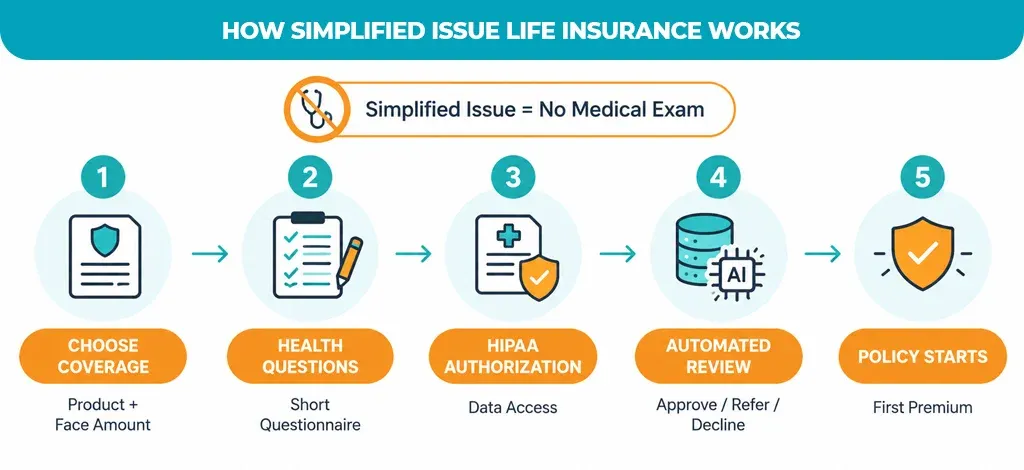
How Simplified Issue Life Insurance Works

  1. Choose the product and face amount. Decide between simplified issue term life insurance, simplified issue whole life insurance, universal life, or a final expense policy, and the death benefit you want.
  2. Complete the health questionnaire. Expect questions on major diagnoses, hospitalizations, current medications, tobacco or nicotine use, and high-risk activities or occupations.
  3. Sign the HIPAA authorization. This permits the insurer to retrieve prescription, MIB, identity, and driving data. Declining it ends the application.
  4. Automated review runs. The system compares your answers against the data pulled and either approves, refers, or declines.
  5. A phone interview may follow. Choice Mutual notes that applications are often held for a telephone interview when the health history contains ambiguous information that blocks an instant decision.
  6. Pay the first premium and the policy takes effect. Progressive notes that with some insurers, coverage can begin minutes after the application is completed and the first payment is made.

Ready to Find Your No-Exam Coverage?

Skip the medical exam and lock in fast, reliable protection tailored to your health profile. Compare personalized rates from top carriers and secure the right policy for your peace of mind.

Types of Simplified Issue Life Insurance Policies

Simplified underwriting is applied across the main policy families, so the label tells you how you qualify, while the policy type tells you what you get.

Simplified issue term life insurance

Simplified issue term life covers a fixed period, commonly 10, 20, or 30 years, and pays a level death benefit if you die while the policy is in force. There is no cash value. This is the version most often marketed as simple term life insurance or instant life insurance, and Progressive describes instant coverage as a specific type of simplified issue policy. According to Choice Mutual, approved simplified issue term and universal life policies do not carry a waiting period.

Simplified issue whole life insurance

Simplified issue whole life is permanent coverage with level premiums and a cash value account that builds over time. Because the coverage lasts for life and the insurer carries risk indefinitely, premiums are substantially higher than term at the same face amount. Choice Mutual notes that some simplified issue whole life policies can be issued on a modified benefit basis, which means a two-year waiting period applies, depending on how you answer specific health questions.

Simplified issue universal life insurance

Universal life offers permanent coverage with flexible premiums and an interest-crediting cash value component. Simplified underwriting is widely available on these products, and rates fall between term and whole life at the same face amount in the sample data published by Choice Mutual.

Simplified issue final expense insurance

Final expense insurance, also called burial insurance, is small-face-amount whole life designed to cover end-of-life costs. Most of it is underwritten on a simplified issue basis. The National Funeral Directors Association reports a national median cost of $8,300 for a funeral with viewing and burial, rising to $9,995 when a vault is included, and $6,280 for a funeral with viewing and cremation. Those medians are the reason final expense face amounts typically cluster between $5,000 and $25,000.

How Much Does Simplified Issue Life Insurance Cost?

Simplified issue policies generally cost more than comparable fully underwritten coverage. Progressive and Aflac both attribute the difference to risk: without an exam, the insurer has less information, so it prices in a margin for the uncertainty.

Actual premiums depend on the policy type, your age, sex, health history, face amount, and tobacco use. The sample monthly rates below are published by Choice Mutual and were valid as of April 2, 2026, at a preferred non-tobacco rating.

Age20-year term, $100,000Whole life, $50,000Final expense, $10,000
30$8 F / $9 M$35 F / $41 M$16 F / $17 M
40$9 F / $10 M$51 F / $59 M$21 F / $23 M
50$17 F / $21 M$79 F / $92 M$24 F / $31 M
60$37 F / $52 M$118 F / $136 M$33 F / $43 M
70Not shown in source$188 F / $218 M$53 F / $70 M
80Not shown in source$322 F / $374 M$98 F / $134 M

Why the price gap exists

  • Anti-selection risk. People who expect to be rated or declined are more likely to seek no-exam coverage, so the pool skews higher-risk.
  • Fewer rate classes. Full underwriting can reward excellent lab results with preferred-plus pricing; simplified products usually offer a narrower set of classes.
  • Lower face amounts. Fixed policy costs are spread across a smaller death benefit, which raises the cost per thousand dollars of coverage.

Simplified Issue vs. Guaranteed Issue vs. Fully Underwritten Life Insurance
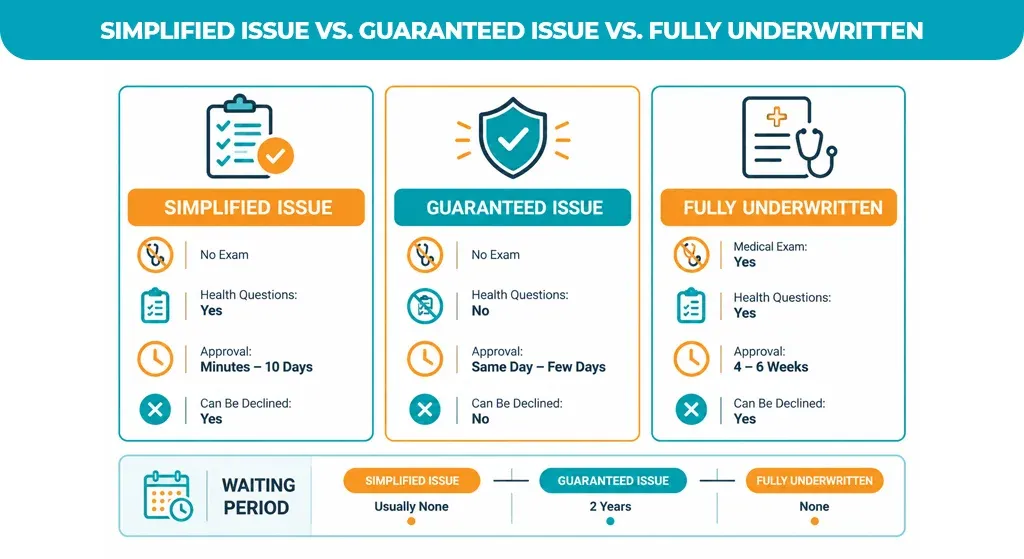
Simplified Issue vs. Guaranteed Issue vs. Fully Underwritten

The clearest way to understand simplified issue is to place it beside the two options on either side of it.

FeatureSimplified issueGuaranteed issueFully underwritten
Medical examNoNoYes
Health questionsYesNoYes
Medical records requestedNoNoYes
Can you be declined?YesNoYes
Typical approval timeMinutes to about 10 daysSame day to a few daysAbout 4 to 6 weeks
Waiting periodUsually none; some whole life versions are modified benefitsAlways two years for natural deathNone
Relative costHigher than fully underwrittenHighest per dollar of coverageLowest
Typical coverage capVaries widely by insurer, often up to about $500,000Commonly about $25,000Highest available

What is the difference between guaranteed issue and simplified issue life insurance?

Guaranteed issue, also called guaranteed acceptance, approves every eligible applicant within the age band and asks no health questions. The trade-off is a mandatory two-year waiting period: Choice Mutual notes that if the insured dies of natural causes during those 24 months, the insurer refunds premiums rather than paying the death benefit. Simplified issue does ask health questions, and because of that screening, it can offer higher face amounts, lower premiums, and, in most cases, immediate full coverage once approved.

In short: guaranteed issue trades price and access for certainty of approval. Simplified issue trades a short questionnaire for better pricing and larger death benefits. If you can pass the health questions, simplified issue is usually the stronger value.

Simplified Issue Life Insurance Pros and Cons

Advantages

Drawbacks

No exam, no needles, no lab work

Generally costs more than fully underwritten coverage

Approval in minutes to about ten days

Face amounts are capped well below full underwriting

No medical records request or physician statements

Applicants with high-risk conditions may still be declined

Can usually be purchased online or by phone

Fewer preferred rate classes, so good health is rewarded less

Available as term, whole, universal, and final expense

Some whole life versions carry a modified-benefit waiting period

Who Should Consider Simplified Issue Life Insurance?

Simplified issue fits a specific set of circumstances rather than being a default choice.
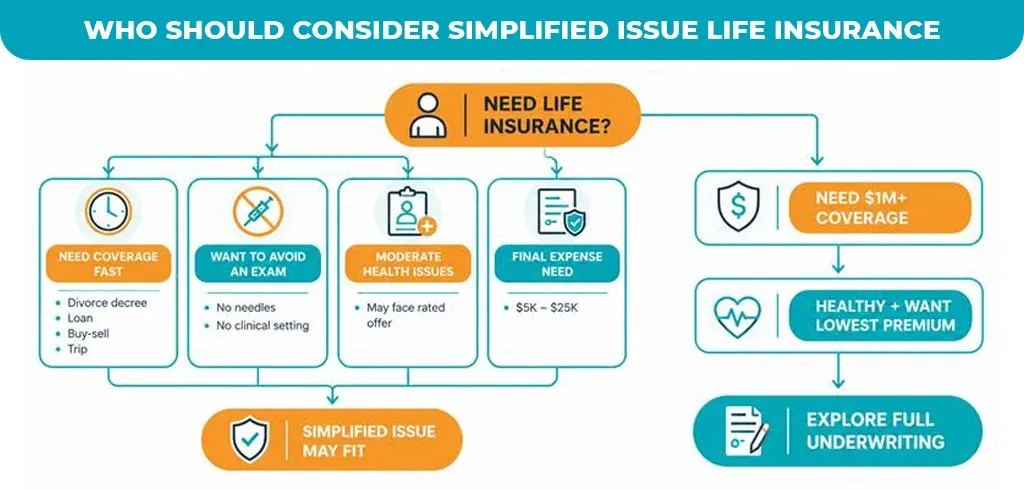
Who Should Consider Simplified Issue Life Insurance

Good candidates

  • Buyers who need coverage on a deadline, such as a divorce decree, an SBA loan requirement, a buy-sell agreement, or an imminent trip.
  • People with a genuine aversion to needles, exams, or clinical settings.
  • Applicants with moderate health issues who expect a rated offer under full underwriting.
  • Older buyers seeking final expense coverage in the $5,000 to $25,000 range.
  • Anyone filling a temporary gap between policies or supplementing existing group coverage.

Who should probably look elsewhere?

  • Healthy applicants who can pass an exam and want the lowest possible premium.
  • Families who need $1 million or more of income replacement, which usually exceeds simplified issue caps.
  • Applicants with severe conditions such as congestive heart failure or COPD, which Choice Mutual notes will likely lead to a decline on simplified products. Guaranteed issue is the more realistic route in those cases.


How to Buy Simplified Issue Life Insurance

  • Calculate the death benefit you actually need. Add outstanding debt, mortgage balance, income replacement, and final expenses, then subtract existing coverage and liquid savings.
  • Decide term or permanent. Temporary obligations point to simplified issue term. Lifelong needs and funeral costs point to whole life or final expense.
  • Compare quotes from several carriers. Because knockout questions differ, pricing and approval odds differ too.
  • Check the insurer’s financial strength. AM Best publishes Financial Strength Ratings that measure an insurer’s ability to meet its policy obligations. You can verify any carrier’s current rating free at ambest.com.
  • Check the complaint record. The NAIC Consumer Information Source at naic.org lets you look up a company’s licensing status and complaint index.
  • Answer every question accurately. Progressive warns that misstating information to obtain coverage or reduce a premium is life insurance fraud.
  • Name and update your beneficiaries. Name a primary and a contingent beneficiary, and revisit the designations after a marriage, divorce, or birth.

Compare Your Options Before You Apply

Simplified issue life insurance rewards preparation. Because each insurer writes its own health questions and sets its own limits, the same applicant can be approved at a competitive rate by one carrier and declined by another. Comparing several quotes before you submit an application is the single most effective way to protect both your premium and your approval odds.

Securing simplified issue life insurance eliminates the hassle of medical exams while offering faster approvals and larger death benefits than guaranteed acceptance alternatives. By carefully matching your health history to carrier guidelines, you can effortlessly turn policy uncertainty into absolute peace of mind.

Compare top-rated carriers today, secure your ideal policy without a physical exam, and guarantee a stable, protected financial legacy for your family.

Ready to Find Your No-Exam Coverage?

Simplified issue life insurance removes the friction of medical exams, giving you faster approvals and reliable protection without the wait. Don’t leave your family’s future to chance. Connect with the licensed specialists at Premier Services Agency today to compare personalized rates

Frequently Asked Questions

It means the insurer decides your eligibility using a short health questionnaire and third-party data instead of a paramedical exam and medical records. The term describes the underwriting method, so it can be attached to term, whole life, universal life, or final expense policies.

The main advantages are speed, no exam, and the ability to apply online or by phone. The main drawbacks are higher premiums than fully underwritten coverage, lower maximum face amounts, and the possibility of being declined if your health answers or prescription history disqualify you.

Guaranteed issue asks no health questions and cannot decline you, but it always carries a two-year waiting period for natural death and is typically limited to around $25,000. Simplified issue asks health questions, can decline you, and in return offers lower premiums, higher limits, and, once approved, coverage that is usually effective immediately.

It is permanent life insurance with level premiums and cash value, underwritten through health questions rather than an exam. It stays in force for life as long as premiums are paid. Some versions are issued as modified benefit policies with a two-year waiting period, depending on how specific health questions are answered.

Limits vary by insurer and product. Choice Mutual reports that simplified issue coverage is generally available up to about $500,000 and, depending on the carrier, up to age 85. Final expense policies are usually offered in much smaller amounts, commonly $5,000 to $25,000.