


What Is Group Term Life Insurance?
Group term life insurance is a life insurance contract that covers a defined group of people, most often the employees of one company, under a single master policy rather than through individually underwritten contracts. The employer or association is the policyholder, and each covered person receives a certificate of insurance that summarizes their coverage amount and beneficiary designation.
Because the policy is written as “term” insurance, it provides pure death-benefit protection with no cash value and no investment component. This distinguishes it from whole life or universal life insurance, which build cash value over time.
Group term life insurance is offered in two main forms. Employer-sponsored group life insurance is by far the most common and is tied to active employment. Association or membership-group life insurance, offered through organizations such as unions, alumni groups, or membership clubs, is less common and often functions more like a discounted individual policy than a true employer group plan.
How Does Group Term Life Insurance Work?
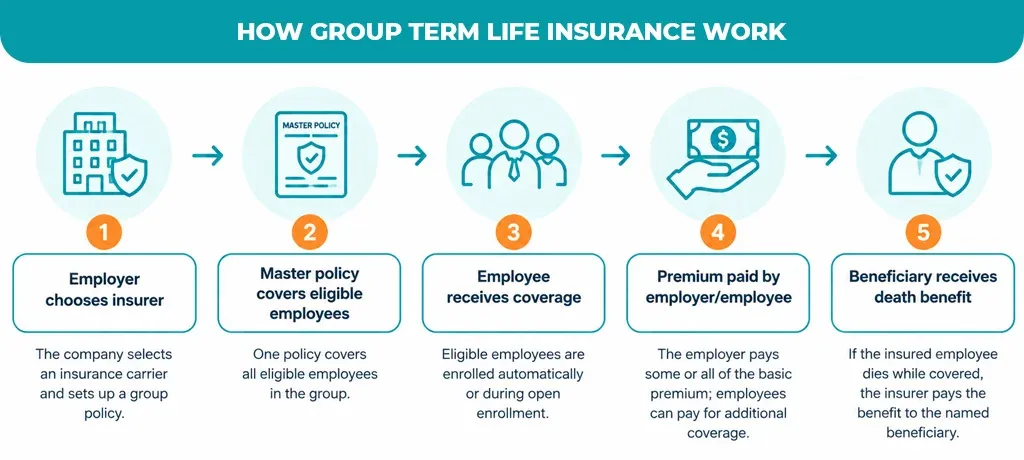
An employer selects an insurance carrier and purchases one master policy covering all eligible employees, who are then enrolled automatically or through open enrollment without individual medical underwriting in most cases. The basic mechanics generally follow the same sequence:
- The employer selects a group life insurance carrier and decides on a plan design, typically a flat benefit amount or a multiple of salary.
- Eligible employees are enrolled in the basic plan automatically, often without answering health questions, as long as they enroll during their initial eligibility window.
- Employees who want more coverage than the basic amount can typically purchase supplemental or voluntary group life insurance through payroll deduction.
- The insurer bills the employer directly; the employer pays all or part of the basic premium and may pass the cost of supplemental coverage to the employee.
- If the insured employee dies while actively covered, the insurer pays a death benefit to the named beneficiary, similar to any other term life insurance payout.
Is Group Life Insurance Term or Whole Life?
Employer-sponsored group life insurance is almost always term insurance, meaning it has no cash value and provides coverage only while the policy or employment relationship remains in force. Some insurers also market group universal life or group whole life products as supplemental options, but the default employer-provided benefit referred to as “group life insurance” is group term life insurance.
Is Group Term Life Insurance Taxable? Understanding IRC Section 79
Group term life insurance is not taxable on the first $50,000 of employer-paid coverage. Coverage above $50,000 is taxable, and the value of that excess coverage is added to the employee’s income as “imputed income” under Internal Revenue Code Section 79.
The $50,000 Tax-Free Threshold
Section 79 of the Internal Revenue Code provides an exclusion for the first $50,000 of group term life insurance coverage carried directly or indirectly by an employer. If the total amount of employer-provided group term life coverage does not exceed $50,000, there are no tax consequences to the employee.
If total employer-paid coverage exceeds $50,000, the cost of the coverage above that threshold must be included in the employee’s gross income and is also subject to Social Security and Medicare tax.
IRS Table I Rates: How Imputed Income Is Calculated
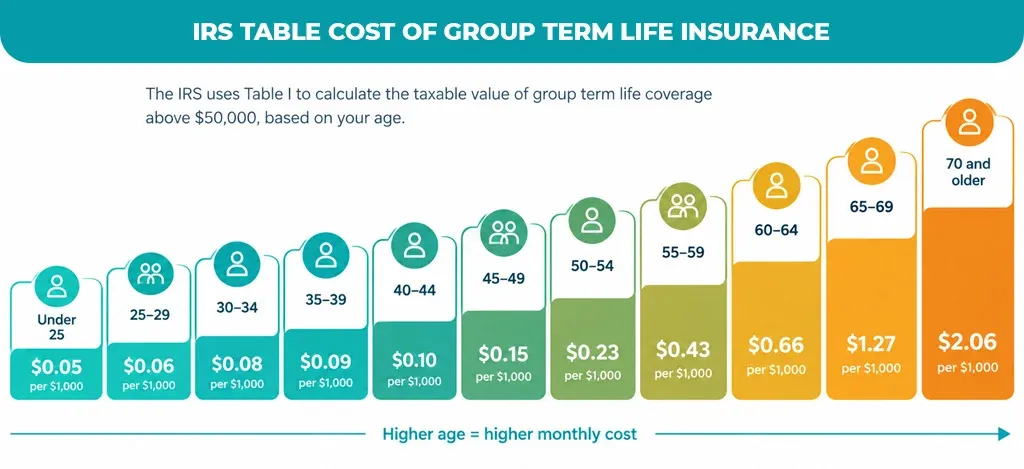
The IRS calculates the taxable value of group term life coverage above $50,000 using a standardized rate table, called Table I, that assigns a monthly cost per $1,000 of coverage based on the employee’s age. These rates have applied since regulations took effect on July 1, 1999, and are unrelated to the actual premium the employer pays the insurer.
Worked Example: Calculating Taxable Group Term Life Insurance
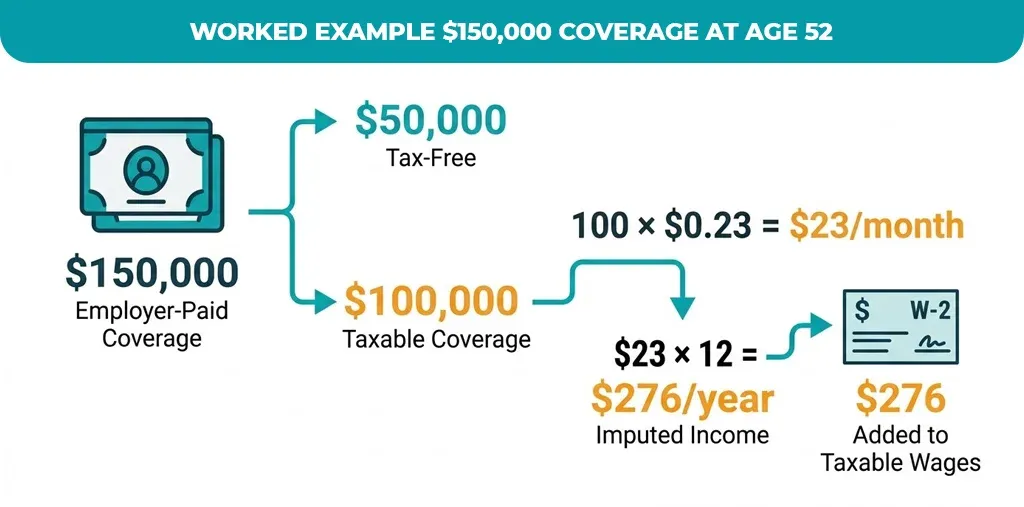
Consider an employee who is 52 years old and receives $150,000 of employer-paid group term life coverage for a full calendar year, with no employee contribution toward the premium.
- Excludable coverage: $50,000 (tax-free under Section 79)
- Excess coverage subject to tax: $150,000 − $50,000 = $100,000, or 100 units of $1,000
- Table I rate for ages 50–54: $0.23 per $1,000 per month
- Monthly imputed income: 100 × $0.23 = $23.00
- Annual imputed income: $23.00 × 12 months = $276.00
That $276 is added to the employee’s wages in Boxes 1, 3, and 5 of Form W-2 and separately reported in Box 12 using Code C. The employee owes ordinary income tax and their share of Social Security and Medicare tax on that amount, even though no cash was actually received.
Advantages and Disadvantages of Group Term Life Insurance
Advantages
- Low or no cost for basic coverage, since the employer typically pays some or all of the premium.
- Guaranteed issue underwriting for basic and often for supplemental coverage up to a set limit, which is valuable for employees who might not qualify for affordable individual coverage due to health history.
- Convenient payroll deduction for any supplemental coverage the employee elects to purchase.
- Employer-negotiated group rates, which can be lower than comparable individually underwritten coverage, particularly for younger or higher-risk employees.
What Are the Disadvantages of Group Term Insurance?
The main disadvantages of group term life insurance are that coverage is not portable, the benefit amount is often too small to fully replace income, and premiums for supplemental coverage can rise as the group ages. Employees who rely solely on employer-provided coverage take on real risk if they leave their job or need more protection than the plan formula provides.
- Coverage typically ends when employment ends, unless the employee elects portability or conversion within the required window, usually 31 days.
- Benefit amounts are set by an employer formula and may fall well short of what a family actually needs to replace lost income.
- Supplemental group premiums are often based on one-year renewable term rates that increase as the employee moves into an older age bracket, unlike a level individual term policy.
- Coverage above $50,000 creates imputed income that increases the employee’s taxable wages every year it remains in force.
- If coverage must be converted after leaving a job, the conversion policy is usually a whole life policy with a materially higher premium than the original group term rate.
What Happens to Group Term Life Insurance When You Leave Your Job?
Group term life insurance generally ends when employment ends, but most policies give departing employees a limited window, commonly 31 days, to port coverage to a new term policy or convert it to an individual whole life policy without answering health questions. The two options work differently and are not always both available under every plan.
- Portability: Continues the coverage as a new group or individual term policy, billed directly to the former employee, without proof of good health, if the plan offers this feature.
- Conversion: Converts the coverage into an individual whole life policy, also without a medical exam, but typically at a higher premium than the group rate.
- Both options usually require electing coverage and paying the first premium within 31 days of the date group coverage ends.
Get Your Group Term Life Insurance Coverage Right
Employer-provided group term life insurance is a valuable starting benefit, but it is rarely enough on its own once you account for a mortgage, dependents, or outstanding debt. Review your current certificate of coverage to see exactly how much you have, whether it is portable, and how much of it is taxable imputed income.
If your employer plan leaves a gap, talk with a licensed life insurance agent or your HR benefits team about supplementing it with an individual term policy sized to your actual financial obligations, and ask about your portability and conversion rights before you change jobs.
Need Extra Coverage Beyond Your Group Policy? Employer-provided life insurance is a great start, but it may not fully cover your family’s long-term financial needs or follow you if you change jobs. Take control of your financial protection today get a personalized, no-obligation quote. Premier Services Agency.