


Cremation itself takes 1.5 to 3 hours inside the cremation chamber. But the full journey from the moment of death to the family receiving the cremated remains usually takes 3 to 10 days, and sometimes up to two or three weeks. The difference comes down to legal paperwork, mandatory waiting periods, and scheduling, not the physical process.
Understanding this timeline matters because grief already makes waiting hard. Knowing what happens at each stage, and why, helps families set realistic expectations while arrangements move forward.
Quick Answer: How Long Does Cremation Take?
| Stage | Typical Duration |
| Legal waiting period after death | 24 to 48 hours (state-dependent) |
| Paperwork (death certificate, permits, authorization) | 2 to 5 days |
| The physical cremation process | 1.5 to 3 hours |
| Cooling and processing of remains | 1 to 2 hours after the burn |
| Total time from death to receiving ashes | 3 days to 3 weeks |
Direct cremation, which skips a viewing or funeral service beforehand, is generally the fastest option. A traditional funeral followed by cremation adds several more days for visitation, services, and coordination with family and clergy.
Key Takeaways
- The actual burn inside the retort takes 1.5 to 3 hours, according to the Cremation Association of North America (CANA).
- Most states require a 24- to 48-hour waiting period after death before cremation can legally occur.
- Full turnaround, from death to receiving cremated remains, typically runs one to three weeks.
- Body size, container type, and crematory scheduling can extend the physical process or the overall wait.
- Cremation is generally less expensive than burial: the National Funeral Directors Association (NFDA) reported a national median cost of $6,280 for a funeral with cremation in 2026, compared with $8,300 for a funeral with burial.
Understanding the Cremation Timeline: From Authorization to Ashes
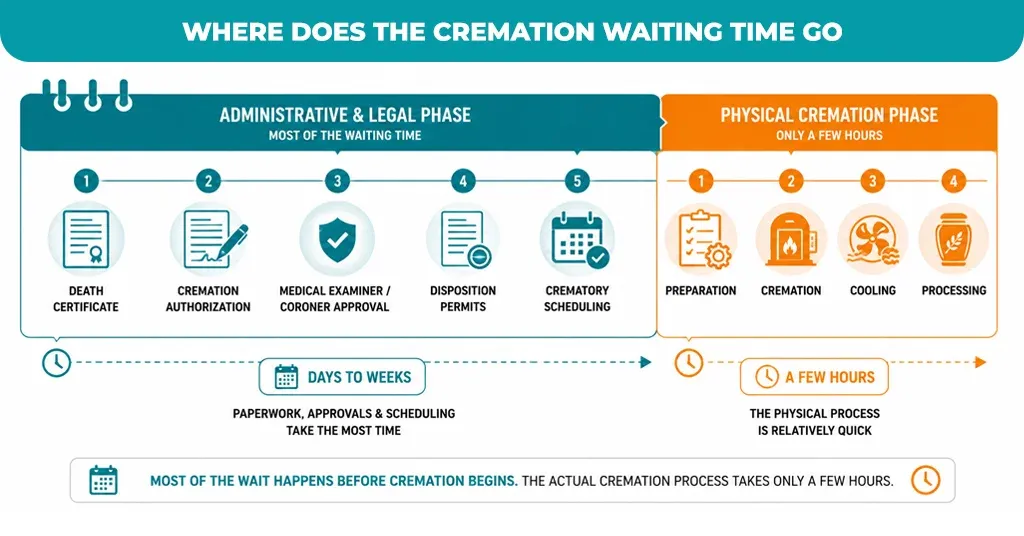
The complete cremation timeline breaks into two very different phases. The administrative and legal phase, securing authorization, permits, and scheduling, is what actually consumes most of the calendar time. The physical cremation process itself is comparatively brief.
“How long does it take to cremate a body?” is a common question from families. expecting the answer to explain the whole wait. In reality, the burn is only a small fraction of the total cremation timeline. Most of the days pass while paperwork moves through local vital records offices, medical examiners, or coroners, depending on the circumstances of the death.
Direct cremation, where the body is cremated soon after the legal waiting period and required paperwork are complete, without an embalming, viewing, or funeral service beforehand, is usually the quickest path to receiving ashes. Traditional funeral service followed by cremation takes longer because it adds embalming (if chosen), a viewing or visitation, and a funeral service, all of which need to be scheduled around family availability and, often, clergy or venue calendars.
The Legal and Administrative Waiting Period
Before any crematory can proceed, several legal requirements have to be satisfied. These vary by state, but the pattern is broadly consistent across the country.
Mandatory Waiting Periods
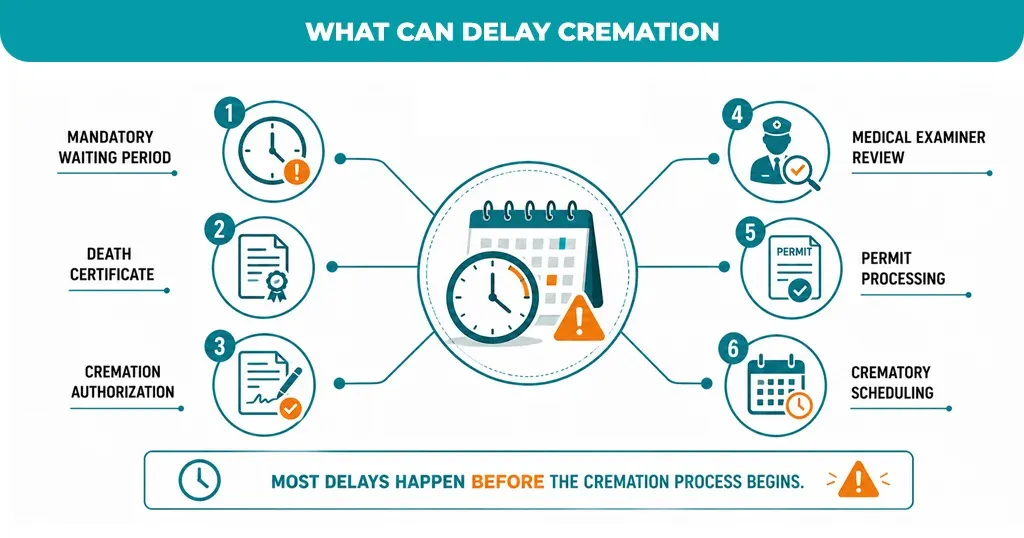
Most U.S. states require a waiting period between the time of death and the cremation itself, commonly 24 to 48 hours. Texas, for example, generally prohibits cremation within 48 hours of the recorded time of death under Texas Health & Safety Code § 716.004, unless a justice of the peace or medical examiner issues a written waiver. Florida similarly sets a 48-hour minimum. Colorado is one of a smaller number of states without a fixed statewide waiting period, though its embalming-or-refrigeration rule effectively creates a similar 24-hour checkpoint.
Required Paperwork
A death certificate is required before any crematory in the United States will perform a cremation. In addition to the death certificate, most jurisdictions require:
- A burial-transit or disposition permit issued by the local registrar or health department
- A signed cremation authorization from the legally next of kin
- Medical examiner or coroner sign-off, if the death falls under their jurisdiction (such as an unattended, accidental, or unexplained death)
Assembling this paperwork typically takes two to five days, according to legal guidance on cremation requirements. If the death requires a medical examiner review or additional investigation, this stage can extend further, sometimes by a week or more.
Permits and Fees
Local or county permit fees for cremation authorization generally range from about $15 to $60, though some counties charge more; Milwaukee County, Wisconsin, for instance, has charged over $350 for its coroner cremation release fee. These fees are usually itemized in the funeral home’s General Price List as a pass-through charge.
Step-by-Step Breakdown of the Actual Cremation Process
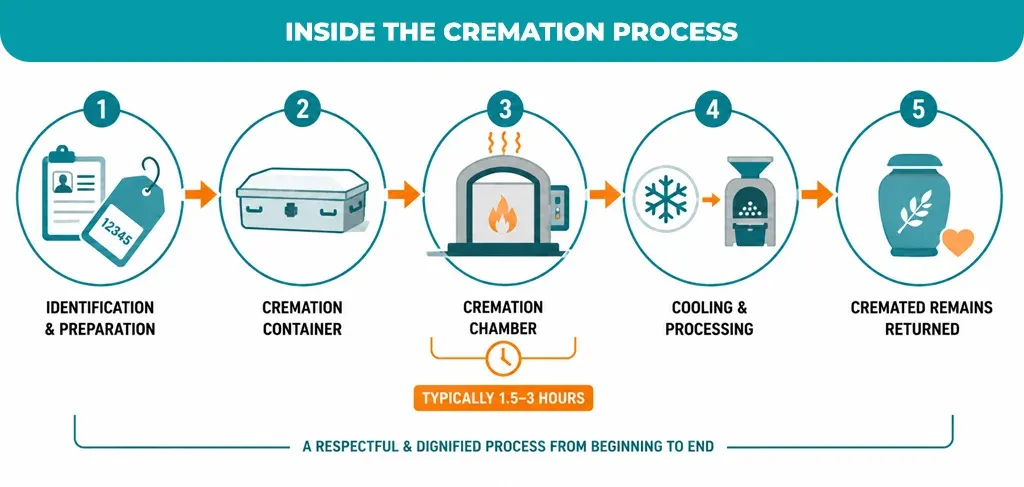
Once legal authorization is complete, the physical cremation process itself follows a defined sequence, guided by CANA’s industry standards.
Identification and Preparation
Before cremation begins, the deceased is fitted with a permanent identification tag or disc that stays with the remains through every stage of the process. This chain of identification is one of the most tightly controlled parts of cremation, precisely because the process is irreversible. Any medical devices with batteries, such as pacemakers, must be removed beforehand, since they can rupture or explode at high temperatures.
Placement in the Cremation Container
The body is placed in a cremation container. CANA specifies that this container must be rigid, leak-resistant, fully enclosed, and combustible. This can be a simple, sturdy cardboard container or a wooden casket, depending on the family’s choice.
The Cremation Process (The “Burn”)
The container is placed into the retort, the specialized furnace where cremation occurs. According to CANA, the chamber operates at roughly 1,400 to 1,600 degrees Fahrenheit, with other industry sources citing a broader range up to 1,800 degrees Fahrenheit depending on the equipment. Under CANA’s own guidance, the cremation process itself generally takes between 30 minutes and two hours, depending largely on the size of the body; other industry estimates put the range slightly higher, at roughly 1.5 to 3 hours, when factoring in larger adults, denser containers, or older equipment. This stage is what most people mean when they ask “how long does it take to cremate a body,” but it represents only one part of the full cremation timeline.
Cooling and Processing
After the burn, the remains need time to cool before they can be safely handled, which typically adds another period of time before processing can begin. What remains at this point are bone fragments, not soft ash. A crematory operator then removes any non-combustible material, such as metal from joint replacements, surgical hardware, or dental work, before running the bone fragments through a processor known as a cremulator. This machine pulverizes the fragments into the fine, consistent texture that families recognize as cremated remains, or “cremains.”
Return of the Remains
Once processed, the cremated remains are placed into a temporary container or the family’s chosen urn and returned to the authorized representative. Depending on the crematory’s workload and the family’s arrangements, this final handoff can happen within a day or two of the cremation itself, or be coordinated around a memorial service date.
Pros and Cons of Choosing Cremation
Cremation has become the majority choice for American families. The NFDA projected the U.S. cremation rate would reach 63.4% in 2026, more than double the projected burial rate of 31.6%, and forecasts cremation reaching 82.3% by 2045. Weighing the pros and cons against your family’s values and beliefs is still worth doing before deciding.
Pros
- Lower overall cost. The NFDA reported a national median cost of $6,280 for a funeral with cremation (including viewing and service) in 2026, compared with $8,300 for a comparable funeral with burial, and $9,995 with a burial vault included. A basic direct cremation with no service costs considerably less than either option.
- Flexibility in memorialization. Families are not bound to a single funeral date or location; a memorial service, scattering, or interment of the urn can happen weeks or months later.
- Environmentally lighter footprint options. Cremation avoids the land use, vault materials, and embalming chemicals associated with traditional burial, and interest in green funeral options has been rising: the NFDA’s 2026 Consumer Awareness and Preferences Report found 61.4% of consumers interested in exploring green funeral options, up from 55.7% the prior year.
- Easier long-term relocation of remains. Cremated remains can be kept, divided among family members, or moved without the logistics involved in disinterring a burial plot.
Cons
- Irreversibility. Once cremation is performed, the decision cannot be undone, which is part of why states require a waiting period and clear next-of-kin authorization beforehand.
- Potential religious or cultural restrictions. Some faith traditions discourage or prohibit cremation, so families should confirm what their religious community allows before proceeding.
- Decision fatigue around urns and memorial spaces. Without a default burial plot, families must actively choose an urn, a scattering location, a columbarium niche, or another permanent resting place.
- No permanent grave marker by default. Unless the family purchases a niche, plot, or memorial marker separately, cremation does not automatically include a fixed physical location to visit.
Securing Peace of Mind for Your Family
The cremation process itself takes only a few hours, but the full path from a loved one’s passing to receiving their cremated remains generally spans one to three weeks once legal, administrative, and scheduling steps are accounted for. Knowing this timeline in advance can ease some of the uncertainty during an already difficult time. What families can control ahead of time is the financial side of these arrangements. Cremation and memorial services involve immediate out-of-pocket costs that standard health insurance does not cover, and those costs often come due well before other financial matters are settled.
Planning ahead with the right coverage in place means your loved ones can focus on saying goodbye, not on how to pay for it. Visit Premier Services Agency today to explore affordable burial and final expense insurance solutions tailored to your family’s needs.