

You’ve probably heard of joint life insurance as an option to purchasing two distinct individual policies if you and your spouse are considering how to safeguard your household’s finances. A joint life insurance policy insures two people under a single contract and a single premium, and it is most often chosen by married couples, business partners, or co-borrowers who want to consolidate their coverage into one plan. Before you commit to a joint life insurance policy, an individual policy, or a combination of both, it helps to understand exactly how a joint policy pays out, what drives its cost, and where its coverage gaps can leave a household exposed. This guide breaks down how joint life insurance works, compares first-to-die and survivorship structures, and walks through the underwriting factors, target buyers, and decision points that matter most when you are contrasting individual life insurance policies with joint life insurance.
Key Takeaways
|
What Is Joint Life Insurance and How Does It Work?
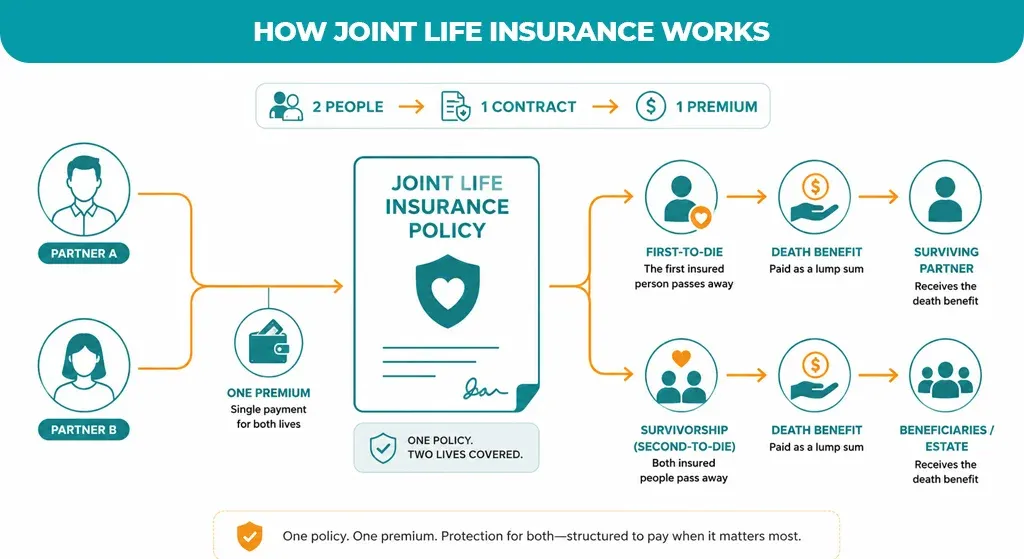
Joint life insurance is a single life insurance policy that insures two people, most commonly spouses or business partners, under one contract and one premium. Instead of underwriting and issuing two separate policies, the insurer evaluates both individuals together and structures the death benefit to pay out either on the first death or after both deaths, depending on the policy type you choose.
First-to-Die Life Insurance
A joint life insurance policy that pays out its death benefit as soon as the first of the two insured individuals passes away is known as a first-to-die policy. The dividend is given to the surviving partner and can be used for daily living expenditures, mortgage repayment, or income replacement. Because the policy is designed around a single triggering event, it typically carries a lower combined premium than two separate individual policies with the same face value would. However, once the death benefit is paid, the policy terminates, and the surviving partner is left without coverage under that contract.
Survivorship (Second-to-Die) Life Insurance
The death benefit of a survivorship life insurance policy, also known as second-to-die life insurance, is only paid once both insured parties have passed away. This structure is commonly used for estate planning, leaving an inheritance, or funding a special needs trust, since the payout is timed to arrive when estate taxes or wealth-transfer obligations are typically due. Survivorship policies are generally issued as permanent coverage, such as whole life or universal life insurance, and build cash value that a policyholder can borrow against over time. Survivorship life insurance usually offers a higher death benefit because the insurer does not pay out until both parties have passed away.
How Underwriting Evaluates Two Lives
Underwriting for a joint life insurance policy considers the age, health history, and tobacco use of both applicants rather than just one. Insurers use actuarial mortality assumptions, of the kind developed and maintained by organizations such as the Society of Actuaries, to estimate the combined probability of a death benefit being paid within a given period. For permanent joint policies, part of the premium also funds a cash value account that grows over time and can be borrowed against or, in some cases, used to help cover premiums later in the policy’s life.
Joint First-to-Die vs. Individual Policies: Which Is Better?
There is no single answer to whether a joint first-to-die policy or two individual policies is the better choice; it depends on how the household’s finances, ages, and long-term needs are structured. The comparison below outlines the core trade-offs between the two approaches.
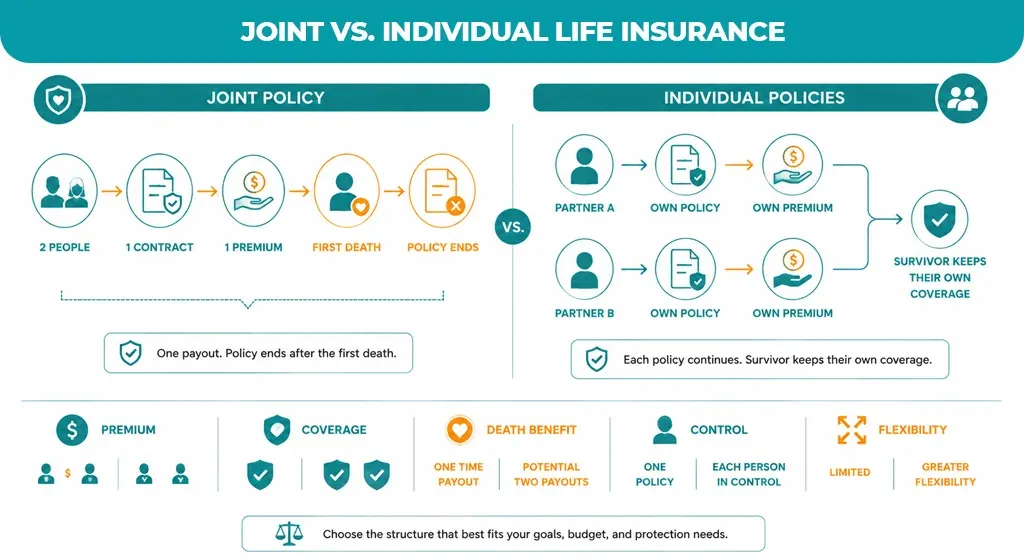
Criteria | Joint First-to-Die Policy | Two Individual Policies |
Premium structure | One combined premium for both insured people | Two separate premiums, priced independently |
Coverage after a death | Terminates once the death benefit is paid | Survivor’s own policy remains active |
Underwriting | Evaluated jointly, which may help if one partner has health issues | Each partner underwritten and priced on their own risk |
Flexibility in a divorce | Changes generally require both policyholders’ consent | Each partner independently controls their own policy |
Convertibility and riders | Riders such as waiver of premium apply to the joint contract as a whole | Riders such as guaranteed insurability can be tailored to each individual |
A joint first-to-die policy tends to suit dual-income couples with a shared mortgage or other joint debt who want administrative simplicity and are comfortable with the coverage ending after the first claim. Two individual policies tend to make more sense for couples with a significant age gap, different coverage amounts in mind, or a desire for the surviving partner to retain guaranteed protection for the rest of their own life. In short, a joint policy can reduce administrative hassle and, in some cases, cost, while individual policies provide a longer-term safety net for whichever partner survives.
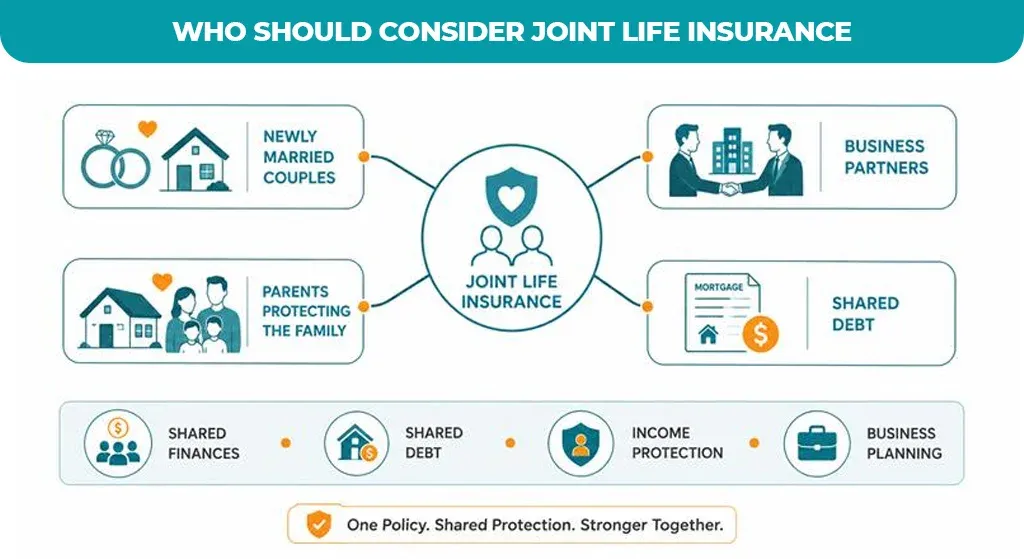
Who Should Consider Joint Life Insurance?
Target Demographics
- Newly married couples who are combining finances and taking on shared property or debt for the first time.
- Business partners who need funding certainty for a buy-sell agreement if one owner dies.
- Parents seeking straightforward income replacement to cover shared childcare and household living expenses.
Financial Milestone Checklist
Before choosing a joint policy over individual coverage, it helps to work through a short set of questions with your partner:
- Do we have shared debt, such as a mortgage, that would need to be paid off if one of us died?
- Would the surviving partner need to replace lost income, or would they need to remain insurable on their own after a claim?
- Are our ages and health profiles similar enough that combined underwriting would be cost-effective?
- Is our primary goal income replacement during our working years, or wealth transfer and estate planning later in life?
- How would a divorce or separation affect our ability to modify or split the policy?
Factors That Impact Joint Life Insurance Rates
Underwriting Variables
- Age and life expectancy of both applicants, including how large the age gap is between partners.
- Current health status, medical history, and tobacco use for each insured person.
- Coverage amount, or face value, and whether the policy is structured as term life insurance or permanent coverage such as whole or universal life.
- Policy type: first-to-die versus survivorship structures are priced differently because they are triggered by different events.
Tips for Lowering Premiums
- Apply while both partners are younger and in good health, since age and health status are core underwriting variables.
- Compare term versus permanent coverage, since term policies generally cost less but do not build cash value the way whole or universal life policies do.
- Address controllable health factors, such as tobacco use, before applying, since insurers weigh these factors during underwriting.
- Request quotes for both a joint policy and two individual policies so you can compare the actual pricing for your specific ages and health profiles.
Securing the Right Policy
Navigating the choice between a joint life insurance policy and individual coverage can feel complicated, especially when you are also weighing term versus permanent options, riders, and underwriting outcomes for two people at once. At Premier Services Agency, our licensed advisors specialize in helping couples and families compare joint and individual life insurance policies side by side, ensuring you choose the structure that actually fits your household’s unique finances and goals.
When you work with Premier Services Agency, you gain access to a range of top-rated insurance carriers, transparent side-by-side comparisons, and policy structuring tailored directly to your budget and debt obligations. Ready to find the right protection for your household? Visit Premier Services Agency to get a quote today to speak with a licensed advisor and request your free, no-obligation quote.