


What Is Whole Life Insurance and How Does It Work for Seniors?
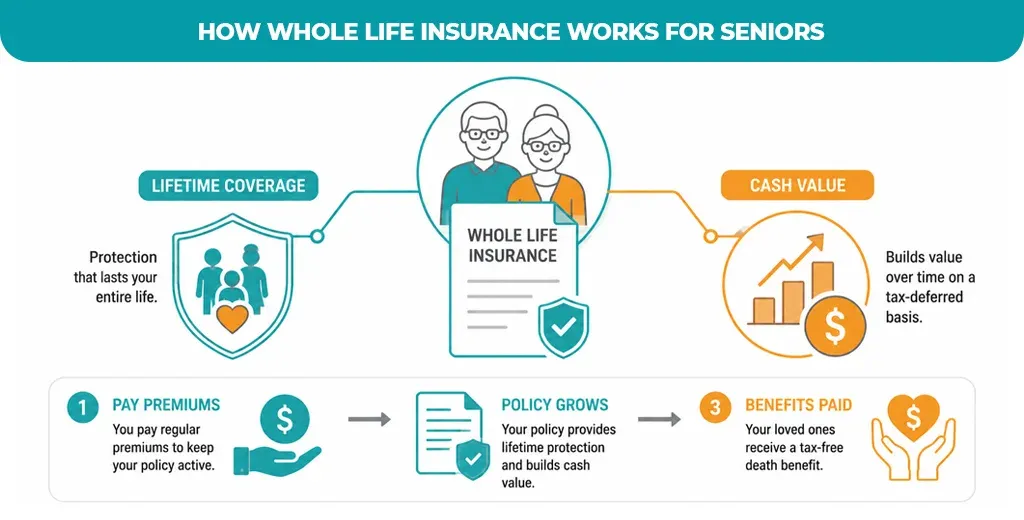
Whole life insurance is a category of permanent life insurance. Once you are approved and the policy is active, coverage does not expire at a set age or after a set number of years. As long as premiums are paid, the insurer is contractually obligated to pay a death benefit whenever you pass away, whether that happens next year or three decades from now.
Breaking Down Permanent Coverage vs. Term
Term life insurance is built for a defined window, commonly 10, 20, or 30 years, and it ends when that term is up. For a senior applying at 68 or 72, a 20-year term policy would need to carry them into their late 80s or 90s, and many term carriers stop issuing new policies to applicants over 75 to 80. Whole life insurance policies for seniors avoid that expiration problem entirely, which is the main reason permanent coverage is the more common recommendation for anyone focused on final expenses or legacy planning rather than income replacement.
The Two Pillars: Death Benefits and Cash Value Growth
A whole life policy is built around two components working together.
- Death benefit: the lump sum paid to your named beneficiaries when you pass away. Under IRC Section 101(a)(1) of the federal tax code, this amount is generally excluded from the beneficiary’s taxable income, meaning it is paid income-tax-free in the large majority of cases.
- Cash value: a savings-like component that grows on a tax-deferred basis at a guaranteed minimum rate set by the insurer. Policyholders can typically borrow against this cash value while still living, which is why whole life is sometimes described as offering “living benefits” in addition to the death benefit.
Most traditional carriers set a maximum issue age for whole life insurance around 85, and a smaller number of insurers extend eligibility to 90, according to MoneyGeek’s 2026 review of whole life insurance for seniors. Guaranteed issue whole life insurance for seniors, which asks no health questions, commonly uses a similar 50-to-85 age band.
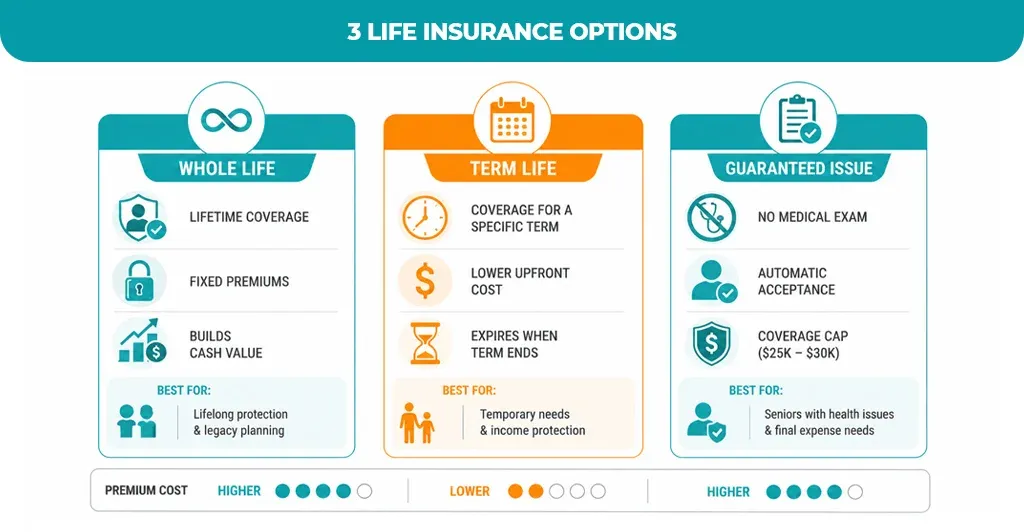
- Term life insurance: The lowest upfront cost, but coverage expires at the end of the term. Most carriers stop issuing new term policies somewhere between age 75 and 85, and a 20-year term applied for at 70 can run well over $1,000 a month once available at all, so it works best for a healthy senior with a specific, time-limited need, such as covering a spouse to age 75.
- Guaranteed issue whole life insurance: No medical exam and no health questions, so approval is close to automatic within the eligible age range. The trade-off is a lower coverage cap, typically $25,000 to $30,000, and many guaranteed issue policies include a two-year limited benefit period, during which a death from natural causes returns the premiums paid plus interest rather than the full face amount.
- Traditional (simplified or fully underwritten) whole life: Requires a short health questionnaire or, less often, a medical exam. Healthy seniors typically qualify for higher coverage limits and meaningfully lower rates than guaranteed issue, so it is worth applying for simplified issue coverage first if your health allows it.
Whole Life Insurance Cost Factors and Affordability for Older Adults
Premiums for whole life insurance for seniors over 65 and whole life insurance for seniors over 70 are driven primarily by four factors: current age, gender, tobacco use, and how much coverage you select. Women generally pay less than men at the same age because of longer average life expectancy, and nonsmokers pay less than smokers at every age.
To make a policy more affordable, most agents recommend applying as soon as you decide you need coverage rather than waiting, choosing a smaller face value sized to actual final expenses rather than a round number, and confirming non-tobacco status if you have quit.
Estimated Monthly Rates by Age
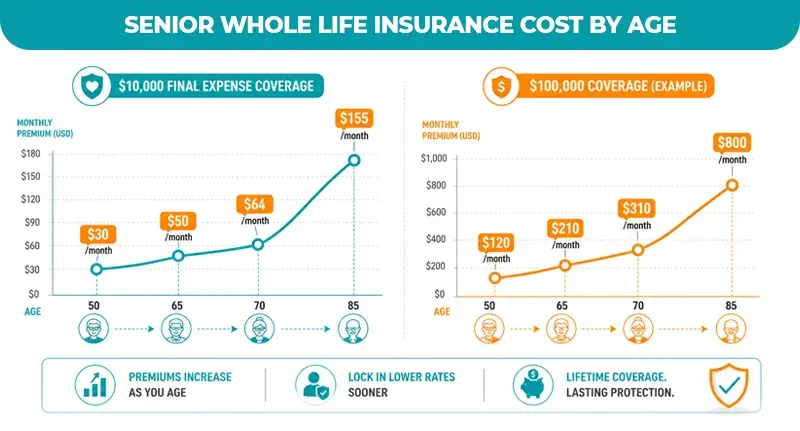
The table below reflects published, non-tobacco rate data from two independent industry sources. Actual quotes vary by carrier, state, and health class, so treat these as planning estimates rather than guaranteed prices.
Age | $10,000 Final Expense (Female) | $100,000 Traditional Whole Life |
50 | ≈ $30/month | Varies by carrier; typically underwritten |
65 | ≈ $50/month | ≈ $416/month |
70 | ≈ $64/month | Rises significantly |
85 | ≈ $155/month | ≈ $1,455/month |
Sources: $10,000 final expense figures come from MoneyGeek’s 2026 final expense insurance cost analysis, which found men pay roughly $16 more per month than women for the same $10,000 of coverage at age 65. $100,000 traditional whole life figures come from Insurance and Estates’ 2026 whole life rate guide, based on a Preferred Plus non-tobacco applicant.
For a larger policy, MoneyGeek’s 2026 whole life rate analysis found that a $500,000 policy costs more than $2,200 a month for a 70-year-old woman and more than $2,800 a month for a 70-year-old man on average, which is why most seniors focused on final expenses rather than estate planning choose a smaller face amount.
Conclusion
Whole life insurance for seniors offers something a savings account or a hope-for-the-best plan cannot: a guaranteed, predictable payout that protects your family from the $6,280 to $9,995 a funeral can realistically cost, plus any medical bills or debts left behind. Premiums are higher later in life, but the certainty of a locked-in rate and a lifetime of coverage is exactly why so many seniors choose to lock in a policy sooner rather than later.
Ready to find a policy that fits your budget and lifestyle? Navigating life insurance options doesn’t have to be overwhelming. At Premier Services Agency, our licensed experts specialize in matching seniors with custom, affordable whole life and final expense coverage options. Contact Premier Services Agency today for a free, no-obligation quote and let us help you secure your family’s peace of mind.