


Are you searching for whole life insurance quotes but feel buried under confusing terminology, conflicting numbers, and one-size-fits-all sales pitches? You’re not alone. Whole life insurance is one of the most powerful and most misunderstood tools in long-term financial planning, offering lifelong protection plus a guaranteed cash value component that term policies simply can’t match.
This guide breaks down exactly how whole life insurance quotes are calculated, what drives your premium up or down, how whole life stacks up against term coverage, and how to know whether permanent protection actually fits your financial goals.
What Is Whole Life Insurance and How Does It Work?
Whole life insurance is a form of permanent life insurance, meaning it’s designed to last your entire lifetime rather than expiring after a set number of years like term coverage. As long as premiums are paid on schedule, the policy remains in force; there’s no renewal date, no re-underwriting, and no risk of “outliving” your coverage.
Every whole life policy is built on three core components:
- Death benefit: A guaranteed, tax-free payout to your beneficiaries upon your passing.
- Fixed premiums: Your payment is locked in at issue and never increases, regardless of age or health changes later in life.
- Guaranteed cash value accumulation: A portion of every premium is set aside in a tax-deferred savings component that grows at a guaranteed minimum rate.
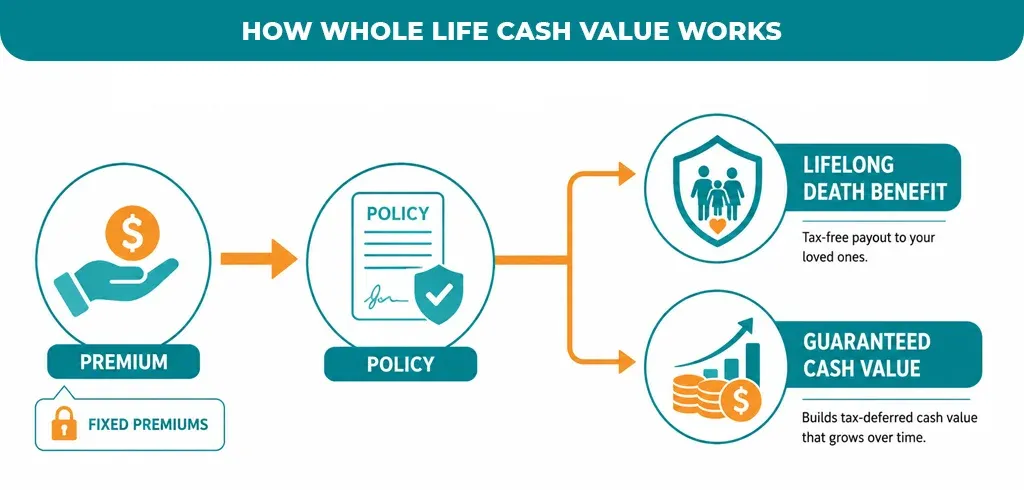
According to the Insurance Information Institute (III), permanent life insurance policies are structured so that a level premium, calculated using the insured’s age at issue, funds increasing risk in later years while simultaneously building equity inside the policy. That structural guarantee a benefit that never expires and a premium that never rises is the defining feature that separates whole life insurance quotes from every temporary insurance product on the market.
Whole Life vs. Term Life: Which Is Right for You?
Before requesting a whole life insurance quote, it helps to understand exactly how permanent coverage differs from term life insurance, the other major category of life insurance most families consider.
| Feature | Whole Life Insurance | Term Life Insurance |
| Duration | Lifelong coverage (typically to age 100-121) | Specified term (10, 20, or 30 years) |
| Premiums | Fixed for life, generally higher at the outset | Lower initially; can rise sharply if renewed after term ends |
| Cash Value | Yes – builds guaranteed, tax-deferred cash value | No cash value component |
| Best For | Lifelong needs, estate planning, cash value growth | Temporary needs like a mortgage or income replacement years |
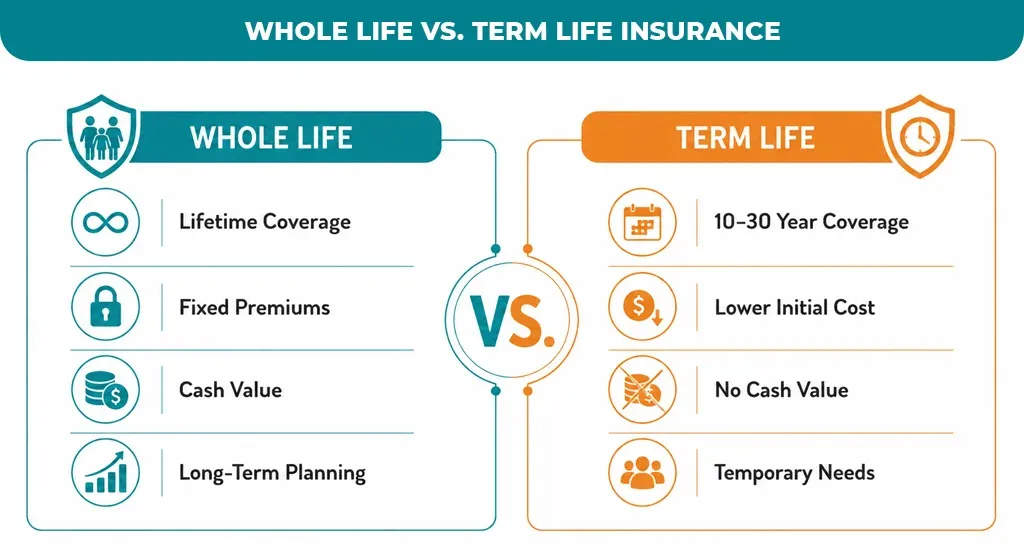
Industry research from LIMRA, a leading authority on life insurance consumer trends, consistently shows that term life insurance remains the more commonly purchased entry point for younger families because of its lower initial cost, while whole life insurance tends to attract buyers prioritizing lifelong certainty, estate planning, or a guaranteed savings vehicle alongside protection.
The right choice ultimately comes down to your time horizon. If you need coverage for a specific period, like the years until your mortgage is paid off or your children are financially independent, term life may be more cost-effective. If you want coverage that never expires and a policy that builds real, accessible equity over decades, a whole life insurance quote is worth serious consideration.
Key Factors That Influence Whole Life Insurance Quotes
No two whole life insurance policy quotes look exactly alike, because insurers price every policy based on a highly individualized risk profile. Understanding these variables can help you anticipate your rate before you ever request an online whole life insurance quote.
Age and Health Status
Age is the single largest driver of cost. Because premiums are locked in for life, insurers price in the mortality risk of a much longer coverage window, which is why locking in a whole life insurance instant quote earlier in life almost always results in a lower fixed premium than waiting.
Most fully underwritten policies require a medical exam, blood and urine panels, and a review of your prescription history and medical records. Simplified-issue and guaranteed-issue whole life products (often marketed as instant online whole life insurance quotes) skip the exam in exchange for a higher premium or a graded death benefit in the early policy years.
Gender, Lifestyle, and Family History
- Gender: Actuarial mortality tables generally reflect longer average life expectancy for women, which can translate into a lower whole life insurance quote for a given age and health class.
- Tobacco and lifestyle factors: Tobacco use, hazardous hobbies (such as skydiving or private aviation), and high-risk occupations typically move an applicant into a higher-cost rate class.
- Family medical history: A pattern of early-onset heart disease, cancer, or other hereditary conditions in your immediate family can influence underwriting decisions.
Coverage Amount and Premium Structure
Your face value (death benefit amount) has a direct, proportional relationship with your premium. Beyond that, insurers offer different premium payment structures that materially change your quote:
- Pay-to-age-100 or Pay-to-121: Premiums are spread across your expected lifetime, keeping payments lower.
- 20-Pay or 10-Pay Life: Premiums are compressed into a shorter window (paid in full after 10 or 20 years), resulting in a higher payment now but no premium obligation later.
- Single-premium whole life: One lump-sum payment funds the policy for life, a strategy often used in estate and legacy planning.
These variables are exactly why insurers rely on actuarial mortality tables published by major life insurance rating bureaus to price risk consistently across millions of policyholders, and why comparing multiple whole life insurance quotes online, from Gerber whole life insurance quotes for children’s policies to AARP whole life insurance quotes for older adults, is the single best way to find a competitive rate for your specific profile.
How the Cash Value in Whole Life Insurance Works
One of the biggest reasons buyers choose permanent coverage over term is the cash value accumulation feature, a built-in savings mechanism unique to whole life and other forms of permanent insurance.
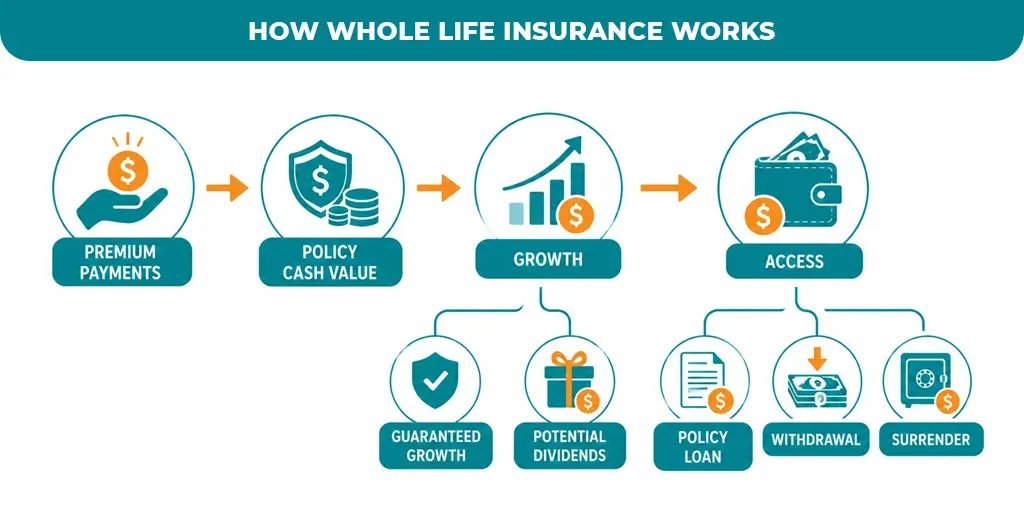
Here’s how it functions: a portion of each premium payment is allocated to a separate cash value account within the policy. That balance grows on a tax-deferred basis under Internal Revenue Code (IRC) guidelines, meaning you don’t owe income tax on the growth as long as the funds remain inside the policy.
Growth Mechanisms
- Guaranteed minimum interest rate: Most whole life contracts guarantee a minimum crediting rate written directly into the policy, regardless of market performance.
- Dividends: Policies issued by mutual insurance companies (owned by policyholders rather than shareholders) may pay non-guaranteed annual dividends, which can be taken as cash, used to reduce premiums, or reinvested to purchase additional coverage.
Accessing Your Funds
As cash value accumulates, it becomes a flexible financial resource you can access while you’re still living:
- Policy loans: Borrow against your cash value, typically at a competitive interest rate, without the credit check or approval process of a traditional loan.
- Withdrawals: Withdraw a portion of the cash value directly, which may reduce your death benefit.
- Surrender: Cancel the policy entirely and receive the accumulated cash value, minus any applicable surrender charges.
This dual-purpose structure permanent protection plus a living financial asset is precisely why whole life insurance is often described as a conservative cornerstone within a diversified financial plan, rather than simply a death benefit.
Conclusion
Whole life insurance quotes can look like a wall of numbers at first glance, but once you understand what’s actually driving them (age, health, coverage amount, and payment structure) and what you’re getting in return (a lifelong death benefit plus guaranteed, tax-deferred cash value), the decision becomes far clearer.
The single most important step in this process is comparison. Gathering multiple whole life insurance quotes, whether you’re evaluating a policy for a child, reviewing AARP whole life insurance quotes as a retiree, or requesting an instant quote for whole life insurance online, allows you to weigh premiums, riders, and carrier strength side by side, so you land on coverage that balances lifelong protection with long-term affordability.
Ready to Secure Your Financial Future?
Don’t navigate the complex world of permanent insurance alone. At Premier Services Agency, our experienced team is dedicated to matching you with customized coverage that protects your loved ones and builds lasting wealth.