

When a family loses someone they love, the choices that follow can feel overwhelming. In recent years, a gentler, water-based alternative to fire has entered the conversation, offering both environmental and emotional appeal. Water cremation, also known as aquamation, is quickly becoming one of the most requested eco-friendly funeral options in the United States and abroad.
If you’re asking “what is water cremation” for the first time, you’re not alone. This guide walks through how the water cremation process works, what it costs, where it’s legal, and how it compares to fire cremation and burial, so you can make a decision with confidence and peace of mind.
What Is Water Cremation? (The Science of Alkaline Hydrolysis)
Water cremation is the common name for alkaline hydrolysis, a process that uses water, gentle heat, and alkali compounds instead of open flame to return a body to its most basic elements. Rather than burning remains, cremation by water accelerates the same natural chemical breakdown that occurs during burial, only in a controlled, contained, and dignified setting.
How Does Water Cremation Work?
Understanding how water cremation works helps demystify a process that can otherwise sound unfamiliar. The body is placed in a pressurized, stainless-steel chamber filled with a solution of roughly 95% water and 5% alkali, typically potassium hydroxide or sodium hydroxide.
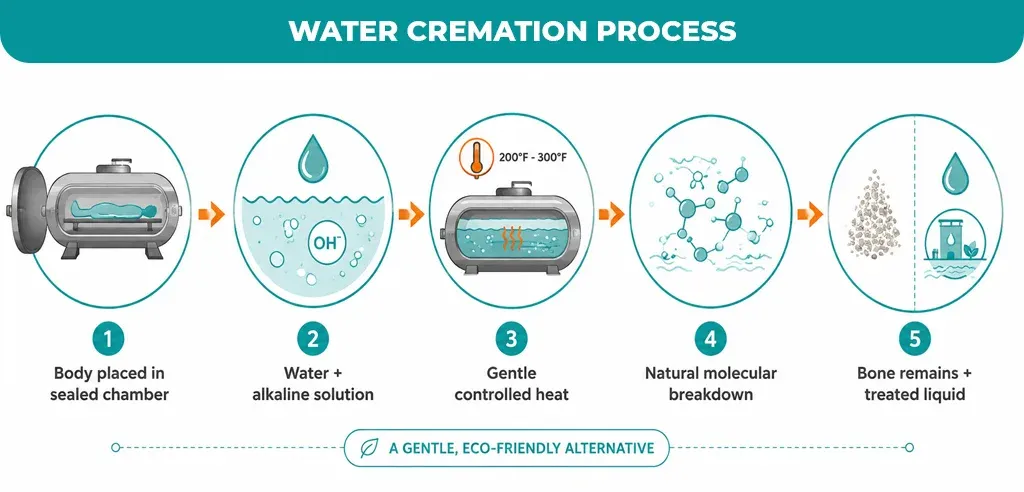
- Controlled heat: The chamber is gently heated, generally between 200°F and 300°F, well below the temperature of flame-based cremation.
- Duration: A water-based cremation typically takes between 4 and 8 hours from start to finish, depending on the specific system and jurisdiction.
- End result: Soft tissue is fully broken down at the molecular level, leaving behind sterile bone fragments and a nutrient-rich liquid effluent that is safely treated.
This is why the process is often described as a water-based cremation rather than a chemical one; the alkali simply speeds up decomposition that would eventually happen in nature, and the entire cycle takes place inside a sealed, automated system supervised by trained funeral professionals.
The Environmental Benefits: Why Choose Green Cremation?
For families weighing eco-friendly funeral options, the environmental case for water cremation is one of the strongest arguments in its favor. As a leading green cremation method, alkaline hydrolysis fundamentally changes the resource footprint of final disposition.
- Lower emissions: Water cremation uses significantly less energy than flame-based cremation and can produce up to 90% fewer carbon emissions.
- No air pollution: Because there is no combustion, water cremation produces zero direct atmospheric pollutants, including no mercury release from dental fillings and no greenhouse gas stack output.
- Resource conscious: The liquid byproduct is sterile, nutrient-rich, and safely reintegrated through standard wastewater treatment protocols, meaning no fossil fuels are burned, and no land is disturbed.
For families who see sustainability as part of a loved one’s legacy, this alkaline hydrolysis process offers a way to honor both the person and the planet at the same time.
What Happens to the Remains? (What Families Receive Back)
One of the most common questions families ask is what happens physically at the end of a water-based cremation. The reassuring answer: families still receive cremated remains to keep, scatter, or inter, just as they would with traditional cremation.
What Do Remains Look Like After Water Cremation?
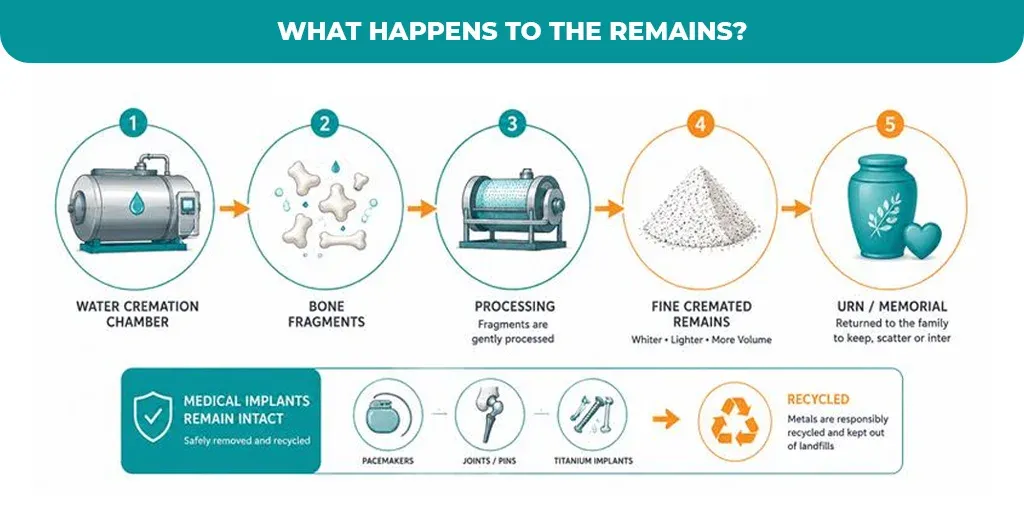
- Same basic form: The bone fragments remaining after the process are processed into a fine, sand-like powder, just as with flame cremation.
- Lighter in color: Because there is no combustion or scorching, remains from water cremation tend to be noticeably whiter and lighter in color than remains from flame cremation.
- More volume: Because more of the bone mineral is preserved rather than incinerated, families typically receive roughly 20% to 30% more volume of remains than with flame cremation.
- Implants preserved: Medical devices such as pacemakers, surgical pins, and titanium implants remain fully intact through the gentle process and can be safely removed and recycled, rather than posing the explosion risk they carry in flame cremation.
This makes cremation with water an appealing option not only for its environmental profile, but also for the gentle, non-destructive way it treats the body.
Legal Status, Availability, and Costs
Understanding where water cremation is legal and what it costs is essential to planning ahead.
What States Allow Water Cremation?
Water cremation is currently authorized in more than 25 U.S. states, with additional states actively considering legislation. Availability is expanding steadily as more families ask their funeral homes about this option, and international regions have begun adopting similar frameworks.
It’s worth noting that legal status in a state doesn’t always guarantee a nearby facility. Some regions permit the practice but do not yet have the specialized equipment installed locally, which occasionally requires coordinating transport to a partner provider. If you’re searching for water cremation near me, a knowledgeable funeral advisor can confirm current local availability and any transport logistics involved.
You may also wonder why water cremation is illegal in some places despite being approved elsewhere. In most cases, this comes down to state legislatures needing to update decades-old cremation and wastewater statutes rather than any safety concern with the process itself. As more states modernize these laws, access continues to grow.
How Much Does Water Cremation Cost?
Water cremation cost varies by provider, region, and service level, much like flame cremation. Because the specialized alkaline hydrolysis equipment represents a significant investment for funeral homes, water cremation can sometimes be priced somewhat higher than a basic flame cremation, though the gap continues to narrow as more providers adopt the technology.
- Base pricing: Direct water cremation, without additional services, is often comparably priced to direct flame cremation in the same market.
- Added services: Costs rise with add-ons such as viewings, memorial services, urns, or transportation.
- Ask for a breakdown: Asking for an itemized quote helps families compare water cremation cost against flame cremation and burial side by side.
Water Cremation vs. Traditional Flame Cremation & Burial
When comparing water cremation vs fire cremation and traditional burial, the core differences come down to method, environmental impact, and personal or cultural preference.
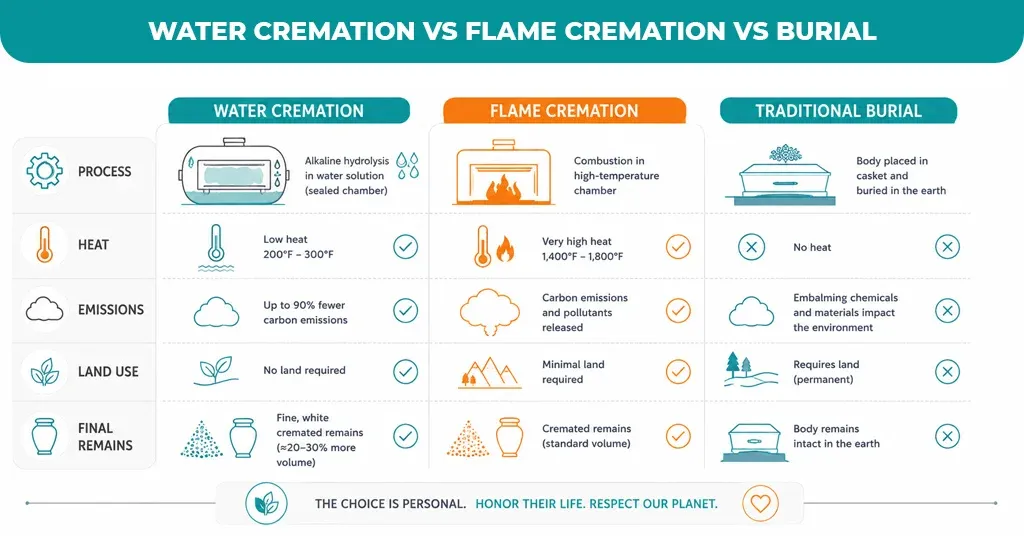
- Process: Traditional flame cremation uses direct fire and extreme heat (often exceeding 1,400°F), while water cremation vs fire cremation shows the water-based method relies on a much gentler heated alkaline solution.
- Environmental impact: Burial requires land, a casket, and often embalming chemicals; flame cremation uses fossil fuels and releases emissions; water cremation uses a fraction of the energy and produces no direct air emissions.
- Memorialization: All three methods allow for an urn, a scattering ceremony, a memorial service, or keepsake jewelry, so families don’t have to sacrifice tradition to choose a greener option.
- Emotional tone: Many families describe water-based dissolution as feeling like a softer, more natural transition compared to flame, which can bring emotional comfort during grief.
For those wondering, can you be cremated by water regardless of species, many providers also offer pet cremation by water, extending the same gentle, eco-conscious option to beloved animal companions.
Conclusion
Choosing between water cremation, flame cremation, and traditional burial is one of the most personal decisions a family can make. Water cremation offers a scientifically sound, gentle, and environmentally responsible path forward, one that lets you honor a loved one’s memory while minimizing impact on the planet they leave behind.
Whatever you decide, the most important step is getting clear, compassionate guidance from people who understand both the practical details and the emotional weight of the moment. Visit Premier Services Agency today to explore your options, access trusted resources, and secure peace of mind for the road ahead.